The era of pure opinions may be coming to an end.
Author: David, Deep Tide TechFlow
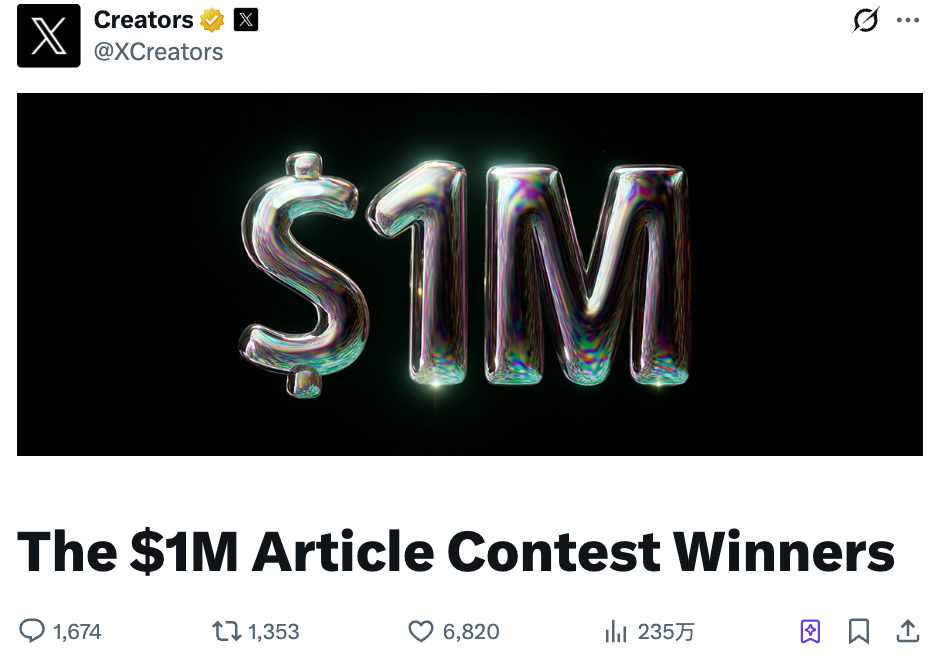
In mid-January, X announced a $1 million reward for the best long-form articles on the platform.
Elon Musk personally retweeted to confirm. The rules are simple: only for U.S. users, original articles in English over 1,000 words, primarily ranked by exposure among U.S. paid users.
You may recall that just a few days before this content incentive initiative was announced, personal growth blogger Dan Koe published an article titled "How to fix your entire life in 1 day," which garnered 170 million views, becoming the best-performing article in X's history.
X clearly saw the traffic potential of long-form content and quickly followed suit; lowering the threshold for the Articles feature, adjusting algorithm weights to prioritize long articles over short posts, and announcing a million-dollar writing competition.
During the two-week competition period, tens of thousands participated.
On February 4, the results were announced, with a total prize pool of $2.15 million, more than double what was promised. The champion received $1 million, the runner-up $500,000, along with a $250,000 "Creator Choice" award and four $100,000 honorable mentions.
The award results are as follows:
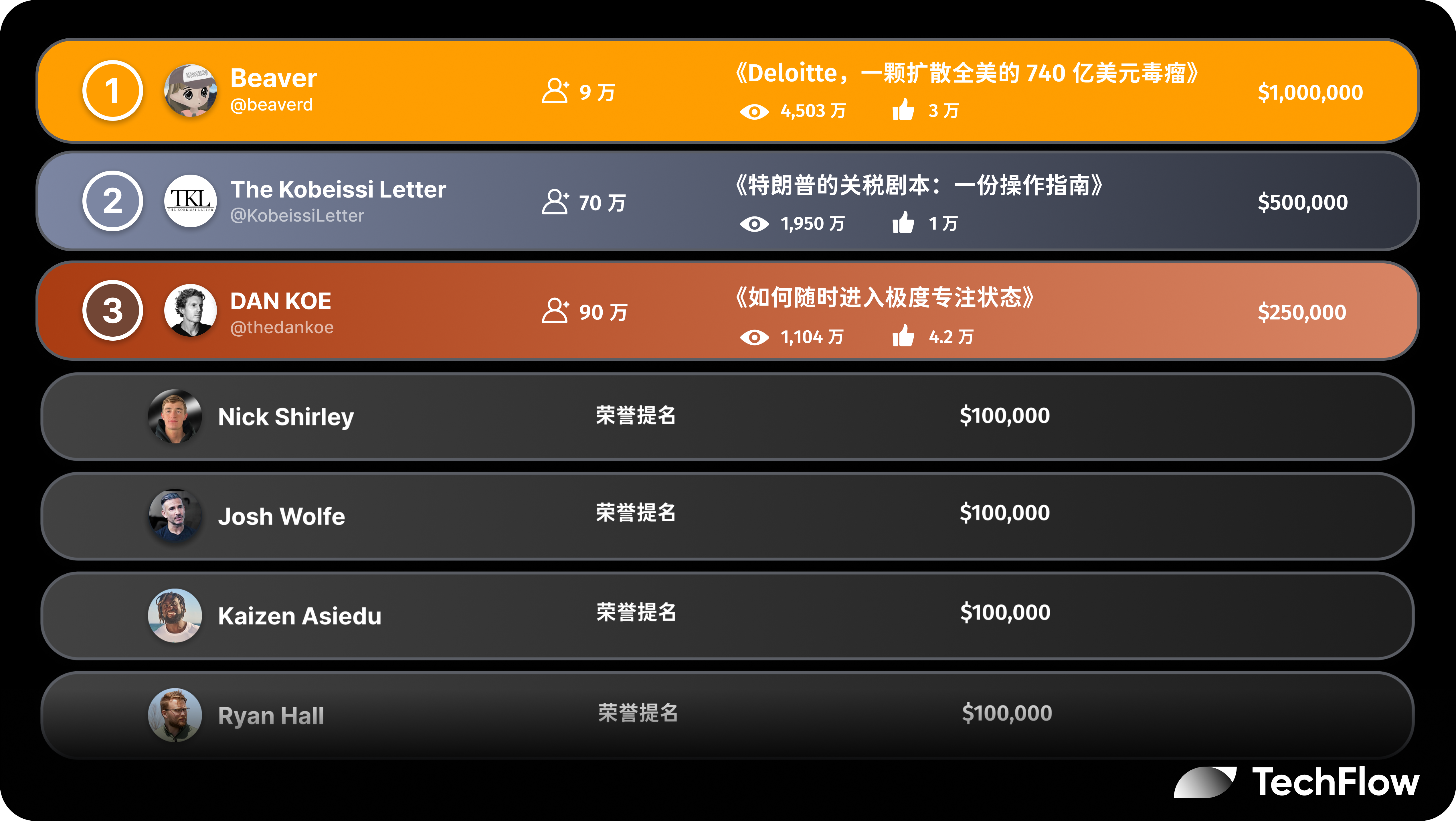
You can see that Dan Koe made the list again. However, his previous article on how to fix life in a day had 170 million views, while the champion of this writing competition only had 45 million.
Viral hits are still hard to come by, but several of the award-winning articles are worth analyzing.
🏆 Champion: A 90,000-follower "small account" wins $1 million with a self-built database
The champion @beaverd's article is titled "Deloitte, a $74 billion tumor spreading across the U.S." It discusses the well-known consulting firm Deloitte.
This account currently has "only" 90,000 followers, which is considered a small account compared to the other award winners, and it has no media affiliation or any endorsements beyond the blue verification check.
The topic he wrote about does not touch on any trending keywords, but the issues he exposes are quite topical, namely how Deloitte secured $74 billion in contracts from federal and state governments and then botched the projects.
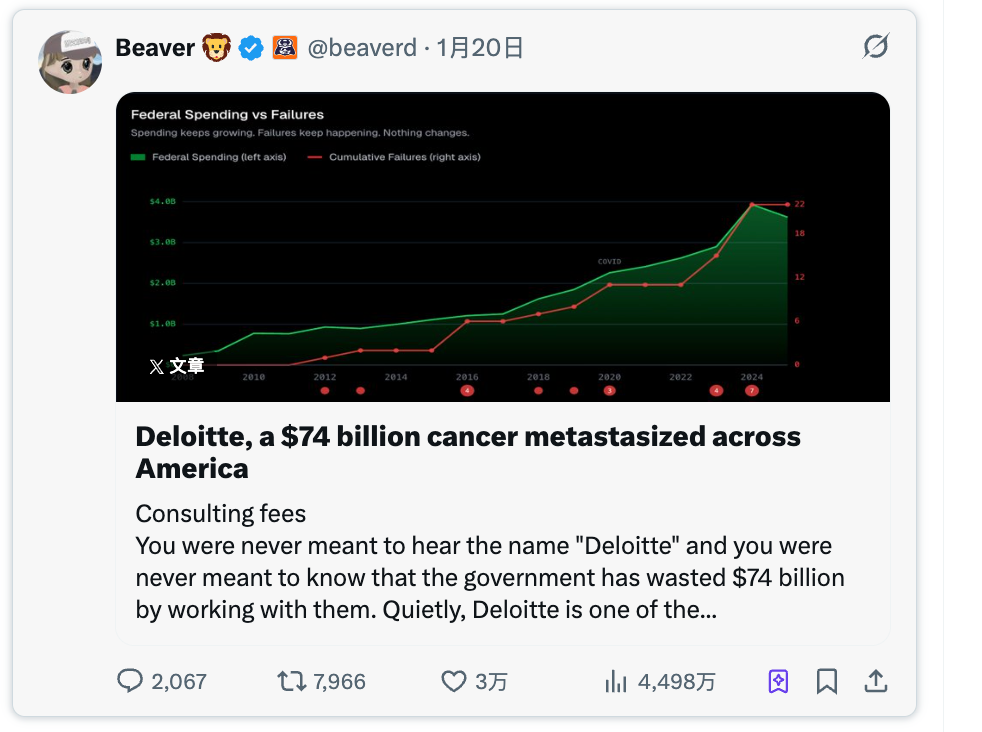
Upon clicking in, you'll find that this person truly put in the effort.
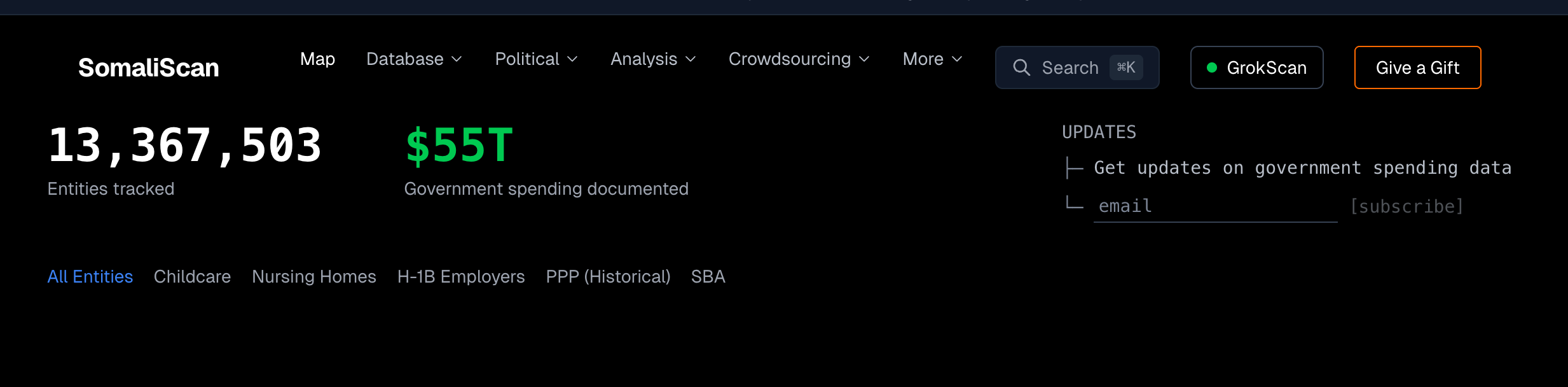
He built a website called somaliscan.com, capturing millions of government invoice data, cross-referencing them with audit reports and system failure records.
Then, using this primary data, he told a series of shocking stories: California's unemployment system was defrauded of $32 billion, Tennessee's Medicaid system collapsed leaving 250,000 children without coverage, and a court information system overhaul burned through $1.9 billion and was left unfinished… covering a total of 25 states.
He also uncovered the revolving door between Deloitte executives and government officials, detailing who moved from Deloitte to which department and which contracts were awarded back, listing names and amounts clearly.
One person built a database and conducted research to earn $1 million.
🥈 Runner-up: A 700,000-follower finance account teaches you how to profit during tariff panic
The runner-up @KobeissiLetter is a familiar face in the macro finance circle, with 700,000 followers, closely following U.S. economic policies and market fluctuations.
His article directly breaks down Trump's tariff strategies into a repeatable trading framework, titled "Trump's Tariff Script: An Operating Guide."
Since Trump often deviates from the norm, announcing some outrageous policies and threats to other countries, but does not always fully follow through, some on Wall Street summarized this pattern as TACO, which stands for Trump Always Chickens Out.
TACO describes a recurring pattern:
Trump announces severe tariffs → Market crashes → A few days later, he backs off or delays → Market rebounds.
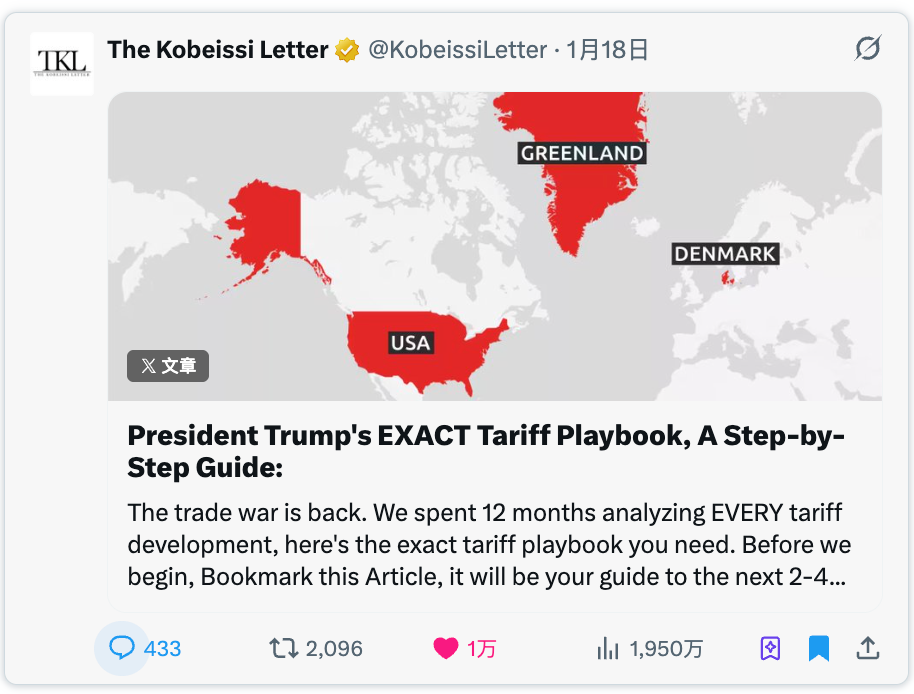
KobeissiLetter's article transforms TACO from a joke into a time-stamped operating manual. He used tariff events from the past 12 months as samples to break down a complete cycle template for trading.
For example, news from the White House over the weekend creates panic, funds enter the market midweek, a calming signal is released the next weekend, and some agreement is reached within 2 to 4 weeks. He also continues to update at each step, telling you where you are in the process, making it more like a serialized pre-research post.
He also provided practical methods, such as keeping an eye on the U.S. 10-year Treasury yield. If this number breaks 4.60%, Trump is likely to concede.
For the paid users on X who focus on macro and trading, this kind of content is very appealing.
It does not discuss whether tariffs are good or bad, nor does it make moral judgments; it simply tells you what actions to take at what time to make money the next time this happens.
🥉 Third place: The most liked DAN KOE, familiar life methodology
Dan Koe's entry article "How to Enter a State of Extreme Focus Anytime" received 42,000 likes and 8,681 retweets, both the highest among all participating articles. However, the exposure was only 11.04 million, less than a quarter of the champion's.
X did not technically classify him as third place; he was awarded a separate "Creator Choice" (official selection) award worth $250,000.
This is understandable, as Dan Koe "inspired this competition." His viral article from early January with 170 million views directly showed X how high the traffic ceiling for long-form content could be.
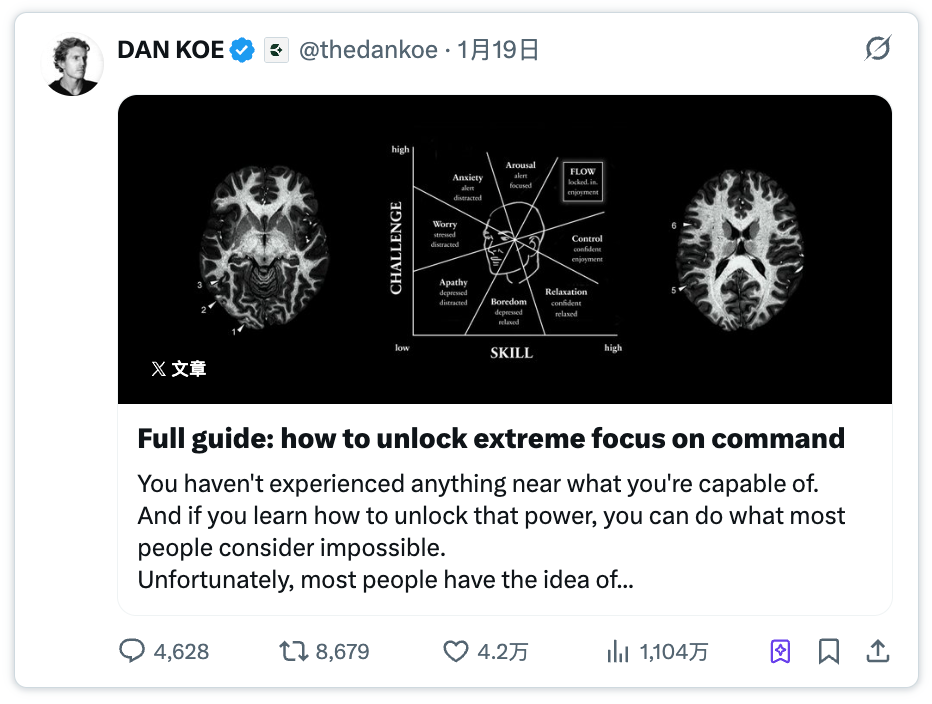
The article itself does not elaborate much, sticking to the familiar life growth methodology. It generally discusses how to gain focus and cites concepts from neuroscience and flow states to support and deepen the discussion.
In fact, this article had the best interaction data, but according to the core competition rule of "exposure among U.S. paid users," it did not rank at the top.
Why does the article with the best interaction have lower exposure? This discrepancy will be discussed later.
Honorable Mentions: 100,000 ×4
Nick Shirley, Josh Wolfe, Kaizen Asiedu, and Ryan Hall each received $100,000 in incentives. Their accounts cover public policy, geopolitics, history, and public safety.
Among them, Josh Wolfe is a co-founder of Lux Capital and a well-known venture capitalist, who also announced he would donate the prize money equally to four charitable organizations.
Since the original post did not list the specific articles of these four individuals, we did not conduct further investigation due to time and resource constraints. We welcome everyone to fill in the information.
Some In-Depth Observations
From the results of this competition, some patterns can be observed:
- The most liked article had only a quarter of the exposure of the champion
The most counterintuitive data from this competition is certainly Dan Koe's.
42,000 likes, 8,681 retweets, and 4,627 comments, all the highest interaction data in the competition. But the exposure was only 11.04 million, less than a quarter of champion @beaverd's. Meanwhile, @beaverd's likes were 30,000, which is even less than Dan Koe's.
If you have experience in social media management, you would find this set of data quite odd. Generally, the higher the interaction, the more the algorithm is willing to promote it, and the exposure should be larger.
However, X's competition calculated not total exposure, but "exposure on the U.S. paid users' home timeline." This metric excludes non-U.S. users, non-paid users, searches, and visits to personal homepages.
Dan Koe's writing is about personal growth, which naturally has a more global audience, with many non-U.S. users among his followers. @beaverd's article discusses how taxpayer money is wasted by Deloitte, which naturally concentrates the audience in the U.S. Under the same algorithmic recommendation mechanism, the "regional concentration" of content determines the height of this metric.
- A 90,000-follower account beats a 700,000-follower account; content scarcity > follower base
Champion @beaverd had 90,000 followers before the competition. Runner-up @KobeissiLetter had 700,000 followers. Dan Koe had 900,000 followers.
If follower count could determine exposure, the ranking should be reversed. But the actual results indicate that in X's Articles recommendation logic, the weight of follower base is far less significant than imagined.
@beaverd's victory hinged on having something others did not, with content scarcity playing a crucial role.
This is completely different from traditional traffic logic. Large accounts rely on follower stock and publishing frequency, but in an algorithm-driven distribution environment, "whether you have exclusive content" is more important than "how many followers you have."
- You need to build your own content "hardware"
Looking at it from a step back, the topics of these three award-winning articles are completely unrelated: one exposes government contracts, one teaches you how to trade tariff fluctuations, and one discusses how to concentrate attention.
In any content platform's categorization system, they would not appear on the same list. But they share a common point: each has its own independent "hardware," in other words, you need to have a narrative framework.
@beaverd's "hardware" is a self-built database that crawls government data; KobeissiLetter's "hardware" is a trading framework that has been backtested over 12 months, while Dan Koe's "hardware" is a six-chapter methodology that integrates neuroscience and psychology, which may seem profound but is actually based on principles everyone knows.
None of the award-winning articles are purely opinion pieces. They all require a long format to convey substantial information, which is precisely the reason for the existence of the X Articles product.
Another noteworthy fact is that none of the eight award winners are traditional media.
They are all independent creators. This is not to say that traditional media did not participate, but under this competition format, personal accounts have a distinct advantage.
Institutional media typically publish content on their own websites, only sharing links and summaries on social media. However, Articles require complete content to be posted on X, which is a cumbersome action for media accustomed to driving traffic off-site.
What is X really buying with $2.15 million?
Returning to the platform itself.
X initially promised $1 million in incentives but ultimately distributed $2.15 million. During the competition, a series of supporting actions were also taken: expanding the Articles feature from creator accounts to all paid users, adjusting the algorithm to increase the recommendation weight of long-form content, and changing the scoring method to "exposure on the home timeline of U.S. paid users."
Spending such a large amount is primarily because X needs original long-form content within the platform.
In the past, long content on X relied heavily on external links, such as Substack, Medium, and personal blogs. Users would click and jump away, leaving reading time and interaction data with others. The goal of Articles is to keep this content on the platform, allowing users to read from start to finish without leaving X.
On a deeper level, X has Grok. Training large language models requires high-quality long text data, while the vast majority of content on X consists of 280-character tweets. If Articles can continuously attract creators to produce in-depth long-form content, this content will serve as training material for Grok.
Finally, the value of paid users.
The competition rules limited the metrics to "exposure on the home timeline of U.S. paid users," which directly tells creators that their content must serve paid users.
This is using creators' content to support the paid system, making paid users feel that "the money I spent is worth it because I can see in-depth content on the homepage that I can't find elsewhere."
From the perspective of content creators, we believe that the era of pure opinions may be coming to an end.
This trend also applies to creators in the crypto space. The crypto industry is not lacking in opinions, with countless people making calls, predicting prices, and commenting on regulations on X every day.
However, few can build an on-chain data analysis tool like @beaverd or break down market cycles into repeatable trading scripts like KobeissiLetter.
Maintaining scarcity and independence while continuously producing content is actually a very professional task, and it is also a work that brings a great sense of achievement and positive feedback.
We also hope to see more content from the Chinese-speaking community appearing on the leaderboard in the future.
免责声明:本文章仅代表作者个人观点,不代表本平台的立场和观点。本文章仅供信息分享,不构成对任何人的任何投资建议。用户与作者之间的任何争议,与本平台无关。如网页中刊载的文章或图片涉及侵权,请提供相关的权利证明和身份证明发送邮件到support@aicoin.com,本平台相关工作人员将会进行核查。


