Author: ifanr
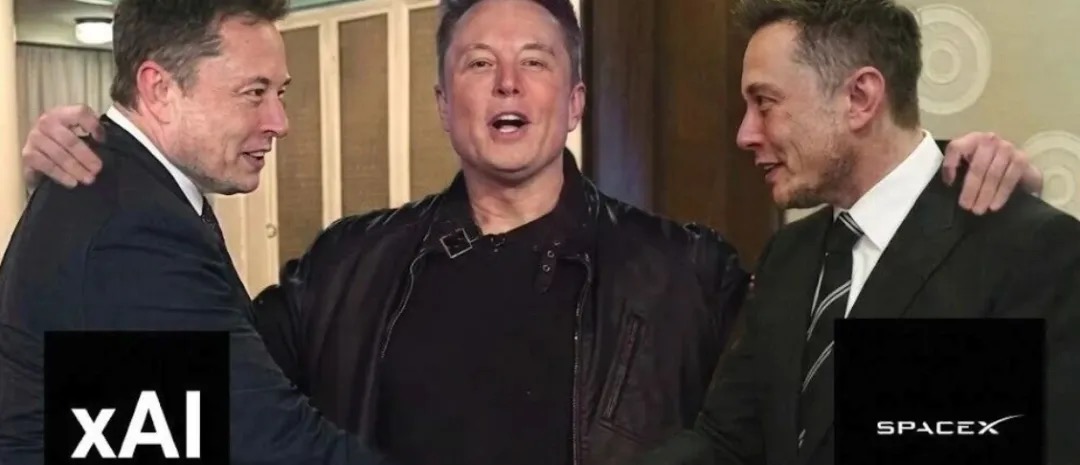
Just now, SpaceX officially acquired xAI.
The combined valuation of the two companies is expected to reach $1.25 trillion. Among them, SpaceX is valued at $1 trillion, and xAI at $250 billion, with the transaction being an all-stock deal, involving no cash.
This is not the first time Musk has engaged in this kind of "left hand receiving right hand," assembling companies he controls like "building with Lego."
In November 2016, Tesla acquired another renewable energy company controlled by Musk, SolarCity, for a staggering $2.6 billion. This transaction faced lawsuits, with investors accusing Musk of using Tesla's ample cash at the time to "rescue" the underperforming SolarCity.
In March 2025, the newly established xAI acquired Musk-controlled X (formerly Twitter) in a stock swap, aiming to create a closed loop of social platforms, data, models, computing power, and talent. After that, X became a testing ground for xAI's model Grok.
And now, today, SpaceX has acquired xAI.
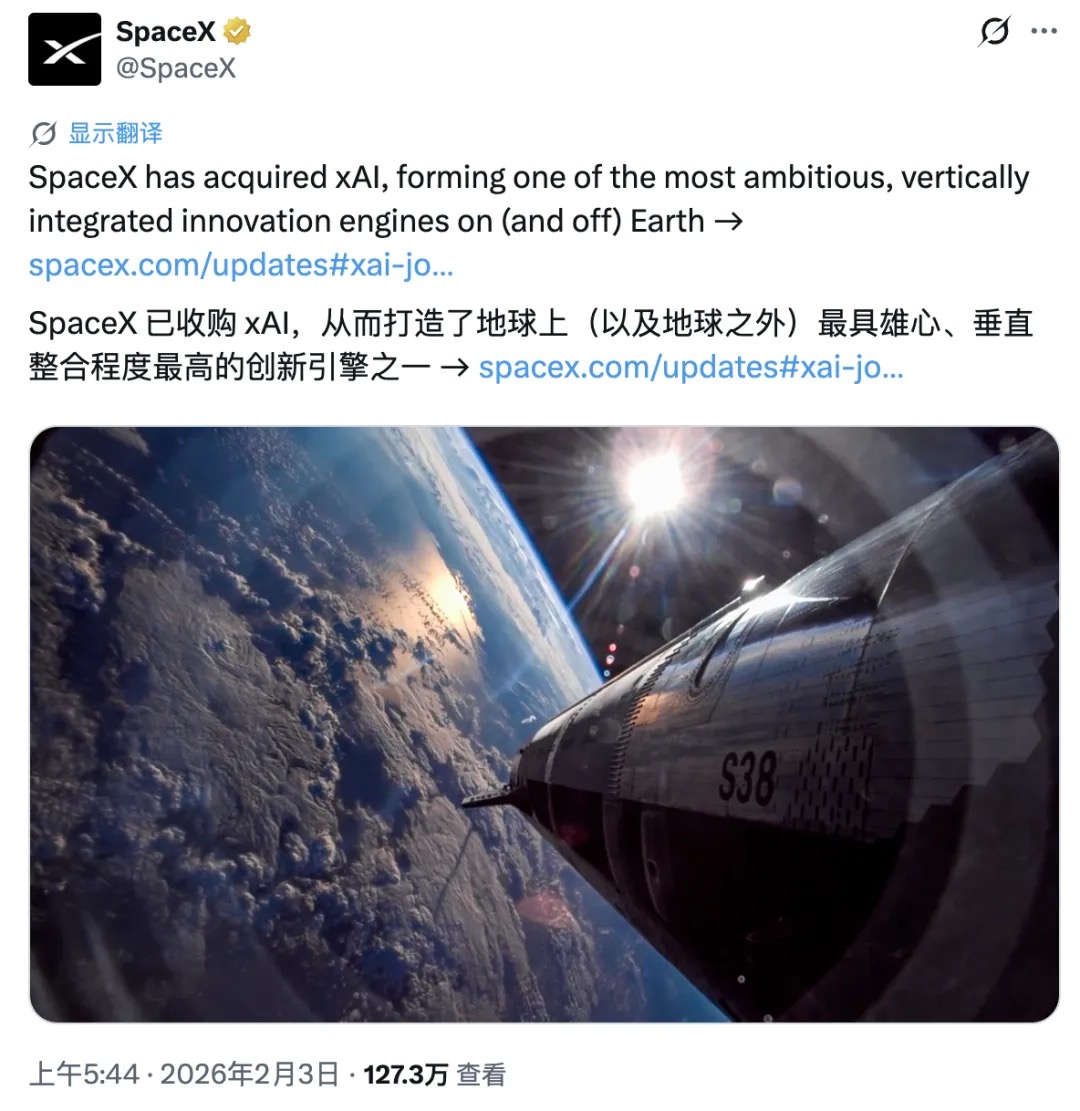
In the new structure, Grok and X represent the model and social content platform scenarios, while Starlink and Starship represent orbital networks and launch capabilities. Viewed together, SpaceX's acquisition of xAI is far more than a simple capital operation; it resembles a reorganization that packages the "upstream and downstream of the AI industry chain."
This news was released by Musk himself on the SpaceX official website, accompanied by a lengthy open letter. The core idea in the letter is very clear: to move AI data centers into space.
The reason is simple and direct:
Ground computing power growth faces energy and heat dissipation constraints; continuing to expand is both expensive and slow, and it will also trigger community and environmental disputes. For an AI company that burns cash at a scale of billions of dollars each month, this pressure will not disappear in the short term.
He calculated: to use one-millionth of solar energy, it would require a million times the current total energy consumption of human civilization. Earth simply does not have the conditions for this. So the only way is to move AI to space.
What are the benefits of space? Infinite solar energy, always sunny.
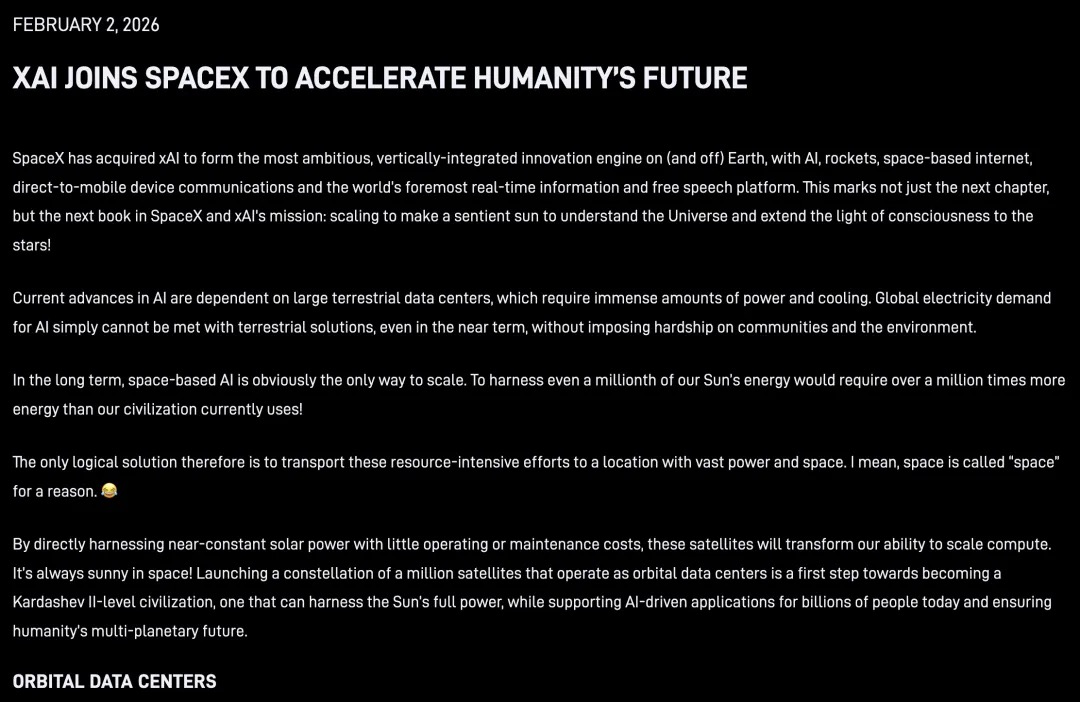
Musk's plan is to launch one million orbital data center satellites. Each year, he aims to launch 1 million tons of AI satellites into orbit, generating capacity calculated at 100 kilowatts per ton, equivalent to adding 100 gigawatts of AI computing power each year.
The ultimate goal is to launch 1 terawatt of AI satellites from Earth each year. Additionally, he wants to establish a manufacturing base on the Moon, using lunar resources to build satellites and launching them into deep space using electromagnetic mass drivers. This way, 500 to 1000 terawatts of AI satellites can be deployed each year.
Regarding the details of this acquisition, Musk did not disclose them in the open letter. Reports indicate that the transaction was communicated to employees through an internal memo, and the terms have not been fully disclosed to the public. To the outside world, it appears more like a "merger that has already happened" rather than a transaction process with significant negotiation space. This rhythm aligns with Musk's past operational style: first set the direction, then fill in the details.
According to Bloomberg, citing informed sources, the post-merger company is valued at approximately $526.59 per share. xAI had just completed a round of financing with a valuation of $230 billion in January, while SpaceX planned to sell equity at an $800 billion valuation last December.
This merger was completed in an all-stock format, with no cash payment involved.
The Structure Behind the Merger
Looking back at the merger over the past few years, a clear integration thread emerges.
In 2022, Musk, like a "barbarian at the gate," bought Twitter and renamed it X, and in 2025, he had xAI acquire X in a stock swap, tying the content platform and model together.
Now with SpaceX coming in, it effectively adds "orbital infrastructure" to this closed loop.
— Musk has always excelled at restructuring his companies into a mutually dependent system, and this move is just placing the puzzle pieces in a more complete position.
The pressure on the capital side is also very real. xAI, on one hand, needs to catch up with competitors like OpenAI and Anthropic, while on the other hand, it is also burning cash at a high rate.
Although SpaceX is more mature, its revenue structure also has concentration issues; Reuters reported that a significant portion of its revenue comes from launching its own Starlink satellites.
Merging the two companies means xAI gains stable launch capabilities, while SpaceX secures long-term satellite launch orders, creating a mutually supportive financial structure.
Adding to the funding background, the puzzle becomes more complete.
Bloomberg reported that xAI's monthly cash burn could reach around $1 billion, while Tesla and SpaceX have previously invested about $2 billion in xAI, making the merger appear more like a "systemic blood transfusion."
Meanwhile, SpaceX is preparing for an IPO, with market rumors suggesting it may initiate the listing in 2026, but it remains unclear whether the merger will affect the timeline.
For investors, doing a round of "asset stacking" before going public also makes sense: the aerospace attributes of SpaceX combined with the AI narrative indeed make it easier to achieve a higher valuation anchor.
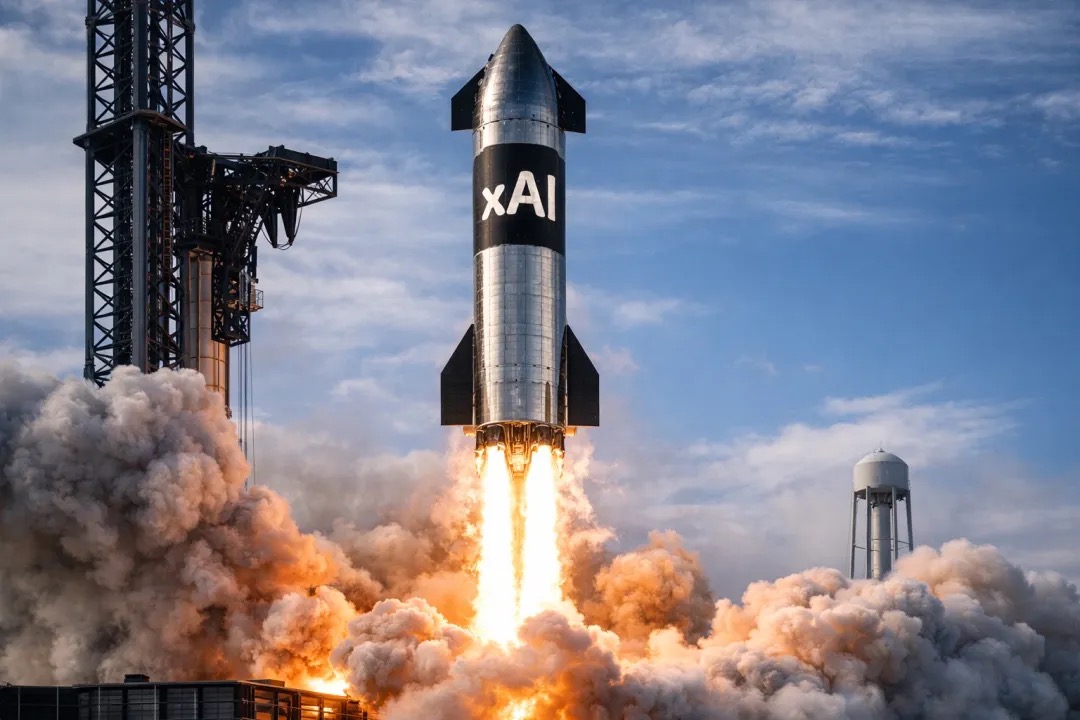
Musk's statements in the open letter are very direct:
“SpaceX has acquired xAI, and the merged company will become the most ambitious and vertically integrated innovation engine on Earth (and beyond), combining artificial intelligence, rocket technology, space internet, direct mobile device communication technology, and the world's most important real-time information platform X. This is not only the next chapter of SpaceX and xAI's mission but also the next book: to create a 'sun' with perception capabilities, understand the universe, and extend the light of consciousness to the stars.”
Sending Data Centers to Space
The most intriguing part of the announcement is Musk's extreme judgment:
He wrote: "In the long run, space AI is the only scalable way," and provided a timeline—within 2 to 3 years, space will become the cheapest source of AI computing power.
Space has nearly constant solar energy; in his own words: "It is always sunny in space."
To align with this route, SpaceX plans to launch satellites equipped with computing power using Starship, directly moving computing power to orbit.
Moreover, the scale is not "a few hundred": public reports indicate that SpaceX has already submitted an application to the FCC, hoping to be approved to launch up to 1 million data center satellites.
These satellites will create long-term and massive launch demand, in turn providing stable income for SpaceX's launch system—this sounds reasonable, but objectively it also touches on the "related party transaction" red line. Of course, as mentioned earlier, Musk is no stranger to this kind of left hand to right hand maneuvering, and today's U.S. regulatory agencies have more pressing matters to attend to, leaving them little time to monitor him.
Starlink currently has over 9,000 satellites in orbit, making it the largest satellite network in the world. The scale itself is a moat, which also determines why this route can only be attempted by a few companies.
In a grander narrative, Musk describes this route as the beginning of a "sentient sun," even mentioning extending the "light of consciousness" to the stars.
It sounds a bit abstract, but it can be understood this way: the range within which human civilization can influence and be influenced is imagined by him as a beam of expanding light—this is also the core emotional drive in this merger narrative.
Of course, not everyone believes in this route.
Microsoft President Brad Smith publicly questioned the feasibility of space data centers; Google has also proposed research projects like Project Suncatcher, but they remain in the experimental stage.
From a practical perspective, xAI itself has not given up on expanding ground computing power; it is advancing a data center project worth about $20 billion in Mississippi, indicating that "going to space" is more of a long-term solution rather than a short-term alternative.
免责声明:本文章仅代表作者个人观点,不代表本平台的立场和观点。本文章仅供信息分享,不构成对任何人的任何投资建议。用户与作者之间的任何争议,与本平台无关。如网页中刊载的文章或图片涉及侵权,请提供相关的权利证明和身份证明发送邮件到support@aicoin.com,本平台相关工作人员将会进行核查。


