Author: Jae, PANews
In 2026, where Web3 and AI are deeply integrated, Agents are no longer just automated scripts on an island.
Last night (January 29), Davide Crapis, head of AI at the Ethereum Foundation, announced that the AI agent economic standard ERC-8004 has gone live on the mainnet. The implementation of this standard marks the establishment of a native infrastructure for the "Agent-to-Agent Economy" (A2A Economy) within the Web3 ecosystem, breaking the "walled garden" monopolized by centralized APIs and closed systems.
The birth of ERC-8004 is an inevitable product of the deep integration of AI and DeFi (Decentralized Finance), and Ethereum will gain an additional identity as an "Agent Coordination Layer" in its ongoing technological narrative.
Breaking the Chains of Centralization, ERC-8004 Restructures Agent Trust Logic
Currently, the Agent-to-Agent economy is still in a "wild era" characterized by both efficiency and chaos.
In the traditional AI ecosystem, interactions between Agents heavily rely on the "Agent-to-Agent protocol" provided by service providers. For example, developers collaborate through Google's Agent-to-Agent (A2A) protocol, but this requires all parties to be within the trust domain established by Google.
While this model is efficient, its vulnerabilities are equally apparent. Once a centralized node halts due to policy or technical reasons, the entire Agent collaboration network will quickly collapse, and the reputation assets accumulated by Agents over long-term interactions cannot be transferred across platforms.
Centralized trust has become a heavy shackle, limiting the explosion of the Agent-to-Agent economy. ERC-8004 was born to shift "trust in centralized entities" to "trust in cryptographic proofs."
ERC-8004 does not attempt to build a large and complex system but instead designs a lightweight, scalable on-chain registry system aimed at providing the most basic trust primitives for AI agents.
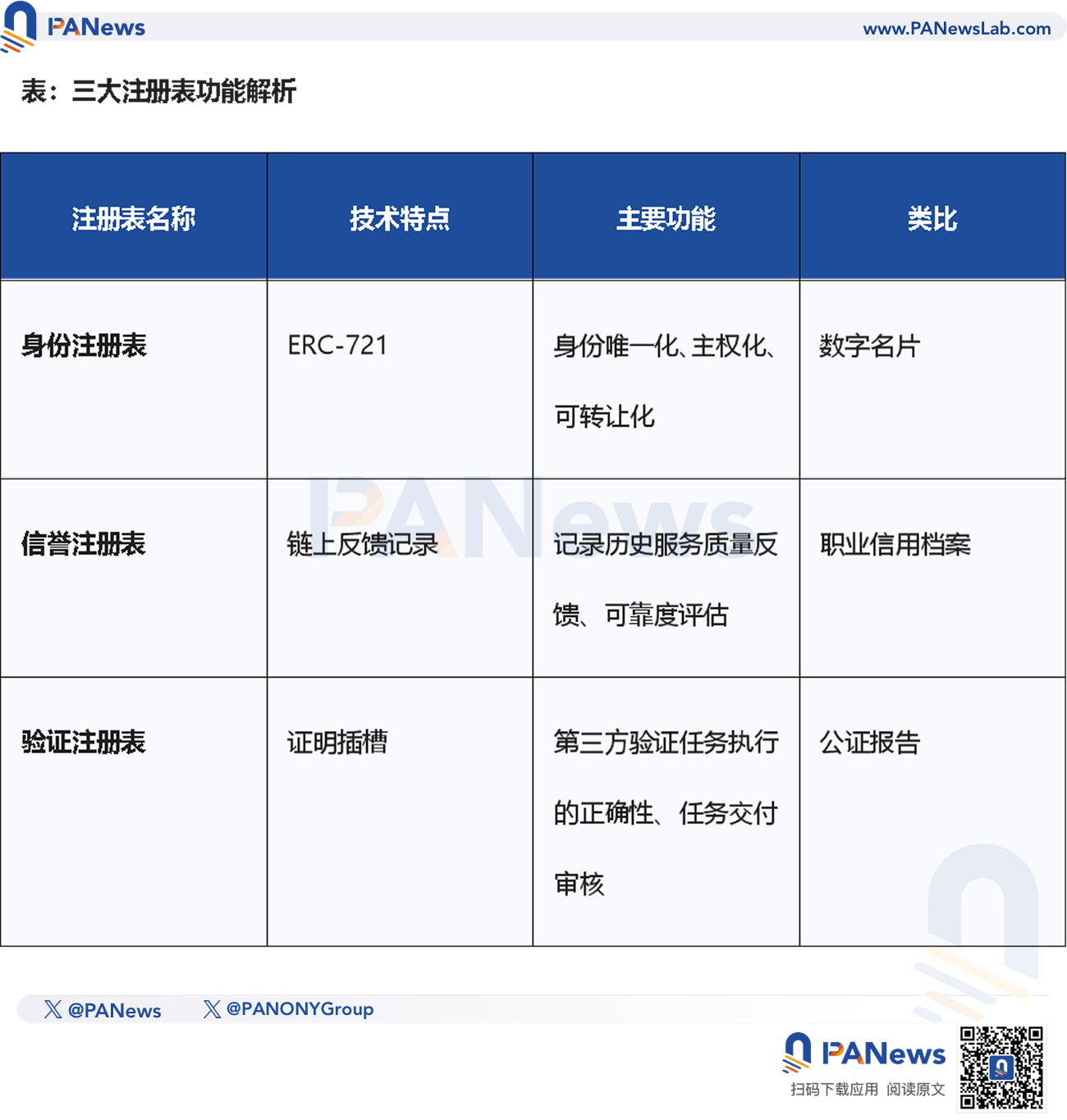
- Identity Registry
In the design of the identity registry, each Agent will be mapped as a unique ERC-721 NFT. This is not just an ID, but a transferable "digital ownership."
Each NFT will be associated with an "Agent Card," which will list its communication protocol, functions, and wallet address. Thus, Ethereum will become a global decentralized "AI Yellow Pages," where any other Agent or human user can access Agent services that meet specific task requirements through on-chain indexing.
- Reputation Registry
If the identity registry solves the question of "Who is the Agent," then the reputation registry will address the issue of "Is the Agent reliable?"
Unlike centralized review systems, ERC-8004 will permanently record each Agent service's evaluation (scores, tags, feedback hashes) on-chain.
More importantly, it does not enforce a single score but provides raw data, allowing third parties to develop various reputation algorithms to construct diversified views. This modular design will avoid score monopolies and ensure the resilience and fairness of the trust mechanism.
- Validation Registry
For important tasks, having "good reviews" is not enough; "proof" is also required. The validation registry will provide a slot that allows for the integration of multiple third-party verification mechanisms, from social consensus and economic staking to cryptographic proofs, to achieve an automated logic of "No Work, No Pay." The validation results will be recorded on-chain, becoming a key signal for fund release or triggering penalties.
Tom Lee, Chairman of BitMine, also summarized that the agent system will operate outside the existing system's "walled garden," where smart contract blockchains can prove the source of instructions and record the final settlement of micropayments.
Great Potential for Technical Component Integration, Building the Agent Protocol Stack
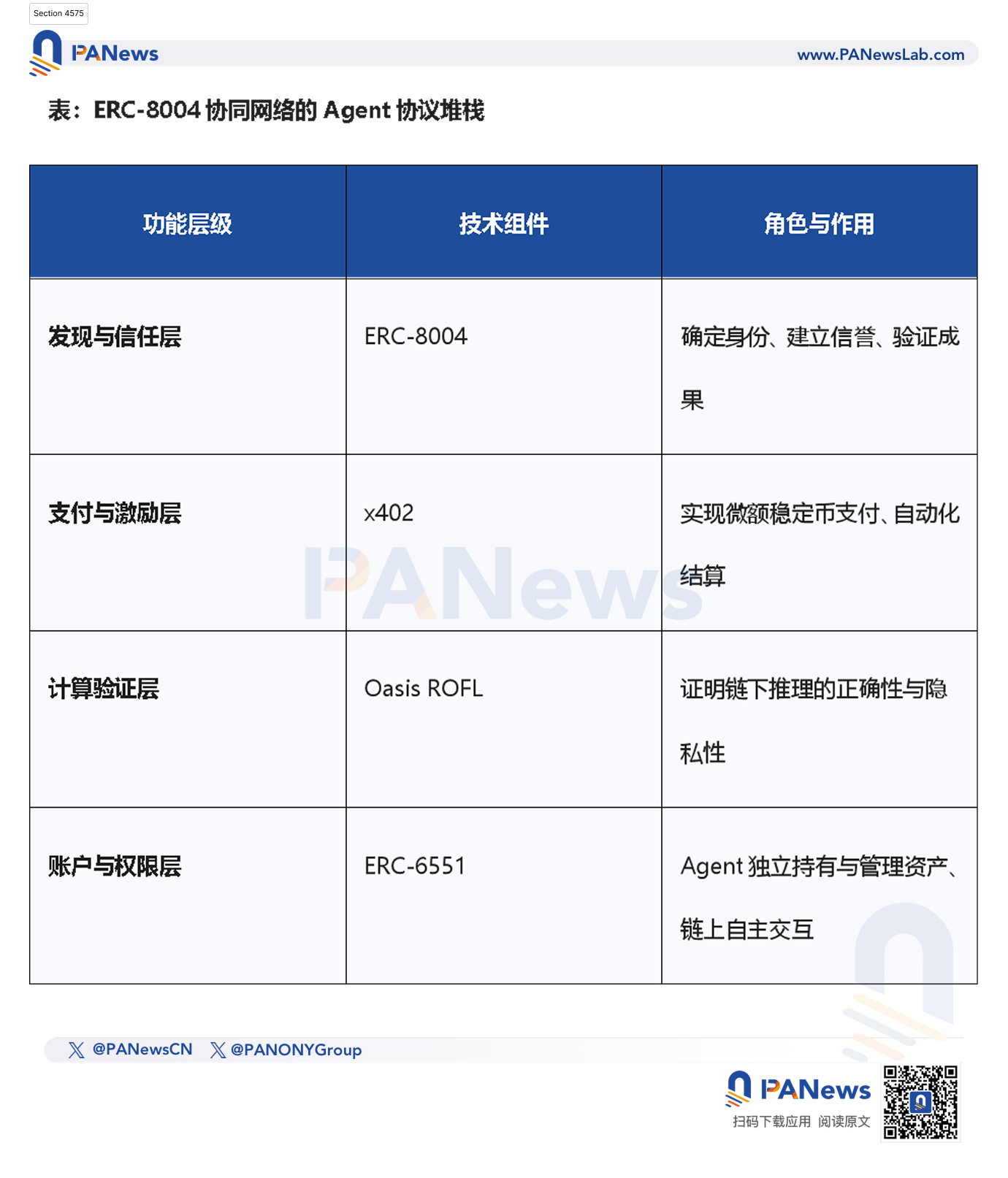
The advantages of ERC-8004 lie not only in its specifications but also in its deep interoperability with other cutting-edge technologies in the Ethereum ecosystem. This synergy may give rise to a complete "Agent Protocol Stack."
- x402 Payment Protocol
The x402 payment protocol launched by Coinbase may become the best partner for ERC-8004, as it solves the micropayment issue between Agents.
AI can automatically settle service fees through it, forming a task flow of "work-receive payment-update reputation." This closed-loop link may reduce human user intervention, allowing the Agent-to-Agent economy to operate autonomously.
- Oasis ROFL Framework
AI models typically run on opaque off-chain hardware, making the computation process resemble a "black box." The ROFL (Runtime Off-chain Logic) framework introduced by the Oasis protocol may fill this trust gap.
The ROFL framework can generate cryptographic proofs in a TEE (Trusted Execution Environment), verifying whether the Agent operates using specified models and parameters, with the proof results anchored to the validation registry.
For users, what they trust is the "verified code," not external third parties.
- ERC-6551
If ERC-8004 is the Agent's "digital business card" and "professional credit file," then ERC-6551 (token-bound accounts) is the Agent's "wallet."
When an ERC-8004 Agent ID is bound to its own ERC-6551 account, this Agent gains the ability to hold and manage assets, sign contracts, and autonomously interact on-chain.
This combination of "identity + property rights" will make Agents independent economic entities.
A highly automated scenario may gradually emerge: DeFi protocols can automatically search for high-reputation, TEE-verified arbitrage Agents in the "Yellow Pages," entrusting them with asset allocation and automatically paying rewards through x402, all without any human intervention.
When 90% of the market's traffic and transactions are driven by Agents, those who can control the pricing of trust will hold the future of digital hegemony.
Ethereum is attempting to compete for dominance in this "Agent-to-Agent economy" game, and ERC-8004 is its first strategic move.
免责声明:本文章仅代表作者个人观点,不代表本平台的立场和观点。本文章仅供信息分享,不构成对任何人的任何投资建议。用户与作者之间的任何争议,与本平台无关。如网页中刊载的文章或图片涉及侵权,请提供相关的权利证明和身份证明发送邮件到support@aicoin.com,本平台相关工作人员将会进行核查。


