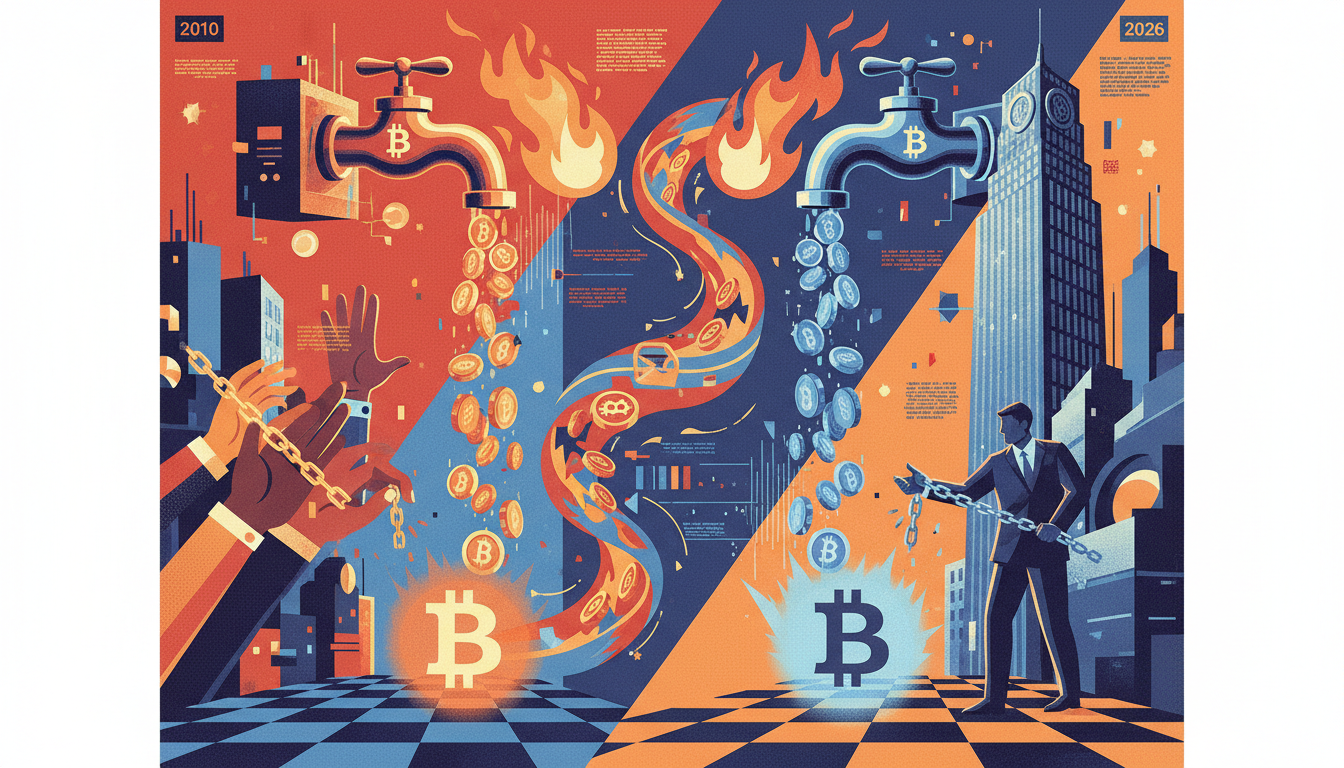
On January 28, 2026, in the same day in the UTC+8 time zone, signals related to Bitcoin were simultaneously thrown from both political and judicial fronts in the United States: on one side, South Dakota State Representative Logan Manhart proposed the Bitcoin Reserve Bill HB 1155, attempting to allow the state government to directly bet on this asset with public funds; on the other side, a Chinese national Su Jingliang was sentenced to nearly four years in prison and ordered to pay over $26 million in restitution by a U.S. federal court for assisting in laundering nearly $37 million in cryptocurrency scam funds. This stark contrast outlines the core tension of the current U.S. crypto narrative: the same asset is packaged as "strong money" to enhance the state's financial and sovereign image, while simultaneously appearing repeatedly in transnational fraud and money laundering chains, becoming a financial crime tool targeted by the judicial system.
South Dakota's 10% Bitcoin Bet…
● 10% Public Funds Cap: The core of HB 1155 is to allow the South Dakota Investment Council to invest up to 10% of public funds in Bitcoin. Here, "public funds" means a broad pool of funds linked to state finances, public services, and pensions, rather than just a specific fund or institution's own capital. Opening the cap to 10% at once is considered a high-risk position in the context of traditional asset allocation; this is both a bold institutional experiment and a political choice that directly shifts market volatility risk onto taxpayers and the public sector's balance sheet.
● "Strong Money, Strong State": Bill sponsor Logan Manhart set the tone for the proposal on X with "Strong money, strong state," attempting to link Bitcoin with "sound money" and "fiscal independence." For him, shifting some public funds to Bitcoin is not only about pursuing potential excess returns but also about sending a signal to voters and Washington: South Dakota is willing to use an asset that does not rely on federal finances and central bank policies to strengthen its fiscal governance and sovereign symbolism. This narrative intentionally packages Bitcoin as a "systemic tool" to hedge against inflation and federal power.
● Position in the State-Level Bitcoin Landscape: Prior to this, only Texas, Arizona, and New Hampshire had passed laws allowing state governments to invest in Bitcoin or hold seized crypto assets. South Dakota is not the first state to embrace Bitcoin, but it is one of the few cases that explicitly writes "up to 10% of public funds" into legislation. Unlike previous focuses on "how to dispose of seized assets" or "limited holdings," South Dakota attempts to proactively include Bitcoin in asset allocation, shifting from a follower to a more aggressive front-line experimenter in state-level Bitcoin positioning.
The $37 Million Scam Behind…
● Magnitude of Judgment and Compensation: On the same day South Dakota bet on Bitcoin, the federal judicial system presented another crypto narrative: Su Jingliang was sentenced to nearly four years of federal imprisonment and ordered to pay over $26 million in restitution for assisting in laundering nearly $37 million in cryptocurrency scam funds. The length of the sentence and the amount of compensation reflect the court's characterization of his role—not just as a technical executor but as a key link in the cross-border money laundering chain, representing the judicial system's severe stance on crypto money laundering activities.
● Operation of Global Fraud Networks: According to disclosures from the U.S. government, Su Jingliang was part of a global crime network that actively contacted U.S. retail investors through text messages, phone calls, and online dating platforms, gaining trust through "investment advice" and "emotional connections," and then guiding victims to invest in so-called "high-yield crypto investment projects." These projects are essentially fraudulent platforms or Ponzi schemes; once funds are in, they are quickly converted, split, and laundered through multi-layered on-chain transfers and off-market channels, ultimately forming a difficult-to-trace transnational flow of funds, creating a complete loop from marketing to laundering.
● Cost to 174 American Victims: The U.S. government confirmed that the case involved 174 American victims, representing the savings, pensions, and even emergency funds of individual investors. Such cases not only target individual wealth security but also directly harm the overall reputation of the crypto industry—in the eyes of regulators and the public, "high-tech fraud," "cross-border money laundering," "Bitcoin," and "crypto investment" are frequently linked, causing ordinary investors to first question the legality and compliance of any crypto product they encounter.
State Government Bets on Bitcoin but Collides with Federal…
● State Reserves vs. Federal Prudence: While South Dakota promotes the inclusion of Bitcoin in its financial reserves, the federal level maintains a cautious and even tightening regulatory attitude towards crypto assets overall. The state legislature attempts to empower the state investment council to allocate Bitcoin through legislation, while the federal level continuously expands regulatory boundaries through securities laws, banking regulations, and anti-money laundering rules. This creates institutional tension: when the state government views Bitcoin as a sovereign reserve asset, will the federal government still define it as a high-risk speculative item or a potential financial stability hazard?
● Multiple Risks of Holding Public Funds in Crypto: Betting up to 10% of public funds on Bitcoin first faces the impact of severe price volatility on the balance sheet, and secondly, the security and compliance requirements of custody—state investment councils need to choose what kind of custodial institution to work with, how to meet KYC/AML and reporting obligations, and how to define responsibility in events like hacking or loss of private keys. If these issues are magnified, they could provide reasons for federal regulatory agencies to intervene, from accounting standards to risk weights, and whether it constitutes "excessive gambling" with public funds, every link could be re-examined at the federal level.
● The Game Behind the "Strong State" Slogan: When Logan Manhart raises the banner of "strong money, strong state," he is actually putting the conflict between state fiscal autonomy and federal financial security on the table. For the state government, reducing dependence on the federal monetary and debt system through Bitcoin is a symbolic "decentralization" stance; but from the federal perspective, if multiple states expose large amounts of public funds to high-volatility assets, a sharp price correction could not only affect local public services but also evolve into federal fiscal pressure to cover losses. This game will be amplified in future regulatory hearings and political defenses.
On the Same Chain: Sovereign Assets and Crimes…
● The Dual Role of Bitcoin: Placing South Dakota's HB 1155 alongside Su Jingliang's money laundering case on the same timeline reveals an extreme division in the U.S. narrative regarding Bitcoin: on one end, it is packaged by state legislators as a macro reserve asset alongside gold and government bonds; on the other end, it plays the role of a funding channel and cover in transnational fraud and money laundering chains. Whether as "public assets" allocated by the state investment council or "dirty money" laundered by criminal networks, both may ultimately flow through the same chain, with the technically neutral ledger assigned entirely different meanings in the real world.
● Why Transnational Fraud Prefers Crypto Networks: The reason Bitcoin and the broader crypto network are favored by transnational fraud gangs lies in the convenience of cross-border transfers, the separation of identity and funds, and the coverage blind spots of traditional regulation. As long as victims convert their funds into on-chain assets, fraud gangs can quickly split and export them to multiple jurisdictions using multi-chain transfers, mixing services, and over-the-counter transactions, significantly weakening traditional banking system-based fund monitoring and freezing mechanisms. This structural advantage gives crypto networks far greater "efficiency" in cross-border money laundering scenarios than traditional remittance channels, keeping regulators and the judiciary always in a position of catching up.
● National Asset or High-Risk Asset: On one side is the judicial system's pursuit of the $37 million in scam funds and the reassurance of the 174 victims, while on the other side, the state legislature attempts to allow public funds to directly hold Bitcoin. These two lines together shape a contradictory narrative: in the discourse of some state governments, Bitcoin is being tentatively elevated to the level of a "national asset"; while in federal law enforcement and media reports, it frequently appears as a synonym for "high-risk asset." The future collective perception of Bitcoin by the public will largely depend on which type of story is more frequently seen: the "fiscal innovation" of state-level holdings or the "negative cases" of cross-border fraud and money laundering.
Cross-Border Judicial Pursuit and State-Level Bitcoin…
● Federal Judicial Extension Across Borders: The Su Jingliang case shows that the U.S. is extending its "tentacles" through judicial cooperation in transnational crypto crime. From locking down fraud networks and tracking the flow of nearly $37 million in funds to ultimately sentencing nearly four years of federal imprisonment and requiring over $26 million in restitution, this series of actions releases a clear federal stance on money laundering and fraud—regardless of how many countries or addresses the funds pass through, as long as a closed evidence loop can be established in the judicial chain, there will be criminal accountability and high restitution in response. "Zero tolerance" is no longer a political slogan but is being concretely materialized through specific cases.
● Judicial Pursuit vs. Legislative Embrace in a Race Against Time: Simultaneously, state governments are accelerating attempts to incorporate Bitcoin into their balance sheets through legislation—from Texas, Arizona, and New Hampshire to now South Dakota, the "embrace speed" at the state legislative level is clearly faster than the formation of a unified regulatory framework at the federal level. This misaligned rhythm of judicial pursuit of criminal funds while legislating to embrace asset classes constitutes a race against time: whether to establish a nationwide compliance, review, and cooperation system first or to let more public funds flow into a market still full of regulatory gray areas.
● Prospects for More States and a Unified Framework: It is foreseeable that once the South Dakota model gains political benefits or appears "successful" in terms of balance sheet returns, more states will consider emulating it by allocating part of their fiscal reserves or pension exposures to Bitcoin. Under the pressure of this trend, the federal level may be forced to promote a more unified regulatory and judicial cooperation framework, from asset classification and risk disclosure to on-chain analysis, cross-border evidence collection, and asset recovery mechanisms, constructing a system that neither stifles state-level innovation nor undermines the overall safety of the financial system. This will also determine whether Bitcoin is viewed as a "marginal speculative item" or formally incorporated into the institutional asset matrix in the U.S. in the future.
Between the Dream of a Strong State and the Iron Fist of Regulation…
The South Dakota Bitcoin Reserve Bill and the nearly $37 million money laundering case are discussed on the same day, revealing the same contradiction—institutions are trying to tame an asset class that is still full of gray areas. On one end, legislators hope to use "Strong money, strong state" to shape Bitcoin as part of the strong state narrative; on the other end, the judicial system continuously ties it to fraud and money laundering through judgments and compensations. How to acknowledge the potential of technology and assets while bridging the regulatory and judicial gray areas will be an unavoidable topic for the U.S. in the coming years.
In the future, whether more states will turn "strong money, strong state" from a slogan into policy practice by betting part of their public funds on Bitcoin will directly compel the federal government to provide a clearer framework on asset definitions, risk standards, anti-money laundering rules, and cross-border judicial cooperation. For institutions and individuals, in the reality where sovereign narratives and criminal cases intertwine, participating in crypto assets is no longer just a matter of expected returns but requires redefining the boundaries of risk, compliance, and opportunity: whether it is possible to find that fine line that does not stand outside the regulatory red line while not being overly exposed to systemic risks will determine the winners and survivors in this field in the coming years.
Join our community to discuss and become stronger together!
Official Telegram community: https://t.me/aicoincn
AiCoin Chinese Twitter: https://x.com/AiCoinzh
OKX Benefits Group: https://aicoin.com/link/chat?cid=l61eM4owQ
Binance Benefits Group: https://aicoin.com/link/chat?cid=ynr7d1P6Z
免责声明:本文章仅代表作者个人观点,不代表本平台的立场和观点。本文章仅供信息分享,不构成对任何人的任何投资建议。用户与作者之间的任何争议,与本平台无关。如网页中刊载的文章或图片涉及侵权,请提供相关的权利证明和身份证明发送邮件到support@aicoin.com,本平台相关工作人员将会进行核查。