Author: Zhou Ailin, Tencent Finance
Editor: Liu Peng
In the early hours of January 22, Beijing time, the U.S. stock market rebounded sharply. The previous day, U.S. stocks experienced their largest single-day drop since "Liberation Day," but U.S. President Trump’s speech in Davos regarding the Greenland crisis calmed the market.
At the close, the S&P 500 index rose by 78.76 points, an increase of 1.16%, closing at 6875.62 points; the Dow Jones Industrial Average rose by 588.64 points, an increase of 1.21%, closing at 49077.23 points; the Nasdaq rose by 270.502 points, an increase of 1.18%, closing at 23224.825 points; Chinese concept stocks surged, with the Nasdaq Golden Dragon China Index rising by 2.21%, closing at 7776.15 points. The Chinese concept internet index ETF (KWEB) rose by 1.74%; among popular Chinese concept stocks, Baidu initially rose by 8%, Century Internet rose by 7.4%, GDS Holdings rose by 6.1%, Kingsoft Cloud rose by 4.6%, WeRide rose by 4.3%, Alibaba rose by 3.9%, Yum China rose by 2.7%, and Pinduoduo rose by 1.4%.
Has the alarm for the Greenland crisis been completely lifted? How will the global market change subsequently?
1. Trump’s Change of Tone Calms the Market
In his keynote speech at the World Economic Forum in Davos, Switzerland, Trump called for "immediate negotiations" regarding the acquisition of Greenland, a territory of Denmark, and stated that only the U.S. could ensure its security.
However, he also hinted that he would not use force to control the island. "Unless I decide to use excessive force, we might get nothing. Frankly, in that case, we would be unstoppable, but I won’t do that."
Trump also stated on Wednesday that he had reached a cooperation framework with NATO regarding Greenland, retracting his tariff threats against eight European countries. According to a report by The New York Times, three senior officials familiar with the discussions revealed that prior to the announcement, NATO held a meeting on Wednesday where the top military officials of member countries discussed a compromise plan: Denmark would cede sovereignty over a small piece of land in Greenland to the U.S. for the construction of a military base. These officials indicated that this idea had been pushed by NATO Secretary General Jens Stoltenberg. Two of the officials compared it to the British military bases in Cyprus—those bases are considered British territory. It remains unclear whether this idea falls under the framework agreement announced by Trump. He did not immediately disclose the specific details of the framework.
Despite a temporary "sell-off of U.S. assets" in the market, Tencent News' "Periscope" previously learned that the key is to observe the sustainability of this volatility. Traders are still seeking buying opportunities on dips and believe that Trump’s actions are more like a negotiation strategy; although the process may be uncomfortable, his style is, "I come out with a big hammer first, and then negotiate with you."
Earlier this week, Trump proposed imposing a 10% tariff on imports from eight European countries (Germany, France, the UK, the Netherlands, Denmark, Norway, Sweden, and Finland) starting February 1, and threatened to raise the tariff to 25% on June 1 if no agreement could be reached regarding his intention to acquire Greenland (implementation remains highly uncertain).
2. U.S. Stocks Stop the Bleeding
The response of U.S. stocks has reflected the change in market sentiment. Previously, Tencent News' "Periscope" learned from traders that rather than saying Tuesday's sharp decline stemmed from extreme market concerns over the Greenland crisis, it was more of a position-driven shock amplified by rising global yields.
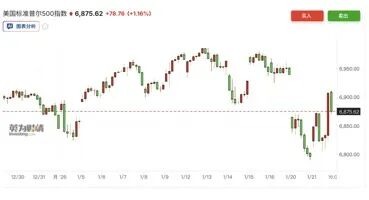
In addition to geopolitical risks, U.S. and Japanese government bond yields also surged simultaneously, which was a fatal blow to the stock market. Moreover, the current bullish positions and optimistic sentiment among investors are at high levels, making them more susceptible to external shocks.
On January 20, the 40-year U.S. Treasury yield historically broke above 4%, while the 20-year and 30-year yields surged more than 20 basis points in a single day. U.S. Treasury Secretary Janet Yellen attributed the surge in U.S. Treasury yields to Japan, possibly due to Japanese Prime Minister Fumio Kishida proposing a reduction in food taxes without clarifying the funding sources, leading to a sell-off in Japanese bonds overnight. On that day, the yield on the 10-year U.S. Treasury rose by 8 basis points to 4.293%.
Tim Sun, a senior researcher at HashKey Group, believes that the underlying logic is that, apart from the U.S., the volatility in the Japanese bond market is far more dangerous and systemically destructive than that of ordinary countries. Due to Japan's long-term low interest rates, it has become a major liquidity provider for the global financial market, especially in Europe and the U.S. Therefore, once bond yields rise, the attractiveness of Japanese investors' overseas assets declines, which may trigger a repatriation to the domestic market, leading to a sell-off of U.S. and European bonds, further increasing borrowing costs in the global financial market and impacting risk assets, including potentially spreading to the real economy, as Japan is one of the centers of the global supply chain.
Goldman Sachs' research indicates that when the yield on the 10-year U.S. Treasury experiences a 2 standard deviation fluctuation within a month (currently equivalent to 50 basis points), historical data shows that U.S. stocks tend to correct (an increase in interest rates means a compression of stock market valuations).
However, market risk sentiment is expected to continue to ease. Traders generally believe that although positions had previously expanded excessively and market sentiment was extremely bullish, which posed a risk for significant volatility due to sudden news, the current capital flow still supports U.S. stocks. Therefore, the most likely short-term trend is a slight sell-off (on Tuesday), followed by a rebound (on Wednesday). The key is that the inflow of funds into the stock market has remained strong (the rotation of money market fund capital into the stock market has finally become apparent), companies are entering the buyback window, and capital market activities are recovering.
Coincidentally, Goldman Sachs' global hedge fund business head Tony Pasquariello mentioned in his macro notes on Wednesday that the world seems to be becoming increasingly turbulent, and it would not be surprising to see more risk transfers in the short term. However, more important factors should not be overlooked: the U.S. economy is growing strongly, and the Federal Reserve is increasing liquidity injections.
"In summary, the U.S. economy is accelerating. Several data points from last week were particularly notable, especially the ISM services index rising (54.4, the highest in over a year) and the decline in initial jobless claims (198,000, a significantly healthy level). At the same time, various housing activity indicators also show signs of stabilization. Overall, our current activity indicators for the U.S. have risen to the highest level since the end of 2024," he stated.
3. Gold's Uptrend Difficult to Change
Due to the easing of geopolitical risks, silver plummeted, and gold experienced a rapid pullback in the short term, but the gold price quickly rebounded. As of 7 a.m. Beijing time on January 22, the international spot gold price was reported at $4831.45 per ounce, with an increase of over 11% this year and a year-on-year increase of about 70%.
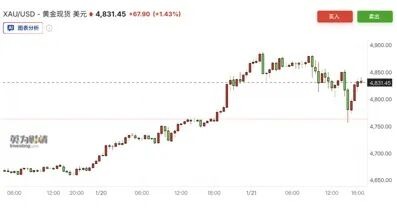
The main reasons for gold's continued rise include: Gold is linked to the real interest rates of the U.S. dollar, showing a negative correlation. The overall decline in real interest rates supports gold; at the same time, gold is also a safe-haven tool, serving as a hedge against concerns over the independence of the Federal Reserve and against the "dollar exceptionalism" narrative of de-dollarization. This demand will not change drastically due to the temporary cooling of the Greenland crisis.
Zhu Liang, Deputy General Manager and Investment Director of the China branch of the U.S. asset management firm Invesco, mentioned that as of the end of the third quarter of 2025, the largest demand for gold comes from ETF investment, accounting for about 43% of total demand; followed by jewelry demand, accounting for about 33%, which also represents a portion of investment demand; thirdly, the reserve demand from central banks and institutions like the Federal Reserve accounts for about 17%; and finally, industrial demand, which is quite small, at around 7%.
Adam Berger, a multi-asset strategist at Wellington Management, believes that risk appetite and safe-haven sentiment are not necessarily mutually exclusive. During periods of rising gold prices, stocks can also perform well.
Wall Street's prediction of gold prices hitting $5,000 by 2026 seems to be realized ahead of schedule. UBS continues to be optimistic about gold and has raised its target prices for March, June, and September 2026 from $4,500 per ounce to $5,000, expecting a slight decline to $4,800 by the end of 2026 (after the U.S. midterm elections). If political or financial risks rise further, gold prices are expected to surge to $5,400 (previously $4,900). Gold remains an extremely attractive asset and an important risk-hedging tool in investment portfolios.
免责声明:本文章仅代表作者个人观点,不代表本平台的立场和观点。本文章仅供信息分享,不构成对任何人的任何投资建议。用户与作者之间的任何争议,与本平台无关。如网页中刊载的文章或图片涉及侵权,请提供相关的权利证明和身份证明发送邮件到support@aicoin.com,本平台相关工作人员将会进行核查。


