We are still in the "waterwheel stage" of AI, forcibly integrating chatbots into workflows designed for humans.
Written by: Ivan Zhao
Translated by: AididiaoJP, Foresight News
Every era is shaped by its unique technological materials. Steel forged the Gilded Age, semiconductors ushered in the digital age. Now, artificial intelligence arrives in the form of infinite intelligence. History tells us: whoever masters the materials defines the era.
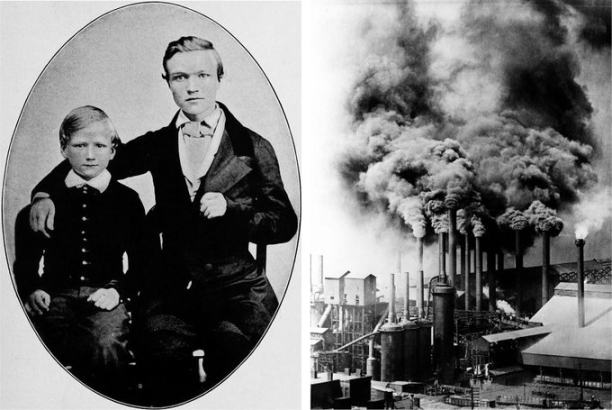
Left image: Young Andrew Carnegie and his brother. Right image: Steel mills in Pittsburgh during the Gilded Age.
In the 1850s, Andrew Carnegie was a telegraph operator running through the muddy streets of Pittsburgh, at a time when six out of ten Americans were farmers. Just two generations later, Carnegie and his peers forged the modern world, as horses gave way to railroads, candlelight to electric light, and iron to steel.
Since then, work has shifted from factories to offices. Today, I run a software company in San Francisco, creating tools for thousands of knowledge workers. In this tech town, everyone is talking about artificial general intelligence (AGI), but most of the two billion office workers have yet to feel its presence. What will knowledge work look like soon? What will happen when unceasing intelligence is integrated into organizational structures?
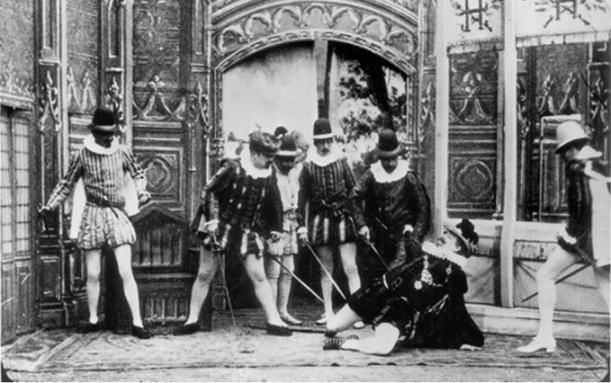
Early films often resembled stage plays, with a camera pointed at the stage.
The future is often hard to predict because it always disguises itself as the past. Early calls were as brief as telegrams, and early films were like recorded stage plays. As Marshall McLuhan said, "We always drive into the future using our rearview mirror."
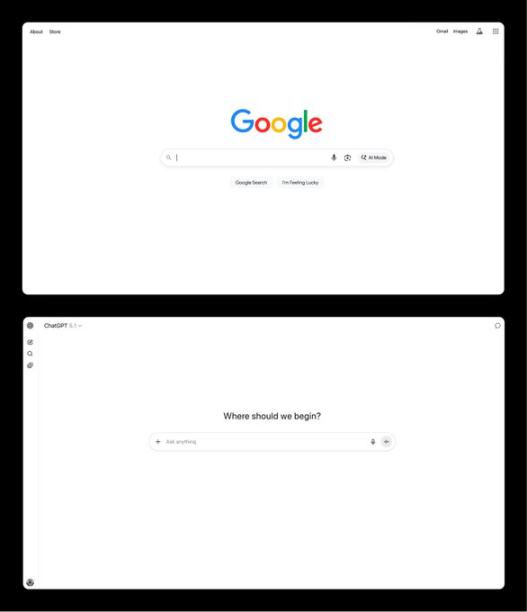
Today's most common artificial intelligence still resembles past Google searches. Quoting McLuhan: "We always drive into the future using our rearview mirror." Today, we see AI chatbots mimicking the Google search box. We are deeply entrenched in that uncomfortable transitional period that occurs with every technological revolution.
I don't have all the answers about what the future will hold. But I like to use a few historical metaphors to think about how artificial intelligence will function at different levels—personal, organizational, and even economic.
Personal: From Bicycle to Car
The initial signs can be seen in the "high-level practitioners" of knowledge work, the programmers.
My co-founder Simon was once a "tenx programmer," but he has rarely written code himself lately. Walking past his workstation, you would see him simultaneously scheduling three or four AI programming assistants. These assistants not only type faster but also think, making him an engineer with a 30 to 40 times increase in efficiency. He often queues up tasks before lunch or bedtime, allowing the AI to continue working while he is away. He has transformed into a manager of infinite intelligence.
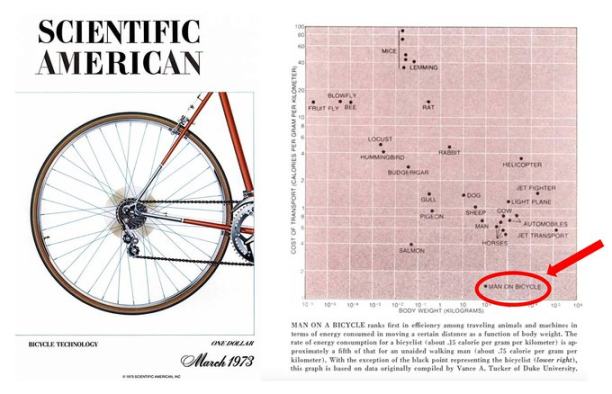
A study on exercise efficiency published in Scientific American in the 1970s inspired Steve Jobs to propose the famous metaphor of the "bicycle for the mind." For decades since then, we have been "pedaling a bicycle" on the information highway.
In the 1980s, Steve Jobs referred to personal computers as "bicycles for the mind." A decade later, we paved the "information highway" known as the internet. Yet today, most knowledge work still relies on human effort. It's as if we have been riding bicycles on the highway all along.
With AI assistants, people like Simon have upgraded from riding bicycles to driving cars.
When will other types of knowledge workers be able to "drive cars"? Two questions must be addressed.
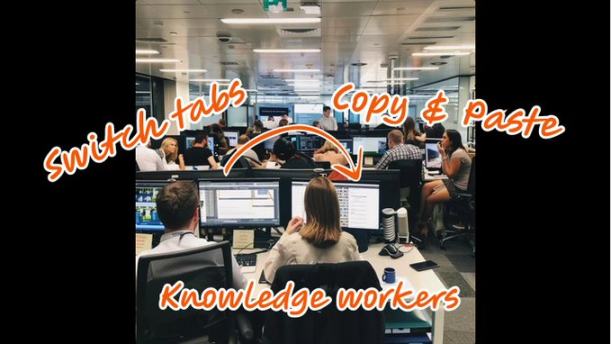
Why is AI-assisted knowledge work more challenging compared to programming assistants? Because knowledge work is more fragmented and harder to verify.
The first issue is contextual fragmentation. In programming, tools and contexts are often centralized: integrated development environments, code repositories, terminals. But general knowledge work is scattered across dozens of tools. Imagine an AI assistant trying to draft a product brief: it needs to extract information from Slack discussion threads, strategic documents, last quarter's data in dashboards, and organizational memory that exists only in someone's mind. Currently, humans act as the glue, piecing everything together through copy-pasting and switching between browser tabs. As long as the context remains unintegrated, AI assistants can only be limited to narrow uses.
The second missing element is verifiability. Code has a magical property: you can verify it through testing and error reporting. Model developers leverage this to train AI to program better through reinforcement learning and other methods. But how do you verify whether a project is well-managed or if a strategic memo is excellent? We have yet to find ways to improve the general knowledge work model. Therefore, humans still need to stay in the loop to supervise, guide, and demonstrate what is "good."
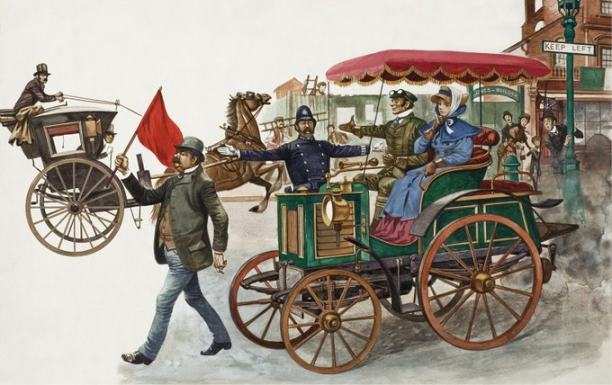
The 1865 Red Flag Act required that when automobiles were driven on the street, a flag bearer must walk in front of the vehicle (the act was repealed in 1896).
This year's programming assistant practices tell us that "humans in the loop" are not always ideal. It's like having people inspect bolts one by one on a production line or walking in front of cars to clear the way (see the 1865 Red Flag Act). We should have humans supervising the loop from a higher vantage point rather than being part of it. Once the context is integrated and work becomes verifiable, billions of workers will transition from "pedaling bicycles" to "driving cars," and then from "driving" to "autonomous driving."
Organization: Steel and Steam
Companies are a modern invention, and as they scale, their efficiency diminishes, eventually reaching a limit.
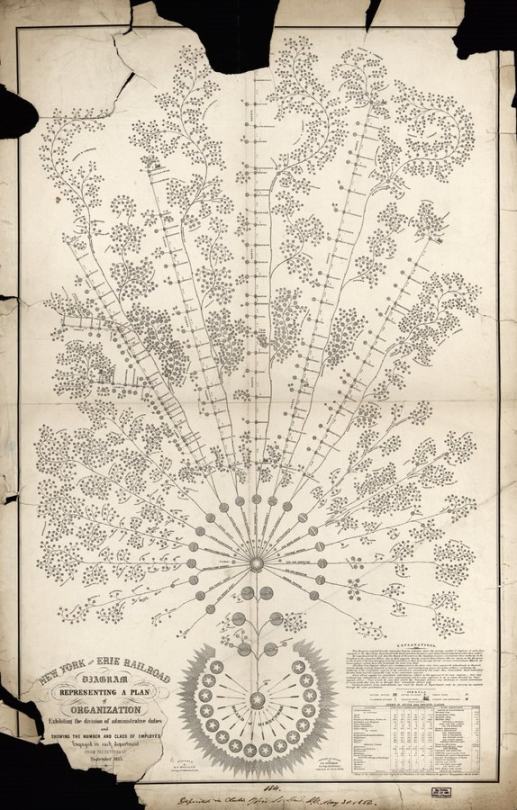
The organizational chart of the New York and Erie Railroad Company in 1855. Modern companies and their organizational structures evolved from railroad companies, which were among the first enterprises requiring long-distance coordination of thousands of people.
Hundreds of years ago, most companies were just workshops of a dozen people. Today, we have multinational corporations with hundreds of thousands of employees. The communication infrastructure, relying on meetings and the human brain connected by information, is overwhelmed under the exponentially increasing load. We try to solve this with hierarchies, processes, and documentation, but it is akin to building skyscrapers with wood—using tools designed for human scale to solve problems of industrial scale.
Two historical metaphors illustrate how organizations might look different when they possess new technological materials.

The marvel of steel: the Woolworth Building in New York, completed in 1913, was once the tallest building in the world.
The first is steel. Before steel, the height of buildings in the 19th century was limited to six or seven stories. Iron, while strong, is brittle and heavy; adding floors would cause the structure to collapse under its own weight. Steel changed everything. It is strong and flexible, allowing for lighter frames and thinner walls, enabling buildings to rise to dozens of stories, making new types of architecture possible.
AI is the "steel" of organizations. It promises to maintain contextual coherence across workflows, presenting decisions when needed without noise interference. Human communication no longer needs to act as load-bearing walls. Weekly two-hour alignment meetings could become five-minute asynchronous reviews; executive decisions requiring three layers of approval might be completed in minutes. Companies can truly scale without the efficiency decline we once viewed as inevitable.
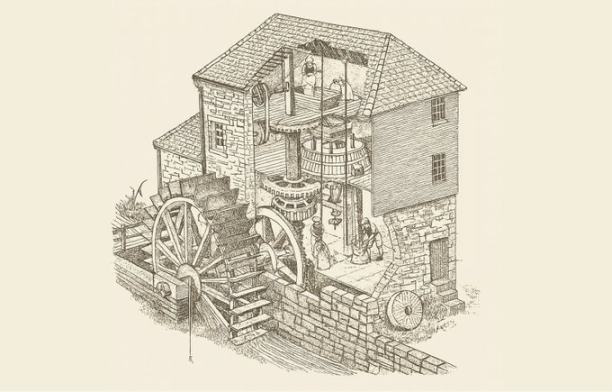
Water-powered mills. Hydropower is strong but unstable and limited by location and season.
The second story is about the steam engine. In the early stages of the Industrial Revolution, early textile factories were built along rivers, powered by waterwheels. When the steam engine appeared, factory owners initially just replaced waterwheels with steam engines, keeping everything else the same, resulting in limited productivity gains.
The real breakthrough occurred when factory owners realized they could completely free themselves from the constraints of water sources. They built larger factories near workers, ports, and raw materials, and redesigned layouts around steam engines (later, with the advent of electricity, factory owners further freed themselves from central power shafts, distributing small engines throughout factories to power different machines). Productivity exploded, leading to the true rise of the Second Industrial Revolution.
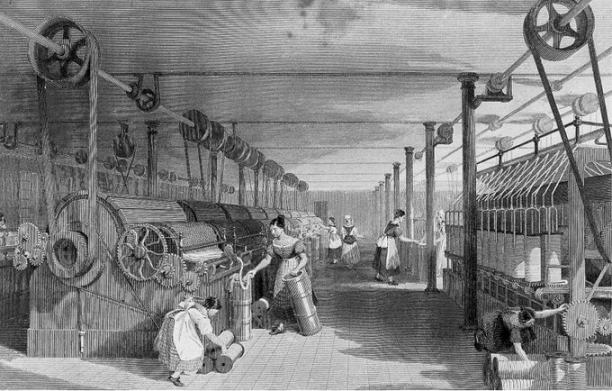
An 1835 engraving by Thomas Allom depicting a steam-powered textile factory in Lancashire, England.
We are still in the "waterwheel replacement" stage. By forcibly stuffing AI chatbots into workflows designed for humans, we have yet to reimagine what organizations will look like when old constraints disappear and companies can operate relying on infinite intelligence that continues to work while you sleep.
At my company Notion, we have been experimenting. In addition to 1,000 employees, there are now over 700 AI assistants handling repetitive tasks: recording meetings, answering questions to consolidate team knowledge, processing IT requests, documenting customer feedback, helping new employees familiarize themselves with benefits, writing weekly status reports to avoid manual copy-pasting… This is just the beginning. The true potential is only limited by our imagination and inertia.
Economy: From Florence to Megacities
Steel and steam have changed not only buildings and factories but also cities.

Until a few hundred years ago, cities were still human-scale. You could walk across Florence in forty minutes, and the rhythm of life was determined by walking distances and the range of sound propagation.
Then, steel frameworks made skyscrapers possible; steam-powered railroads connected city centers with hinterlands; elevators, subways, and highways followed. The scale and density of cities expanded dramatically—Tokyo, Chongqing, Dallas.
These are not just enlarged versions of Florence; they represent an entirely new way of life. Megacities can be disorienting, anonymous, and difficult to navigate. This "difficulty in recognition" is the cost of scale. However, they also offer more opportunities, more freedom, and support more people engaging in a wider variety of activities in more diverse combinations—something that the Renaissance cities of human scale could not achieve.
I believe the knowledge economy is about to undergo the same transformation.
Today, knowledge work accounts for nearly half of the U.S. GDP, but its operations largely remain at a human scale: teams of dozens, workflows dependent on the rhythm of meetings and emails, organizations that struggle to sustain themselves once they exceed a hundred people… We have been building "Florence" with stone and wood.
When AI assistants are deployed on a large scale, we will construct "Tokyo," an organization composed of thousands of AIs working alongside humans; workflows that operate continuously across time zones without waiting for someone to wake up; decisions synthesized with just the right amount of human involvement.
That will be a different experience: faster, with greater leverage, but initially more disorienting. The rhythm of weekly meetings, quarterly planning, and annual evaluations may no longer apply, and new rhythms will emerge. We will lose some clarity, but we will gain scale and speed.
Beyond the Waterwheel
Every technological material demands that people stop viewing the world through the rearview mirror and begin to imagine a new world. Carnegie gazed at steel and saw the city skyline; the mill owners of Lancashire looked at the steam engine and envisioned factories away from rivers.
We are still in the "waterwheel stage" of AI, forcibly integrating chatbots into workflows designed for humans. We should not be satisfied with merely having AI act as a co-pilot; we need to imagine what knowledge work will look like when human organizations are reinforced by steel and when mundane tasks are entrusted to unceasing intelligence.
Steel, steam, and infinite intelligence. The next skyline is just ahead, waiting for us to build it ourselves.
免责声明:本文章仅代表作者个人观点,不代表本平台的立场和观点。本文章仅供信息分享,不构成对任何人的任何投资建议。用户与作者之间的任何争议,与本平台无关。如网页中刊载的文章或图片涉及侵权,请提供相关的权利证明和身份证明发送邮件到support@aicoin.com,本平台相关工作人员将会进行核查。


