You'd better honestly ask yourself: which camp are you in? Do you like cryptocurrency?
Written by: Evanss6
Translated by: AididiaoJP, Foresight News
At any time in the past, it might have been good advice when talking about cryptocurrency: hoard Bitcoin, or mainstream coins are fine, do some staking, try out new products with rewards, play contracts without getting liquidated, and you would likely have made some money. Behind this are two core beliefs: Bitcoin will become a more mainstream non-sovereign store of value; smart contracts will become the infrastructure of finance.
I won't elaborate on how these judgments have been validated, as we need to talk about this "cage." Just two facts:
Bitcoin ETFs have seen inflows of $49 billion, Ethereum ETFs have seen inflows of $4.3 billion, and more altcoin ETFs are just getting started. Michael Saylor himself has bought over $40 billion, and many companies are gradually buying in.
Robinhood just announced plans to build an EVM chain using Arbitrum's tech stack as the backend financial infrastructure for its platform, and it will also launch the most popular cryptocurrency product: perpetual contracts.
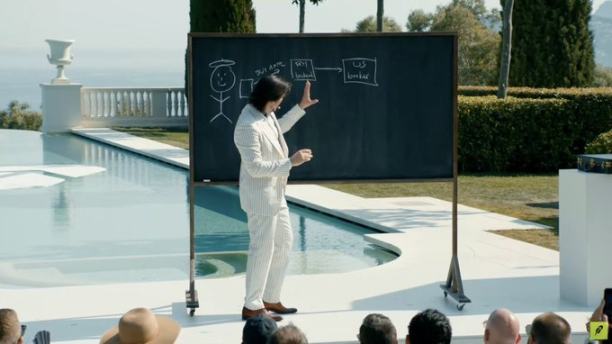
Cryptocurrency is increasingly resembling traditional finance. It is being purchased by the previous generation in brokerage accounts, marketed by Larry Fink, and utilized by companies like Robinhood using technology. What many of us imagined a decade ago is coming true.
So what exactly is the "sunk cost cage"?
In simple terms, it is the persistence in something due to past investments. This can appear in many areas: your skills, investments you still hold, your relationships, a job you are afraid to quit, or spending all your time on cryptocurrency.
"I don't want to leave her because our past is too deep."
"I don't want to change careers because I've spent too much time on this."
"I don't want to sell Ethereum because I bought it early, and it has treated me well."
These are all examples of the sunk cost fallacy. Not realizing you are thinking this way is a form of self-sabotage, causing you to continue doing something you know in your heart is no longer beneficial.
The sunk cost cage is a modern version of Plato's allegory of the cave.
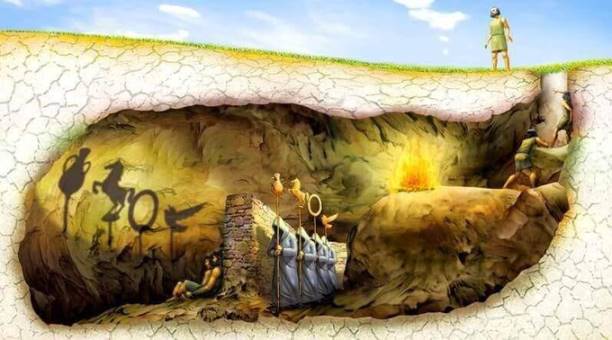
The prisoners only know the shadows on the wall, unaware of how the shadows come to be, and they do not know there is a larger world outside.
In Plato's allegory, the prisoners remain in the cave because they mistakenly take the shadows for reality, unaware that there is a "more real" world outside. In the modern version, we stay not out of ignorance, but because we have invested too much in the shadows. That unsuitable job, the career you no longer believe in, the identity built on long hours of work and silent endurance—these are all costs incurred. The more time, education, and reputation invested, the harder it is to leave. The illusion is no longer just external; it has been internalized into responsibilities, logic, and "reasonable things."
But freedom is not cheap. Escaping the sunk cost cage means acknowledging that what you have built may no longer be beneficial to you. Past efforts cannot be a reason to stay. Just like the prisoners turning to face the light, this requires not only courage but also a betrayal of the self that has been overly loyal to self-investment. The hardest part is not seeing the truth, but saying goodbye to the self that has lingered too long, believed too firmly, and paid the price for the cage.
My Experience
I myself have been in the cage for a long time.
As a teenager, I fell in love with poker. In the back row of high school classes, I was always calculating expected funds in my notebook, not paying attention to the lessons or taking notes. Within two years, I went from $0.01/$0.02 small stakes to high-stakes tables. Over time, I grew to dislike playing more and more, seeing it only as a means to make money, always thinking, "I'll quit in two or three years."
But ten years passed, and nothing changed. I was still playing, still winning, yet always felt I didn't have enough money to "do something else." Worse, I didn't even know what else I could do, and I could see clearly: poker is a declining game, and I had to work harder and harder to keep up. But I told myself I should continue because I had spent too much time getting better, it offered more returns than other options, I had no other viable paths, and I didn't have time to think. Just maintaining stability as a winner in high-stakes online games was exhausting: researching strategies, finding suitable games, preventing cheating, and avoiding scam sites…
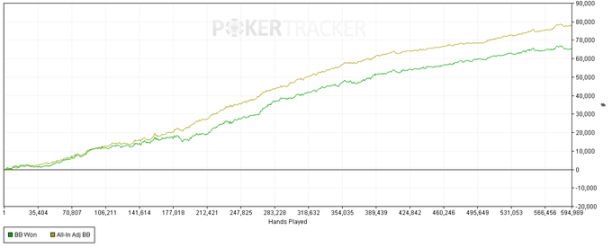
To be honest, this "I can't easily change careers because I can make money" is a luxurious problem. But as I found it increasingly difficult to find a better industry, I knew my time was running out.
First Encounter with Cryptocurrency
I was exposed to cryptocurrency early on due to my previous profession. In 2012, I first read about Bitcoin on a poker forum called TwoPlusTwo. At that time, the Bitcoin subforum had already been open for over a year.
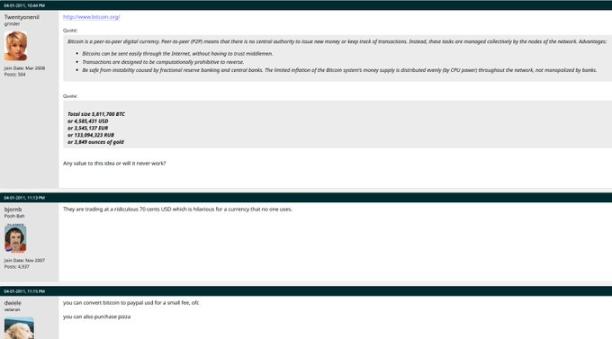
The first reply was quite funny: "This thing is worth 70 cents now, a currency that no one uses can actually reach this price, hilarious." The second reply mentioned that it could actually be exchanged for dollars or used to buy pizza, which was the early use case for what would later become a $2 trillion asset. A few replies down:
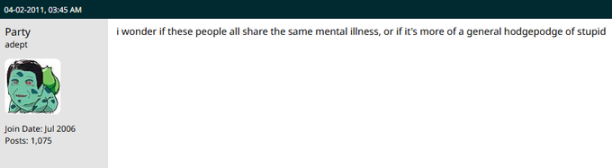
"I really missed an era." In short, I noticed it because some poker sites started using it. At that time, I thought its market cap of $2 billion was ridiculous. If it could only be used in black markets, it might be worth that price; if it could mainstream, its value would multiply countless times.
By 2016-17, as my investments became substantial, I spent more and more time on cryptocurrency (especially ICOs). This diversion of time was the first step in my escape from the cage. But it wasn't until the rise of DeFi in 2020, when it could really make money, that I truly jumped in.
At that time, I didn't understand trading at all and could only learn as I went. I studied economic mathematics in college, but what I really knew was poker. Fortunately, poker is an excellent training ground for learning trading: it provides you with ruthless real-time feedback on your decisions, forces you to manage risk, price correctly, develop overall strategies, and builds emotional resilience and soft skills to endure tough times—all of which are necessary for independent trading.
In the end, I am very grateful and lucky to have spent a lot of time exploring these curiosities from 2013 to 2019, which put me in the best position when opportunities arose. If I had focused more on poker during those years, I might have played better, but I was really lucky to have followed my intuition in formulating a transition/exit plan.
How Does This "Cage" Apply Today?
In recent years, financial nihilism in the cryptocurrency space has become increasingly evident. More and more people no longer believe in the beautiful ideals they had when they first entered the market. The goal has become "to make money," fully investing and working hard, and once enough is earned, "to exit."
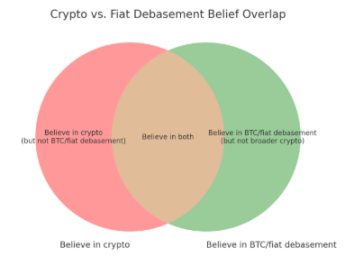
There are roughly four camps:
Green Camp (believes in Bitcoin, does not believe in other cryptocurrencies)
Red Camp (believes in cryptocurrency, does not believe in Bitcoin)
Brown Camp (believes in both)
White Camp (does not believe in either)
Each camp can be further divided into two situations, making eight in total:
(a) Believes there is still room for growth and it is worth the risk
(b) Believes the growth potential has already been taken by early buyers
I believe that only those in 2(a) should invest all their time in cryptocurrency. If you are in 1(b), 2(b), 3(b), or 4(b), you better start dividing your time and making an exit plan. If you are in 1(a) or 4(a), just hold onto Bitcoin and don't worry too much about the rest. Those in 3(a) can hold some Bitcoin and other assets, dividing their time and energy between cryptocurrency and non-cryptocurrency. If you have seen my account and posts, you can probably tell that for most of the time from 2015 to 2023, I was in 2(a), and now I am somewhat oscillating between 1(a), 3(a), and 3(b).
Let's talk about the Red Camp. It has been quite painful to be here in recent years.
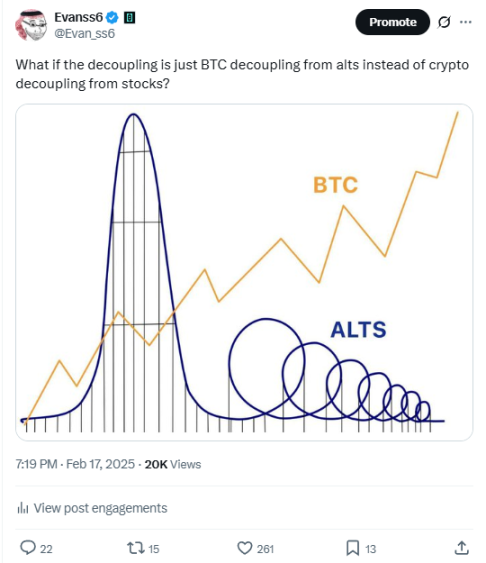
We are basically in a situation where Bitcoin's dominance continues to rise, even though the overall cryptocurrency system has become more widespread. Even if you accurately predicted that Ethereum ETFs would see over $4 billion in net inflows, predicted that giants like Robinhood would use its technology, predicted that Trump would win, reform the SEC, end OCP2.0, and create an environment supportive of cryptocurrency, your Ethereum investment would still have dropped since the day the ETF launched. And today, Ethereum is around $2600, with investors from 2015 seeing returns of 2000 to 8600 times.
So the answer
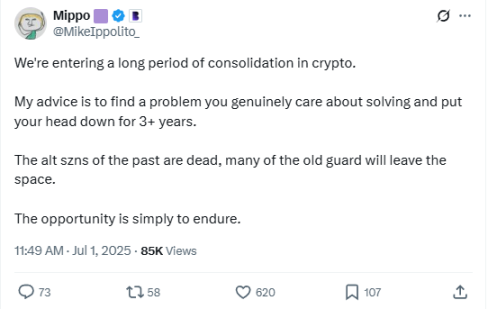
I wonder if the "patience" mentioned by Mippo in the tweet at the beginning of this article is really the right path, the biggest opportunity. Everything you dream of has either already happened or is on its way. In 2017, if Robinhood announced it was developing on Ethereum, the coin price would have immediately risen by 10%, but now it has changed. The current operation is to buy HOOD stock. I believe there are still opportunities in cryptocurrency, but the trend of opportunities being taken by non-cryptocurrency assets (stocks) or insiders (teams/private investors, look at Celestia Finance) is not very friendly to dreamers. If you really want to "be patient," you need to invest in these projects early or take action yourself. So Mippo is not wrong; solving real problems in cryptocurrency is still an opportunity. But don't think that just because cryptocurrency technology has become widespread, the current coin prices will necessarily rise (especially compared to other assets you can invest in).
Unless you are a true Red Camp diehard in 2(a), otherwise "patience" is just choosing to stay in the cave watching the shadows on the wall, while those outside are already working on AI and robotics.
You'd better honestly ask yourself: which camp are you in? Do you like cryptocurrency? In any case, try to cultivate some skills that can be useful elsewhere, just in case it doesn't work out, you have a backup plan. At the very least, you won't be unhappy for investing all your time in something you are already tired of. And if you are wrong, you will also have a soft landing place.
The door of the sunk cost cage is not locked; what traps you are just your own thoughts. All you need to do is occasionally open the door and walk out. Life is beautiful, and the world is full of possibilities.
免责声明:本文章仅代表作者个人观点,不代表本平台的立场和观点。本文章仅供信息分享,不构成对任何人的任何投资建议。用户与作者之间的任何争议,与本平台无关。如网页中刊载的文章或图片涉及侵权,请提供相关的权利证明和身份证明发送邮件到support@aicoin.com,本平台相关工作人员将会进行核查。
