The industry has its hot spots, but the construction of Bitcoin does not have a cycle.
Author: Cathy
A couple of days ago, the Bitcoin ecosystem research and consulting team 1A1z published an in-depth report on Bitcoin Core builders.
At first glance, the article seems to be just an ordinary developer interview survey, but it reveals a layer of reality in the crypto industry that is easily overlooked: there is a group of people who stay away from the traffic center, do not talk about narratives, do not engage in marketing, and are dedicated to maintaining the most fundamental and critical infrastructure of this industry over the long term.
In the list of sponsors supporting Bitcoin Core, the name of OKX is not prominently displayed. It is precisely because of this low profile that many people realize for the first time: there are still large platforms in this industry investing resources in "public research and development," which may not yield short-term returns but will determine the direction of the industry in the long run.
After the article was published, OKX Star retweeted and quoted a statement from within the team: "From the very beginning, we have insisted on contributing our modest efforts to the underlying development of Bitcoin. For more than a decade, we have never hyped or promoted because we firmly believe in the future of blockchain."
Similar expressions are not uncommon in the industry. However, when this statement is placed in the context of Bitcoin Core, its meaning changes—it is not a marketing slogan, but a value choice: whether one is willing to invest time, resources, and patience in places that no one pays attention to.
01 Paying Salaries to the People Behind Bitcoin's "Operating System"
To understand the significance of this, we must first return to a core question: what exactly is Bitcoin Core?
In simple terms, Bitcoin Core is the "operating system" of Bitcoin. It is the software that runs full nodes, the rule enforcer of the entire network, the transaction validator, and the foundation that maintains Bitcoin's security, network consistency, and resistance to censorship.
The BTC price, block height, transaction confirmations, and network stability that we are familiar with—all the metrics mentioned daily by countless people—depend entirely on the correct operation of the Bitcoin Core code.
More importantly, Bitcoin Core has never been a commercial project since its inception. It has no CEO, no KPIs, no profit model, and no "investment return cycle." It relies on contributions from global volunteers and long-term support from external sponsors.
Some developers focus on network performance optimization, some research validation rules and security, some are dedicated to privacy improvements and user experience optimization, and some do work that ordinary users will never see, but the entire ecosystem cannot do without.
Because Bitcoin Core has no profit model and no corporate backing, it requires external funding support. The 1A1z report shows that the sponsors supporting Bitcoin Core include foundations, research institutions, infrastructure companies, and a few exchanges. These funds are primarily used for node performance optimization, security research, network synchronization, privacy enhancement, code review, and other areas.
It can be said that without this continuous support, Bitcoin Core would find it difficult to maintain stable development over the past decade.
The report identified 13 main sponsoring organizations: Blockstream, Chaincode Labs, MIT, Spiral (formerly Square Crypto), OKX, the Human Rights Foundation, Brink, Btrust, OpenSats, Vinteum, Maelstrom, B4OS, and 2140.
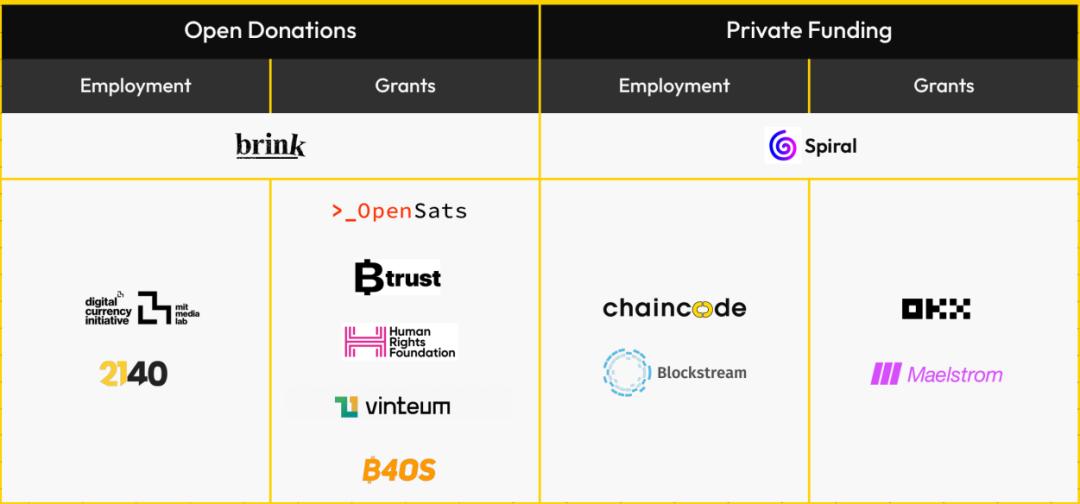
Image: Main sponsoring organizations of Bitcoin Core, source: 1A1z
The criteria for entering this core list are clear: long-term, stable, and low-profile.
This is also why, although exchanges like Coinbase, Kraken, and Gemini have historically had developer funding programs, they are not included as core sponsors—the report points out that these projects are either inactive, infrequent, or no longer focused on Bitcoin development. In contrast, OKX's funding program, which started in 2019, has continued to this day, making it the only exchange among the 13 core sponsors.
Take Marco Falke as an example; he is one of only six core maintainers with the authority to approve or reject changes to Bitcoin's underlying code (he resigned in February 2023). His job is to rigorously review every proposal in the codebase to prevent malicious or flawed code from entering the Bitcoin protocol. This is a job that is crucial to the global crypto economy, but it is unpaid.
Since 2019, OKX (and its predecessor Okcoin) has continuously provided funding to Falke to ensure he can dedicate himself full-time to this work, which is vital for network security. In addition to Falke, OKX has also funded Bitcoin Core developer Amiti Uttarwar, Lightning Network developer Antoine Riard, and non-profit organizations like Brink and Vinteum.
As of now, OKX's funding for these projects has approached $2 million. In fact, even before 2019, Okcoin had already established a funding program for open-source developers.
It is worth noting that this investment has been almost entirely unpublicized for a long time. It was only recently, with the release of the 1A1z report, that many people realized that so many organizations and companies are quietly supporting the foundational construction of Bitcoin.
In this industry, most companies chase hot topics and create narratives. In contrast, these sponsors choose to pay for things that "must be done by someone, but no one is obligated to do."
02 More Than Just the Foundation, There's the "Last Mile"
Support for the underlying protocol is just one aspect. More easily overlooked are those infrastructures that may not seem so "grand," but determine whether users can truly utilize the technology.
User-Side Barriers
Take OKX Wallet as an example; it has become the starting point for many people entering Web3. Supporting hundreds of chains, various account models, self-custody and MPC technology, rapid ecosystem integration, compliance chain support, etc.—these may sound like "product details," but they essentially belong to "user-side infrastructure."
For an industry to move towards large-scale application, these details ultimately determine whether the last mile can be successfully traversed.
Ordinary users do not care what consensus algorithm you use or how advanced your Layer 2 technology is; they care about: can it be used easily? Will they lose coins? Are the transaction fees high?
The design of CeDeFi is aimed at solving these problems—combining the advantages of centralized exchanges and decentralized exchanges. Users can access over 100 decentralized liquidity pools without leaving the platform, and the system automatically finds the best prices. More importantly, there is no need to remember seed phrases (using Passkey authentication) and no need for cross-chain bridges (routing directly within the platform), addressing the two most troublesome issues for DeFi users: losing coins and being hacked.
These features may not seem attractive, but they are more important for large-scale adoption than the technology itself.
Long-Termism in Developer Ecosystems
In addition to the user side, OKX has also been continuously promoting the development of the developer ecosystem, test networks, cross-chain infrastructure, hackathons, research collaborations, and auditing systems over the years.
These investments may be far from the hot topics, but they are crucial for the healthy development of the industry.
Hackathons do not directly bring users, test networks do not generate transaction volumes, and auditing systems do not create buzz. But without these, the developer ecosystem cannot thrive, security incidents will occur frequently, and the entire industry's trust foundation will be eroded.
To some extent, the driving force behind the crypto industry is not just the trading volumes on the leaderboard and the new narratives that rotate weekly, but those who write code, run nodes, test protocols, and fund infrastructure.
03 The Value of Long-Termism
The phrase "ten years of hard work" sounds like a marketing slogan in the crypto industry. But looking at the numbers, some things are indeed happening.
Consider the state of the industry in 2025:
The number of tokens has skyrocketed from hundreds of thousands in 2021 to tens of millions in 2025 (over 50 million).
The token issuance cycle has been compressed from two years to 3-6 months.
A project spends less than 20% of its total costs on technology, with the remaining funds spent on listing fees, market makers, KOLs, and media promotion (ICODA DeFi marketing budget guide).
In such an environment, choosing to invest resources in "invisible returns" areas like underlying protocols, developer ecosystems, and user infrastructure is challenging: there are no short-term returns, but they determine survival in the long run.
This continuous investment will ultimately translate into competitiveness:
Technical efficiency will bring cost advantages. When your system's processing speed is fast enough and costs are low enough, there is naturally room to offer users better prices. This is not a price war; it is a technological dividend.
User experience determines large-scale adoption. Not having to remember seed phrases, not worrying about cross-chain hacks, and having the system automatically find the best prices—these features address real pain points. When the details are well done, users are willing to stay.
Infrastructure construction determines future capacity. When the RWA market truly reaches a scale of $600 billion by 2030 (as predicted by Boston Consulting Group), the infrastructure capable of supporting the flow of these assets will become the most scarce resource. At that time, those who have laid out in advance will have the greatest first-mover advantage.
This is the value of long-termism: laying the foundation while others chase hot topics, and having built the skyscraper by the time others wake up.
04 Conclusion
The industry has its hot spots, but the construction of Bitcoin does not have a cycle.
Market noise can rise and fall, but foundational infrastructure needs to be built and maintained over ten or twenty years. This may be the most difficult yet most important thing in the industry.
In this sense, participants like OKX are worth paying attention to, not because of publicity, but because they choose to do things that "must be done by someone" but "no one is obligated to do."
Builders do not necessarily need applause, but they deserve to be seen.
And where the crypto industry ultimately goes will largely depend on these invisible choices.
免责声明:本文章仅代表作者个人观点,不代表本平台的立场和观点。本文章仅供信息分享,不构成对任何人的任何投资建议。用户与作者之间的任何争议,与本平台无关。如网页中刊载的文章或图片涉及侵权,请提供相关的权利证明和身份证明发送邮件到support@aicoin.com,本平台相关工作人员将会进行核查。


