The Federal Reserve has lowered interest rates by 25 basis points as expected, and the market generally anticipates that the Fed will maintain an accommodative policy next year. Meanwhile, central banks in Europe, Canada, Japan, Australia, and New Zealand are generally maintaining a tightening stance. Analysts from Goldman Sachs and others believe that this policy divergence is expected to manifest significant impacts through the exchange rate market around 2026, with the pressure of dollar depreciation becoming a market focus. A weaker dollar may drive currencies like the euro to appreciate passively, thereby suppressing inflation levels in related regions, ultimately forcing the European Central Bank and others to "be compelled to cut rates."
Written by: Li Jia
Source: Wall Street Insights
The divergence in global central bank policies is accelerating. While the Federal Reserve continues its path of rate cuts, central banks in Europe, Canada, Japan, Australia, and New Zealand are generally maintaining a tightening stance, even entering a rate hike phase. The divergence in monetary policy is expected to have a significant impact through the exchange rate channel by 2026, with the depreciation pressure on the dollar becoming a market focus and potentially a key external variable influencing the ECB's policy direction.
On Wednesday local time, the Federal Reserve lowered rates by 25 basis points as expected. Goldman Sachs analyst Rich Privorotsky's latest research report points out that although the market has developed hawkish expectations due to Powell's cautious remarks on neutral interest rates and the presence of several dissenting votes at the meeting, this decision actually conveys a dovish tone.
In stark contrast, ECB officials have clearly stated that they will not closely monitor the Fed's rate cuts. The Governor of the Bank of France, François Villeroy de Galhau, recently stated, "It is a misunderstanding to think that the ECB will follow the Fed step by step," and pointed out that "the monetary policy stance in Europe is already more accommodative than that of the United States."
The core impact of policy divergence is expected to manifest through the exchange rate channel. Goldman Sachs emphasizes that if the Fed continues to cut rates while other major central banks maintain a tightening stance, market attention will focus on the potential for sustained depreciation pressure on the dollar.
Market Consensus on Fed Rate Cuts Next Year
Major Wall Street investment banks maintain their expectations for further Fed rate cuts following the decision. Morgan Stanley and Citigroup predict another rate cut in January next year, judging that the easing cycle has not yet ended. Goldman Sachs and Barclays analyze that the hawkish wording in the policy statement aims to "balance" this rate cut and avoid sending overly accommodative signals.
Citigroup, Morgan Stanley, and JPMorgan all point to January next year as the timing for the first rate cut, with Citigroup expecting another cut in March, Morgan Stanley predicting a second cut in April, and JPMorgan believing that policy will enter an observation period thereafter.
Goldman Sachs, Wells Fargo, and Barclays expect the rate cut window to open in March, with a possible second cut in June.
Will Dollar Depreciation Force the ECB to Cut Rates?
Several ECB officials have been vocal around the time of the Fed's December meeting, emphasizing their monetary policy independence. The Governor of the Bank of France, François Villeroy de Galhau, stated last Friday that the ECB should keep the option to cut rates but "should not abandon its own policy pace due to the actions of the Fed."
Isabel Schnabel, a member of the ECB's Executive Board, further pointed out in an interview: "Changes in the U.S. monetary policy stance will not have a direct impact on the ECB. We independently formulate policies based on data and analysis from the Eurozone." She even suggested that there is a possibility of a rate hike in the ECB's next steps.
The divergence in monetary policy between Europe and the U.S. is not a new phenomenon. In mid-2024, the ECB began its rate cut cycle ahead of the Fed, which maintained rates unchanged at that time. Villeroy noted, "Despite the differences in policy pace, the foreign exchange market has absorbed this situation without significant volatility, and similar situations have occurred multiple times over the past decade."
The likelihood of the ECB following the Fed's rate cuts in the short term is low. Currently, the Fed has lowered its rate range to 3.5%-3.75%, while the ECB's key rate is 2% after cutting rates in June, indicating structural differences in policy space and inflation conditions between the two.
Although the ECB repeatedly emphasizes its monetary policy independence, the actual transmission effects of exchange rate fluctuations may effectively dominate its policy direction. Since 2025, the euro has appreciated approximately 12% against the dollar, and this change is imposing substantial constraints on the ECB's decision-making through the inflation channel.
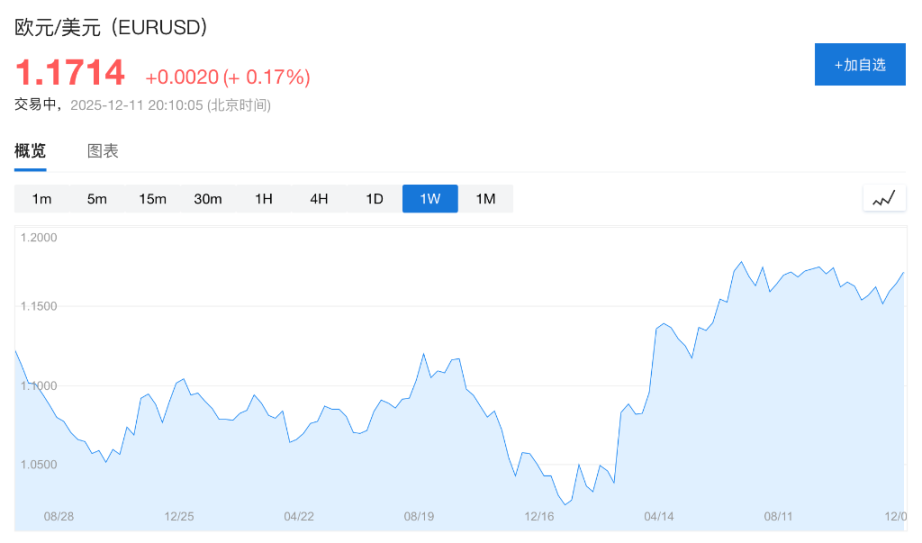
ECB Chief Economist Philip Lane recently pointed out that exchange rates have a significant transmission effect on inflation. According to the bank's internal model calculations, a 10% appreciation of the euro will suppress inflation over three years, with the most significant impact occurring in the first year, during which the rate of price increases will be 0.6 percentage points slower than in other scenarios.
This impact is primarily transmitted through dual channels: the prices of imported goods and services decrease directly due to the appreciation of the local currency; at the same time, a stronger euro weakens export competitiveness, indirectly suppressing economic growth and upward price pressures.
It is noteworthy that the ECB's latest forecast has lowered the inflation rate for 2026 to 1.7%, below its 2% policy target. If the Fed accelerates rate cuts, leading to further dollar weakness and pushing the euro to continue appreciating, the inflation recovery path for 2027 will also face pressure. Lane has indicated that while the central bank will not react to "small, temporary" deviations in inflation, it will adjust policy in response to "large, persistent" deviations.
Currently, the ECB's forecasts assume that the euro exchange rate will remain roughly at current levels in 2026-2027. However, if the pace or magnitude of Fed rate cuts exceeds expectations, leading to sustained dollar weakness and passive appreciation of the euro, it may create new policy pressures. This essentially forms a latent policy transmission chain: Fed rate cuts → dollar weakness → euro appreciation → further pressure on eurozone inflation → ECB may be forced to shift to rate cuts, indicating that even while maintaining verbal independence, the transmission mechanisms of exchange rates and inflation may still impose "de facto constraints" on ECB decision-making.
免责声明:本文章仅代表作者个人观点,不代表本平台的立场和观点。本文章仅供信息分享,不构成对任何人的任何投资建议。用户与作者之间的任何争议,与本平台无关。如网页中刊载的文章或图片涉及侵权,请提供相关的权利证明和身份证明发送邮件到support@aicoin.com,本平台相关工作人员将会进行核查。


