Author: zhou, ChainCatcher
Farcaster co-founder Dan Romero (dwr) recently announced that the platform will undergo a significant strategic shift, officially abandoning the "social-first" path it has adhered to for the past 4.5 years, and instead embracing a growth model driven by a "wallet core."
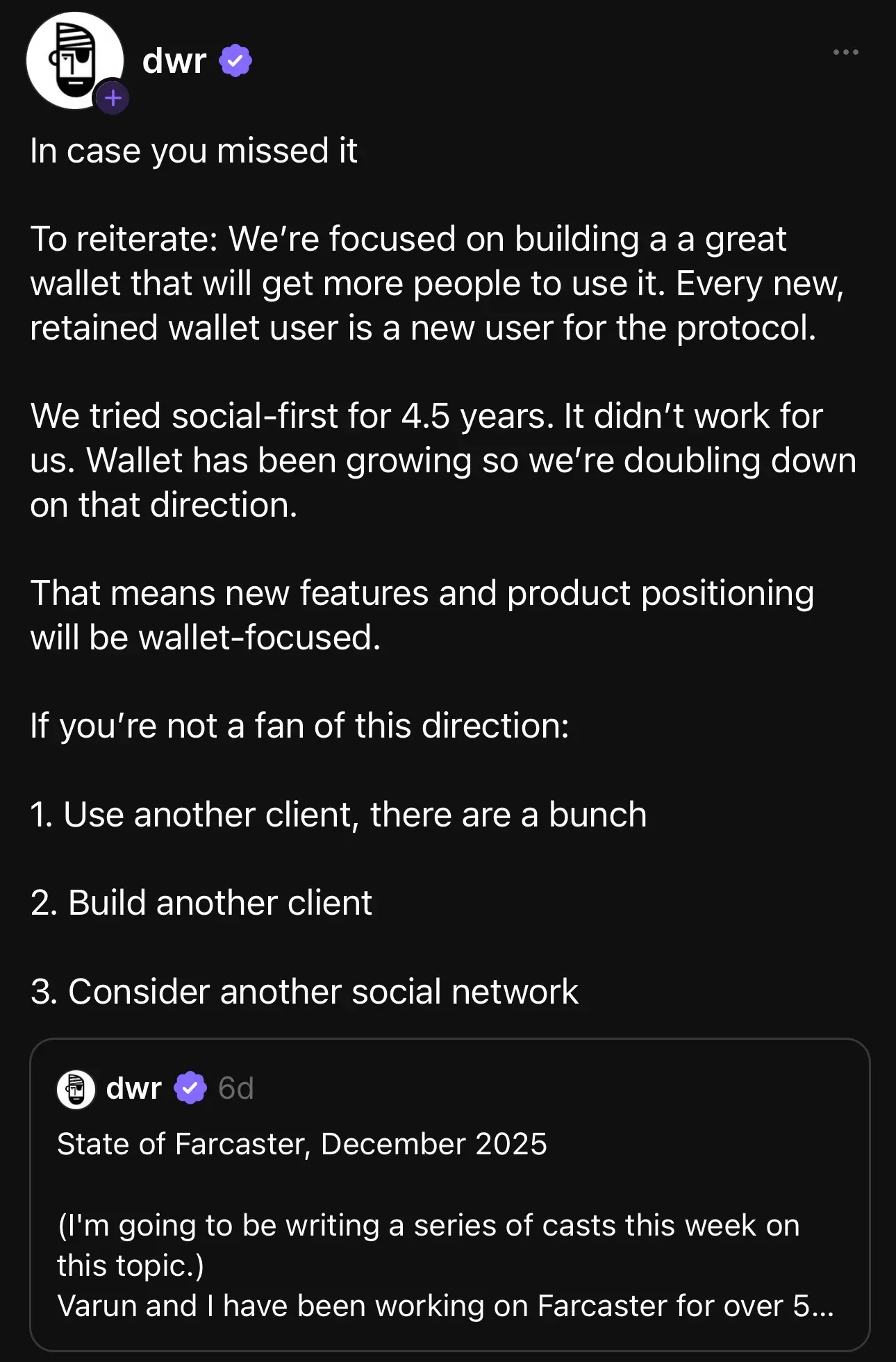
It is reported that Farcaster was initially positioned as a decentralized social network, allowing developers to build novel social networks. It is an open protocol that can support many clients, much like email. Users will always be able to freely move their social identities between applications, and developers will always be able to freely build applications with new features on the network.
Dan Romero stated that under the social-first strategy, the platform released a fully functional version of the protocol, which was sufficiently decentralized and allowed multiple independent teams to build and integrate on it. However, data shows that despite significant efforts, the social-first strategy ultimately proved unsustainable.
At the beginning of 2024, thanks to the stimulation of the Frames feature and the DEGEN airdrop, daily active users (DAU) surged from around 2,000 to 100,000, with registered users surpassing 350,000, and monthly growth exceeding 400% at one point.
However, this peak lasted for less than three months. Starting in September 2024, data showed a dramatic decline: DAU fell back to around 60,000, monthly active users decreased by 40%, and daily new user registrations plummeted from a peak of 15,000 to just a few hundred.
Entering 2025, the situation continued to deteriorate, with daily active users on the social side dropping nearly 40% again, until the launch of a 10% reward program for USDC deposits in October, which helped pull overall daily active users back to the range of 50,000 to 60,000 through wallet functionality.
At the same time, the protocol's revenue also plummeted: by October 2025, monthly revenue had dropped to about $10,000, the lowest level in four months, representing a decline of about 99% from its peak revenue.
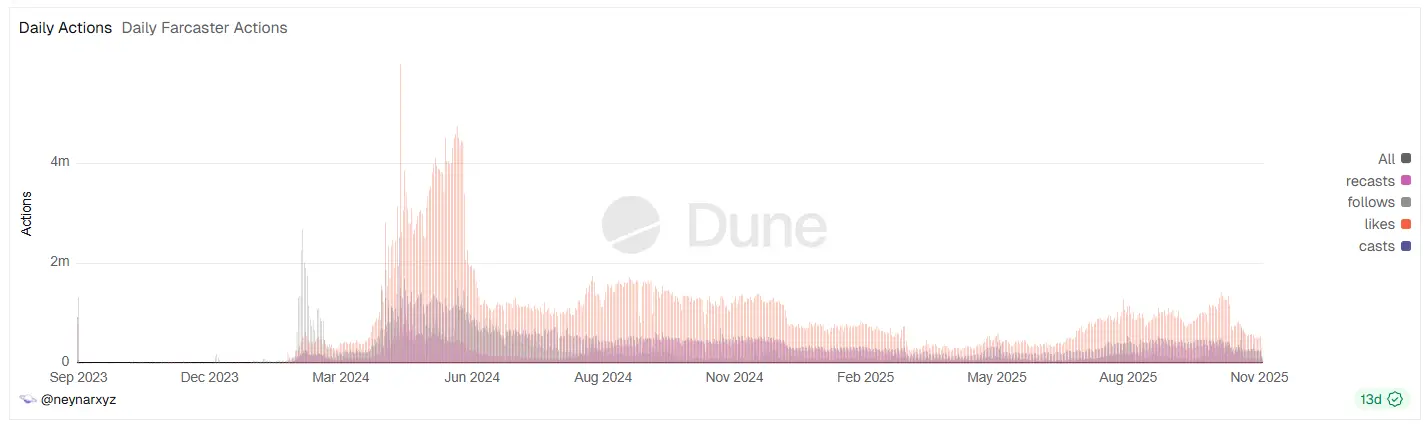
Faced with this harsh reality, Dan Romero admitted that it has always failed to find a sustainable growth mechanism for a Twitter-like social network.
Therefore, Farcaster's transformation decision takes a pragmatic approach, no longer pursuing a purely social narrative, but instead betting resources on the robust growth of wallet functionality: first use the tool (wallet), then solidify the network (protocol).
The team observed that the wallet feature launched in the app earlier this year expanded rapidly and is the module closest to product-market fit they have achieved in five years. The new user flow has been redesigned, with user registration - wallet recharge - wallet usage as activation points.
Dan Romero summarized that every new, retained wallet user is a new user of the protocol. As users have commented, SocialFi is a combination of social and finance, and the integration with wallets is the true beginning.
On the product level, the core goal of Farcaster's official app Warpcast has shifted to building an excellent wallet, focusing on expanding the intersectional capabilities of wallets and social features. DWR believes that adding a wallet to a social network is easier than adding a social network to a wallet. This integration is achieved through the Farcaster Mini App, a lightweight web application based on the Farcaster protocol that can be seamlessly integrated into clients like Warpcast.
At the same time, Farcaster is actively deploying financial infrastructure:
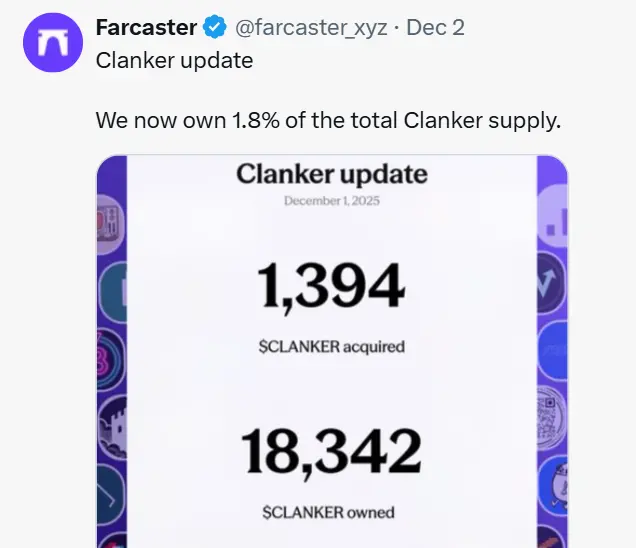
- Asset issuance: By acquiring the token issuance platform Clanker, Farcaster has equipped its wallet core strategy with asset issuance capabilities, currently holding 1.8% of Clanker's total supply.
- Financial incentives: In October, it launched a USDC deposit program offering a 10% additional reward, directly accelerating user conversion to on-chain asset holders through financial incentives.
On the content level, Frames (interactive mini-apps) are the display form of Mini Apps in the information stream and are a key hub for realizing the "content as transaction" mechanism. Users can complete financial actions such as minting, trading, and payments directly within the information stream, with each interaction directly driving the use of the built-in wallet. This model transforms Farcaster from an information consumption space to a value transfer space, accelerating the financialization process of the ecosystem.
Of course, this strategic transformation is built on Farcaster's strong resource foundation and elite team background. The platform has garnered favor from top institutions including Paradigm, a16z, and Union Square Ventures, raising $150 million in Series A funding in 2024, with a valuation of $1 billion. On the team side, co-founders Dan Romero (former VP of Operations at Coinbase) and Varun Srinivasan, along with developer ecosystem lead Linda Xie (an early employee at Coinbase), all have deep backgrounds at Coinbase, and Coinbase Ventures also participated in Farcaster's early seed round financing.
However, this transformation is also accompanied by industry skepticism regarding "maximizing decentralization." Notable crypto researcher CM believes that Farcaster's shift to a wallet route and abandonment of the social-first strategy means that the final dream of SocialFi has also ended, and the entire Crypto field seems to have returned to the ICO era of 2017, where everything revolves around transactions and issuance.
Other comments point out that Farcaster's early products had issues with low usability and slow login on Android systems, criticizing its pragmatic decisions that did not please maximalists of decentralization in terms of decentralization and user experience.
Dan Romero's post clearly states that this does not mean the protocol has become a casino. The Farcaster protocol remains an open system, and developers can freely choose to use the parts they find most useful. The official app (Warpcast) simply chooses to focus on the "intersection of wallets and social," while other clients like Uno, Recaster, and Cura are taking different approaches.
In other words, if users do not agree with this direction, they can choose to use other clients, build their own clients, or consider another social network. CM also added that theoretically, it is possible to build other clients, but it is estimated that very few people would attempt to do so at present.
Additionally, some comments point out that the current competition in the wallet space is already fierce, with Base App and others actively developing, and Farcaster still faces certain challenges. At the same time, the winner in the wallet competition must correctly answer one question: what wallet features do people really want? A pile-up of features may lead to feature bloat, ultimately resulting in a cumbersome wallet.
Overall, Farcaster's transformation is driven by harsh market data and pragmatic execution, revealing the essence of the current SocialFi space and setting a key tone: purely Web3 social may be difficult to run smoothly, requiring high-value, high-frequency financial tools as an entry point, and a content-driven financialization mechanism as the core of network stickiness and value accumulation.
Click to learn about job openings at ChainCatcher
免责声明:本文章仅代表作者个人观点,不代表本平台的立场和观点。本文章仅供信息分享,不构成对任何人的任何投资建议。用户与作者之间的任何争议,与本平台无关。如网页中刊载的文章或图片涉及侵权,请提供相关的权利证明和身份证明发送邮件到support@aicoin.com,本平台相关工作人员将会进行核查。


