Fidelity CEO Abigail Johnson shares insights on Bitcoin, early mining, crypto custody, stablecoins, innovative investment models, and topics like "build vs. buy."
Compiled by: Bibi News
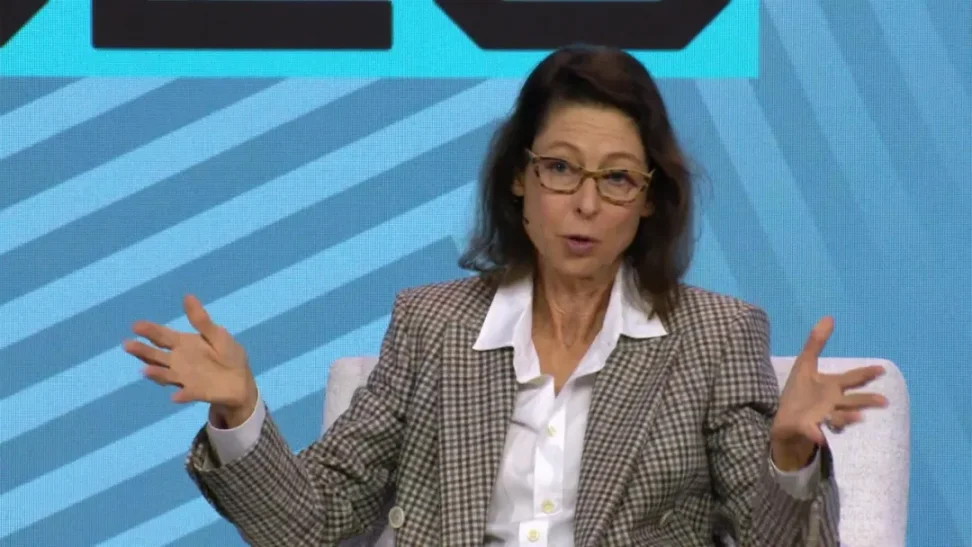
This interview was recorded at A16Z's recent founder summit, hosted by Anthony Albanese, CEO of A16Z Crypto. The guest of the conversation is Abigail Johnson, Chairman and CEO of Fidelity Investments. The discussion revolves around key topics such as Bitcoin, early mining, crypto custody, stablecoins, innovative investment models, and "build vs. buy."
In what is being called the "year of institutional adoption," this conversation exemplifies how traditional finance is strategically positioning itself to embrace crypto assets from a fresh perspective.
Anthony: Good morning, everyone. I’m very pleased to welcome Abigail Johnson, the CEO of Fidelity Investments, here today. Abigail, welcome.
Abigail: Thank you, everyone. I’ve heard that many people are looking forward to this conversation, and I’m glad we finally have the chance to sit down together.
Anthony: Let’s get straight to the point. You know, my background is in traditional finance. Before joining A16Z, I worked at the New York Stock Exchange. I’m very aware of how difficult it was for a large financial institution to venture into the crypto space. But you took that step with Fidelity ten years ago.
Why did you do it then, and how did you manage it?
Abigail: Actually, it all started with "curiosity" and "learning." Fidelity has always emphasized a culture of learning, and when we first heard about Bitcoin, like many others, we had just one question: What is this thing? How does it work? Is it real?
In 2012 and 2013, there weren’t many people answering those questions. So, a group of colleagues and I began to meet regularly to discuss and research. Eventually, we realized that something real and significant was indeed happening.
We started brainstorming the potential impacts of Bitcoin on our business and even listed 52 potential use cases. Later, we assigned projects to various teams within the company for validation, and only one direction really took off—but it was critical.
Someone suggested that Bitcoin created a lot of new wealth, and these people needed a channel to use crypto assets for charitable donations. Fidelity has its own charitable donation fund, so we became one of the first institutions willing to accept Bitcoin donations. At that time, no other large institution was willing to do so. This helped us establish credibility in the early crypto ecosystem and made more people aware of Fidelity.
At the same time, I insisted that if we were going to enter this space, we had to start from the basics—like mining. We did an analysis, and mining seemed like a good business. It turned out that if you started mining in 2013, the returns were indeed very substantial (laughs). When I proposed spending $200,000 to buy early Antminers, some tried to veto it, but ultimately, it became one of our highest-return projects.
That’s where the story begins.
Anthony: How did things develop from there? When did you start offering trading services to clients?
Abigail: We continued to explore those use cases, and although most didn’t materialize, they drove our ongoing learning and experimentation.
The first client-facing business that really took off was—custody.
Honestly, I was quite surprised. Custody is one of the oldest businesses in traditional finance, and it seemed to be at odds with the "spirit of crypto." However, there was a huge demand for custody services from advisors and clients. Many early holders wanted to plan for the future: if they were no longer around, how would their families inherit these assets? This had to rely on a reliable custody institution.
Thus, we entered the custody business. As an institution that places a high value on security, we built a very rigorous cybersecurity and traditional security system, which further solidified our credibility in the crypto space.
As these foundational capabilities matured, crypto business has now spread across multiple departments at Fidelity: custody exists alongside traditional brokerage; digital asset management drives crypto ETPs; incubation and lab teams explore new crypto technologies; innovative projects are scattered throughout the company. This distributed innovation keeps Fidelity at the forefront.
Anthony: You just mentioned the "Genius Act," which is an important breakthrough in crypto policy this year. For the past few years, we’ve been striving for regulatory clarity, and now we’ve finally taken a big step forward. What do you think its impact will be on Fidelity and its clients?
Abigail: In the past regulatory environment, the crypto industry received almost no attention during its nascent stage. Many people just viewed it as some strange, absurd new technology. When you went to Washington, you often encountered those "What are you talking about?" looks; they either didn’t understand or didn’t like it, and in most cases, they simply didn’t get it.
As the voice of crypto grew louder, but understanding didn’t keep pace, this "lack of understanding" actually intensified their rejection. By the time the scale of crypto continued to expand, it triggered various "negative immune responses." Some existing, even clearly outdated, regulatory rules were retroactively applied to the crypto space. Although these regulations were neither applicable nor truly valid, they indeed created an extremely unfavorable regulatory atmosphere.
For mature companies like ours, we have core businesses and a long-term responsibility to existing clients. Nevertheless, we kept receiving inquiries from clients: "When will Fidelity start investing in cryptocurrencies? I want to participate, but most of my assets are with you. I want to do it through Fidelity, not open an account elsewhere."
We even did a survey on how many clients were calling inquiring about crypto business. What was even more surprising was that many colleagues within the company also stepped up and said, "I want to get involved in this." This spontaneous enthusiasm was very encouraging.
So, we formed a small internal team—completely made up of volunteers who were willing to engage in all the conversations primarily centered around Bitcoin at the time. Then, we began to build foundational capabilities while maintaining existing business and continuing to observe and wait for changes in the regulatory environment. But the regulatory situation didn’t improve; in fact, at certain stages, it became stricter and more hostile.
That’s why it’s particularly exciting for us now to finally see policies gradually clarifying and "catching up."
Anthony: I personally really liked the stablecoin report recently released by Fidelity. With the passage of the "Genius Act," discussions around stablecoins have reached unprecedented levels. Where do you see the real potential of stablecoins? Why is everyone talking about it now?
Abigail: My initial impression of stablecoins was a few years ago; I can’t remember exactly when. At that time, I thought stablecoins seemed almost the opposite of the logic behind custody, and I wasn’t sure if it was reasonable at first.
But when I realized that Fidelity has a natural advantage in the "bridging assets" space, I began to truly invest in this area. It excited me greatly. If more smart people join us in this direction, that would be fantastic.
We actively advocated for "whether stablecoins can pay interest" for a long time, and we raised our voices on this. Internally, it sparked intense debates because it challenged our long-standing business logic. We have always been committed to creating returns for investors, either through capital appreciation or interest. If we took clients' money but didn’t provide any returns, it would go against Fidelity’s values.
Therefore, we insisted on exploring the possibility of interest until the very last moment. But frankly, if we continued to insist, the project might have been stalled. I ultimately intervened in the discussion, and while I felt disappointed, I also understood that we had to compromise on this point.
But the important thing is: things eventually moved forward, which is a good thing. So we started thinking, "Are there alternative solutions?" because we weren’t satisfied with just ending it this way.
I believe we ultimately found a solution: we launched an on-chain tokenized money market fund, with yields consistent with our traditional money market fund, which has long been a leader in the industry. This design was aligned with the stablecoin ecosystem from the very beginning.
The idea is simple: funds can first be placed in the tokenized money market fund to earn market-leading liquidity returns, and when needed, switch to stablecoins with one click. This is truly a fantastic combination.
Although the process didn’t fully follow the ideal path I envisioned at the beginning, this evolution is very exciting.
Anthony: In the banking system, crypto has always been quite controversial. But I appreciate your correct understanding of it. We released the latest "State of Cryptocurrency" report yesterday, which is published annually. One of this year’s conclusions is that 2025 will be the year when crypto assets are truly adopted on a large scale by institutions.
Over the past year, we’ve met with many large institutions, including Fidelity, and your team was among them. We keep hearing a common theme: many institutions want to enter the crypto space but are torn between "build or buy"—whether to develop technology themselves or to acquire and procure external capabilities.
Abigail: This is a topic we discuss repeatedly internally. Sometimes it’s build vs. buy, and sometimes it’s buy vs. collaborate. Compared to other large financial institutions, we lean more towards building, but no company can do everything on its own.
The key is to identify which capabilities are strategically differentiated and ensure that you can maintain control over them in the long term.
That’s what truly determines long-term viability.
Anthony: There are many entrepreneurs here who are eager to collaborate with Fidelity. What advice would you give them?
Abigail: We actually have a few team members here on-site.
First of all, we are very eager to hear everyone’s thoughts, and we welcome you to visit Fidelity. There’s a very active "Parts Enthusiasts Club" (BITS Club) within the company, with 4,500 members. We hold numerous events to promote communication, and members include both crypto industry practitioners and anyone within Fidelity who is interested in this field.
We also regularly host senior management forums, inviting external partners to share the latest developments; at the same time, various business lines hold many technical or product exchange meetings.
So the answer varies by context, but we have indeed established collaborative relationships with many teams. The essence of crypto is open collaboration, where everyone contributes a part to connect together.
We hope to continue maintaining this open dialogue. Fidelity does not have rigid collaboration rules; we maintain a high degree of flexibility in this regard.
Anthony: In your nearly ten years as a company leader, president, and CEO, what is the most important lesson you’ve learned about leadership?
Abigail: I’ve learned a lot along the way. First, maintain curiosity and never stop learning. If I don’t keep learning, I can’t fulfill my role.
In terms of organizational operations and culture building, it’s a continuously iterative process. One important system I’ve pushed for is internal "mandatory mobility," which allows employees to rotate positions periodically and prohibits long-term fixation in one position.
This is very valuable. It provides a multidimensional perspective rather than being stuck in a single way of thinking.
Additionally, we’ve spent a lot of time building a culture that encourages everyone to bring "bad news" as soon as possible. I often say, "Don’t just tell me good news; then I have nothing to do." To truly implement this culture requires a lot of effort.
Anthony: So, is there anything you wish you had known from the very beginning?
Abigail: There’s so much. If I had to highlight one key point, it would be to trust your instincts. Everyone has a voice inside that has brought them to where they are today. You need to learn to listen to it and follow it.
Now, let’s move into the Q&A session. We have many enthusiastic audience members who want to ask you questions. To give more people a chance to ask, please keep your questions brief. Hello, everyone.
Q&A Session
Audience: Hello, I’m Abby Banks, a former IDEO employee. In fact, you founded the IDEO Cryptocurrency Collaborative Lab in 2015, and Fidelity established a related team the same year. Thank you very much for your contributions to the industry over the past decade.
There was one point in yesterday's discussion that particularly interested me: everyone was talking about how the "Genius mechanism" drives stablecoins and institutional adoption, while the market structure bill is also about to be introduced. I’d like to ask, if this bill passes this year or next, what new chapters will it open? Looking ahead, what are your thoughts?
Abigail: Our team has been closely following the market structure bill. To be honest, every time we receive an update, the content has almost completely changed. So I often tell my colleagues, "Maybe I don’t need to be updated so frequently; just let me know when things settle down."
Of course, I hope to start in-depth discussions before the agreement is officially signed. But we still need to reach consensus on several key issues. Right now, I’m a bit "in waiting," but we have a professional team closely monitoring it. I believe if both sides haven’t connected yet, they would be very willing to reach out.
Audience: Thank you for everything you’ve done. In the crypto-native community, there’s a viewpoint that all financial systems will be rebuilt on a new underlying architecture in the future. On the traditional finance side, some have thought, "This won’t happen." But there’s also a middle-ground view: traditional finance will adopt these technologies and integrate them. Which path do you think the future will take?
Abigail: We can completely rule out the option of "it won’t happen" because it is happening. Ten years ago, when we conducted that research on 52 use cases, I was indeed more inclined towards the first path you mentioned: how these technologies will replace many cumbersome processes in today’s systems.
If you look at the reality of traditional finance, you’ll find it is almost composed of a very complex "network of reconciliation systems." From a macro perspective, it’s quite daunting. No one would actively design a system to be like it is today; it’s just the result of decades of technological iterations, with each layer built on the technology of its time, and the interconnectivity locks everyone into the lowest technological level of the past.
This poses a survival-level challenge for the industry. Large institutions want to accelerate infrastructure upgrades, but the industry is "democratic," and smaller institutions often lack the capacity to participate in upgrades. Therefore, it’s not a question of "whether it will happen," but rather "how it will evolve."
Ultimately, it will be a compromise path, gradually driven by competitive pressure and regulatory standards.
From our perspective, we are more focused on projects that allow the company to try new ways and create new opportunities that were previously impossible.
Anthony: Indeed, the inertia in the financial industry is very strong, and ironically, this is precisely because its systems are highly interconnected.
Audience: Thank you for your insights, and thank you for bringing legitimacy to this field since 2013. When I was at MIT, most of my colleagues thought I was "crazy" for studying crypto. It wasn’t until Fidelity came to our seminar that people realized, "Oh, Fidelity is here; this is real."
My question is about Bitcoin. You have witnessed the emergence of different asset classes and have driven many financial products. Where do you think Bitcoin will stand next? I’m not asking about the price, but rather its role in your overall asset system.
Abigail: I don’t know if it’s because I entered the space relatively early or because I’m getting older and more "old-fashioned," but I really do like Bitcoin. I don’t hold many digital currencies, but Bitcoin is one I’ve always kept.
I believe Bitcoin will continue to play an important role in many people's savings systems. It is the "gold standard" of the entire crypto world—having existed for a long time, being very stable, and having weathered various cycles while remaining robust; it is a very strong system.
In the long term, I have great confidence in Bitcoin. I believe it will continue to be an important asset that we must consider in our overall product system. Moreover, I hope we can be one of the promoters that make Bitcoin more accessible and easier to use. Because while Bitcoin’s design is ingeniously clever, if some of IDEO’s user experience resources had been involved back then, it might have allowed more people to participate earlier and more easily.
Audience: I received my first internship paycheck at IDEO CoLab, so hearing this is really special. Thank you. As a CEO, you need to balance betting on risks with daily operations. When you face internal resistance within the organization, how do you build a firm belief in a new direction?
Abigail: That’s a great question. As I mentioned earlier, we bring together various perspectives and beliefs within the team through employee rotations and team combinations. One natural side effect of this is that it generates a lot of internal discussions, which I believe is an essential part of a healthy organization.
Of course, there’s a fine line between healthy discussion and "religious wars." The crypto space has sparked many primal, emotional reactions, and at one point, it was indeed as intense as a "religious war." You may have also seen some leaders in traditional finance strongly oppose things in the crypto space in a very immature but loud manner.
During that time, I felt I had to remain patient and keep pushing forward. The noise will eventually pass, and much of the resistance from people is actually just due to misunderstanding, yet they see this trend gaining momentum, which makes them feel frustrated. What I tried to do was to prevent conflicts from escalating and help the team gradually digest and adapt.
This also included the Bitcoin and other crypto projects we were exploring at the time.
Structurally, we provided a "safe space" for the team through our R&D lab—which my father founded decades ago—and the internal incubator I later institutionalized, allowing for experimentation, failure, and even spaces where failure was expected.
I often tell the team that if all the projects in our lab succeed, it means we’re not taking enough risks; we need some quick failures, or it means we’re not pushing far enough.
Once these mechanisms are institutionalized, they create "permission" for the team to do things that not everyone agrees with, and that is at the core of innovation.
Anthony: This is very interesting and quite similar to venture capital. If all the companies we invest in succeed, it means we’re not casting a wide enough net and not taking enough risks. That’s great; I love that saying. Does anyone else have a question?
Audience: If digital assets and traditional assets eventually converge in the future, what is your vision for this "crossroad"? What aspects of traditional finance will we bring into digital assets? And what will traditional finance learn from digital assets?
Abigail: Simply put, both.
As I mentioned earlier, I’m more excited about the new things we will bring to people rather than interested in "doing what we already do but with a different underlying technology."
But it’s not that simple. If you return to the premise I mentioned, we have a long-term structural deflation in our industry, then all technologies will ultimately be forced to change.
We started migrating our core business to the cloud a few years ago. It took us several years of exploration to find a method that is both highly reliable and highly secure. Fortunately, we first tested the waters in some lower-risk scenarios and learned a lot from that.
This is a huge structural migration for us, and it is still ongoing.
So you can’t help but ask, will there be some capability in the future that allows blockchain to ultimately replace the vast and complex "reconciliation network" of today’s financial system?
Yes, you can definitely see that trend. The question is, what will the migration path look like? How fast will the migration be? These can only be observed and felt as they unfold.
Our current approach is to build the technologies we believe are most likely to land in the short term while maintaining a longer-term vision.
What surprises me is that our current position is closer to the "bridging phase" than I expected, which is already a clear use case for the intersection of old and new.
For example, stablecoins and "tokenized money market funds." You need stablecoins to participate in DeFi, but if you want to earn interest, you also need a digital product version from the traditional world.
To be honest, I wish I could provide a more "scientific" answer, but this is a very difficult question. It’s something everyone must think about and push forward simultaneously. To some extent, we are both the cause and the result.
Audience: You mentioned "long-term structural deflation" twice today. My understanding is that technology causes the prices of everything to keep falling. But from the outside, the acceptance of new technologies seems to vary greatly among different financial institutions. I’m curious, what determines whether an institution is willing to adopt new technologies like crypto assets?
Abigail: That’s a very good question. The answer comes from a combination of two factors: time horizon and the willingness to take a little risk.
Not regulatory risk, but the reputational risk often discussed in traditional business.
During those "most controversial years," there were often discussions within Fidelity about "what is the reputational risk of our involvement in this space?" even though what we were actually doing was quite limited.
For example, when we first accepted Bitcoin donations through our charitable fund, those donations came from people who had just made money through Bitcoin. To me, that sounded a bit crazy; but for many, it was not just crazy, but "untouchable."
So I think this is largely a personal factor. And those of you here belong to a creative and healthily risk-tolerant group. But in large companies, especially in the financial industry, such traits are often not a natural soil and are not a "breeding ground."
Of course, some investors, like those managing portfolios or hedge funds, are inherently risk-takers. But their risks are taken within a defined framework. And they probably don’t think about the technical details and infrastructure that support their operational capabilities.
I believe this is what makes Fidelity a bit special; we place a high value on thinking about the technical details that support our business operations.
Over the years, we’ve learned that the more technology we personally participate in building, customizing, or adjusting to meet our needs, the more competitive advantage we can gain—especially sustainable competitive advantage. Because this allows us to continuously keep our technology updated and have the freedom to make the adjustments we want.
And this is not the mindset I often see in traditional financial services.
Anthony: Well, Abigail, this discussion has been fantastic. Thank you again for coming to chat with us; it’s been really interesting.
Abigail: Thank you for the invitation, and thank you all.
免责声明:本文章仅代表作者个人观点,不代表本平台的立场和观点。本文章仅供信息分享,不构成对任何人的任何投资建议。用户与作者之间的任何争议,与本平台无关。如网页中刊载的文章或图片涉及侵权,请提供相关的权利证明和身份证明发送邮件到support@aicoin.com,本平台相关工作人员将会进行核查。


