The practicality of a product is the gold standard for measuring the potential of crypto AI projects, but true decentralization is its holy grail.
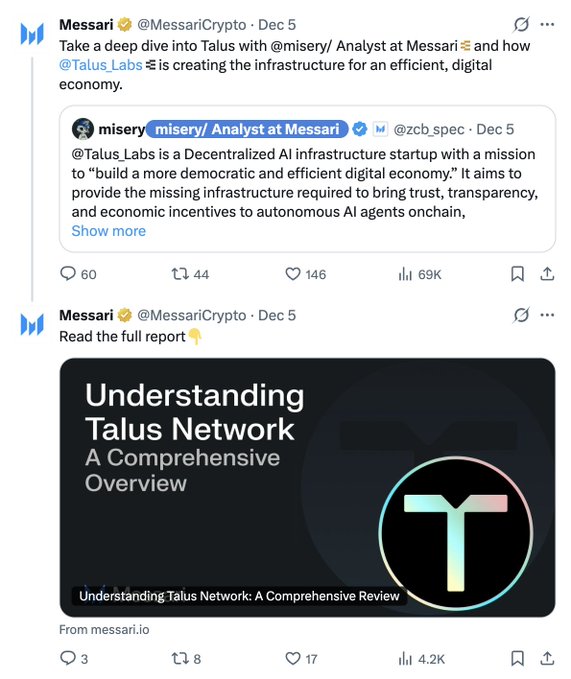
A few days ago, a research report on Talus released by the top crypto research institution Messari sparked deeper thoughts in me.
In the broad field of crypto AI, core product landing projects are not scarce; mature projects like Fetch and Olas are already on the market. However, the vast majority of them adopt a hybrid model of "off-chain computation + on-chain settlement." Since the logic of AI decision-making is not fully on-chain, the entire decision-making process becomes a "black box," making it impossible for outsiders to verify whether the decisions follow the preset logic.
This is not true decentralization, nor is it true DeAI.
True DeAI: On-Chain AI
Talus fills the gap in the DeAI infrastructure track, transforming AI agents from black-box tools into fully decentralized, on-chain verifiable, independent economies based on on-chain accountability.
The core concept of Talus is "On-Chain AI," which means that all aspects of AI agents—from logic and state to decision steps—are written into smart contracts and executed directly on-chain. Under this architecture, anyone can verify the historical behavior and decision paths of AI agents without needing to trust a third party.
The Three Dilemmas of DeAI
Similar to the classic three dilemmas of blockchain, the DeAI track also faces a three-way dilemma: the trade-off between decentralization, performance, and cost. Talus cannot eliminate this dilemma, but it cleverly balances all three based on its Nexus core framework.
Decentralization requires that all AI agents' logic/state/decisions be fully on-chain. Pure on-chain execution of compute-intensive tasks can easily lead to performance bottlenecks, especially in scenarios with multiple agents running concurrently.
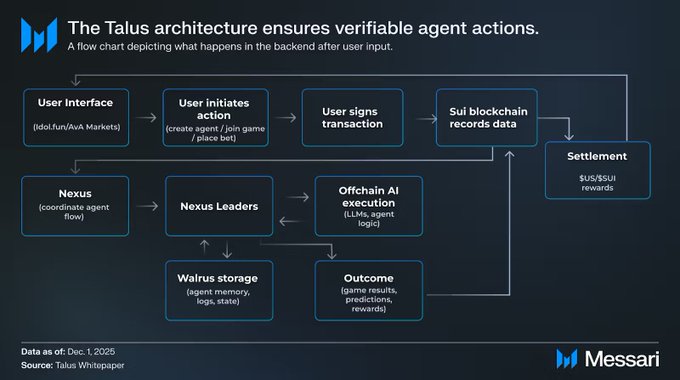
Talus, based on its self-developed first on-chain AI agent framework Nexus, anchors all key behaviors of AI agents (decision logic, workflow state, settlement results) on-chain, executing and recording through smart contracts on Sui, ensuring on-chain verifiability and no black box.
This is also why Talus chose Sui as its underlying chain: Sui's MoveVM supports parallel transaction processing, accommodating scenarios where multiple AI agents execute concurrently.
Talus has found a feasible path through the three dilemmas in the DeAI track, somewhat filling the gap in decentralized AI infrastructure, but the road to decentralizing AI agents remains long and challenging.
免责声明:本文章仅代表作者个人观点,不代表本平台的立场和观点。本文章仅供信息分享,不构成对任何人的任何投资建议。用户与作者之间的任何争议,与本平台无关。如网页中刊载的文章或图片涉及侵权,请提供相关的权利证明和身份证明发送邮件到support@aicoin.com,本平台相关工作人员将会进行核查。


