Author: Jae, PANews
On December 4th, Ethereum officially activated the Fusaka upgrade. Possibly driven by this positive news, Ethereum spot ETFs saw a net inflow of $140 million yesterday, with none of the nine products experiencing outflows, indicating an optimistic sentiment in the market regarding Ethereum's fundamentals.
As Ethereum's roadmap continues to evolve, each hard fork is an important piece of the puzzle towards the goal of becoming a "world computer." The Fusaka upgrade serves as a bridge for Ethereum's progression towards the "The Verge" and "The Purge" phases. It is not only a routine hard fork but is also seen as a key step for Ethereum to mitigate centralization risks and lower hardware thresholds. However, behind this promising technological vision, challenges related to increasing technical complexity still loom.
PeerDAS Unlocks Scalability Limits, Further Empowering the L2 Ecosystem
The activation of the Fusaka upgrade marks a critical next stage in the development of the mainnet. The core purpose of the Fusaka upgrade is to deploy EIP-7594, which is the PeerDAS (Peer Data Availability Sampling) technology. The introduction of PeerDAS aims to fundamentally reshape Ethereum's underlying architecture and data verification mechanisms, significantly enhancing the network's scalability, security, and user experience.
Ethereum previously introduced data containers called "Blob" through EIP-4844 (Proto-Danksharding) during the Dencun upgrade, successfully reducing Layer 2 (L2) transaction fees by 60% to 90%, greatly improving the user experience of Rollups. However, Proto-Danksharding is merely a temporary solution. While it created a cost-effective data space, it did not fundamentally increase the mainnet's data capacity limits, failing to meet the long-term demands of large-scale applications.
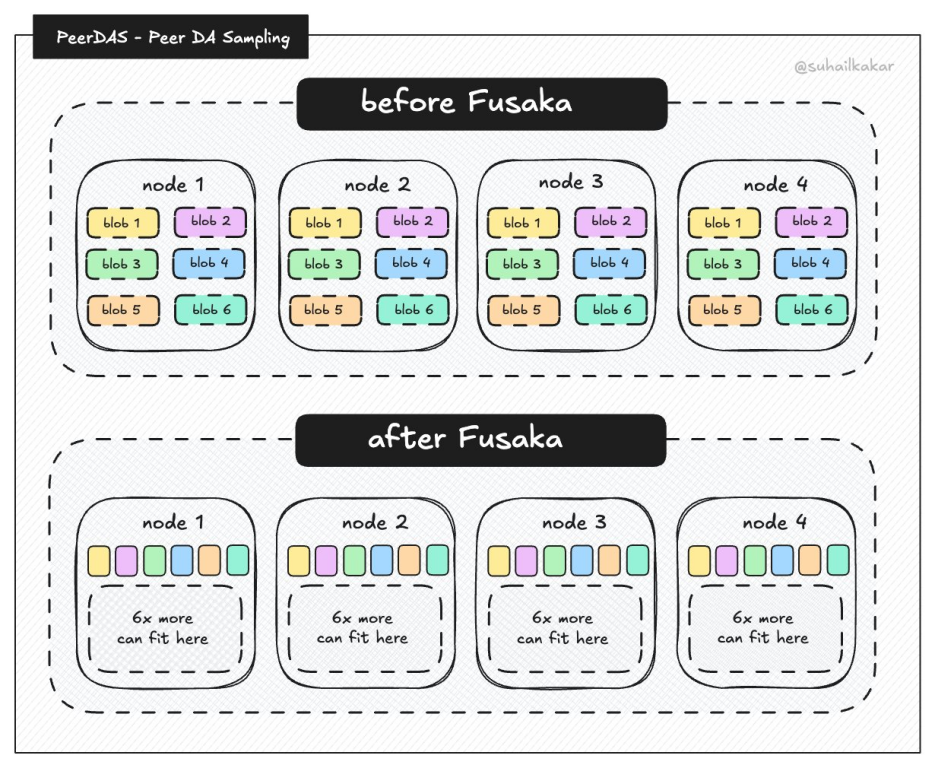
PeerDAS will change the way the network collects and verifies L2 data, no longer requiring all nodes to store all Blob data. With PeerDAS technology, network nodes only need to store one-eighth of the Blob data to verify its availability and integrity through a data sampling mechanism. This improvement in storage efficiency allows the mainnet to significantly expand Blob capacity without increasing the hardware burden on individual nodes.
In theory, the design of PeerDAS will unlock up to 8 times the scalability for Rollups. This also marks Ethereum's first step towards full data sharding (Full Danksharding), further reducing the cost burden on L2 by increasing Blob capacity.
As of now, possibly due to Ethereum just completing the Fusaka upgrade and on-chain activity being in a lull, there have not been significant changes in data.
For L2 operators, PeerDAS can provide predictable data availability costs. This will encourage the development of more data-intensive applications, such as more complex DeFi protocols, large gaming platforms, or data storage tools, without the worry of high cost constraints. This architectural optimization will also enhance the stickiness of L2, encouraging them to continue developing within the Ethereum ecosystem, further solidifying Ethereum's position as a "global settlement layer."
The Fusaka Upgrade May Alleviate Geographic Centralization Risks While Lowering Hardware Thresholds
On November 20th, Ethereum co-founder Vitalik Buterin stated at Devconnect that if large institutions like BlackRock continue to expand their ETH holdings, the foundational layer technology roadmap may be dominated by institutional demand, making it difficult for ordinary users to run nodes and leading to network and geographic centralization issues.
Related Reading: Ethereum at a Crossroads: Quantum Threats Loom, Wall Street Capital Faces Dual Pressure
Although Ethereum has a large number of validating nodes, their geographic distribution is highly concentrated, primarily located in a few low-latency areas such as the U.S. East Coast and Europe, where large staking service providers are dense. This phenomenon is a natural product of profit-seeking behavior under physical constraints. In Ethereum's consensus mechanism, low latency helps validators receive and propagate blocks faster, thus earning more rewards and achieving higher overall profitability.
Currently, running an Ethereum validating node still has a high hardware threshold, requiring hundreds of GB of disk space and a long synchronization time. These stringent technical and operational requirements, while easily borne by large staking service providers, pose significant obstacles for independent stakers. As block data rapidly grows, this issue has gradually become apparent, with staking rights concentrating among institutions and professional entities.
The Verkle Trees introduced in the Fusaka upgrade may alleviate this risk. Verkle Trees are a new type of data structure algorithm designed to replace the current Merkle Patricia Trees, optimizing on-chain data storage and node size.
The breakthrough of this technology lies in its enabling of stateless validator clients. This means that nodes do not need to locally store all historical state data of the blockchain when validating transactions. Vitalik Buterin emphasized that Verkle Trees will reduce the disk space required to run a staking node to "approaching zero" and achieve "almost instantaneous" synchronization times.
The reduction in hardware thresholds brought by Verkle Trees is a key measure in combating geographic centralization risks at the technical level. When the user experience for independent stakers is significantly improved, they will join or return in large numbers, thereby counterbalancing the centralization trend of large staking pools.
Empowering individual participants in Ethereum is not only a technical optimization but also a strong defense of its decentralization principles.
Accumulating Technical Debt Will Become a Long-Term Challenge
Ethereum Foundation researcher Ansgar Dietrichs described PeerDAS as a "fundamental change" to the nature of L1. It is not merely a software patch but involves the underlying logic of how the consensus layer handles data availability proofs. Such a reconstruction of the infrastructure requires all clients in the Ethereum ecosystem to synchronize updates and coordinate, which will significantly increase overall technical complexity.
Taking Verkle Trees as an example, the vector commitment it relies on is a complex cryptographic construct. When such cryptographic structures are integrated into smart contracts, any minor error could lead to serious protocol-level vulnerabilities.
In fact, every major upgrade of Ethereum is a deep reshaping of the underlying architecture. This cumulative effect of technical complexity has also led to a significant accumulation of technical debt. This will increase the difficulty for developers to maintain client code and implement security audits, as well as increase potential systemic risks.
As network complexity increases dramatically, Ethereum's development focus is shifting from early performance optimization to stability, decentralization, and economic balance. How to maintain this increasingly complex protocol while adhering to decentralization principles will become a long-term challenge for Ethereum.
The Fusaka upgrade is a necessary path for Ethereum towards "Endgame." It attempts to reshape the foundational color of decentralization by lowering hardware thresholds and continues to pave the way for the prosperity of L2, representing Ethereum's evolution from pursuing performance to pursuing sustainability.
However, ensuring security within the increasingly complex underlying architecture will be a challenge that developers must address. For the community and investors, the Fusaka upgrade is not only a technological iteration but also a reaffirmation of Ethereum's long-term value.
免责声明:本文章仅代表作者个人观点,不代表本平台的立场和观点。本文章仅供信息分享,不构成对任何人的任何投资建议。用户与作者之间的任何争议,与本平台无关。如网页中刊载的文章或图片涉及侵权,请提供相关的权利证明和身份证明发送邮件到support@aicoin.com,本平台相关工作人员将会进行核查。


