LambdaClass Founder Fede Explains Anti-fragility, 1 Gigagas Expansion Goals, and the Vision for Lean Ethereum.
Written by: Zhixiong Pan, ChainFeeds
At the Ethereum Devconnect ARG, LambdaClass founder Fede delivered a passionate and thought-provoking speech. He rejected the traditional narrative of the "world computer" and redefined Ethereum as the first "verifiable computer" in human history. Fede believes that this "anti-fragility," which relies not on trust but solely on mathematical and economic incentives, is the fundamental cornerstone for Ethereum to establish internet property rights and support a "global economy" worth trillions.
However, this was not merely a celebration; it served as a harsh wake-up call. In the face of the rise of high-performance public chains like Solana, Fede bluntly stated that the Ethereum community is at risk of "complacency leading to death." From denouncing the false prosperity of "most L2s not running at all" to criticizing the development experience of Solidity as "shooting itself in the foot," he called on the community to break out of information silos and regain the ambition and fighting spirit of the "Bronze Age." He quoted a former Intel CEO's famous saying to warn the audience: in the brutal tech competition, "only the paranoid survive."
From pushing the performance limits of 1 Gigagas to constructing the architectural vision of Lean Ethereum, Fede showcased how Ethereum can maintain its dominance over the next decade with the hardest technical details and the most sincere emotions. This is not just a technical roadmap but a declaration of war against mediocrity.
Below are the highlights of this speech.
Speaker: Fede (LambdaClass)
Today, I want to talk about the next decade of Ethereum: from "verifiable computer" to "global economy."
Core Definition: Ethereum is the First "Verifiable Computer"
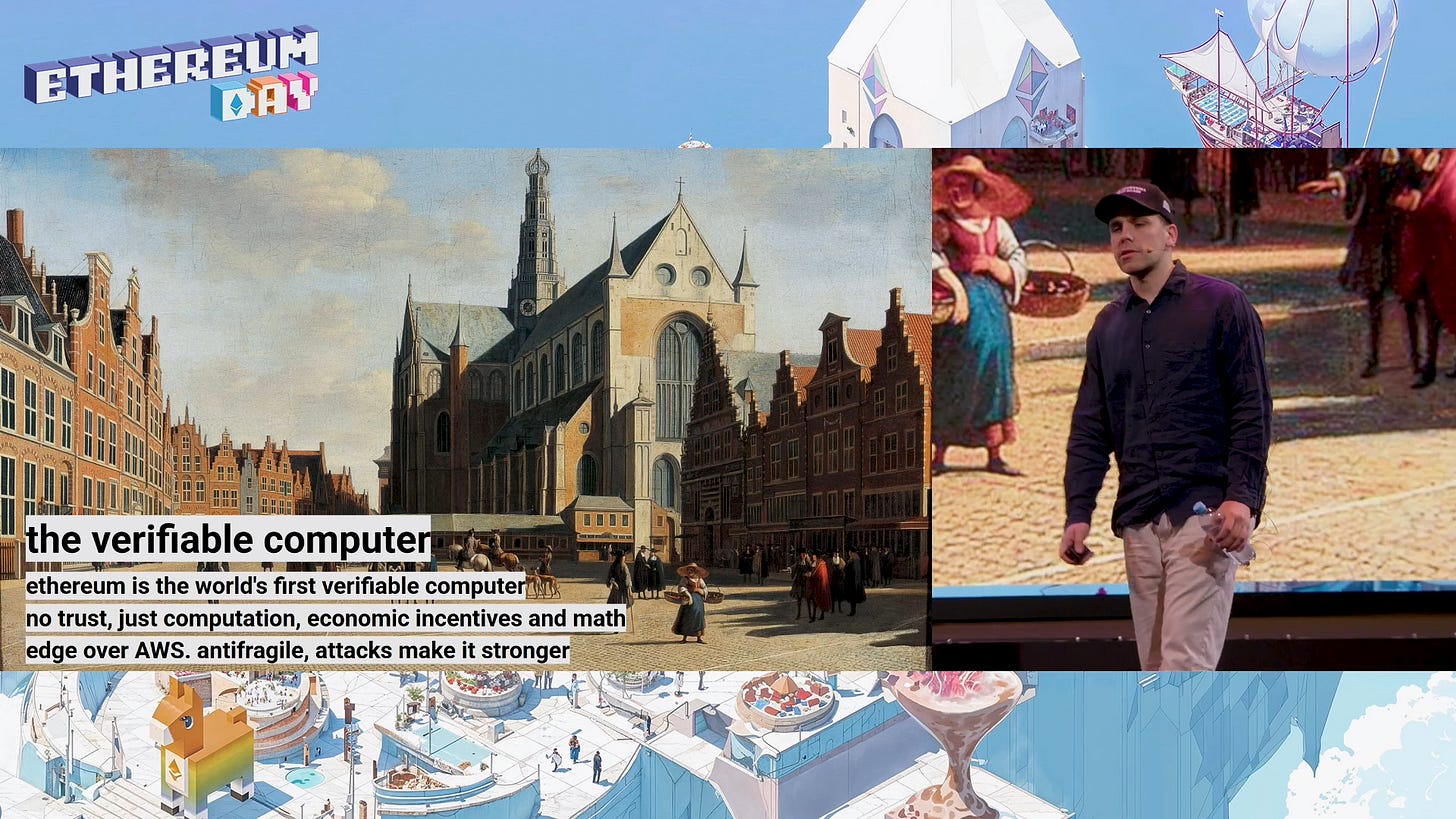
To me, Ethereum is a verifiable computer.
I have never been fond of the "world computer" meme. I believe AWS or Google is the real "world computer." They have countless funds and servers, but you have to trust them. The biggest difference between Ethereum and them is verifiability.
Ethereum is the world's first verifiable computer that does not require trust in the computation itself, only trust in economic incentives and mathematics. This gives it a significant advantage over AWS or Google Cloud. In traditional cloud services, everything is based on trust, and trust can be broken.
A few days ago, I saw on Twitter that someone hacked Bing and modified the movie list. If you search for "top ten movies," the results are altered by hackers. In this case, you are actually trusting the hacker. Such a thing cannot happen on Ethereum unless the entire network is compromised, which is extremely difficult because you would have to simultaneously breach multiple teams and multiple client implementations, and everyone can see the attack process.
This makes Ethereum anti-fragile. Whether it’s North Korea, other state actors, or private hackers, every attack attempt actually makes Ethereum stronger because it continues to run, carrying vast amounts of funds.
The Transformation Brought by Verifiable Computers
Verifiable computers achieve true internet property rights.
True ownership: You no longer need to click "agree to terms" to hand over your data to tech giants; instead, you control everything through private keys. Private keys are more reliable than any service terms.
Global neutrality: Developers from China, traders from Russia, funds from the U.S., and users from Argentina all compete on the same fair playing field.
The cornerstone of artificial intelligence: In the next decade, we will tokenize everything, from artworks and land to artificial intelligence. This is crucial. If the future is driven by AI, hackers will have a huge incentive to tamper with AI parameters. We need Ethereum to verify that AI is functioning as expected.
Current Situation and Product-Market Fit (PMF)
Ethereum has created a complete economy. Currently, this is not just a scale of $300 billion, but a monthly transaction volume of $3 trillion through stablecoins, which is three times that of Visa.
Our biggest advantage over Visa or the NYSE is composability. All funds, assets, and artworks are in one place and can be exchanged at any time. This creates a flywheel effect. In this sense, Ethereum is less fragmented than global capital markets because it operates around the clock.
The current product-market fit (PMF) of Ethereum can be summarized as:
Decentralized / permissionless verifiability.
Privacy (features we need to build at the core layer).
Stablecoins (programmable, private, borderless dollars).
Technical Challenges: The Hard Nuts to Crack
To continue winning in the next decade, I must "vent" from a technical perspective. Here are the challenges I see:
- Performance
We (LambdaClass) are building the Ethrex client. My team just told me that we are only 10% away from Reth in terms of performance. Apart from Nethermind, Reth, Geth, and us, most clients struggle with performance.
Without raising the hardware requirements for validators, it will be difficult for us to achieve the performance needed to compete with Solana and others.
This touches on a sensitive topic: Gas Limit. For the past three years, we decided not to raise the Gas Limit, which has slowed us down. I believe we can increase speed while maintaining verifiability. This used to be a taboo topic, but now we need to accelerate to compete. If other execution layers cannot keep up, we cannot wait. Ethereum is more important than any single team.
I am also reflecting: Is Ethereum's goal really to allow everyone to run a node at home with a $50 Raspberry Pi? I am not sure. Maybe as long as the verification cost is low enough (a few thousand dollars or even a few dollars), it doesn't necessarily have to be an extremely low threshold.
- Scalability
I believe we should increase the Gas Limit by 100 times. The cheaper it is, the more people will use it. The internet was born after it became faster, leading to the emergence of YouTube.
Additionally, I am a loyal fan of RISC-V and not very fond of Solidity. Solidity does not represent Ethereum. While it has made significant contributions, it has many issues. I believe RISC-V should become the default standard.
Regarding Layer 2: Frankly, most L2 tech stacks do not run at all. You clone the codebase to run it, and it is bad. The current incentive mechanism is "issue a token, then ignore it, and wait for it to die." If you believe in a rollup-centric roadmap, we must make running rollups extremely simple. We are working hard to make Ethrex able to run L2 with a single command.
- Interoperability and Decentralization
A few days ago, AWS went down, and some rollups also went down, which is terrible. The Solana community mocked us, and I think they have a point. We need to advance to "Stage 2," we need decentralized sequencers, we need Based Rollups (reusing L1 pipelines to build L2), and technologies like CommitBoost for pre-confirmations.
- Privacy
I once received a call from a lawyer warning me that I was in big trouble, so I feel deeply about this. We need to support all developers committed to privacy (like Roman, Alexei, and the developers of Samurai Wallet). If I want my mom to use Ethereum, she would never want all her transactions to be visible to the world. The current rules around privacy development are very vague, and we need to fight for clarity together.
- Security
There are too few maintainers of the Solidity compiler, with only one or two people on GitHub. This is the most important programming language for Ethereum, yet it faces a huge risk of manpower shortage. Solidity's syntax is simple, but it is easy to write security vulnerabilities. As a developer who has used more than 20 languages, writing Solidity feels like shooting myself in the foot. We need better compilers or long-term solutions like RISC-V ZKVM.
- Post-Quantum
We are working with Justin Drake to develop Lean Ethereum. Compared to Bitcoin, Ethereum has a significant advantage in deploying post-quantum cryptography because we allow multiple client implementations, and the community is more open, even if it means we are making some radical changes.
Social and Cultural Challenges: Rejecting Mediocrity
I am a die-hard fan of Ethereum, and my company relies on Ethereum, but I must speak frankly:
We need to have a "Bronze Age" mentality: Do not think "we either won or are winning." This complacency leads to stagnation. Look at Intel, once a giant, now left behind by NVIDIA and AMD. We need to maintain a sense of hunger and ambition.
Break the closed-door approach: Science and engineering require open debate. Important decisions like EOF (Ethereum Object Format) should not be made in closed-door meetings. If decisions are made behind closed doors, state actors can easily control the network by infiltrating key decision-makers (refer to the OpenBSD case).
Learn from competitors: I have attended every Solana Breakpoint conference, not because I support Solana, but because I want to learn from competitors. Linux succeeded by copying the advantages of Solaris and open-sourcing them. We need this attitude.
Reject echo chambers: We need to pay those who hold contrarian views. In my company, there are partners who often criticize me, and while it makes me uncomfortable, it establishes a good feedback loop. Without a good culture, there will be no long-term good technology.
What is LambdaClass Doing?
We are not just venting; we are taking action:
Collaboration with Governments in Latin America: In Argentina (Sobra project), Mexico, and Colombia, we are conducting identity verification, KYC, and lending through on-chain ID.
Global Infrastructure: Establishing passport and property rights infrastructure in Africa and Central Asia (such as Uzbekistan).
Tech Stack: Building Ethrex (L1 client), L2 stack based on SP1 and Zisk, ZKVM in collaboration with TMI Labs, as well as privacy and decentralized AI projects.
Partnerships: We are collaborating with IRSA (an Argentine real estate giant) to streamline payment channels.
Q&A Session
Q: How do you feel about hosting Devconnect in Argentina at this moment?
Happy. Very happy. I’m glad my mother is here; she can finally understand what I’m doing. I’m also excited to show the world what we are doing.
Q: What do you think is the most important initiative right now?
Lean Ethereum. I was never really into the "Ultrasound Money" meme. But Lean Ethereum is like a great cathedral. When Justin Drake and I were walking in a cathedral in Cambridge, he asked me, "Do you think people will look at Ethereum's design 500 years from now like they look at this cathedral?" I said, "Yes, and you are one of the architects."
Q: How much do you think the Gas Limit can be increased in the near future?
With Nethermind's amazing engineering capabilities (even though I don’t like C#), and our efforts with Reth, I believe we can reach 300-400 Megagas on good servers. In the coming years, with technological improvements, we aim to push towards 1 Gigagas.
Q: You have interacted with a variety of people from governments to developers; what do they have in common?
Even those big figures who don’t fully understand Ethereum (royalty, billionaires) know this is "the real deal." They trust "nerds" because they are not just driven by money. They see Ethereum as the future winner.
Q: What advice do you have for young builders?
Don’t raise funds until you find product-market fit (PMF). Money is just fuel; connections and vision are more important. Work with those who are ethical, passionate, and want to do good for society. Do things you will be proud of in ten years.
免责声明:本文章仅代表作者个人观点,不代表本平台的立场和观点。本文章仅供信息分享,不构成对任何人的任何投资建议。用户与作者之间的任何争议,与本平台无关。如网页中刊载的文章或图片涉及侵权,请提供相关的权利证明和身份证明发送邮件到support@aicoin.com,本平台相关工作人员将会进行核查。


