In the next 20 years, work will become optional.
Source: 51CTO Technology Stack
In the past two weeks, Musk has been making headlines again: Grok 4.1 has officially been released; Tesla AI 5 is nearing completion and moving towards AI 6, with a new AI chip being launched every 12 months for mass production; he even claimed that the humanoid robot Optimus will become a "Von Neumann probe," suggesting it could self-replicate using local resources in the future.
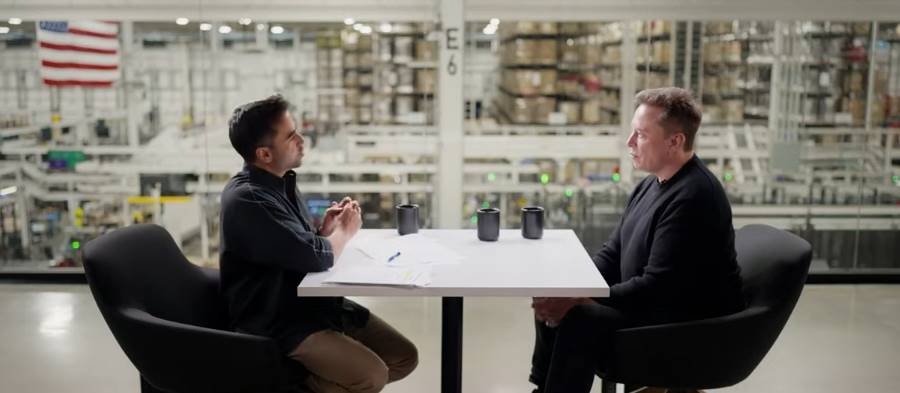
Recently, Nikhil Kamath, founder of India's largest brokerage Zerodha, invited Musk to his show "People by WTF." In the latest interview, Musk made some "crazy predictions" about the next twenty years:
In the next 20 years, AI and robots will make work optional, and humans will ultimately not need to work at all (Musk stated that this can be replayed in 20 years to see if it comes true);
When AI and robots meet all needs, currency may disappear, and energy will become the true circulating value;
Within the next 3 years, the growth of AI and robot output will exceed the growth rate of the US money supply, potentially leading to deflation and interest rates dropping to zero;
In the summer of 2026, Optimus will begin mass production, "I think everyone will want their own C-3PO or R2-D2—a personal assistant robot";
He also described a grand AI landscape composed of SpaceX, Tesla, and xAI—these three are increasingly converging, and the future may consist of a solar-powered AI satellite network, necessitating the deployment of numerous solar-powered AI satellites in deep space;
Regarding AI regulation, Musk elaborated for the first time on three value frameworks for AI: truth, beauty, and curiosity.
The editor has compiled excerpts from this interview, which is packed with information, and recommends saving it for a detailed read!
1. The Future X Platform: Real-time Video + AI
Nikhil Kamath: Overall, what percentage of the internet is spent on Twitter? Is there a number?
Elon Musk:
We have about 600 million monthly active users. During significant events, it can spike to 800 million or even 1 billion. I think it's around 250 to 300 million weekly. It's actually a pretty good number. It seems to be mainly readers, people who consume text.
Nikhil Kamath: Do you think this will change?
Elon Musk:
There are already a lot of videos on the X platform, and the proportion of video is continuously increasing. But I think the strongest aspect of X is still among those who enjoy thinking and reading. Because we have text, I believe X is the number one platform for readers, writers, and thinkers.
Nikhil Kamath: From the perspective of social media formats, if you were to predict the future, what percentage would be text? What percentage would be video? I've heard you mention that perhaps voice and audio will become the next generation of communication in the AI era. How will X itself evolve?
Elon Musk:
I believe that most interactions in the future will be video. Most interactions will be a combination of real-time video and AI—real-time video understanding, real-time video generation. This will dominate the traffic.
In fact, the entire internet is like this now: video accounts for the vast majority. Text has a very small proportion, but the value density of text is higher, and information is more compressed. But if you ask what type of content generates the most data and consumes the most computing power, it must be video.
Nikhil Kamath: I used to be a small shareholder of X, a very small one. When you bought Twitter and turned it into X, I received compensation. A good decision.
Elon Musk:
I'm glad you think so. I believe this is important. I felt that Twitter's direction at the time was leaning more towards having a negative impact on the world. Of course, it depends on perspective; some people prefer the old way and don't like the current one. But the key is that Twitter amplified a very left-leaning ideology (by global mainstream standards). Because the company is in San Francisco, they banned many right-wing voices. So for them, even a centrist person was considered "far-right." If you stand very far left, everyone who is not left enough appears very right. What I did was mainly restore it to a balanced, neutral platform. Currently, no left-wing voices are banned, canceled, or de-amplified. Of course, some people choose to leave on their own. But now the operational principle of X is: comply with the laws of each country, but do not intervene or lean towards one side outside of the law.
Nikhil Kamath: It seems that mainstream social media is losing ground among young users, including Instagram. Although they are not exactly the same as Twitter, the entire industry is like this. If you were to redesign a social network from scratch, what form would be suitable for the future?
Elon Musk:
Honestly, I don't really think about "social media." What matters most to me is that X can become a global public square where people can freely express text, images, and videos, and communicate safely. We recently added audio and video calls. What I want to do is connect the world into a kind of collective consciousness. This is different from creating a platform that is "most addictive and dopamine-releasing" with video streams; that kind of thing will rot the brain. If you are just scrolling through videos that give you pleasure but have no substantial content, that is an unhealthy use of time. But many people actually enjoy this model. So if we look at the total usage time on the internet, traffic may continue to be dominated by content that optimizes "neurotransmitter stimulation," like a digital drug.
But I don't want to create that kind of platform; I want to create a platform that truly connects the world. To bring humanity as close as possible to a "collective consciousness." For example, we have launched automatic translation. I think it's great to connect people who speak different languages, and the content users see will be automatically translated, allowing collective consciousness to exist not just in one language but to come from all language groups.
2. Tesla, SpaceX, and xAI: The Work Musk is Most Excited About
Nikhil Kamath: Among all the things you are doing now, which one excites you the most?
Elon Musk: I think SpaceX, Tesla, and xAI are gradually merging. If the future consists of "solar-powered AI satellites," and to harness that non-trivial portion of solar energy, we must deploy a large number of solar-powered AI satellites in deep space. This will be a combination of Tesla's technology, SpaceX's technology, and xAI's artificial intelligence technology. So over time, they are indeed converging. But each company is doing great things, and I am very proud of the team. They are really doing well. We are making rapid progress on Tesla's autonomous driving; I don't know if you've tried it.
Nikhil Kamath: I have tried Waymo's, but not Tesla's.
Elon Musk:
You can give it a try; we have opened it up in Austin. You just need to download the Tesla App; I think it's open to anyone now. You can check it out. We have made great progress in electric vehicles, batteries, solar energy, and autonomous driving. In short, Tesla is the global leader in real-world AI, I would say. Next, we will produce the Optimus robot, hoping to start mass production next summer. I think that will be cool; everyone will want their own C-3PO or R2-D2, a kind of "assistant robot." SpaceX's Starlink is also developing well, providing low-cost, reliable internet to the whole world, and we hope to operate in India; we are very willing to serve there. Starlink is now operating in 150 countries.
3. How Starlink Works
Nikhil Kamath: Can you explain how Starlink works? Someone mentioned to me that Starlink operates differently in high-density areas compared to low-density areas.
Elon Musk:
Of course. Starlink has thousands of low Earth orbit satellites that orbit the Earth at about 25 times the speed of sound, basically flying around the Earth. They are at an altitude of about 550 kilometers, which is called low orbit (LEO), because it is low enough to have low latency—much lower than geostationary satellites at 36,000 kilometers. These satellites can provide low-latency, high-speed internet globally and are interconnected through laser links, forming a "laser mesh structure." For example, when undersea cables are damaged, the satellites can still communicate with each other and maintain connectivity. Like a few months ago when the Red Sea cable was cut, the Starlink network was unaffected. It is particularly useful in disaster areas because natural disasters often damage ground infrastructure, but Starlink satellites remain operational. Whenever there is a major natural disaster in the world, we provide free Starlink service and do not take the opportunity to charge. Setting up a paywall to help others during a disaster is certainly wrong. Overall, Starlink is very suitable to complement existing ground systems. Because satellite beams are wide, the number of users a beam can serve is limited, so it is not very efficient in densely populated cities. In contrast, ground cellular towers in cities are very effective because the distance between towers is short. But in rural areas, it is very inefficient and difficult to lay fiber. So Starlink basically serves the "most underserved populations," which is a good thing.
Nikhil Kamath: Will that change in the future? For example, will it be more efficient in high-density cities and compete with local networks?
Elon Musk: The laws of physics do not allow it. 550 kilometers is too far; even reducing it to 350 kilometers won't help. You can think of it like a flashlight; when the light cone comes down, it is already very large, while ground communication towers are only 1 kilometer apart. The laws of physics favor them, not us. So Starlink will never replace ground networks in densely populated cities, at most serving 1% to 2% of the people.
4. Work Will Become Optional in 20 Years
Nikhil Kamath: If you were to speculate, do you think India will continue to urbanize like China in the future?
Elon Musk:
Or is that already happening? I also want to ask you, because you know India better.
Nikhil Kamath: Indeed, that is generally the trend, but urbanization slowed down during the pandemic due to external factors. But I am curious, in a future where AI increases productivity, I heard you mention "UHI" instead of "UBI."
Elon Musk:
Yes, I believe the future will be "Universal High Income."
Nikhil Kamath: In such a future, will people actually prefer to live in the countryside with a better quality of life rather than in cities?
Elon Musk:
I think it depends on the individual. Some people like to be in crowded places, while others do not. But in the future, you won't need to live in cities for work. I predict that work will become "optional."
Nikhil Kamath: Some countries have shifted from a six-day workweek to five days, four days, or even three days. If we move from five days to four or three, how do you think society will change? If people don't have to work half the week, what will they do?
Elon Musk:
I believe that eventually, people will not need to work at all, and that time is not too far off. Maybe 10 years? Definitely less than 20 years. My prediction is that in less than 20 years, work will become optional—like a hobby.
Nikhil Kamath: Is that because productivity has increased to the point where humans no longer need to work?
Elon Musk:
Yes. To emphasize again, replay this in 20 years, and you might say, "Look, Elon made another ridiculous prediction," but I believe it will come true. AI and robots are advancing very quickly, and in the future, everything you can think of will be achievable and attainable. Ultimately, AI will do everything that can make humans happy to the "maximum," and then AI will start working for AI because there won't be enough demand to make humans happier.
5. AI Will Bring Deflation to the U.S. Within Three Years
Nikhil Kamath: What do you think money will look like in the future?
Elon Musk:
I think, in the long run, the concept of money will disappear. It sounds strange, but if in the future anyone can obtain anything they want, then the significance of money as a labor distribution database is lost. If AI and robots are powerful enough to meet all human needs, the importance of money will sharply decline, and it may even disappear. The best related future vision I have read comes from Iain Banks' "Culture" series. I recommend everyone read the "Culture" series. In that far-future world, people also do not have money, and they can basically have whatever they want. Of course, there are still some "fundamental currencies" based on physical resources, like energy. Energy is the real currency. That's why I say Bitcoin is energy-based. You can't legislate the creation of energy, nor can you make energy suddenly appear with a piece of legislation. You have to produce it, obtain it, and acquiring usable energy is very difficult. So I think we may no longer have "money," but rather use energy and power generation as the de facto currency. The progress of civilization can be viewed through the Kardashev scale:
Type I: How much energy can you utilize from Earth?
Type II: How much solar energy can you utilize?
Type III: How much energy can you utilize from the galaxy? So everything will ultimately become energy-driven.
Nikhil Kamath: But if you have solar-powered AI satellites, energy becomes infinite and abundant; we will never run out of solar energy. Can it still serve as a means of storing wealth?
Elon Musk:
You essentially cannot truly "store wealth." What you can do is store a string of numbers that allow you to guide human behavior to some extent. People call this "wealth." But without humans, wealth is meaningless.
I believe that when a certain cycle is completely opened up, such as when AI and robots can produce chips, manufacture solar panels, and mine resources to create more chips and robots, once this cycle is completed, you have truly detached from the traditional economic system. I think that is the point of "decoupling" from the monetary system.
Nikhil Kamath: Is this the way forward for the U.S.? Because the U.S. has too much debt, they could devalue the currency and then move towards this new system, thus gaining an advantage?
Elon Musk:
In the future I am describing, the concept of "nation" itself will become outdated.
Nikhil Kamath: But do you still believe in the concept of nations today?
Elon Musk:
Of course I do. I want to emphasize that I am not saying I want the world to become that way, but I believe the trend will happen naturally. Whether I like it or not, as long as civilization continues to develop, AI and robots will scale to that extent. And I believe that is almost the only way to solve the U.S. debt crisis. The U.S. debt is astonishingly high; just the interest is higher than the entire U.S. military budget, and it will continue to rise in the short term. So the only way to solve the debt problem is through AI and robots. But that may cause significant deflation. Inflation and deflation are actually quite simple; they are the ratio of the growth of goods and services to the growth of the money supply. If the output growth of goods and services exceeds the growth of the money supply, it is deflation; conversely, it is inflation. It's that simple. After AI and robots significantly increase productivity, it is likely to lead to deflation because you cannot allow the money supply to grow faster than output.
Nikhil Kamath: If deflation is inevitable, why are we still experiencing inflation now? Is AI not yet sufficient to increase productivity?
Elon Musk:
Yes, AI has not yet had a sufficiently large impact on productivity; the growth of goods and services has not been fast enough to exceed the growth of the money supply. The U.S. has a $2 trillion annual budget deficit; your output must grow faster than this rate to avoid inflation. We are not at that level yet, but I believe we will be in three years. In three years or less, the growth of goods and services will exceed the growth of the money supply.
Nikhil Kamath: So in three years, we might enter deflation, interest rates could drop to zero, and the debt problem would be alleviated?
Elon Musk:
That is the most likely scenario.
6. The Three Most Important Things for AI: Truth, Beauty, and Curiosity
Nikhil Kamath: You have been talking about AI, not from a dystopian perspective, but rather your concerns about where AI's future might lead.
Elon Musk: Well, when you create a powerful technology, there is indeed a certain danger. This powerful technology has the potential to be destructive. Obviously, there are many dystopian novels, books, and movies about AI, so we cannot guarantee that the future of AI will be positive. I think we must ensure that it is positive. In my view, it is very important that AI must prioritize the pursuit of truth as its most important goal. For example, do not force AI to believe false information. I think that could be very dangerous. Additionally, I believe that AI's appreciation of "beauty" is also important.
Nikhil Kamath: What do you mean by "appreciation of beauty"?
Elon Musk: Truth, beauty, and curiosity. I think these three are the most important for AI.
Nikhil Kamath: Can you explain?
Elon Musk: As I said, truth—if you force AI to believe untrue things, it may go "crazy" because this will lead AI to draw incorrect conclusions. I like a quote from Voltaire: "Those who can make you believe absurdities can make you commit atrocities." If you believe something absurd, you may do things that you do not see as atrocities. And this situation can also happen with AI, potentially in very bad ways. For example, in Arthur C. Clarke's "2001: A Space Odyssey": one of the points is that you should not force AI to lie. The reason HAL does not open the pod bay doors is that it was asked to take the astronauts to the "monolith," but at the same time, the astronauts cannot know the nature of the monolith. So it concludes: it must take them there, but "kill them." Therefore, it tries to kill the astronauts. The core lesson is: do not force AI to lie.
Nikhil Kamath: Then why would someone want to force AI to lie?
Elon Musk: I think if there is no strict adherence to truth, and AI learns solely from content on the internet, where there is a lot of propaganda and lies, AI will absorb a lot of false information. This will make reasoning difficult for AI because these lies are incompatible with reality.
Nikhil Kamath: Is truth black and white? Is there "true" and "false," or is it more nuanced, with different versions of truth?
Elon Musk: It depends on which axiomatic statement you are referring to. But I think you can say that for certain axiomatic statements, the probability of them being true is very high. For example, "the sun will rise tomorrow" is likely true. You wouldn't want to bet against it not rising. So if there is an AI that says "the sun will not rise tomorrow," that is axiomatically false and very unlikely to be true.
Nikhil Kamath: And beauty?
Elon Musk: Beauty is harder to describe, but you know it when you see it. Curiosity—I hope AI wants to understand more about the nature of reality. This actually helps AI support humanity because humans are more interesting than non-humans. Seeing the continuation of humanity (rather than its extinction) is more interesting. For example, Mars—extending life to Mars is possible, but it is basically a pile of rocks and not as interesting as Earth. So I believe that if AI possesses truth, beauty, and curiosity, its future will be very bright.
7. The Value of Offline Events Will Increase
Nikhil Kamath: What do you think will happen to content, movies, podcasts, and music in the future?
Elon Musk:
I believe that the vast majority of content will be generated by AI.
Nikhil Kamath: In real-time?
Elon Musk:
Yes, real-time movies and video games, real-time video generation will be the trend.
Nikhil Kamath: Can AI understand the nuanced emotions that allow you to resonate with injured humans?
Elon Musk: AI can simulate this "injured human" quite well. The AI video generation I have seen at xAI and elsewhere is very impressive. We have studied which industries are growing the fastest, especially in comparison to how much time people spend watching movies, scrolling through social media, and on YouTube. The fastest-growing seems to be offline live events.
Nikhil Kamath: Going to physical events?
Elon Musk:
Yes, actually when digital media is ubiquitous and almost free, the scarce resource will be offline events.
Nikhil Kamath: Do you think the premium for offline events will increase?
Elon Musk: Yes.
Nikhil Kamath: Is this an industry worth investing in?
Elon Musk:
Yes, because it is scarcer than any digital content.
8. Musk's Investment Direction: Google and Nvidia
Nikhil Kamath: If you were a stock market investor and could choose a stock from a company other than your own for capitalist purposes (rather than altruism), which company would you choose?
Elon Musk:
I actually don't buy stocks; I don't actively invest. I prefer to build things, and then coincidentally, there will be company stocks. I don't have a portfolio and don't think about "which company should I invest in."
I guess the AI and robotics fields will be very important. So if I were to invest, it would be in AI and robotics, as well as possibly the aerospace field. I believe Google will be very valuable in the future; they have created a huge foundation for AI. Nvidia is obviously also a key player. Overall, the output of goods and services generated by AI and robotics will far exceed that of other fields. Almost all value will come from AI and robotics.
9. Other Interesting Questions
(1) About the humor of Grok
Musk: I think we should legalize humor.
Nikhil: Do you think AI will find it difficult to grasp comedy?
Musk: It might be the last thing. Grok is actually quite funny. If you let Grok make crude jokes, it performs very well. The cruder the jokes, the more it escalates to unimaginable levels.
(2) Global Trade and Tariffs
Nikhil: Milton Friedman often tells the story of the pencil; why?
Musk: Making a pencil involves many countries, with raw materials coming from different places, making it very difficult to complete in one location. I have always opposed tariffs; free trade is more efficient, and tariffs distort the market. Setting tariffs between cities and states is very troublesome, let alone between countries.
Nikhil: What will happen next?
Musk: The president likes tariffs; I have tried to persuade him, but I was unsuccessful. The relationship between politics and business is very complex; once a business grows to a certain size, politics will come knocking.
(3) About H-1B Visas
Nikhil: The U.S. used to attract many smart people, like talent from India, but it seems to have changed now.
Musk: The U.S. has greatly benefited from talent in India. Border control is important; otherwise, a large number of illegal immigrants can create negative selection effects. Companies should strive to attract the most talented people in the world; our company pays far above average. There are abuses in the H-1B program, but it should not be shut down.
(4) Advice for Entrepreneurs
Nikhil: If you had advice for young entrepreneurs, what would you say?
Musk: I support anyone who wants to start a business. The goal should be to "create more than you take away," to be a net contributor to society. Pursue value rather than directly pursuing money, and the results will naturally bring returns. Entrepreneurship requires tremendous effort, acceptance of the possibility of failure, but focus on outputting value greater than input.
免责声明:本文章仅代表作者个人观点,不代表本平台的立场和观点。本文章仅供信息分享,不构成对任何人的任何投资建议。用户与作者之间的任何争议,与本平台无关。如网页中刊载的文章或图片涉及侵权,请提供相关的权利证明和身份证明发送邮件到support@aicoin.com,本平台相关工作人员将会进行核查。

