Original Title: "The Easiest to Understand Fusaka Science Popularization on the Internet: A Comprehensive Analysis of Ethereum Upgrade Implementation and Ecological Impact"
Original Source: Deep Tide TechFlow
Ethereum spot ETFs recorded net inflows again after a weak performance last week, and market sentiment is gradually warming up. The next upgrade for Ethereum is already on the way.
Looking back at history, almost every technical upgrade has become a catalyst for price changes, with the improvements in on-chain performance post-upgrade directly reflected in ETH's valuation expectations.
This time, the upcoming Fusaka upgrade on December 3rd is broader in scope and deeper in impact.

It is not just an efficiency optimization but a significant upgrade to the entire Ethereum mainnet: Gas costs, L1 throughput, L2 capacity, node thresholds… almost every core metric that determines the network's vitality has made significant strides.
If past upgrades made Ethereum "cheaper" or "faster," then the significance of Fusaka lies in making Ethereum more scalable and sustainable.
As the protocol's functions become increasingly complex, the demands on the underlying chain's capacity are rising, and with the rise of AI Agents and high-frequency interactive DApps, this upgrade will directly impact Ethereum's position in the next wave of Web3 applications.
So, what exactly has changed? If you want a quick understanding, here is a visual summary of all the core changes in the Fusaka upgrade:
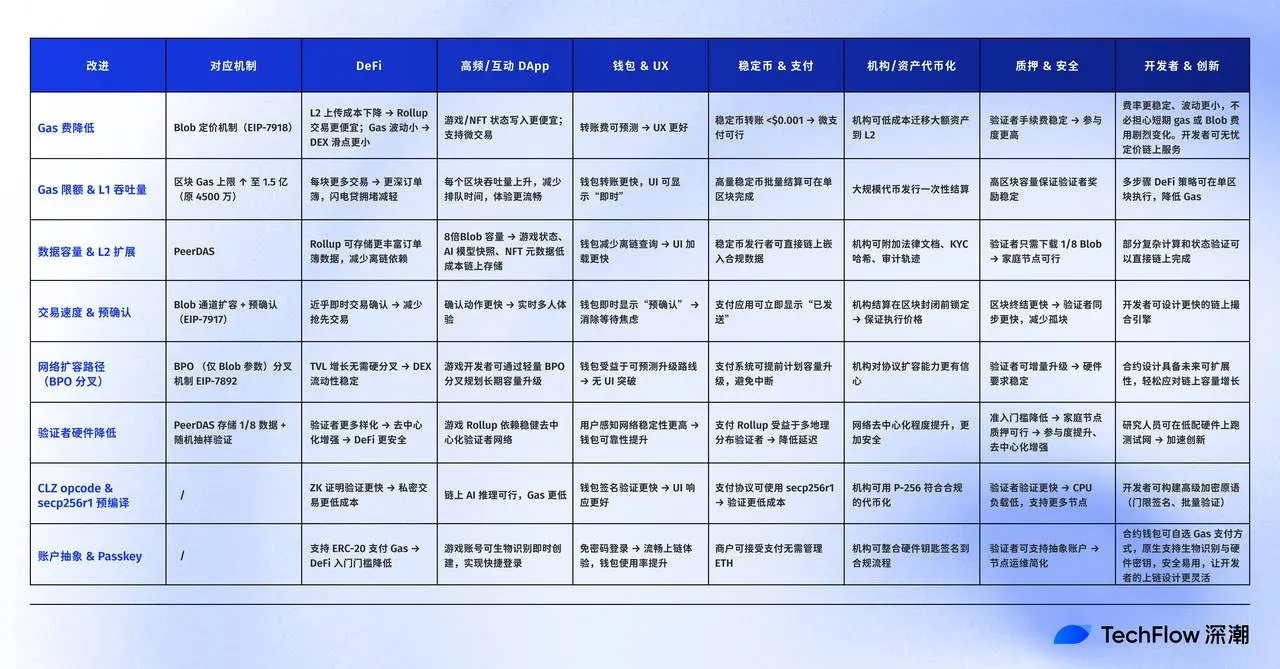
Next, we will explain the core logic of the Fusaka upgrade from both technical and practical impact perspectives.
This is not a technical report meant only for developers; we will explain it in a way that even technical novices can easily understand, helping you quickly grasp the key changes behind this upgrade. If you're not interested in the operational mechanisms, you can skip directly to the latter part to see how this upgrade will affect the Ethereum ecosystem and the experience of every user.
Core of Fusaka Upgrade: Further Scalability
The core purpose of the following technical improvements is singular: to achieve further scalability while ensuring security and decentralization.
PeerDAS: From Full Storage to Sampling Verification
Blob is a new type of data block for storing large amounts of on-chain data in Ethereum, packaging Layer 2 transactions into a "big box," similar to a courier company delivering a large number of packages efficiently uploaded on-chain without occupying permanent storage space.
Before the Fusaka upgrade, each node had to verify data by fully storing every package like a courier company, resulting in overloaded warehouses, strained bandwidth, and skyrocketing node costs.
PeerDAS proposes a more elegant solution: no longer full storage, but network-wide sharding sampling.
Storage: Each blob is divided into 8 parts, and nodes only randomly store 1/8 of it, with the rest distributed among other nodes.
Verification: Through random sampling verification, the error probability is as low as 10²⁰–10²⁴. Nodes can quickly retrieve missing segments using erasure codes, easily reconstructing complete data.
It sounds simple, but it represents a significant improvement in data availability. This effectively means:
- · Node burden decreases by 8 times;
- · Network bandwidth pressure drops sharply;
- · Storage shifts from centralized to distributed, further enhancing security.
Blob Pricing Mechanism
In the Dencun upgrade, Ethereum introduced blobs, allowing Rollups to upload data at a lower cost. Its fees are dynamically adjusted by the system based on demand. However, some limitations have emerged in practice:
When demand plummets, fees can drop to nearly zero, failing to reflect the actual resource usage.
When demand surges, blob fees can spike instantly, causing Rollup costs to soar and block delays.
The severe fluctuations stem from the protocol's inability to perceive the complete price structure, adjusting prices solely based on short-term "consumption."
EIP-7918 in the Fusaka upgrade aims to address the issue of fluctuating fees. The core idea is to no longer allow blob fees to fluctuate indefinitely but to set a reasonable price range for them.
It adds a layer of minimum reserve pricing to the pricing system:
- When prices fall below the execution cost threshold, the algorithm will automatically apply brakes to prevent fees from dropping to nearly zero;
- At the same time, it limits the speed of price adjustments during high load to prevent fees from skyrocketing.
Another EIP-7892 makes Ethereum more friendly to Layer 2. It allows the network to dynamically fine-tune the capacity, quantity, and size of blobs like turning a knob. There is no need to initiate a complete hard fork for parameter adjustments as before.
When L2 requires higher throughput or lower latency, the mainnet can respond instantly to match these demands, significantly enhancing the system's flexibility and scalability.
Security and Usability
Security
Scalability allows Ethereum to handle more transactions, but it also increases the potential attack surface. DoS attacks, or Denial of Service attacks, can lead to network congestion, transaction delays, or even node paralysis, significantly degrading the user experience and security of the entire chain.
Ethereum already has strong DoS resistance designs, and these improvements are not fixes for defects but rather an additional layer of protection on the existing security framework.
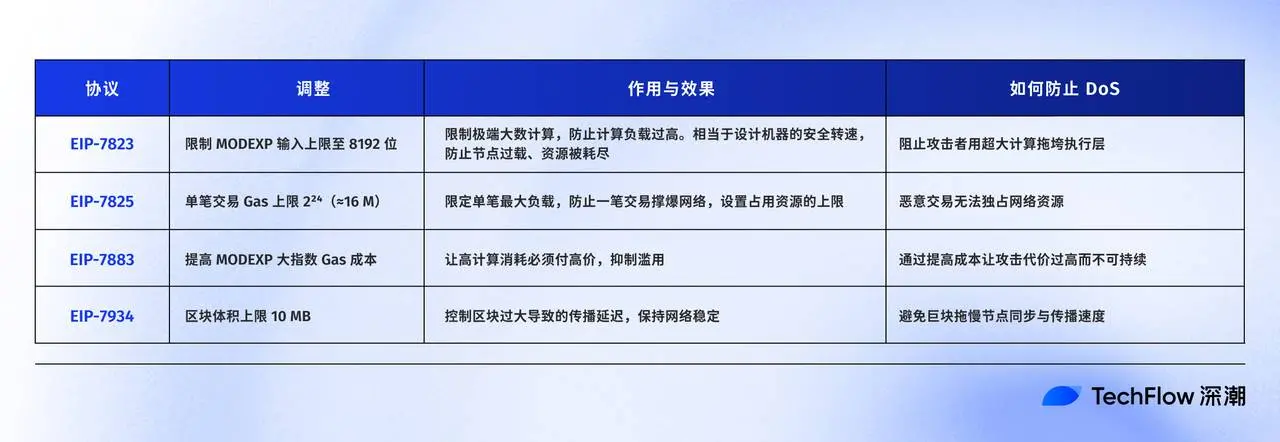
In simple terms, if Ethereum is a highway, then the four EIPs of Fusaka are like simultaneously controlling vehicle speed (EIP-7823), vehicle weight (EIP-7825), toll fees (EIP-7883), and vehicle length (EIP-7934) on the highway, limiting computational load, transaction volume, operational costs, and block size from multiple dimensions, allowing for increased traffic flow while ensuring all vehicles can pass quickly, maintaining Ethereum's robustness, smoothness, and attack resistance during scalability.
Usability
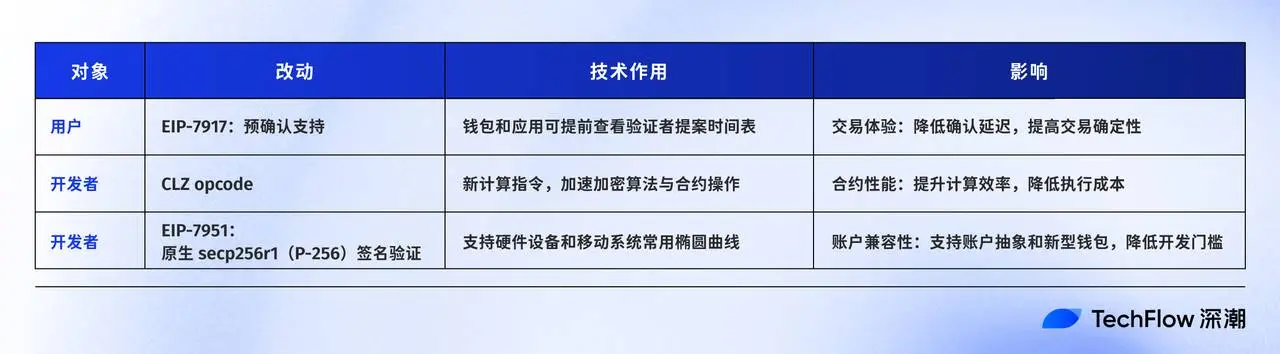
For users, using the highway analogy again: a simple way to understand pre-confirmation is that you can reserve a parking space at the highway entrance, locking in your exit time before the vehicle enters the station, with block confirmations almost instantaneously completed.
For developers: Fusaka optimizes the execution environment: enhancing contract computation efficiency, reducing the cost of complex operations, while supporting hardware keys, fingerprints, and mobile device logins, simplifying account management and user interaction.
Practical Impact
Setting aside the technical aspects, how significant are the changes in user experience and ecosystem? Just look at the visuals to understand:
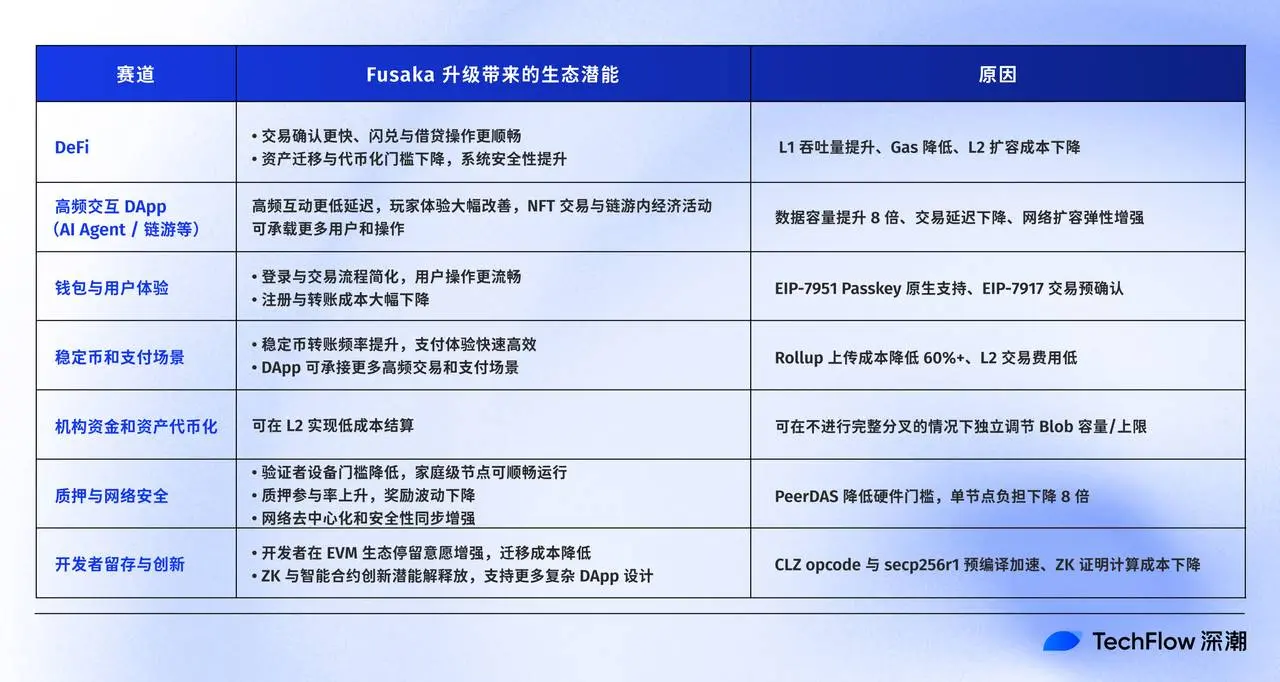
Due to space limitations, here are some points that might be of particular interest:
Staking Will Become Safer and More Stable
In the past, becoming an Ethereum validator was more like a professional sport—high hardware thresholds, complex operational processes, and data synchronization times of several days made it daunting for ordinary users. The Fusaka upgrade is making all of this truly enter the "civilian era."
With the launch of the PeerDAS mechanism, nodes only need to sample download and store about 1/8 of the data segments when verifying blob data availability, significantly reducing bandwidth and storage costs. What is the result?
Before the Fusaka upgrade, according to the official Ethereum.org blog, 32 ETH validators could run nodes stably on devices with just 8 GB of memory. The upcoming Fusaka upgrade will further reduce the bandwidth and storage requirements for validators. Let's look at the data intuitively:
- In the Fusaka testnet, the bandwidth required to become a validating node is about 25 Mb/s.
This device requirement is not high. After the Fusaka upgrade, under good and stable network conditions, more household devices can run Ethereum validating nodes, enjoying native staking rewards.
Fusaka makes household-level nodes a reality—no longer just professional operators, more household devices can join the network validation, jointly ensuring Ethereum's security while directly sharing staking rewards.
This is a true strengthening of decentralization. The lowering of operational thresholds means more independent validators can join, and more validators lead to a more stable, resilient, and decentralized Ethereum.
From an investor's perspective, this is also an optimization of staking risk structure: when validating nodes are no longer concentrated among a few large operators, the chain can maintain stability under high loads; volatility decreases, and the yield curve becomes smoother.
High-Frequency Interaction: Fusaka Opens the Era of "Real-Time Ethereum"
In the Web3 world, DeFi, payments, and AI Agents share a common bottleneck: they all require real-time responsive networks.
In the past, Ethereum was secure but not smooth enough. The rhythm of one block every 12 seconds was sufficient for large single transactions; however, for continuous instruction calls from AI Agents and millisecond-level settlements for on-chain payments, this rhythm is clearly too slow.
Fusaka changes all of this.
Through PeerDAS, increased Gas limits, and reduced L2 costs, Ethereum becomes more suitable for supporting high-frequency interactive applications.
We may soon witness a more instantaneous and explosive Ethereum ecosystem.
Here’s a detailed look at DeFi:
Fusaka not only enhances throughput but also directly optimizes the operational experience of DeFi. Lending, synthetic assets, and high-frequency trading protocols can "run faster and cost less."
Here are a few examples of common protocols:
- · Aave: Loan liquidation windows are shortened, and liquidation fees decrease. This is due to lower L2 upload costs, allowing liquidation transactions to be packaged faster, reducing slippage and delay risks.
- · Synthetix: Instant settlement times for synthetic assets are reduced, and contract interaction fees decrease. The increased blob capacity allows large contract calls to no longer be limited, making fund operations more efficient.
- · High-Frequency DEX: Pool depth increases, and large trades no longer generate significant slippage. The driving force behind this is the increased block Gas limits and lower L2 upload fees, significantly enhancing liquidity utilization.
Conclusion
The potential brought by the Fusaka upgrade is immense; it may become the most ecologically driven upgrade for Ethereum since Merge and Dencun, marking the third milestone-level upgrade.
From an 8-fold increase in on-chain data capacity, a sharp drop in transaction fees, and several times improvement in throughput, to lowered validator thresholds—when all these changes come together, the Ethereum ecosystem will unleash vitality in this new phase following the Fusaka upgrade.
We should all closely observe: after Fusaka, will Ethereum usher in a whole new growth cycle?
免责声明:本文章仅代表作者个人观点,不代表本平台的立场和观点。本文章仅供信息分享,不构成对任何人的任何投资建议。用户与作者之间的任何争议,与本平台无关。如网页中刊载的文章或图片涉及侵权,请提供相关的权利证明和身份证明发送邮件到support@aicoin.com,本平台相关工作人员将会进行核查。


