No matter what happens in court, Storm's impact on cryptocurrency is already set in stone.
Written by: Thejaswini M A
Translated by: Block unicorn
Introduction
At 6 AM, the door was suddenly blown open.
Roman Storm woke from his sleep to the sound of splintering wood and the screams of his three-year-old daughter. Federal agents stormed into his home in Auburn, Washington, brandishing rifles. Storm stood in his pajamas, hands raised.
They handcuffed him in front of his crying daughter. They confiscated his computer. They emptied his crypto wallet. Millions of dollars vanished into thin air.
The raid was not due to drugs, terrorism, or violence. Roman Storm was charged with writing software that privatized blockchain transactions.
He developed Tornado Cash — a non-custodial, trustless, permissionless software.
For federal agents, it was these very characteristics that made him the mastermind of a multi-billion dollar money laundering operation.
Roman Storm faces a potential 45-year federal prison sentence. His case will determine whether privacy continues as a right or becomes a privilege that the government can arbitrarily revoke; whether code is free speech or conspiracy to commit a crime; and whether programmers can build tools without becoming criminals.
The Computer Kid from Chelyabinsk
Roman Storm's path to becoming America's top cryptocurrency developer began in the ruins of the post-Soviet era. Chelyabinsk, nestled between the Ural Mountains, is a forgotten industrial city. Storm witnessed Russia's painful transition from communism to capitalism, with millions of families struggling to survive in the rubble. His parents held ordinary jobs with ordinary salaries. But they saw potential in their tech-obsessed son.
The computer they bought him opened his eyes. In 1990s Russia, where every family struggled between food and heating, owning a personal computer was almost unimaginable luxury. Storm's parents bet everything on their child's potential.
He immersed himself in that machine. He learned programming by analyzing and reconstructing games. He coded day and night. Russia felt small and limiting to him. The United States beckoned with infinite possibilities.
At 19, Storm took the leap. He left behind family, friends, and everything familiar, moving from Chelyabinsk to Seattle.
With a relentless pursuit of the American Dream, he understood deeply what it meant to have nothing. Eventually, he became a U.S. citizen, swearing in with the same immigrant fervor.
Storm climbed the technical ladder at Cisco and Amazon. He followed a standard immigrant programmer's path at some of America's largest companies. He learned software development, system architecture, and perhaps it was these skills that shaped his expertise in blockchain.
While his colleagues were obsessed with enterprise software and cloud services, Storm looked elsewhere, focusing on technologies that could reshape how value flows in the digital space.
The Awakening of Blockchain
Storm's entry into the crypto world was inevitable.
As a Solidity expert at Blockchainlabs.nz, he consulted for projects during the 2017 ICO boom, building smart contracts and designing decentralized systems. He witnessed billions of dollars pouring into experimental projects that promised to revolutionize everything from identity to supply chains.
Most projects failed. But perhaps it was then that Storm began to understand the true power of programmable money.
In 2017, he achieved a breakthrough: the POA consensus protocol. Proof-of-Authority abandoned energy-intensive mining in favor of reputation-based validation. Pre-approved validators staked their reputation rather than computational power.
Storm's POA network became a true financial infrastructure. As CTO, he built a software processing platform worth $150 million for over 100,000 users.
The Privacy Issue
After the success of POA, Storm founded PepperSec Inc., providing security consulting for blockchain projects. Auditing DeFi protocols exposed a fundamental flaw in public systems.
The problem was simple and terrifying: every Ethereum transaction is permanent and visible to everyone. Traditional banks hide your balances, your spending, and your financial relationships. Blockchain strips all that away. Anyone with internet access can trace every payment, every purchase, every connection. If they can link your address to your identity, your entire financial life becomes a public record.
Storm believed that transparency was not just a technical limitation but an infringement on human dignity. People need financial privacy. To donate to controversial causes, pay medical bills, or buy a cup of coffee without broadcasting it to the world.
He was not alone. Roman Semenov and Alexey Pertsev shared his vision. Together, they built a solution that used cutting-edge cryptography to restore privacy on the blockchain.
They called it Tornado Cash.
Tornado Cash utilized zero-knowledge proofs to break blockchain surveillance. Users could prove they deposited funds without revealing which deposit it was. It was like showing someone you have a key without letting them see the key itself.
How does it work? You deposit cryptocurrency into a smart contract pool. In return, you receive a cryptographic receipt. Then, you withdraw the same amount to a completely different address. There is no on-chain connection between the deposit and withdrawal.
The revolutionary aspect of Tornado Cash is that it does not hold user funds like centralized mixers do. Tornado Cash never touches user funds; everything is handled by smart contracts. No exit scams, no government seizures.
Storm and his co-founders cannot access user funds, reverse transactions, or freeze assets.
"I poured my soul into Tornado Cash — a non-custodial, trustless, permissionless, immutable, unstoppable software," Storm wrote.
Every word is crucial. Non-custodial: never holds user funds. Trustless: users do not need to trust the developers. Permissionless: anyone can use it. Immutable: the code cannot be modified. Unstoppable: no government can kill it.
Storm launched Tornado Cash in 2019, firmly believing he was building the infrastructure for financial freedom. Adoption surged among privacy-focused users tired of financial surveillance. Ethereum founder Vitalik Buterin used it for anonymous donations. Activists in authoritarian countries could receive funding without being detected. Ordinary people could protect their spending from employers, competitors, and criminals.
But Storm's creation also attracted other users.
The features that protect activists could also conceal stolen funds. If you can hide legitimate transactions, you can also launder stolen money. The technology is non-discriminatory. Storm's team was well aware of this, but they chose education over restriction.
They developed tools to verify clean funds, communicated best practices, and adhered to their philosophy: technology is neutral. A knife can be used to prepare food or to commit murder. We do not blame the blacksmith. This philosophy faced the ultimate test.
The Lazarus Factor
In March 2022, disaster struck. The North Korean hacking group Lazarus stole $620 million from the backbone network of Axie Infinity — the Ronin Network.
In the following months, $455 million of the stolen Ethereum flowed through Tornado Cash. The hackers laundered their loot through Storm's creation.
Federal prosecutors later claimed that Storm and his team knew about the money laundering but "refused to implement controls." They received complaints from victims and law enforcement but chose profit over compliance.
Storm's team had a different perspective. Implementing controls would destroy decentralization. If they could blacklist addresses or freeze funds, they would not be building a censorship-resistant system but creating another gatekeeping system.
The divide could not be bridged. The government demanded traditional financial compliance, Know Your Customer (KYC) procedures, compliance departments, and regulatory submissions. Storm believed these requirements would destroy all the value of Tornado Cash.
On August 8, 2022, everything changed. The U.S. Treasury's Office of Foreign Assets Control directly sanctioned Tornado Cash. This was the first time in U.S. history that lines of code were deemed illegal.
The sanctions made any interaction by U.S. persons with Tornado Cash smart contracts a crime. Overnight, a privacy tool used by thousands of users became contraband.
The Nightmare Begins
Nearly a year after the sanctions, Storm lived in Washington state. He believed that his role as a software developer would protect him from criminal charges.
But he was wrong.
August 23, 2023 shattered that illusion.
Storm later described the raid: armed federal agents intimidating a family over software code, which became a rallying cry for the crypto community.
The charges were serious. Conspiracy to commit money laundering: up to 20 years. Conspiracy to operate an unlicensed money transmission business: up to 5 years. Conspiracy to violate sanctions: up to 20 years.
Total potential sentence: 45 years. Equivalent to life imprisonment.
After being released on a $2 million bail, Storm entered a legal quagmire. Under the full pressure of the federal government, his life savings evaporated into legal fees. Co-founder Roman Semenov remained at large in Russia. Developer Alexey Pertsev was arrested in the Netherlands in May 2024 and sentenced to over five years in prison — later, Trump made good on his promise, and he was released:
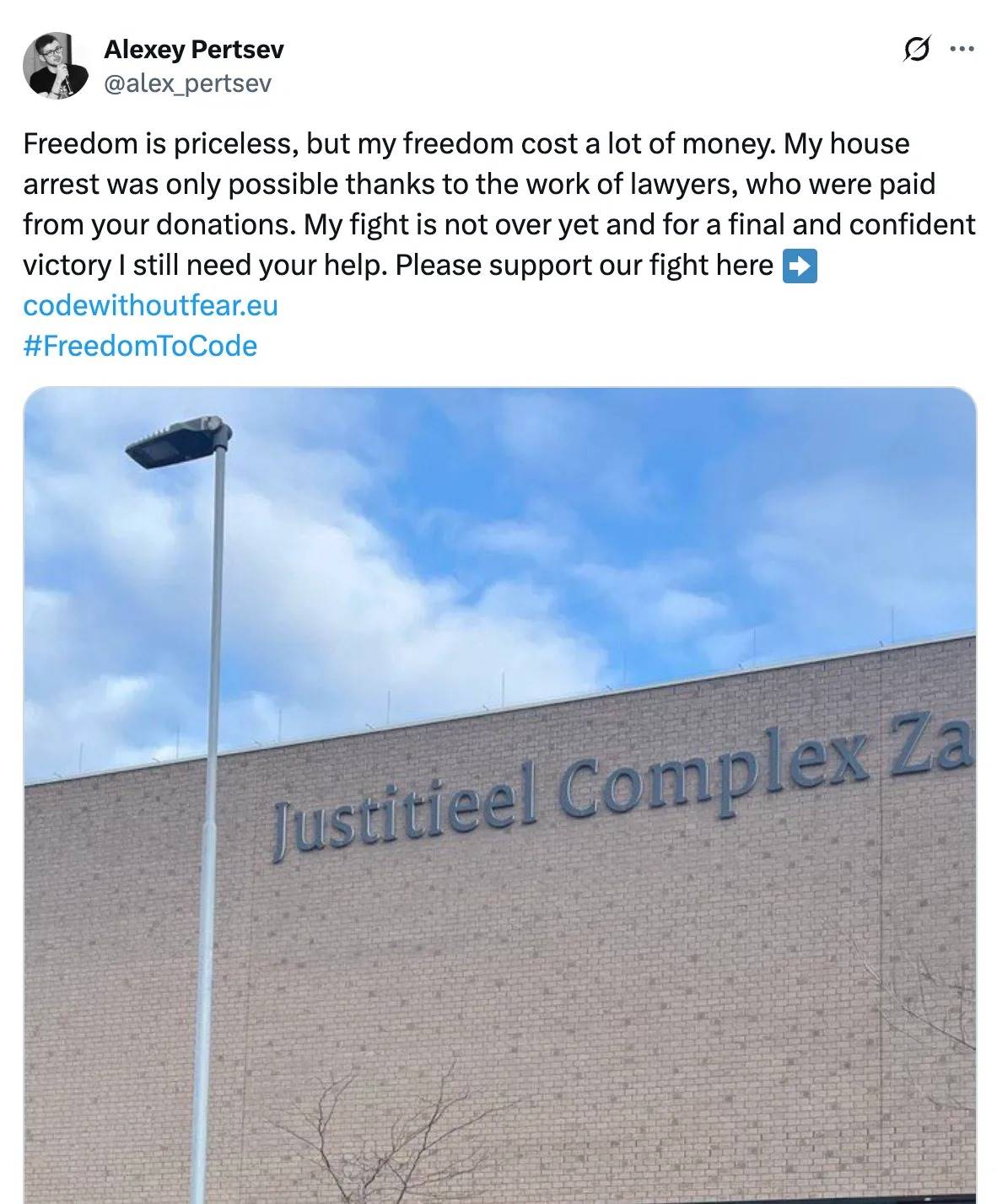
But for Storm, the situation was different.
David vs. Goliath
Storm's legal team, led by Brian Klein and Keri Curtis Axel, focused their defense on two fundamental issues: software development and criminal intent.
The first argument: Tornado Cash does not fit the definition of a money service business. It is decentralized, does not control user funds, and does not charge fees. Traditional money transmission laws target centralized services that hold customer funds, not autonomous smart contracts.
The second argument: The government's case failed to prove the specific intent required for money laundering charges, relying instead on Storm's alleged failure to prevent software misuse, rather than evidence that he knowingly participated in concealing criminal proceeds.
Criminal money laundering charges require proof that someone intentionally assisted in concealing criminal proceeds. Storm's alleged crime was failing to prevent the misuse of self-operating software.
The third argument: Sanction violations depend on the actions of third parties like the Lazarus group, which have no connection to Storm personally. Should software developers be held responsible for every possible misuse of their creations? By the same logic, can we hold the creators of internet protocols like TCP/IP accountable? After all, the internet has also been used for money laundering.
Storm's supporters emphasize the technical reality: "You cannot transfer funds unless you have custody or control." Since Tornado Cash operates through immutable smart contracts, Storm's team cannot access, freeze, or redirect user funds after deployment.
How do you conspire to launder money through a system you cannot control?
Unity in the Crypto Community
Storm's charges have united the cryptocurrency community in unprecedented ways. The case has become a rallying point for privacy advocates, decentralized finance (DeFi) developers, and digital rights organizations who view Storm's prosecution as a threat to the survival of innovation.
On June 13, 2025, the Ethereum Foundation pledged $500,000 for Storm's legal defense and promised to match community donations up to $750,000. Their statement was straightforward: "Privacy is normal, and we are committed to protecting the rights of those who build privacy tools."
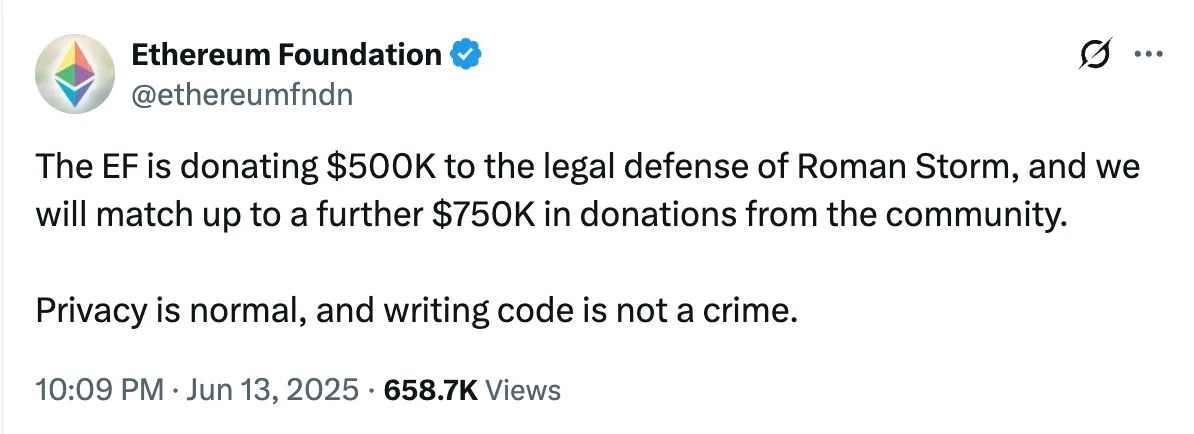
On December 31, 2024, Vitalik Buterin donated 50 Ethereum (approximately $170,000). Paradigm donated $1.25 million and submitted a strong amicus brief.
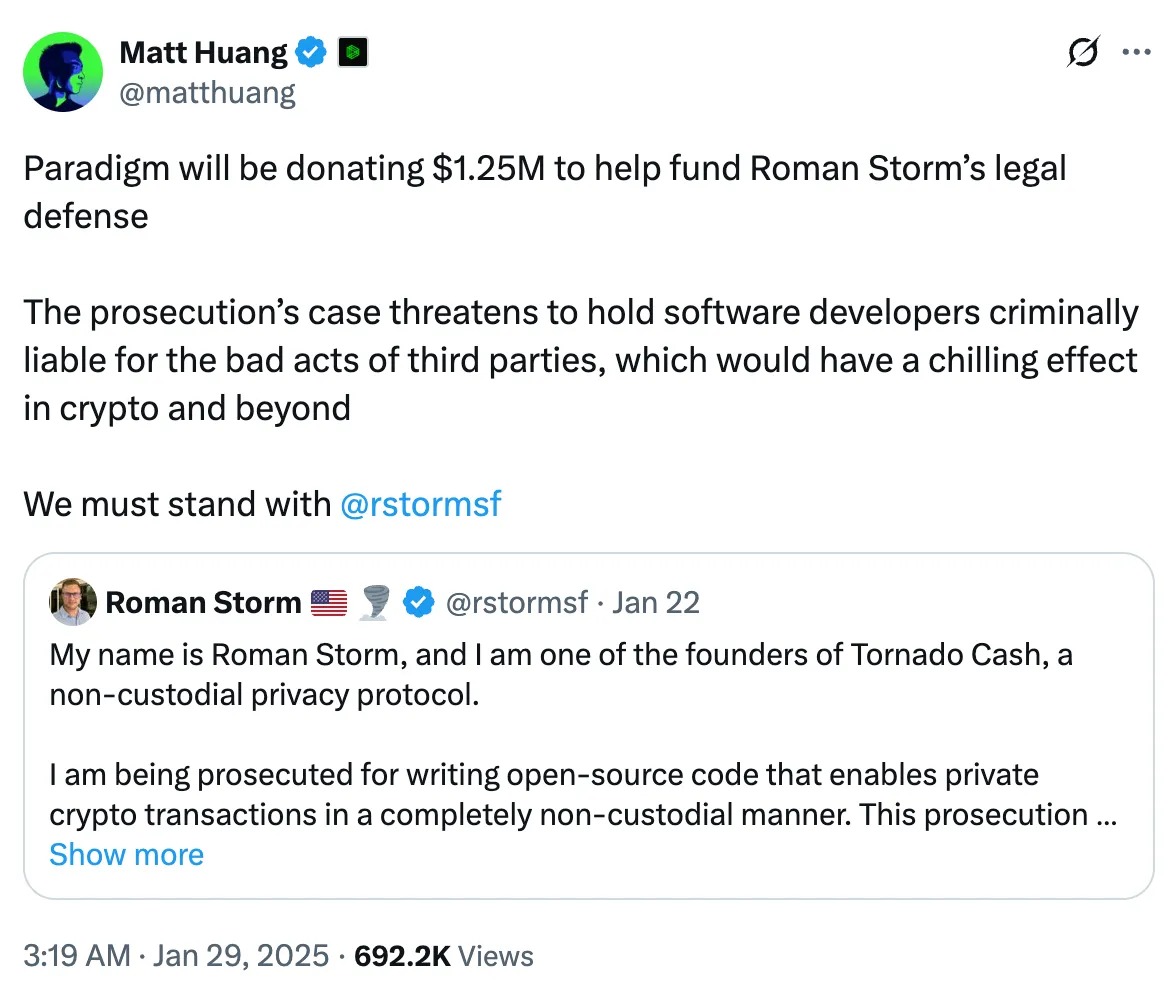
The Electronic Frontier Foundation (EFF) believes Storm's prosecution "extends criminal law beyond its intended scope" and could stifle privacy-focused software development.
Even Vivek Ramaswamy weighed in, arguing that developers should not be prosecuted for third-party misuse of code.
This support reflects genuine concern about the potential impact of a conviction on the future of software development.
Paradigm's amicus brief captured the core issue:
"The position of the Southern District of New York effectively means that any developer of neutral code could be held criminally liable for the use or misuse of that code. It would be as absurd as suing a television manufacturer for leaking state secrets on a television, suing a leather wallet maker for hiding stolen money in a wallet, or suing Apple for conspiracy through phone calls on an iPhone."
This case exposes the fundamental contradictions in the U.S. approach to regulating emerging technologies. Despite the Department of Justice issuing a memo in April 2024 terminating "regulation by prosecution" of crypto services, the Southern District of New York continues to pursue Storm under different legal theories.
Critics argue that prosecutors are using Storm's case to establish precedents that Congress never intended. If the government's theory succeeds, developers of privacy browsers and encrypted messaging could face criminal liability for user actions beyond their control.
The international implications are equally severe. Other countries are watching to see whether the U.S. remains welcoming to technological innovation or becomes a cautionary tale of regulatory overreach.
Human Costs
Beyond the legal complexities lies a personal story: a man watching the American Dream turn into a nightmare.
Storm believes his case is not just a personal legal struggle but a critical moment for the entire industry. Living under a $2 million bail and federal indictment, he faces ongoing restrictions while prosecutors attempt to exclude his expert witnesses. "The Southern District of New York is trying to crush me, blocking every expert witness."
As the trial date of July 14, 2025, approaches, the stakes become clear. The key to the trial is whether jurors understand the distinction between creating software and controlling services. Can prosecutors convince them that Storm was running a business rather than releasing open-source code?
The resource gap remains stark. The government has unlimited resources. Storm's defense relies on community donations, raising about $3 million but still needing $1.5 million.
Regardless of the verdict, the established precedent will impact cryptocurrency development for decades to come.
Our Perspective
No matter what happens in court, Storm's impact on cryptocurrency is already set in stone. His work on the POA network, blockchain interoperability, and Tornado Cash's zero-knowledge proofs has helped build today's DeFi ecosystem and influenced countless privacy applications. But perhaps his most significant contribution is forcing a long-overdue discussion about privacy and security in the digital age.
Ironically, Storm came to the U.S. to pursue the freedom to innovate and build technologies that make the world more open. Now, the same government seeks to imprison him for exercising those freedoms.
Storm's trial will determine not just one person's fate. It will decide whether America remains a place where curiosity and code can reshape the world or whether innovation must yield to institutional control.
If Storm is convicted, the message to developers will be clear: build controllable tools, or face imprisonment. If acquitted, it could establish crucial protections for software developers and clarify the line between legitimate innovation and criminal conspiracy.
This choice belongs to the twelve jurors who will decide whether a curious boy from post-Soviet Russia should spend the rest of his life in an American prison for writing code that privatizes blockchain transactions.
As Storm wrote: "This is not just my end; it is our end."
The verdict will define the relationship between technology and freedom in the 21st century, determining whether privacy continues as a right or becomes a crime.
免责声明:本文章仅代表作者个人观点,不代表本平台的立场和观点。本文章仅供信息分享,不构成对任何人的任何投资建议。用户与作者之间的任何争议,与本平台无关。如网页中刊载的文章或图片涉及侵权,请提供相关的权利证明和身份证明发送邮件到support@aicoin.com,本平台相关工作人员将会进行核查。


