Living in the moment is key.
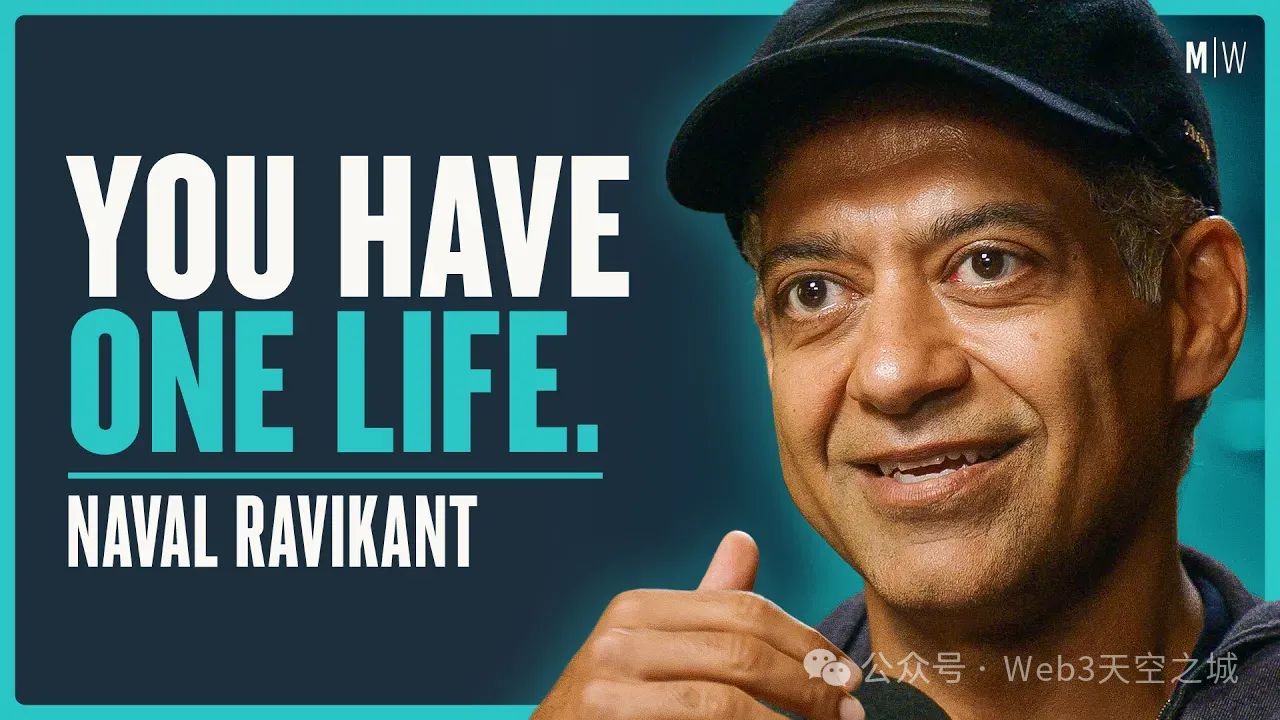
[The Lord of the City says] Naval, a renowned entrepreneur and angel investor. Besides his business success, Naval's broader online influence comes from his profound insights on wealth creation, happiness, and life philosophy. He often shares thoughts on leveraging, cultivating unique skills, taking responsibility, continuous learning, and pursuing inner peace rather than fleeting happiness.
Naval is known for his clear, rational, and highly condensed wisdom, having a significant impact in the tech community and among those seeking personal growth. In simple terms, he is a successful entrepreneur and a highly respected life mentor and thinker.
Naval's latest interview has recently begun to circulate in the Chinese-speaking world. On Bilibili in our city, the full video of this interview was released in early April:
https://www.bilibili.com/video/BV1QbRfY8ECZ/
At the request of fans, I am sharing the complete written version in Chinese here, filled with valuable content totaling 70,000 words. (Note: The latest long videos released on Bilibili are accompanied by full transcripts, so fans interested in reading the text can follow along.)
First, here are the main points of the interview:
The Paradox of Happiness and Success:
The interview opens by pointing out the classic contradiction: happiness comes from satisfaction, while success comes from dissatisfaction. Naval believes that happiness (being content with the current situation, not desiring change) is the more fundamental goal, while traditional notions of success (material satisfaction, achieving goals) are merely one of the paths to happiness, and may not even be the best path.
He cites the stories of Socrates and Diogenes, emphasizing that reducing desires is a form of freedom, with value equal to that of possession.
Naval argues that being happier can actually make you more successful, as happiness gives you more energy, focus, and willingness to do what you excel at and love, thus naturally surpassing others. Happiness and success are not a trade-off, but rather complementary.
Pain, Journey, and the Present:
Naval distinguishes between physical pain and psychological/mental pain. The latter often stems from our avoidance of tasks, dissatisfaction with the current situation, and inner obsessions and judgments.
He emphasizes that what matters in life is to enjoy the journey itself, rather than just focusing on the outcome. Because 99% of life is spent on the journey. Forcing oneself to endure pain in pursuit of results may ultimately lead to regret.
He suggests recognizing through thought exercises (such as reflecting on feelings and goals from specific moments in the past) that much of the pain and obsession at the time may not be necessary in the present. Completing work calmly, even joyfully, is more effective than doing so amidst unnecessary emotional turmoil.
Living in the moment is key. Wasting time is not about doing nothing, but about being absent-minded, not fully engaged in what you are doing at the moment.
Deconstructing the Wealth and Status Game:
Wealth creation is a positive-sum game, allowing for the creation of value that benefits everyone. It can solve financial problems and bring material rewards.
The status game is a zero-sum game, based on rankings and hierarchies, where elevating one's status often means lowering others', inherently competitive and likely to provoke negative emotions.
Humans are hardwired through evolution to pursue status, as it was the only way to acquire resources before the concept of wealth emerged. However, in modern society, wealth creation is a more worthwhile and enjoyable game to pursue.
Fame is a form of status, best when earned, as a byproduct of creating value rather than being pursued for its own sake. Seeking fame for the sake of fame is empty and fragile.
Self-Awareness, Self-Esteem, and Authenticity:
Naval emphasizes the importance of authenticity. Lying (to oneself or others) traps one in a "hall of mirrors," bound by past words and actions. The world is severely lacking in authenticity, and people are very sensitive to it.
Self-esteem comes from within, being "one's own reputation." The key to building self-esteem is strictly adhering to one's internal moral code, remaining consistent in words and actions even in difficult times. Contributing to others and taking responsibility can also enhance self-esteem.
Self-doubt and lack of confidence are different. Healthy doubt is "I don't know what to do, I need to figure it out," rather than "I am not worthy" or "Others know better than I do."
Know yourself: Your implicit knowledge and intuition far exceed what you can articulate clearly. Learn to observe your thoughts and feelings, cultivating the ability to objectively examine yourself (similar to the effects of meditation), rather than fully identifying with and indulging in your thoughts.
Ruthlessly Prioritizing Yourself and Time Management:
Naval candidly admits to being "wholly selfish," believing that everyone essentially puts themselves first.
Time is extremely limited and precious (using 4,000 weeks as an example). He advocates for defaulting to saying "no" to all unimportant things, keeping the calendar free to focus energy on truly important and inspiring matters.
Refuse to commit to the future, avoiding being "kidnapped" by your past self. Maintain flexibility, acting according to the current flow and inspiration for maximum efficiency.
"Self-prioritizing without apology" is not selfishness, but a means to protect one's time and energy, allowing for better focus on creating value and pursuing truly important matters. This requires practice to break free from societal expectations.
Decision-Making and Intuition:
Critically examine your thinking, distinguishing between real problems and those created in your mind. Much anxiety stems from ruminating on things that are uncontrollable or unimportant.
Reflecting on death is an effective way to alleviate anxiety, realizing that everything will eventually return to zero helps to let go of unnecessary worries.
The true test of intelligence is "Did you get what you wanted from life?" This includes two parts: knowing how to obtain and wanting the right things.
When making decisions, prioritize long-term peace. When faced with two seemingly equal choices, choose the one that is more painful in the short term, as the brain tends to overestimate short-term pain and underestimate long-term pain.
Trust your intuition, but test it with reason. Intuition is refined judgment and taste, a synthesis of long-term experience and thought. When making significant decisions, think repeatedly, weigh pros and cons, but ultimately listen to the intuition that arises with conviction.
The three major life decisions: who to be with, what to do, where to live. These early decisions have far-reaching impacts and are worth spending a significant amount of time (e.g., one-third of the decision-making cycle) exploring and contemplating (analogous to the secretary problem).
Embrace Iteration, Cut Losses Quickly:
The essence of learning is error correction. Engaging in 10,000 iterations on anything is closer to mastery than repeating for 10,000 hours.
Cutting losses quickly is crucial. Once you realize that a relationship, project, or path is no longer effective, you should leave as soon as possible, without sunk costs.
Be optimistic about specific things, optimistic overall, but skeptical about specific opportunities.
Find Your "Game":
The key to success is "Productize Yourself." Find those things that feel like play to you but feel like work to others, and that the world needs, then scale them.
Escape competition through your authentic self. The more natural and aligned with your nature what you do is, the less competition you will face.
Utilize the infinite opportunities provided by modern society to explore and try, finding the fields, locations, and people that suit you best. Do not commit too early.
Happiness, Relationships, and the Foundation of Values:
Inner happiness first: True happiness comes from within, not from external circumstances or others. Trying to change others to gain happiness is futile. "The secret to happy relationships is two happy people."
Value alignment is crucial: The foundation of long-lasting relationships (whether partners or others) is a deep consensus on values, which is far more important than shared interests. Values manifest in actions during difficult choices.
The importance of genetics: Naval emphasizes the significant role of genetics in behavior and character, believing that environmental influences are often overestimated. Choosing a partner is, to some extent, also choosing the genetic foundation for your children.
The Power of Learning, Truth, and Understanding:
Understanding surpasses memory and discipline: True learning lies in deep understanding, not rote memorization ("If you have to memorize, it means you haven't understood"). On a psychological level, understanding can change behavior more durably than discipline. Once you see the truth, it is hard to unsee.
"Unteachable lessons": Many of life's most important lessons (such as the relationship between money, fame, and happiness) cannot be learned through guidance; they must be experienced personally. Wisdom is often a cliché until personal experience gives it meaning.
Context is king: Universal philosophical advice is often too broad and must be applied in specific contexts. Life itself is the best place to test and filter applicable principles.
Self-Awareness, Identity, and Embracing Change:
Overcoming loss aversion and fear: Humans are inherently averse to loss, fearing change and starting from scratch. However, successful individuals are willing to start over repeatedly, whether in careers or relationships.
Don't take yourself too seriously: Fame and others' opinions can lead to excessive concern for self-image, limiting action and exploration. Maintaining curiosity and a state of "inner child" is crucial.
The Fluidity of Identity: One should not be bound by past identities or beliefs. When reality conflicts with perception, one should be brave enough to update or even break the old self.
Technology, the Future, and Social Trends:
The Reality of Artificial Intelligence (AI): Naval believes that large language models (LLMs) are powerful tools (solving problems like search, translation, and some coding) and represent a fundamental breakthrough in computer science, but they are not general artificial intelligence (AGI) or superintelligence (ASI). He views them as a different form of intelligence, not a necessary path to human-level or beyond human intelligence, and is skeptical about AGI/ASI.
Reflections on Modern Medicine and the GLP-1 Revolution: He sharply criticizes certain limitations of modern medicine (such as excessive intervention and lack of profound theoretical explanations) while highly praising GLP-1 drugs (like Ozempic), calling them "the most groundbreaking drugs since penicillin." He believes they could bring revolutionary impacts not only in weight loss but also in anti-aging and reducing the risk of various diseases, profoundly changing the structure of society and healthcare costs.
Social Cooperation Systems and Individual Freedom: He reflects on the limitations of pure liberalism, acknowledging the importance of culture, religion, and other cooperative systems. At the same time, he addresses the issue of low birth rates, believing it is more a result of individual choices (women's liberation, hedonism) and economic factors rather than a problem requiring forced intervention, and he trusts that economic and incentive mechanisms will ultimately find solutions.
Parenting Philosophy: Freedom, Love, and Autonomy:
Unconditional Love (as Output): The greatest responsibility of parents is to provide unconditional love (as a parental behavior output, rather than requiring the child to feel it) and to cultivate the child's self-esteem through this.
Protecting Autonomy: Avoid over-"taming" children, encouraging them to maintain their innate initiative and willpower, allowing them to make mistakes and learn from them.
The Core of Education: Rather than instilling knowledge, it is better to cultivate critical thinking and a spirit of inquiry, teaching them how to think, how to question, and how to start from first principles.
The Nature of Wealth, Time, and Attention:
Wealth Equals Freedom: The true value of wealth lies in providing freedom—the freedom to choose, the freedom not to be beholden to others, the freedom to pursue curiosity, and the freedom to take risks to create value.
Attention is the Ultimate Currency: Time is not the most fundamental resource; focused "attention" is. What you choose to focus on determines the quality of your life experience. Be wary of the relentless deprivation of attention in an age of information saturation.
Here is the full dialogue:
[Host]: Happiness is being satisfied with what you have.
[Naval]: Success comes from dissatisfaction. So is success worth it? I'm not sure if that statement still holds true now. I said that a long time ago. And many of these things are just notes I give myself; they are highly contextual, they come quickly and go quickly. Happiness, well, that's a very complex topic. But I always like the story of Socrates, who walked into the market, and they showed him all these luxuries and fine things, and he said, how many things in this world do I not want? That is a form of freedom. So, not wanting something is just as good as having it. In an old story about Alexander and Diogenes, right? Alexander went out to conquer the world and met Diogenes, who lived in a barrel. Diogenes said, "You're blocking my sunlight." Alexander said, "I wish I could be like Diogenes in my next life." Diogenes replied, "That’s the difference; I don’t wish I could…" Sorry, it was Diogenes. Diogenes said, "I don’t…" So, there are two paths to happiness. One is the path of success. You get what you want, satisfying your material needs, or like Diogenes, you simply don’t want anything. I’m not sure which is more valuable. It also depends on how you define success. If the ultimate goal is happiness, then why not be straightforward and pursue it directly? Does happiness make you less successful? That’s a traditional wisdom. It may even be your actual experience in reality. You find that when you are happy, you don’t want anything, so you don’t get up to do things. On the other hand, you still need to do something. You are an animal. You are here. You are here to survive. You are here to reproduce. You are motivated. You are driven. You will do something. You won’t just sit there all day. It’s unlikely. Some people will. Maybe that’s their nature. But I think most people still want to act. They want to live in the moment. They want to be in the arena. I find that as my happiness becomes more of a big word, but more peaceful, calmer, more focused on the present, more satisfied with everything I have, I still want to do things.
[Naval]: I just want to do bigger things. I want to do something purer, more aligned with what I think needs to be done and what I can do uniquely. So in that sense, I think being happier can actually make you more successful, but your definition of success may change in the process.
[Host]: Is this an insight? Do you think you could have reached this point without achieving some success at the beginning?
[Naval]: At least for me, I always wanted to take the path of material success first. I wouldn’t go be a monk, sitting there giving up everything. That seems too unrealistic and too painful. In the story of Buddha, he started as a prince, and then he found all of it to be somewhat meaningless because you will ultimately grow old and die. Then he went into the woods to seek something deeper. I would choose the path of happiness that includes material success. Thank you.
[Host]: I think in some ways that’s faster. One of your insights is that achieving our material desires is far easier than giving them up.
[Naval]: It depends on the individual, but I think you have to try that path. If you want something, go pursue it. I joke that the reason to win the game is to get out of it. So you play the game, win the game. Then hope you get tired of the game. You don’t want to keep looping on the same game, even though many of these games are very engaging, have many levels, and are relatively open. Then in a sense, you get out of this game because you no longer want to win. You know you can win. Then either you turn to another game, or you simply play for the joy of the game itself.
[Host]: Another point you make is that most gains in life come from short-term pain to achieve long-term rewards. That’s classic. Winning the marshmallow test every day. But there’s an interesting challenge; I think people need to avoid becoming addicted to pain. Using pain as a proxy for progress rather than as a result of pain. Like, I feel pain for not eating the marshmallow. I feel pain while doing this work. I associate happiness and satisfaction with pain rather than with the results that pain brings.
[Naval]: If you define pain as physical pain, then that’s a real thing. It happens, and you can’t ignore it. But that’s not what we’re talking about when we say pain. Pain is primarily psychological pain and mental torment. It just means you don’t want to do the task at hand.
If you can do the task at hand well, then you won’t be suffering. Then the question is, what is more effective? Suffering in the process, or understanding it without suffering? You’ll hear many successful people, when they look back, say that the journey is the fun part; that’s actually the entertaining part, and I should have enjoyed it more. That’s a common regret. I like to do a little thought exercise where you can go back in your life and try to put yourself back in the exact position you were in 5 years ago, 10 years ago, 15 years ago, 20 years ago. Then you try to remember, okay, who was I with, what was I doing, what were my feelings, what were my emotions, what were my goals? Really try to transport yourself back and see what advice you could give yourself or what things you would do differently. Now, you don’t have new information. Don’t pretend. You could have gone back and bought stocks or bought Bitcoin or something else. But just based on your current mood and some age-related experiences, how would you do things differently? I think that’s a worthwhile exercise, so don’t let me take away your conclusions. But I’ll tell you, for me, I would do the same things, just with less anger, less emotion, and less inner turmoil. Because that is a choice. It’s not necessary. I think that being able to at least calmly, but perhaps happily, complete work is more effective than those who go through unnecessary emotional turmoil.
[Host]: Well, you ultimately achieve a series of painful successes, and the outcome may be the same, but the whole process of getting there… the journey is not just a reward.
[Naval]: The journey is the only thing that exists. Even with success, human nature makes us quickly forget it because the normal cycle we experience is that you sit there, feel bored, and then you want something. When you want something, you decide that you won’t be happy until you get that thing. Then you start to experience the pain or anticipation phase, working hard to obtain that thing. If you get that thing, you become accustomed to it, and then you feel bored again. Then a few months later, you want something else. If you don’t get it, you’ll be unhappy for a while, then you’ll overcome it, and then you’ll want other things. That’s the normal cycle. So whether you end up happy or not, it often doesn’t last.
I don’t want to flippantly say that how much money you make or success is meaningless; it absolutely is meaningful. Money can solve all your money problems, so having money is good. That said, there are indeed stories like that. I don’t know if you’ve seen those studies; I also don’t know how true these studies are. Many psychological studies cannot be replicated, but it’s an interesting little study that shows that those who are severely injured and those who win the lottery return to their baseline happiness levels after two years. Again, I emphasize, I’m not sure if this is entirely correct. I think if you earn money through hard work, money can buy happiness because in the process, you have pride and confidence, and you have a sense of achievement; you set goals and achieve them, so I bet that will linger in your heart. Then, as I said, money solves your money problems, so I don’t want to be too flippant about it. But I want to say that generally speaking, the cycle of desire, dopamine, satisfaction, and dissatisfaction that we experience, you have to enjoy this journey. The journey is everything, isn’t it? 99% of the time is spent on this journey. If you don’t intend to enjoy this journey, then what kind of journey is it? How can you shorten this contract of desire? You can focus; you can decide that you don’t want most things. I think we have a lot of unnecessary desires that are everywhere, and we have opinions and judgments about everything. So I think realizing these are sources of unhappiness will make you more discerning about your desires. To be honest, if you want to succeed, you have to be discerning about your desires; you have to focus. You can’t excel at everything; you’ll just waste your energy and time.
[Host]: Is fame a goal worth pursuing?
[Naval]: It can get you invited to better parties and take you to better restaurants. Fame is an interesting thing; many people know you, but you don’t know them. It does put you on a pedestal. It can provide you with what you want at a certain distance. So I wouldn’t say it’s worthless; clearly, there’s a reason people want it. It’s high status, and thus it attracts the opposite sex, especially men.
It attracts women, which means it comes at a high cost. It means you have no privacy. You will encounter weirdos and crazies. You will indeed be asked to do some strange things often. You are on stage, so you are forced to perform. You are compelled to be consistent with past statements and actions, and you will have haters and all that nonsense. But the fact that we all seem to want it means that saying, “No, no, I’m famous, but you don’t want to be famous” is hypocritical.
That said, I think fame, like anything else, is best generated or pursued as a byproduct of something potentially more valuable. The desire for fame, the craving for fame, and being famous just for the sake of being famous are all traps. Chasing fame for fame’s sake is not right.
So it’s better to earn fame. For example, respect gained in a tribe is because you did something beneficial for the tribe. Who are the most famous people in human history? They are those who transcended themselves, the Buddhas, Jesuses, and Mohammeds of the world. Who else is famous? Artists are famous. Art can last a long time. Scientists are also famous. They discover things. Conquerors are famous, presumably because they conquered other places for their tribes. They have something to fight for.
So overall, the more you do for a larger crowd, the higher your status, although this can be seen as tyranny or negative; for example, Genghis Khan is very famous, but for the Mongols, he was doing good. For others, not so much. The higher up you are in the hierarchy, the more people you care for, and the greater the respect and fame you gain. I think these are good reasons for becoming famous.
If fame is empty, if you are famous just because your name appears in many places or your face is seen in many places, then that is a hollow fame. I think deep down, you will know this. So it will be fragile; you will always fear losing it, and then you will be forced to perform. So the kind of fame that pure actors and celebrities have, I don’t want. But why avoid fame that you earn because you did something useful?
[Host]: No, you can’t. I think there’s a challenge, especially when people make very loud public statements about this. You mentioned that you are almost a hostage.
Updating your views and changing your mind looks a lot like the hypocrisy of the internet. The things I said in the past are different from what I say now; maybe I learned something, maybe I updated my beliefs, but very few people do it in the right way. I think those frauds… look, this is the evidence that shows he never really believed in that thing from the beginning.
A few years ago, I went to a retreat in Los Angeles, and there was someone I had followed before, a very successful business and productivity advice content creator, who completely withdrew from everything and lived as a hermit, focusing on his own business. I asked him why, and he said, I started to feel like I had to be consistent in private with what I said publicly.
[Naval]: Yeah, what is that? Who said that? Is it Merton? Stupid consistency is the hobgoblin of little minds, but essentially, look, all life is… all learning is error correction; every knowledge creation system operates by correcting errors, making guesses, and correcting errors. So by definition, if you are learning, you will be wrong most of the time, and you will update your prior knowledge. For example, I did this Joe Rogan podcast, I don’t know, about eight or nine years ago. People would point out something that wasn’t right, like… they would attack it because it helped elevate their status slightly in their minds. Haha, I caught his mistake. Well, I think if you catch someone in an obvious lie, where they believe one thing but say another, that’s reasonable. That’s a character flaw. They shouldn’t lie. But on the other hand, if they just made a guess about something and guessed wrong… By the way, mainly about AI—general artificial intelligence—I still think I’m right. But that’s another story. Those who think we have achieved general artificial intelligence, from their perspective, have clearly passed the Turing test. But interestingly, people always cling tightly to a single statement. And the reality is, we are all dynamic systems. We are always changing, always learning, always growing. And hopefully, we can correct our mistakes. What you don’t want to do is lie in public because you want to look good. I think people can sniff that out. What the world really lacks right now is authenticity.
Because everyone wants something; they want to be seen as something, they want to become something, but they are not. So you find many people saying things they don’t really believe. I think people are very sensitive to this.
[Host]: The lie radar has become highly sensitive, trying to judge whether this person really means what they say.
[Naval]: Many people are wrong. Most of us are wrong most of the time, especially in any new endeavor. There is a distinction between being wrong and being insincere. Deliberate wrongness. Yes. Exactly. So I think that’s a big distinction. If someone is wrong, it’s no big deal, as long as they have a genuine reason for saying what they say or believing what they believe. But if they are lying to elevate their status or appearance, or to meet some expectation, then that’s wrong. That’s not just a mistake for the audience; it’s a mistake for them too. Because you will be trapped in a hall of mirrors. You will be forced to be consistent with past statements. So if you are lying to others, you are also lying to yourself. You are being manipulated by someone who is not even you. That’s right. Yeah. Like that line? You are basically trying to impress those who don’t care about you.
[Host]: They don’t like the real you; if they saw the real you, they wouldn’t care either. And those who like the real you can’t see the real you, so they will pass by.
[Naval]: Right. You just want the respect of a very few people you respect. Trying to demand respect from the masses is a foolish thing.
[Host]: The status game, the temptation of accumulation, whether it’s real fame or merely the trap of competitive comparison, is always there. The allure of social validation is indeed strong. How should people learn to be less disturbed by the status game in such situations?
[Naval]: I think understanding that the status game is not as important as it used to be can help. In past societies, going back to the hunter-gatherer era, wealth didn’t exist. What you had was just what you could carry. There was no stored wealth. So the wealth game didn’t exist. The wealth creation game did. The only game that existed was the status game.
If you had high status, then you would first gain those trivial resources. But even then, you had to earn your status by taking care of the tribe. Now we have wealth creation; you can actually create a product or service, you can scale that product or service, and you can provide abundant resources for many people. This is not a zero-sum game; it’s a positive-sum game. I can be rich, you can be rich, and we can create things together. Clearly, since we are collectively much wealthier than in the hunter-gatherer era, wealth creation is positive, but status is limited; status is limited; it’s a ranking ladder, a hierarchy. So to elevate your status, others must have lower status. Now you can have multiple types of status. So you can expand a certain degree of status, but it doesn’t grow as infinitely as wealth creation does; we can all, you know, live in star and moon bases or Mars colonies or elsewhere. So realizing that the status game is inherently limited is important. They are always adversarial. They always require direct competition, whereas the wealth creation game is just you creating a product; you don’t need to fight with others. In the market, your product must succeed. But that’s not entirely the same as insulting others or feeling angry at others, or feeling oppressed or elevated, or having a conflict with someone. So I would say the wealth creation game is more enjoyable. They are positive-sum and can actually bring concrete material rewards. If you have more money, you can buy more things; tell me where you can exchange your status in the bank. Indeed. It’s very vague and unclear.
Now you see people getting rich; they have money, and what do they want? They want status. So they go to Hollywood, start acting in movies, they donate to nonprofits, they go to events like the canned food festival or Davos. Then they start trying to exchange money for status. So people always want what they don’t have. And we are evolutionarily hardwired to pursue status because, as I said, wealth creation didn’t exist before the agricultural revolution, when you could store food, and then the industrial revolution took it to another level. Now the information age has taken it to another level. So people always want what they don’t have. And we are evolutionarily hardwired to pursue status because, as I said, wealth creation didn’t exist before the industrial revolution.
We are biologically hardwired to pursue status because, as I said, wealth creation didn’t really exist before the industrial revolution until it was pushed to another level. We are biologically hardwired to pursue status… focusing on the wealth game and the status game. If you want to build your followers on social networks, become famous, and then get rich through fame, that path is much harder than getting rich first and then pursuing your fame; that’s my advice.
[Host]: As you said, many people indeed do this. Interestingly, those who have reached such levels of wealth, you wouldn’t think, why do you need that status? Considering that most people try to cash in on wealth through status. If you’ve already made money, if you already have assets, as it’s said, why go in the opposite direction? As you said, because we have a glorious evolutionary history of craving status, while wealth is a novelty. It’s new. It’s new. Does this mean that the reason for playing the game is to win the game and end it, and that the difficulty of winning and ending for status is higher than for wealth? That’s a good observation. I hadn’t thought of that before, but you’re right. And you always have this feeling; that’s the point of the leaderboard, that’s the iTunes billboard chart.
[Naval]: Wealth is something you need to understand more rationally. There is indeed a material aspect; you need food more, you need survival more, but to truly understand the impact, power, capability, and limitations of wealth, as well as the pros and cons of wealth, you must use your neocortex more. I think that’s right. I think people always want more status, but I think to a certain degree of wealth, you can feel satisfied.
[Host]: That’s right. And it’s a zero-sum game. Yes. I think that’s the Forbes list of the world’s richest people. Climbing that road is relatively difficult.
[Naval]: But in fact, for example, iTunes and YouTube allow you to compete daily with your contemporaries, showcasing your likes, comments, and ratings in a fluctuating manner. That’s how much you’ve dropped. That’s how much you’ve risen. It’s exactly that. They keep you running on this treadmill forever.
[Host]: Jimmy Carr has a cool idea; he says trajectory is more important than position. Hmm. So if you’re ranked 101st in the world but were 200th last year, and you’re ranked 2nd in the world but were 1st last year, then the feeling of slowing down is very apparent.
[Naval]: It goes back to the issue of evolution. If something is continuously bleeding, it will eventually die unless you stop the bleeding. So you inherently don’t want to lose what you have. And because we evolved in such harsh survival conditions, you don’t want to give up anything. Hmm. So we are inherently reluctant to give up anything. So you hold on tightly. That’s right.
[Host]: The worst outcome in the world is having no self-esteem. Why?
[Naval]: That’s difficult.
I look at those who don’t like themselves, and I don’t want to offend anyone, but I look at those people. It’s the hardest situation. Because they are always fighting with themselves. It’s hard enough to face the outside world. No one will like you more than you like yourself. So if you are struggling with yourself, then the outside world becomes insurmountable.
It’s hard to say why people have low self-esteem. It could be genetic. It could also just be environmental. I think a lot of the time it’s because they didn’t receive unconditional love during childhood. That feeling can seep in deeply. But self-esteem issues can be the most limiting.
An interesting idea is that self-esteem is, to some extent, your own reputation with yourself. You are always observing yourself. You know what you are doing. You have your own moral code.
Everyone has different moral codes. But if you don’t adhere to your own moral code, which is the standard you demand of others, then it will hurt your self-esteem.
So perhaps one way to build self-esteem is to strictly adhere to your own standards. Have a set of standards, and then live by them.
Another way to boost self-esteem might be to do things for others.
Looking back on my life, you know, what moments do I feel proud of? Those moments are very rare.
And they are not as frequent as I expected. It’s not the material success I anticipated. It’s not about learning something or that sort of thing. It’s when I made sacrifices for the people or things I love. That’s when I actually feel the most proud, ironically. Now, this is derived from explicit mental exercises, but I bet, to some extent, I have been implicitly recording this. So this tells me that even if I am not loved, the way to create love is to give love, to express love through sacrifice and responsibility.
So I think doing things like this can quickly boost your self-esteem.
[Host]: When you talk about sacrifice, it’s interesting because many times people say, I sacrificed a lot for my work.
That’s you sacrificing something you want less for something you want more. You want more, not really bearing some kind of cost. I wonder if self-esteem is about following your heart, being consistent in your actions and values, especially in tough times, or perhaps more so in tough times. I wonder if those who are more introspective and have higher moral standards have to pay some kind of price because you feel like you have a heavy toll to pay in some way.
[Naval]: If morality could bring profit, then everyone would do it. So, to some extent, it does involve a kind of sacrifice, but this sacrifice can also be understood as considering long-term benefits rather than short-term ones.
For example, virtue is a set of beliefs, and if everyone in society, as individuals, follows these beliefs, it will bring a win-win outcome for everyone. So if I am honest, and you are honest, then we can do business more easily. We can interact more smoothly because we can trust each other. So even if there may be a few liars in the system, as long as there aren’t many liars and fraudsters, a high-trust society where everyone is honest will be better. I think many virtues operate this way; if I don’t sleep with your wife, and you don’t sleep with mine. And if I don’t take all the food off the table first, etc., then we all get along better, and we can play a win-win game.
In game theory, the most famous game is the prisoner's dilemma, but that’s entirely about everyone cheating and Nash equilibrium, stable equilibrium. Indeed. Everyone is cheating, and the only way you can play a win-win game is if you have a long-term iterative game, but that’s not actually the most common game in society. The most common game is one called hunting deer; if we cooperate, we can hunt a big deer and then have a lavish dinner. But if we don’t cooperate, we have to hunt like rabbits, and everyone can only have a small dinner. So mostly, this game has two stable equilibria: one is that we all hunt rabbits, and the other is that we hunt deer. So it’s a high-trust society.
It’s a more virtuous society where I can trust you to go hunting deer with me, show up on time, do the work, and distribute it properly. So you want to live in a system where everyone has their own set of virtues and follows them, and then we all win. But I don’t think you need to do it for the sake of sacrifice.
You don’t need to do it for others; you can purely do it for yourself. You will have higher self-esteem, and you will attract other virtuous people.
[Host]: Would I go hunting deer with myself? Indeed.
[Naval]: That’s right. If you are the kind of person who conveys ethics and virtues over the long term, then you will attract other ethical and virtuous people. And if you are a shark, you will eventually find yourself completely immersed among sharks, which is an unpleasant existence. But this goes back to the equivalent of the marshmallow test. By the way, the marshmallow test has not been successfully replicated; I recently saw the ecological replication crisis of HOD. But this involves the trade-off between the short term and the long term. So I think for many of these so-called virtues, there are some long-term selfish reasons to pursue virtue.
[Host]: Have you dealt with self-doubt in the past? Was it an obstacle you needed to overcome?
[Naval]: Yes and no. I feel like I have dealt with self-doubt in some sense; I don’t know what I’m doing, and I need to figure it out. But I don’t doubt myself in the sense that I think others know me better than I know myself, that I’m a fool, or that I’m unworthy, or something like that. I think I have an advantage in that I grew up in a loving environment where people loved me unconditionally, so that gave me a lot of confidence. Not the kind of confidence that says I have the answers, but the kind that says I will find the answers, I know what I want, or only I can judge well what I want.
[Host]: I think this level of confidence allows you to determine what is important to me, my self-esteem. Should I change? Should I face this? Rather than being so affected, I can make a fair judgment about it. But that’s a good point; even if you feel like you haven’t consciously recorded what you’ve done, there’s still something quietly existing in your mind. Is it that kind of spirit? Is that what the ancient Greeks or others were talking about?
[Naval]: There’s also a concept in computer science called a daemon, which is a program that runs in the background that you can’t see. Good. Well, this might come from the ancient Greek daemon. However,
you don’t even know that you know things far beyond what you know you know; you can’t even clearly express most of what you know. Some feelings you have are indescribable in words. Some thoughts you have are felt in your body or subconscious, and you’ve never expressed them to yourself. You can’t actually articulate the grammatical rules clearly, but you can use them fluently when speaking. So I think your implicit knowledge and the knowledge you don’t understand far exceed the knowledge you can express and communicate. Therefore, to some extent, you are always observing yourself. That’s your consciousness; it’s the thing that observes everything, including your thoughts and your body. So if you want to have high self-esteem, then you need to earn your self-esteem.
[Host]:
I have this idea, the internal golden rule. The golden rule says to treat others as you wish to be treated. The internal golden rule says to treat yourself as others should treat you. This is a rebuttal to those who did not receive unconditional love in that way while growing up.
[Naval]:
Regarding love, the interesting thing about love is that you can try to recall the feeling of being loved. So go back to when someone loved you or something. Or when someone really loved you. Really, you need to remember that feeling. Sit down and really try to recreate that feeling in your heart. Then go feel the feeling of loving someone. When you are in love. I’m not even talking about romantic love, so be a bit careful in that regard. I’m more talking about…
[Host]:
If you talk about past romantic love, it can sometimes get complicated.
[Naval]:
Right. Siblings, children, and so on. Or parents. Think about the situations in which you felt love for someone or something. Now, which is better? I think the feeling of being in love is actually more exhilarating than the feeling of being loved. Being loved can be a bit annoying. A bit too sweet. You might want to push that person away. It can be a bit awkward. You know if that person is too obsessed, you feel constrained. On the other hand, the feeling of being in love is very expansive. It’s very open. It actually makes you a better version of yourself. It makes you want to be a better person. Therefore, you can create love at any time.
The problem lies in the mindset of desiring to receive love. The most expensive quality is pride. That’s what I said recently. I just tweeted that I think pride is the enemy of learning. So when I observe my friends and colleagues, those who remain stuck in the past and grow the least are those who are proud because they feel they already have the answers, so they don’t want to publicly correct themselves. This goes back to the topic of fame. You are locked into what you once said, which made you famous, and you are known for that, and now you want to transform or change. So pride prevents you from saying, “I was wrong.” It might be as simple as not admitting you were wrong when trading stocks. So you stick to a bad trade. It could be that you made a decision, like marrying someone, moving to a place, or entering a profession. Then the outcome isn’t ideal. And then you don’t admit you were wrong. So you get stuck in it. This is mainly about being trapped in a local optimum rather than, well, going back and climbing the mountain again. You are just stuck in a suboptimal point. This will cost you money. It will make you lose success. And time. There’s always time. Great artists always have this ability to start over, whether it’s Paul Simon or Madonna or U2; I’m being a bit self-deprecating. But even great entrepreneurs are always willing to start over. I’m always amazed by Elon Musk’s story; in fact, he initially did PayPal as x.com. That’s his financial institution merged into PayPal. Having the domain name is a good thing. You know what I mean? That’s right. I’ll set that aside. I’ll keep it. He’s consistent. He’s been using it for a long time. He once said something like, I made $200 million from the sale of PayPal. I put $100 million into SpaceX, $80 million into Tesla, and $20 million into SolarCity, and I still had to borrow money to pay rent. This guy is an eternal adventurer. He’s always willing to start over.
[Host]: How is that? In this context, what is pride? That’s why it’s an expensive deal because you still need to repay it in some form.
[Naval]: He has no self-esteem regarding being seen as successful or as a failure. He is willing to put everything at risk. Each time he starts over. But the key is that he is always willing to start again, even now as he creates a new startup in the U.S., he is basically trying to fix it, just like he fixed his previous startups. I think this is an attitude of being willing to appear foolish, a willingness to start over. And many people simply don’t have that ability. They become successful, or wealthy, or famous. And that’s it. They get stuck. They don’t want to go back to square one. And creating anything great requires going from zero to one, which means you go back to zero. That’s really painful and hard to do.
[Host]: Speaking of risk, I’ve been thinking about something related to you. Anytime you’re unhappy or not joyful, you’re not benefiting anyone. I think many people have become extraordinarily accustomed to silently enduring pain, in this way, having low expectations for the quality of life.
[Naval]: A lot of the time, you just end up with a bad outcome because you think some degree of suffering is noble, or it makes you a better person. Or, my old joke is, if you’re so smart, why aren’t you happy? Why can’t you figure this out? The reality is, you can be smart and happy. There have been many smart and happy people throughout history. I think it starts with saying, okay, you know what, I want to be happy. That’s a guiding principle. A long time ago, I met someone in Thailand who had worked for Tony Robbins. His attitude was very good. We sat together, and he said he realized one day that there must be someone out there who is the happiest person in the world. That person must exist. He said, why can’t it be me? I will take on that burden. I will be that person. When I heard that, I thought, wow, that’s really nice. That’s a great framework. He knew how to reshape things. So I think a lot of happiness is a choice. In a sense, first, you have to affirm to yourself, I will be a happy person. I will figure out how to make it work.
You can also figure out how to make it work in the process. You won’t lose other preferences. You won’t lose your ambitions or your desire for success. I think a lot of people have this fear that if I’m happy, then I won’t want to succeed. No, you will just want to do things that align more with the happy version of yourself. And you will succeed in those things. Trust me, the happy version of you won’t look back at the unhappy self and say, that guy would have been more successful. He would have gotten more success. I wish he were me. That’s exactly it. You are actually working to succeed, so you will be happy.
[Host]: That’s exactly the key. You got it wrong. You, you unlocked a trap card of mine. One of my favorite insights is that we sacrifice what we want to gain something. So we sacrifice happiness in pursuit of success, so that when we are finally successful enough, we can truly feel happy. If you have some kind of simultaneous equation and just remove success from both sides.
[Naval]: At least in my life, I haven’t found any trade-offs. If anything, I find that the happier I am, the more I tend to do things I’m good at and that align with me, which makes me even happier. So I actually become more successful, not less successful.
[Host]: The alignment thing is interesting. I want to express this point as delicately as possible. I want to say that during our time together, you have a very interesting quality, which is overall selfishness. You seem prepared to put yourself first. You don’t seem to care about saying or doing things that might make others feel a bit awkward. If that’s true for you, it’s like unapologetically prioritizing yourself, I think.
[Naval]: I think everyone, or perhaps the unapologetic part is relatively rare, but I think everyone puts themselves first. That’s human nature. You are here because you need to survive. You are an independent organism. It’s interesting.
[Host]: I might be, but I know we like to signal virtue and pretend we are doing things for each other. How many times has someone said, of course, I’d love to attend the wedding? Meanwhile, they are thinking, I don’t want to go to that damn wedding. How many times has someone asked, how are you today?
They don’t tell you how many, I’m not going to that wedding, but that’s my point. So I think you’re not necessarily right. I feel people do. I don’t think they put themselves first. Sometimes I feel they compromise what they want to satisfy the social demands at hand.
[Naval]: I just see it as a waste. Everyone is wasting time. Don’t do things you don’t want to do. Why? Why waste time? You know? Time is so limited in this world. Life goes by quickly. What is it? 4000 weeks? That’s your lifespan. We’ve heard about this, but we don’t remember. But I think I clearly realize how limited my time is, so I won’t waste it.
[Host]: How did you become increasingly accustomed to being an unapologetic self-prioritizer?
[Naval]: I’ve become increasingly ruthless in this regard. Mainly because I see or hear about people’s freedom, which further liberates me. So, I read a blog post by P. Marka, also known as Marc Andreessen, who said, don’t schedule. I took that to heart. So, I deleted my calendar, and I no longer schedule. I try to keep everything in my head. If I can’t remember it, I won’t add it to my schedule. I’m glad you showed up on time. That’s exactly it. I have to check things at the last minute. But ironically, I don’t even know if Marc himself follows this. But he did make a good point. I read a story about Jack Dorsey, who handles all his business with his iPhone and iPad, not even using a Mac. Then I thought, well, I want to do that too. So, I planned to communicate via text and set up an unfriendly email auto-reply. Does that feel like more freedom? It really does. Because you are on the move. So, I have an unfriendly email auto-reply that says, I don’t check emails, and don’t text me. If you need to find me, you will find me. Obviously, some of this is a luxury of success.
[Naval]: But in reality, I developed these habits a long time ago.
[Host]: Aren’t you in a way stifling good luck?
[Naval]: No, no, I’m freeing up all my time. So my whole life is good luck. I can interact with anyone I want at any time, anywhere.
[Host]: So you hear the invitations, but the decision is yours? Because if future things decrease, you assume you always know what’s best for you.
[Naval]: I don’t make commitments to anything in the future. So I would say, okay, if that thing is interesting, I’ll see if I can attend on the day I feel like it. But there’s nothing worse than a commitment made by your past self to something you don’t want to do now. Damn, past Naval. Yeah. Then it ruins your whole schedule. It wrecks your entire day because there’s a one-hour block on the calendar that’s like a piece of crap occupying my calendar, and I have to arrange my whole day around it. I can’t do anything 20 minutes before or after that time. Even calling, if someone wants to call, I’d say, well, text me when you’re free. I’ll text you when I’m free, and we’ll decide on the fly. This way of living is so much better than that overly scheduled life, cal.com or iCal, whatever. An overly scheduled life isn’t worth living. It really isn’t. I think it’s a bad way to live. That’s not how we evolved. That’s not how we grew.
That’s not how we were as kids, hopefully, unless you had helicopter parents or a tiger mom. Your natural order is freedom. A friend once told me, I never want to show up at a specific place at a specific time. At that moment, I thought, my God, that’s freedom. When I heard that, that moment changed my life. Do you still not have an alarm clock? I don’t have an alarm clock. Today, I did set an alarm just to not miss something. Very important. But you know, I set the alarm for 11 AM. Just in case I got the flu and overslept. I’m not setting the alarm for 8 AM. Or 9 AM. As a result, I do get up a few hours before that. But that’s like a backup emergency alarm. In fact, sometimes when I have things to do, I don’t want to look at the calendar, so I set an alarm to remind myself.
[Host]: Digging deeper, it’s like that “screw you” energy, that self-prioritizing, self-prioritizing energy, because I think people rationally like the idea. I want to do what I want to do, even if they have that freedom.
[Naval]: It’s not that “screw you” energy; I don’t think everyone should live that way as much as possible. Clearly, we have some real demands on us regarding work and responsibility that are truly important to us. But don’t waste your life on random arrangements and those unimportant things, meaningless activities, weddings, and boring dinners with people you don’t want to be with. Within the scope where you can bring freedom into your life, optimize that, and you will actually be more productive. You will not only be happier and freer, but you will also be more productive. Because that way, you can focus on the problems at hand, whatever the biggest challenge of the day is. When I wake up in the morning, the first four hours are when I have the most energy. That’s when I want to tackle all the hard problems. The next four hours are when I want to do some outdoor activities, or I want to exercise, or I can have some meetings. But I try to arrange the last few seconds based on the priorities of the day. In the last four hours, I want to relax a bit; I want to spend time with the kids, play games, or read a book. So having that flexibility and freedom is very important. You can slot in the most needed things into that time frame.
If I have a meeting at 2 PM and still need to finish some email work, but I push that to 6 PM, I will become very anxious, leading to inefficiency and a lack of productivity. You are definitely not free.
And I truly believe that inspiration can fade, and you need to act immediately. So when you are inspired to do something, go do that thing. If I’m inspired to write a blog post, I want to finish it at that moment. If I’m inspired to tweet, I want to tweet at that moment. If I’m inspired to solve a problem, I will solve it at that moment. If I’m inspired to read a book, I want to read it immediately. If I’m inspired to solve a problem, I will solve it right away. If I want to learn something, I will learn it in that moment of curiosity. When curiosity strikes, I will learn that thing immediately. I will open Google, I will open ChatGPT, whatever, I will figure that thing out on the spot. That’s when learning happens. It’s not because I scheduled a time or because I set aside an hour, because when that time comes, I might be in a different mood, I might just want to do something different. So I think spontaneity is very important. You learn best when you enjoy the process, not when you are forced to sit there and do it.
Do you remember school? You were forced to learn geography, history, and math at this time, according to this person's requirements. But that didn’t happen. All those things you remember were learned when you wanted to learn them, when you were genuinely interested. And that freedom, the ability to act spontaneously, is so liberating that most of us rarely experience it in life. If you could live your life this way, that would be the secret to happiness.
[Host]: It feels like efficiency.
[Naval]: It is efficient.
[Host]: You get inspired, and that will be the smoothest moment for completing a specific task. So I used to have that inspiration to do things. I would postpone it to a time when I didn’t want to do it as much. And when I wanted to do that thing, I would do something I needed to do because it was on the schedule.
[Naval]: That doesn’t work. Procrastination happens because you don’t want to do that thing right now. You want to do something else. Go do that other thing. I reject the notion that efficiency, productivity, and success are at odds with happiness and freedom. They are actually complementary.
[Host]: How so?
[Naval]: The happier you are, the more you can sustain doing something, and the more likely you are to do things that will make you even happier. And you will keep doing them and surpass others. The freer you are, the better you can allocate your time, and the less you will be bogged down by the web of obligations and commitments. And the more you can focus on the task at hand.
If that’s the case, one thing I like to say is to find things that feel like games to you but look like work to others. To them, it looks like work, but to you, it feels like a game. It’s not work. So you will surpass them because you do it effortlessly. You do it for fun. They do it for work. They do it for some byproduct. For you, it’s an art. It’s a beauty.
It’s a joy, a flow that makes you fulfilled. You must really enjoy producing podcasts; if you didn’t enjoy it, you wouldn’t do it well, right? If you decided that the right way to move forward in life is to write a book, then no one would hear about you. Chris Williamson’s book would completely fail; that’s not you. You are a podcast host; you love talking to people, you love interviewing them. The more natural what you do is, the less competition you have, and through your authentic self, you escape competition.
If I had to summarize how to succeed in life in two words, I would say productize yourself, that’s it. Clarify what you naturally do, things that the world might need, and that you can scale and turn into a product. For you, it will ultimately become effortless; it will always require some work, but it won’t even feel like work to you; it will feel like a game.
Modern society has given us this opportunity. If you lived 2000 years ago, born on a farm, your choices were very limited; you had to do things on that farm. Now you can really wake up and move to a different city. You can change careers, change jobs, change the people you are with. You can change many things about yourself, who you are with, and what you are doing, so for you, there are endless opportunities, truly endless.
So use this as a search function to find those who need you the most, find the work that needs you the most, find the place that suits you best, that’s better. It’s valuable to take time to explore like this before diving into development. In a world with so many choices, the biggest mistake is to commit too early. If you decide too early to become a lawyer or a doctor, and now you’ve invested five years into it, you might completely miss out and end up grinding away for thirty years in the wrong career, in the wrong place, with the wrong people.
The best time to discover this is before, but the second-best time is now, so go change it.
[Host]: At the same time, it’s obviously important to quickly end those ineffective things.
[Naval]: By default, you should end everything. If you can’t decide, the answer is “no”; you should say “no” to most things.
One reason I keep my calendar free is to default to saying “no” to everything. Do I want to specifically create a calendar to add your events or add your needs or desires? Another thing early in life is that you are looking for opportunities. So you are saying yes to everything. This is a phase you have to go through. It’s the exploration phase. Later, when you find something you want to work on, you enter the leveraging phase. You must default to saying no to everything. If you don’t default to saying no to everything, and you even need to deliberately refuse certain things, that will take up time.
For example, there are many people out there enthusiastic about “hustle culture,” and a key part of hustle culture is that if you don’t ask, you won’t get anything, so they hustle others. They will keep sending you requests and messages. This is a celebrity problem, but I have it too. And people always make requests of me. When I receive these messages, I feel a bit overwhelmed, and I believe you receive texts and emails like, “Hey, Chris, my friend, someone really should be on your podcast, or you should come to my event, or you should write a foreword for my book.” When you receive these, don’t you feel uncomfortable? You have to find a way to say no. One thing I’ve learned in this process is that if you don’t ask others to do this, and when you receive such requests yourself, you can just ignore them; you don’t have to respond. You don’t even let it enter your mind; if you want to expand, you must be able to delete emails and texts without hesitation. Expansion is very important. Expanding your time is really important. Every distraction takes away your focus. Therefore, the only way to maintain your flow state is to default to being very good at ignoring these things, or like our mutual friend Tim Ferriss, to shut yourself off like a hermit, or you just become emotionally able to not regard these as things that cause inner turmoil.
[Host]: That kind of emotional detachment. It’s fundamental. It’s so fundamental to many things in life. Okay, can we delve deeper into this? It’s because, again, I’ve only seen you as you are; I didn’t know you as a child twenty years ago. So I’ve only seen this overall selfishness, this comprehensive self-prioritization, whatever we call it.
Selfishness is fine. I accept selfishness. I am a very selfish person. Don’t contact me. That emotional reaction. I have that feeling too; maybe people have lived a life of responsibility for so long that they actually struggle to ignite what they truly want. They’ve hidden their desires and needs for too long, putting themselves in a secondary position, and they ask, what do I want? Actually, what is it? Do I want to go to this event or not? Because what I’m doing is just being manipulated; I’ve been manipulated by the desires of others for so long that I can’t even touch that anymore. The feeling of refusal feels like a war crime.
[Naval]: So I think being able to look at your thoughts and ideas objectively is very good. That’s the main benefit of meditation. It creates a small gap between your awareness, self, and thoughts. This allows you to look at and evaluate your thoughts as if you were observing a third-party statement. If you view your thoughts as you, and they are a whole at any moment, and you react from those thoughts, then you are not in the problem at all. Anything that enters your mind, anything that triggers a reaction, will immediately elicit a response. But if you can observe your thoughts a little, not in some mystical way, but through therapy, journaling, or any way you like, you can take long walks; you don’t have to meditate or sit in lotus position. All of that is unnecessary. But if you can observe your thoughts and look at them with a degree of objectivity, then you can start to become more discerning and critical.
You can realize that there are no problems in the real world, except for things that may cause pain to your body. Everything else must first become a problem in your mind. You must first look at it, interpret it, and create a narrative to make it a problem, and then it will become a problem. Then you will realize that most of your emotional energy is spent reacting to things that you automatically think are problems in your mind. Do you really need all those problems? Do you really need to have so many problems in your life?
I’ll say it again, try to focus on one main problem and then solve that problem. If you want to succeed, define success very specifically. Focus on that and everything else. When it enters your mind, it becomes a problem.
Whether it’s judging a passerby on the street, or a car that just cut in front of you, or the stupid things your accountant does, they will make you feel angry, but take a moment to observe how it triggers you. I created a problem. Do I really want this problem now? Do I want to put my energy into this problem? Or do I want to put my energy elsewhere? And it doesn’t have to be that complicated. The brain’s self-entanglement is also a problem.
[Host]: Because I really want to do this. My problems have problems; I have a real struggle with solving my problems. That’s true.
[Naval]: You will be happier and more focused. Again, I believe happiness, focus, and success can complement each other. You will have more energy. Think of it as mental energy. You will have more mental energy to focus on the actual problems you want to solve if you don’t start unconsciously, subconsciously, and reactively collecting problems everywhere. Therefore, before anything becomes a problem that occupies your emotional energy, you must first accept that it is a problem. You can be discerning about your problems. I’m not saying I’m perfect in this regard, but I think I’m better than I used to be.
[Host]: Well, many people are so obsessed with solving problems that sometimes people create problems, and we don’t have problems at all, just so we can solve them. We have that situation.
[Naval]: Worse, we take on problems we can’t influence. So, I have a little addendum, which is that a rational person can… a rational person should cultivate indifference to things beyond their control, or a rational person can find inner peace by cultivating indifference to things beyond their control. I, like anyone else, get addicted to social media or pessimistic anxiety on X, feeling frustrated about not being able to do anything. Do I want to struggle in my mind with these things I can’t change at all? If you find yourself looping on a problem, like watching the news too much, getting caught in a problem you can’t do anything about, you must temporarily step away from that. Modern media is a mechanism for mimicking the spread of viruses. And what happens now is that hundreds of years ago, if something didn’t happen around you, you wouldn’t hear about it, and it wouldn’t become a problem.
But now every problem in the world has become a mimetic virus, trying to invade the battlefield of news in real-time, captivating your mind with the distant war in Ukraine, or making you obsessed with climate change, or the doomsday of artificial intelligence, or anything else, and nothing is more captivating than that old religious narrative about the apocalypse. The world is ending. Pay attention. The world is ending. On a global scale, the Cassandra syndrome, I believe a large proportion of the population is actually infected by these mutated viruses, which control their minds and lead them to make incredible distortions over things that may not even be real or are severely exaggerated. But even if these things are true to some extent, they are things these people are powerless to change; they should first get their own lives in order. So, the phrase I tell myself is: your family is falling apart, but you want to fix the world, right? People are trying to fix the world while their own old lives are a mess. I think it’s unbelievable if you can’t fix your own life first. If you can’t fix your own life, I won’t take you seriously. Like those philosophers who seem to be people you admire, smart to the point of amazement, or like those outstanding celebrities who have committed suicide. Well, you’ve kind of invalidated your entire lifestyle. It’s like that line in "No Country for Old Men," where the killer is waiting for the protagonist, and when the protagonist shows up, the killer says, well, if your rules have brought you here, then what good are your rules? It doesn’t work. I am selfish overall because I want to achieve objective success in all the things I want. You only have one life. Don’t settle for mediocrity. Don’t settle for mediocrity.
I think the only… people will debate intelligence, right? We talk about IQ tests and all that. But I think the only true test of intelligence is whether you got what you wanted out of life. There are two parts to this. The first is getting what you want. So, you know how to get it. The second is wanting the right things, knowing what to want in the first place. I might want to be a six-foot-eight basketball player, but I won’t achieve that wish. So, that’s wanting the wrong thing. That’s wanting something you can’t have. That’s wanting something you can’t have.
[Host]: It’s also wanting something you don’t want.
[Naval]: Wanting something is like wanting a joke prize. There are many joke prizes out there.
[Host]: I haven’t heard that term in about 20 years. A prize that isn’t worth having or leads to your own problems.
[Naval]: If you’re not careful, you might end up in a life situation you don’t want to be in. This is because you act subconsciously; I generally think people end up there because they follow societal expectations or the expectations of others, or out of guilt, or out of mimetic desire. Peter Thiel has a point about René Girard, talking about mimetic desire, that our desires are acquired from others, and some of those desires are default in society, like going to law school, going to medical school, or perhaps just observing what your friends are doing, what other monkeys are doing. Or it could simply be your parents’ expectations. It might be out of guilt. Guilt is just the voice of society speaking in your head, programming you after socialization to be a good little monkey, doing things that benefit the tribe. But I think the best outcomes come from you thoughtfully making decisions. And I think people don’t spend enough time on decision-making. For example, we operate in these four-year cycles. In Silicon Valley, when you join a startup, your stock investment cycle is four years. That’s the standard. In college, you also go for four years. In high school, you also go for four years. Some things take longer. You have kids, and they enter puberty after nine years. It’s like a nine-year cycle until that relationship changes. But we are accustomed to these relatively long cycles, multi-year cycles, during which we commit to certain things. You go to law school, a four to five-year cycle. You want to become a lawyer, a forty-year cycle. These are all very long cycles. We spend very little time deciding what to do and who to do it with, very, very little time; we spend about three months deciding, spend a month deciding on a job that will last ten or five years. And because many discoveries are path-dependent, the next thing you find on the path depends on where you were on the previous path, so you start moving in that direction. And that’s a very long vector.
[Naval]: People make hasty decisions about where to live, which will determine who their friends are, what their jobs are, their opportunities, their weather, their food supply, their air supply, and their quality of life. That’s a really important decision, but people spend so little time thinking about it. I think if you’re making a four-year decision, spend a year seriously thinking about it, really thinking about it.
[Host]: 25% of the time.
[Naval]: Exactly. There’s the secretary theorem. I don’t know if you know about this.
[Host]: It’s about picking the best one after interviewing so many people, no matter how many there are. Right.
[Naval]: The secretary theorem is a computer science professor trying to figure out how much time he should spend interviewing secretaries and then how long the secretary should work. Suppose he wants to have a secretary for ten years. Should he keep looking for one year, two years, three years, or one month, two months? What’s the optimal time? It turns out the best time is about one-third. About one-third of the time, you choose the best person you’ve worked with and try to find someone equally good or better. So when you’re about one-third of the way through, sorry, you’ve seen enough that you now have some understanding of the standards. Then anyone who meets or exceeds that standard is good enough. This applies to dating, it applies to jobs and careers, it usually applies. But the interesting thing about the secretary theorem is that it’s actually not based on time. It’s not based on one-third of the time. It’s based on iterations. The number of candidates. The number of attempts you make.
[Host]: Right, exactly. So you want to have a lot of iterations. In that sense, you need to retreat quickly and make decisive decisions quickly. Right. You need to seize opportunities quickly and retreat quickly. Correct.
[Naval]: If you look back at failed relationships, perhaps the biggest regret is staying in one after you know it’s over. I should have left sooner. Exactly. You should leave sooner. The moment you know it’s not going to work, you should move on. In that sense, I think Malcolm Gladwell popularized the idea of “10,000 hours to mastery.” I would say it’s actually “10,000 iterations to mastery.”
It’s not actually 10,000 iterations. That’s an unknown number, but it relates to the number of iterations that drive the learning curve. And iteration is not repetition. Repetition is something else. Repetition is doing the same thing over and over. Iteration is modifying it, learning from it, and then making another version. So that’s error correction. If you’ve done 10,000 error corrections on anything, you will become an expert in that field.
[Host]: Don’t collaborate with cynics and pessimists. You mentioned those who experience nightmares at home but try to fix the world. But many times, we find that kind of cynicism and pessimism within ourselves, whether we like it or not, we see it in the world. Whether it’s because we absorb the news or what the negative people around us say, or it’s a bit more intrinsic, it’s how we see the world. How can people avoid the inner cynicism and pessimism?
[Naval]: Cynicism and pessimism are tricky issues. We have a natural tendency toward these. I mention evolution again. Sorry, I always talk about evolution, but in biology, there are very few good explanatory theories, and the theory of evolution by natural selection might be the best. So if you can’t explain… if you can’t explain certain things in life, psychology, or human nature through evolution, then you probably don’t have a good theory. I think pessimism is another tendency that arises from this; in a natural environment, you instinctively tend toward pessimism because suppose I see something rustling in the woods. If I move toward it and it turns out to be food and prey, then great, I can have a meal. But if it turns out to be a predator, I’m going to get eaten. That’s the end of things. So we are programmed to avoid destruction and death. So we are natural pessimists. But modern society is very different. Whatever issues you have with modern society, it is much safer than living in the jungle just to survive. And the opportunities and potential gains are nonlinear. For example, when you invest, if you short a stock, the most you can make is double. You can only lose… if that stock goes to zero, you double your money.
But if that stock is the next Nvidia, growing 100 times or 1,000 times, you will make a lot of money. So the potential gains… precisely because of this… because leverage is almost infinite.
In modern society, because you can interact with so many different people, if a date fails, there are countless others to date. In a tribal system, there might only be 20 people, and you can’t even reach all of them. So modern society has a much higher tolerance for failure. You just need to metabolize and overcome this to some extent. You have to realize that you are actually running a search function to find the right match. Then, that one right match will generate a huge compounding effect in the relationship.
Once you find a lifelong partner, you’ve found a wife or husband, then you can achieve compounding in that relationship. It’s okay even if you have 50 failed dates in the meantime. Similarly, once you find that one career you should invest in, and it compounds returns, it’s fine to have 50 small failed startups or 50 small failed interviews. The quantity of failures doesn’t matter.
So there’s no need to be a pessimist. You want to be an optimist, but I would say you should be skeptical about specific things. Every specific opportunity is problematic. It could fail. But you should remain optimistic overall. Overall, you should believe that some things will succeed.
[Host]: How do you navigate that tension?
[Naval]: I mean, as I said, I’m optimistic overall; if something fails now, then it’s a bit surreal, but it’s not fated. It’s a learning experience. It’s an iteration. As long as I learned something from it, that’s a win. If I didn’t learn anything from it, that’s a failure. But as long as you’re learning and iterating quickly, cutting losses swiftly, then when you find the right thing, you must be optimistic and compound your investments. So you don’t want to jump into the first thing. You don’t necessarily want to marry the first person you date unless you’re very lucky. But you want to investigate and explore quickly until you find a match. Then you must be willing to go all in. You must be willing to put your chips in the center of the table. So both approaches are necessary.
[Host]: So it’s a barbell strategy.
It’s either black or white; most people get stuck in that gray area. I’m a bit involved, but I’m not quite sure if I’m involved.
[Naval]: I also think that labels like pessimist, optimist, cynic, introvert, and extrovert are very self-limiting. Humans are very dynamic; sometimes you want to be introverted, sometimes you want to be extroverted. In some situations, you may feel pessimistic, and in others, you may feel optimistic. Don’t worry about those labels; just focus on the issues at hand, the way you perceive reality, and try to detach yourself from the equation to some extent.
Clearly, you are involved, but motivated reasoning is the worst form of reasoning. You won’t find the truth through highly motivated reasoning; you must remain objective. Objectivity means detaching yourself as much as possible, or at least trying to detach your personality. Therefore, the extent to which you act with this heavy identity and personality will blur your judgment. It will try to lock you into the past.
If you say, “I am a repressed, unhappy person,” you will be unhappy. This is a way of locking yourself into the past, even saying, “I have trauma, I have PTSD.” You feel something, there are memories, there are flashes, sometimes there are bad feelings, but don’t define yourself by these, because then you lock it into your identity, and you will just cycle around it.
Staying flexible is a better choice because reality is always changing, and you must be able to adapt to it. Adaptation is also a form of wisdom; adaptation is survival, and it’s also the reason you are here. You are here because you are an adapter, and your ancestors were adapters too. So, adapt, and you will see more clearly. If you view things through your identity, it will blur your judgment.
[Host]: Next, let’s talk about happiness; clearly, this is one of your areas of focus… To be honest, this is a topic I feel least qualified to discuss. It’s like a person with very long arms teaching you how to bench press, or a very tall person teaching you how to deadlift? Does anyone feel like they are coming out of a predicament?
[Naval]: You’re asking a crazy person about their thoughts. I just thought about it.
[Host]: Is happiness more about calmness than about joy?
[Naval]: It’s just an overloaded word; it means different things to different people. So I’m not even sure we’re speaking the same language. But what is happiness? I think it’s basically being satisfied with the state you are in.
[Host]: Not wanting it to be different?
[Naval]: Not wanting things to be different from the current state. Not enjoying the moment. Not feeling that there is anything missing in this moment.
[Host]: Needing some change. Your current positive state relies on some adjustment. It relies on getting something from the outside world.
[Naval]: Ironically, I think most people, if you ask them when they are happiest, it’s during a sustained period, not a fleeting moment, because joy can cover happiness and create an illusion of happiness. But if you ask people when they feel sustained joy, they might be doing some variant of doing nothing. But you will feel bored. If you stay still, you will feel bored. So you want adventure; you want surprise.
There’s an interesting thought experiment called the happiness machine. Suppose I could drill a hole in your head and put in an electrode; they’ve done this experiment with monkeys. I could insert a wire and then stimulate the exact part of your brain, and I could put you in a state of bliss. You would be immersed in ecstasy all the time. Would you want that? How long could it last? Try it; I’ll tell you. Right.
So most people would say, “I don’t want that. I want meaning. I don’t just want happiness. I want meaning.” You might say, “Okay, I’ll give you an electrode to gain meaning. Would that work?”
If you extend this thought experiment long enough, I think most people would realize that what they actually want is surprise. They want the world to surprise them; they want to struggle with it in some predictable yet not entirely predictable way. As a result, you find yourself back at the starting point.
So I don’t know if this is necessarily… For some people, pure happiness is the ultimate goal. They just want to be happy at all times and in all places. But I think for others, most people would say, “Well, I’m in this world, I’m in this life, I don’t understand it or why, but I want to be a part of it. I want to feel surprised. I want to do things. I want to accomplish things. I want to want certain things and then get them; that’s the whole game we’re all playing.
[Host]: Surprise is really interesting. This unpredictability, I think, there’s complete pseudoscience here, but I’m sure this is how dopamine works, that things are a little better than you expect.
At this point, it means that for those who are perpetually restless overachievers, craving control, really wanting to be able to do it, with a perfectly flawless schedule, we know the itinerary, we know where we will be at this time. In a sense, I think you are diminishing the capacity for surprise because everything becomes very intentional, prescribed, pre-arranged, and planned. Your capacity for surprise is actually decreasing.
[Naval]: If nothing develops the way you expect, if everything happens by chance, and you don’t want it that way, you will become anxious. On the other hand, if everything develops as you expect and want, you will be able to do it. If nothing develops the way you expect, you will feel so bored that living is worse than dying. So, the river of life flows between these two banks; enjoy it.
[Host]: You say that thinking about oneself is the source of all unhappiness, but it can be inferred that you also need to work on yourself and your weaknesses. Therefore, a certain degree of reflection is important. If thinking about oneself is the source of suffering, is that the price you have to pay? I need to have some introspection. I have to temporarily lower this sense of happiness, and then I can use this new level. I’ve tied my brown belt, which can serve as a brown belt to enter this world.
[Naval]: What I specifically mean is that if you are overly obsessed with thinking about your personality and self, and your character, this is where a lot of depression and unhappiness breed and cultivate. So thinking about poor me, this thing happened to me, that thing happened to me, I have this personality, I have this problem, I deserve this, I didn’t get that. That’s… you’re just amplifying a little beast inside that is never satisfied. And I think a lot of unhappiness comes from here. What is this beast? It is the self, but that word is overused, and I’m a bit reluctant to use it. But it’s a very self-referential thought that never feels satisfied. And it’s very specific. So it’s not easily adaptable and not particularly flexible. Well, you’re just amplifying these thoughts by constantly thinking about them. You’re creating narratives and stories. You’re creating identities. But that’s different from solving personal problems. So if you encounter something, learn from it, reflect on the learning process, then you can reflect on it, absorb it, and move on.
But sitting there saying, “I’m Chris, I’m Naval, I deserve this, this happened to me, that person wronged me, this is me, this shouldn’t happen, I need to take revenge for this, or I need to fix that or change this.” I think that’s the source of many psychological disorders. So it depends on whether you are considering something to solve a problem, to release the burden within, to let go of what’s on your mind. If it ultimately makes your thinking clearer, then I think it’s worth it. If it ultimately makes your thinking busier, then you might be going in the wrong direction.
[Host]: Is this a justification for detachment, willful ignorance, and distraction? Detachment is not a goal.
[Naval]: Detachment is a byproduct. It’s just a byproduct. It’s a byproduct of realizing what is important and what is not.
Speaking of self, I think everyone craves to think about something beyond themselves. If you want happiness, to some extent, you have to forget personal issues. And one way to achieve this is to take on other larger problems. This can be a mission, it can be spiritual, or it can be about children. It may involve caring for the Earth, although I think people sometimes go too far, supporting abstract concepts in a somewhat oppressive and authoritarian way. However, these can also go too far, just like religion, for example… anything in excess. Anything in excess, right? But generally speaking, the less you think about yourself, the more you can think about a mission, God, children, or other similar things.
[Host]: I remember Vinnie Heimath, the founder of Loom, once said, “I’m very wealthy, but I don’t know how to spend my life.” And you responded, “God, children, or mission; at least choose one.” Right. Maybe all three.
[Naval]: That’s very liberating. I think overthinking oneself may… it may not be the cause of depression, but it certainly doesn’t help. Rumination.
[Host]: I feel a bit like I have self-induced Stockholm syndrome because I enjoy thinking about various things, and you provide endless material for thought. So you’re a bit like both the prisoner and the jailer.
[Host]: I invited Abigail Shrier to the show. She wrote a book called "Bad Therapy," specifically opposing the treatment culture aimed at children. But its influence almost covers everything, including cognitive behavioral therapy (CBT).
I feel like we are gradually approaching something truly evidence-based. But the more you think about it, the more you look up the evidence, you find that there is basically a direct correlation between how self-reflective you are and how much pain you experience.
[Naval]: If therapy allows you to vent and solve problems, then that’s good. Then after X number of sessions, you’re done, and you’re clear. But if you’re looping forever on the same thing, that’s actually the opposite. You’re soaking in it; you’re indulging in it.
[Host]: How has your technique for becoming happy evolved over time?
[Naval]: I used to have a lot of these techniques. Now I’m trying not to use any techniques because I think those techniques are a struggle in themselves. It’s a bit like bidding for status implies that you are in a low position. It indicates that you are in a low position. So a person who is basically trying to show off will appear to be in a low position. In the same way, a person trying to be happy is a bit like saying, “I’m not happy,” and creating that framework. So it’s best not to think that way at all.
[Host]: You position yourself as lacking in order to gain.
[Naval]: I don’t even think in terms of happiness and unhappiness anymore. I just do my own thing.
[Host]: Again, it’s a question similar to many others. If you don’t follow a program, a system, step by step, thinking that this is the result, and then go out, do you think you can get there?
[Naval]: I don’t think there’s any formula. I think it’s unique to each person. It’s like asking a successful person how they became successful. Each of them will give you a different story. You can’t follow someone else’s path, and most of them might even be telling you some narrative version that isn’t entirely true.
[Host]: This is something I keep realizing, especially when I have more time to interact with successful people. And it’s important to prioritize work-life balance, which is one of the most common things successful people say, but that hasn’t been my experience. However, if you think about it, you shouldn’t ask a successful person how they continue to succeed now. You should ask them how they succeeded when they were in your position.
[Naval]: And those who are truly extraordinarily successful aren’t just sitting around watching success porn. They just go and do it. What is that?
They have a strong desire for success in what they are doing, to the extent that they just go and do it. They don’t have time to learn, research, and listen. They just go and do it. A strong desire is the most important thing, and the focus that comes from that desire is too.
[Host]: Your tweet said that those who are good at creating wealth or acquiring wealth don’t need to teach others how to do it.
[Naval]: You don’t need a mentor; you need action. That’s just one part of it. Another is that those who truly know how to make money don’t need to sell your course. It’s right here. There are many variations. But if you lie in bed at night not thinking about this problem, then you don’t want it enough.
[Host]: I’ve heard you say before that unresolved issues keep you up at night. And this… I’m not a good sleeper.
[Naval]: Talk to me about this. My eight-hour sleep device hates me. It always tells me I didn’t sleep well again. Brian Johnson thinks I’m going to die young. He might be right. How much do you sleep at night? Have you thought about it? It’s really random. Some nights I sleep eight hours, and some nights I sleep four hours. But it really is random. Do you care about it? Are you trying to optimize? Are you getting a sleep coach to teach you how to… I don’t blame myself for these things. If I want to sleep, I sleep. If I don’t want to sleep, I don’t sleep. It’s not a… I don’t think I’m always doing the right thing. You don’t label it as a good night or a bad night. No, I work out every day because I think it gives me more energy, and I’ve developed that good habit. Maybe I’ll do the same with sleep. Maybe I’ll develop a good habit, but I won’t blame myself for it. There will always be a moment that is important to me, and at that moment, I will do it. Most of the time, like if you look at those with addiction issues, binge eating, smoking, or whatever. They can try various different methods, but they are all half-hearted. Then one day they’ll say, “Wow, I have lung cancer.” My dad had lung cancer. They’ll think, “Wow, I need to do this.” They’ll quit immediately.
So I think a lot of change is more about desire and understanding rather than forcing yourself or trying to tame yourself.
[Host]: I think this is again a question of efficiency. Combining what you want to do with how you feel about wanting to do it.
[Naval]: Don’t get caught up in half-hearted desires or mimicking desires. It’s really about realizing what you truly want at this moment. When you want something, you will act with your maximum ability. That’s the time for action. At the same time, just because someone else tells you you should do it, or society tells you you should do it, or you feel slightly guilty about it, those are all half-hearted efforts, and half-hearted efforts won’t get you to your goals.
[Host]: It’s very detail-oriented, not letting things go easily, losing sleep at night, thinking about these things. This is a sign of suspicion. What do you understand about anxiety and how to deal with it?
[Naval]: Anxiety and stress are interesting. They are very related.
Stress is like when you look at a steel beam; when the steel beam is under stress, it’s because it’s being bent in two different directions at the same time. So when your mind is under stress, it’s because it has two conflicting desires at the same time. For example, you want to be liked, but you also want to do something selfish, and you can’t reconcile the two, so you feel stressed. You want to do something for others, but you also want to do something for yourself; those are examples. You don’t want to go to work, but you want to make money, so you feel stressed; you have two conflicting desires.
I think one way to cope with stress is to acknowledge that I actually have two conflicting desires. I either need to resolve it or choose one and accept losing the other, or I can decide later. But at least realizing the reason for your stress can help alleviate a lot of it.
Then anxiety, I think, is a pervasive, hard-to-pinpoint stress where you always feel tense, even unsure why, unable to identify the root problem. The reason for this is that you have too many unresolved issues, unresolved stress points piling up in your life, making it impossible for you to identify what the problem is anymore. Your mind is cluttered, like an iceberg, with only a small part showing above water. That’s anxiety. But underneath, there are many unresolved things.
So whenever you feel anxious, you need to analyze it carefully. For example, “Okay, why do I feel anxious this time? I don’t know why. Let me sit down and think about it. Let me write down possible reasons. Let me meditate on it. Let me journal. Let me talk to a therapist. Let me talk to my friends. Let me see when the stress will go away.” If you can identify, untangle, and resolve those issues, I think it helps eliminate anxiety.
A lot of anxiety accumulates because we live too hurriedly, not observing our reactions to things. We don’t resolve them. So this contradicts what I said earlier about not overthinking things. But you need to reflect on problems to observe and resolve them. You’re not reflecting on them to feel better.
Nor to indulge in them. If you do it just to feel better, then you’re doing it for your own sake. That may reinforce your personality and self, leading to a more fragile personality. For me, a significant way to resolve anxiety is to reflect on death. I think that’s a good way. You will eventually die. Everything will return to zero. You can’t take anything with you. I know this is cliché. I know we don’t spend enough time thinking about those important questions. We give up on those thoughts at a very, very young age. Little kids might ask some profound questions, like, “Why are we here? What is the meaning of life? What’s going on? Is there a Santa Claus? Does God exist?” But as adults, we are taught not to think about those things. We’ve given them up. But I think those profound questions are important for a good reason. If you can always keep in mind that you will die and that everything will literally return to zero, then what is there to worry about?
[Host]: Regardless of good or bad, life is very short. How should people cope with its brevity?
[Naval]: Enjoy it. Make the most of it. It’s even shorter than that. Every moment is disappearing; it’s gone. There is only one present moment, and it disappears in an instant. So if you’re not in that moment, if you feel stressed or anxious, or you’re thinking about other things, you’re missing it. Therefore, in any moment you’re not in that moment, you’re as good as dead. You might as well be dead because your mind is doing other things, or living in some imagined reality, which is really meaningless. So, one of my recent realizations is, what is wasting time? What counts as wasting time? Therefore, I don’t like wasting time, but what is wasting time? In a sense, everything is a waste of time because, in the ultimate sense, nothing is important. But in every single moment, that thing is important. In every moment, that’s the only thing that matters. What’s happening in front of you truly has the meaning of the whole world. So, what’s important is to be fully present in the moment.
If you’re doing something you want to do and you’re fully engaged, then that’s not wasting time. If you don’t want to do it, your mind is escaping, feeling resentful, wishing you were somewhere else, thinking about other things, anticipating future things, or regretting past things, or feeling fear about something, then that is wasting time. When you’re not actually focused on the reality in front of you, that is wasting time. So my definition of wasting time is that I do want to get some material things in life. In life, some things are more valuable than others, but life is very short and limited. So the real waste of time is the time you’re not present in, when you’re not fully engaged in what you want to do to the extent that you’re completely immersed in it. If you’re not immersed in that moment, then you are wasting time.
[Host]: People worry about death and non-existence, but they don’t realize how much time in their lives is spent not being here. Exactly.
[Naval]: I think people crave being here. When you’re here, you’re actually not thinking about yourself. You’re more immersed in things, moments, and the tasks at hand. We don’t want inner peace. We want peace of mind. Exactly. The mind is something that, if you let it exist, will eat you alive. And you are not just your thoughts. How to say? I don’t want to break down the body; let’s put it this way, please continue. In the end, everything arises in your consciousness,
[Host]: You have nowhere else to go to experience it. Sorry?
[Naval]: You have nowhere else to go to experience it. You have nowhere else to go to experience it. And that consciousness is, in a sense, relatively static, from the moment you are born to the moment you die; it’s completely the same. Everything you experience, from the body, mind, to the world, and even everything, is within that consciousness. That thing, the foundational level of existence, is what Buddhists will tell you is the real thing. Everything that comes and goes in between, including your thoughts, including your body, is unreal. And trying to find stability in these transient things is like building castles on sand, which will eventually collapse.
[Host]: Life will unfold in its own way. There will be some good things and some bad things.
Most of it actually depends on your interpretation. You are born, have a series of sensory experiences, and then you die. How you choose to interpret those experiences is up to you, and different people interpret them in different ways.
[Naval]: It’s like two people walking down the street who have exactly the same experiences. One person is happy, and the other is sad, right? It’s a narrative in their minds, depending on how they choose to interpret it. So I think when I say this, it was a long time ago; I was more talking about positive interpretations and negative interpretations. But these days, I think it’s best not to have any interpretation at all. Just let things be as they are. You will still have interpretations. You can’t stop it. Nor should you try to stop it. But even having interpretations is something you can just let go of.
[Host]: I really want to delve into the best way to remind people to value time. Just how fleeting it is when you spend time pondering, distracted, fearing the past, regretting.
[Naval]: I don’t want to tell anyone how to live their life. I just want to say that to the extent you want to improve the quality of your life, the simplest and best way is to observe your mind and thoughts, trying to observe yourself in a slightly objective way, not necessarily critically. Then you will realize your cycles and patterns. This takes time. It doesn’t happen overnight. It doesn’t happen in an instant. So what you mean is… letting go is not a one-time event. And… letting go is not necessarily the right answer. For example, if you want to be an enlightened being and want to live like a god, everything will be perfect, you can become a Buddha, of course, you can let go. But I think in practice, that’s actually quite difficult. I would say that by doing what you want to do and sincerely exploring what you want, you will gain a lot of satisfaction from life, rather than doing what others expect you to do. Or what society expects you to do, or what you might feel is the default thing you should do. I think most successful older people would tell you that their lives were best when they unapologetically lived their own way. Be selfish. Wholeheartedly selfish. That’s it. Absolutely right. We can clip that part…
[Host]: I tell you to be selfish.
Then everyone can say he’s a bad person. Great. I have this insight, or let’s say a question. To what extent do you think we should trust the voices in our heads? Because half of the wisdom suggests relying on your underlying intuition, while the other half must think rationally as much as possible from the top down. How do you navigate the tension between the mind and intuition in this way? I think intuition is the deciding factor.
[Naval]: The mind is more of a rationalization afterward. Intuition is the ultimate decision-maker. What is intuition? Intuition is refined judgment. It’s taste. It’s aggregated. It can be aggregated through evolution. It’s in your genes and DNA, or it can be aggregated through your experiences and what you’ve thought about. The mind is good at solving new problems, especially new problems with clear boundaries in the external world, with a beginning, an end, and a goal. What the mind is actually least good at is making tough decisions.
So when you face a tough decision, I find it best to, yes, think it over repeatedly. You consider all the pros and cons, but then you need to sleep on it. You need to wait a few days. You need to wait until that intuitive answer comes with conviction and feels right. When you’re young, this process takes longer because you don’t have as much experience. And when you’re older, this process can happen more quickly, which is why you have less time, and older people tend to stick to their ways more because they know what they want. They know what they don’t want. So developing your intuition and judgment takes time, but once you develop those, don’t trust anything else because you cannot go against your intuition. Ultimately, it will backfire on you. Usually in relationships. I’ve failed. You can look back and say, actually, I knew it would fail for this reason, but I did it anyway because I hoped it would be different. Right. I hoped this person would exist in a different way. I wanted something different from it than what I originally thought I would get, but I just wanted it. So sometimes desire can override your judgment and trap you. Blind optimism.
[Naval]: It traps you on a time-wasting path.
[Host]: What is that deep down inside you? We think we can’t change ourselves, but we can. We think we can change others, but we can’t. Alain de Botton said that people sometimes change, but rarely in relationships, and never when asked to change.
[Naval]: I want to add that you cannot change others. You can change your reaction to them. You can change yourself, but others can only change under trauma or their own realizations on their own timeline, and they will never change in the way you like.
The fastest way to make someone feel alienated is to tell them to change. In fact, at Dale Carnegie’s public speaking school, the approach is like this.
The operation is, they take you there, and they realize that the biggest problem with public speaking is that people are very self-conscious.
So, at Dale Carnegie’s public speaking school, I don’t know. I’ve never attended.
I’ve heard about it, so I might be wrong, but I love this story. They stand up and start speaking, and the people in the audience can only praise them.
Genuine praise, not false praise for what they did well, but you cannot criticize them for what they did poorly. Ultimately, we get through all of this, and they build confidence.
Similarly, there’s the Michel Thomas language learning school. There, what they do is you listen to the teacher and the students talk.
They’re not teaching you. You don’t need to remember or memorize anything. You’re just listening to a student stumble through the language.
This is a better way to learn because you don’t feel flustered yourself.
You’re being tested, graded… you’re not too immersed in your own thoughts.
You might even laugh at the student, or you might agree with the teacher, or vice versa, or you might sympathize with the student.
But because you’re a passive observer, you can be more objective about it without feeling threatened or fearful, and that way you can learn better.
Going back to the point that you can’t change people, if you really want to change someone’s behavior, I think the only effective way is to praise them when they do what you hope they will do, rather than being positive or impulsive. That’s right, indeed. Not insulting them or holding a negative or critical attitude when they do what you don’t want them to do. We can’t avoid it. Obviously, criticism is part of our nature, and I’m like that too. But it reminds me that when someone does something praiseworthy, don’t forget to praise them. Make sure to intentionally compliment them. It should be heartfelt. It must be genuine. It can’t be fake. It’s not the kind of casual praise that people will see through in the end. They want sincerity. But please don’t forget to praise others when they do something praiseworthy, and you will see more of that behavior.
[Host]: There’s a very famous post on Reddit that talks about five questions you should ask yourself if you feel uncertain about your relationship. One of the questions is, do you really love your partner? Or just their potential or the idea of them? This is… they show great potential. Look at their ability to change and grow. They are on the right path.
[Naval]: Finding the right partner is so difficult. When people come to ask me, for example, should I date this person? If you ask me, the answer is obviously no, because if you’re with the right person, you wouldn’t need to ask that question. Or when you ask someone why they are with someone, and they start reciting their resume, that’s also a bad sign.
“We have a lot in common.” “We play golf together.” That’s not the foundation of a relationship. Or, “She’s a ballerina” or “He went to Harvard” or something like that. That’s just a resume entry. So that’s not the true essence of that person.
What’s a better answer?
[Naval]: I just like being with this person. I just trust them. I enjoy being with them. I like how capable he is. I love her kindness. I love her spirit. I love his energy.
The more material and concretely definable the reasons you’re together, the worse it is.
[Host]: The ineffable is actually where true love resides.
[Naval]: Because true love is a form of unity. It’s a form of connection. It’s connecting souls. You too? My consciousness meets your consciousness. This is the underlying drive in love, art, science, and mysticism. Is there? It’s a desire for unity. It’s a desire for connection. As you know, Borges famously wrote that there’s a sense of infinite loss in everyone. You have a God-shaped hole in you that you’re trying to fill. So we are always trying to find that connection. Love is seeking it in another person and saying, well, you’re male, I’m female, or whatever. Whatever your preference is. Now we are connected. Now we form a whole, a connected whole. In mysticism, this sits down first. Meditate. You will feel that wholeness. In science, this atomic pulsation is mechanics, but that generates heat. So thermodynamics and motion or dynamics are a unifying theory. That’s a whole. Electricity and magnetism are one and the same. That’s the whole. Generating that sense of awe. In art, this is where I feel an emotion. I create a piece of art around it. Then you see that painting, or you see the Sistine Chapel, or you read that poem, and you feel that emotion. So again, this practice is about creating unity. It’s about creating connection. I think everyone craves that feeling. So when you truly love someone, it’s because you feel a sense of completeness when you’re around them. And that sense of completeness may have nothing to do with the schools they attended or the professions they are in.
[Host]: Just combining this point with “life is short, don’t waste time.” If you face a tough choice and can’t decide, the answer is no. The reason is that modern society is full of choices. No. Knowing this rationally sounds good. But in reality, to bravely commit to it, I think, is another task.
And quickly cutting losses, especially in the three major areas—relationships, work, and location—is indeed difficult. What do you say to someone who might intellectually agree with you and say, I understand? The answer is no.
[Naval]: My cousin said this to me. He said what I really notice about you is your ability to walk away from situations that are not good enough for you or not good enough. I think that’s one of my traits. I won’t accept second-best results in my life. Ultimately, you will reach a place that is acceptable to you. What you get from life will be everything you can accept. And for me, some things are very, very important. I will never settle for suboptimal choices on those things. But there are many other things I don’t care about at all. Because if I spend all my time caring about those things, I won’t have the energy to focus on those few important things.
So when making decisions, I set a few heuristic rules for myself. Others can use their own rules. But my rules are: if you can’t decide, the answer is no. If you’re offered an opportunity, or on a new choice, you’re saying yes or no, which is different from your starting point, the default answer is always “no.”
Secondly, if you face two choices. If you have A or B. And these two choices seem very equal. Choose the path that is more painful in the short term. The one that will bring immediate pain. Because your brain is always trying to avoid pain. So any imminent pain, it will perceive as much greater than it actually is. This is somewhat like Taleb’s surgeon in decision-making. Taleb’s surgeon is the one you want to choose who looks less appealing because he’s more likely to be an excellent surgeon. It’s quite similar. In that appearances are deceptive because you’re avoiding conflict. You’re avoiding pain. So choose the path that is more painful in the short term. Because your brain is creating an illusion that short-term pain is greater than long-term pain. Because in the long term, you’re committing your future self to experience various long-term pains. Tomorrow, tomorrow. Exactly tomorrow. So choose that one that is more painful in the short term.
The last thing I would credit Kapil Gupta with is that the choice you want to make should be one that allows you to maintain greater calm in the long term. Here, "quantum" means a longer-term inner peace, more psychological tranquility. So whatever allows you to think more clearly and engages less in future self-dialogue, if you can visualize that, it might be the better path.
Then I would focus decision-making on three truly important things, because everything else is an extension of these three decisions, especially since these are decisions made early in life, and what you need to optimize in later years will differ. But in the early stages of life, you need to figure out who you are with, what you are doing, and where you are living. I think you need to seriously consider these three things.
People sometimes unconsciously do things, like who they are with, often it’s like, we are in a relationship, it’s a bit rocky, it feels okay, we’ve been together long enough, so we get married, which is not a very good reason. It might not be a very bad reason either. Sometimes people who overthink these things don’t arrive at the right answer. But perhaps here, if you are the kind of person who is unwilling to accept suboptimal choices, you will iterate continuously within a limited timeframe so that you don’t let time run out.
Then you decide what you want to do, try various different things until you find something that feels like play to you, while it looks like work to others, and you won’t fail in that regard. Find some leverage, try to find its practical application, and then delve deeper.
Where you live is really important. I don’t think people spend enough time on this. I think people randomly choose cities based on where they went to school, or where their family happens to be, or where their friends are, or a place they visited one weekend and really liked. You really want to think carefully about this because where you live truly limits and defines your choices.
But I want to emphasize that the second point does not determine every specific center to which I will send students to your Telegram account; it’s just an online call. So the question is, how do I use it? How do I leverage it to accurately understand what each track wants to express?
What decisions do you have regarding online links? I think 6 out of 10 alumni just casually pulled up a link, and I set the checkboxes as simply as possible. They thought about this much less than the other two.
[Host]: To some extent, but you’re right, how many people accidentally fall into a relationship, and before they realize it, we start living together, we get a dog, and have kids, we get married, and then when you have kids, because that’s you and their half running around together, you can never separate from this. So once you have kids with someone, then the most important thing in the world for you is that person’s half, whether you like it or not.
[Host]: Jeffrey Miller once tweeted something I’ve been thinking about; he said all the parenting books in the world could be replaced by a book on behavioral genetics. I really believe in genetics.
[Naval]: I do believe that a lot of behavior is downstream results of genetics. I think we underestimate this. For social reasons, we like to exaggerate the influence of nurture and downplay the influence of nature. But nature is a big deal. The character of the person you marry may default to reflect in your children. People can change.
[Host]: If you want a securely attached child, choose a securely attached partner.
[Naval]: The secret to a happy relationship is two happy people, so I would say if you want happiness, be with a happy person. Don’t think you will be with an unhappy person and then make them happy later. Or if you don’t mind them being unhappy but like other things about them, that’s fine too. But this goes back to not trying to change others. Compensating for their unhappiness with other things. In fact, we touched a bit on how people successfully connect mentally, about spirituality and… these things, but that might be a bit abstract. If you want to be more practical, it might be based on values. Values are a set of things you won’t compromise on. Values are about tough decisions, like, my parents are sick. Are they moving in with us, or are we putting them in a nursing home? Are we giving money to the kids, or not? Are we moving across the country to be closer to our family, or staying where we are now? Are we arguing about politics, or caring, or not caring? Values are far more important than items on a checklist. I think if people can reach a greater consensus on their values, they will have more successful relationships.
[Host]: Regarding the emotional pain of fearing change, I have this thing, work, location, partner, I will largely enter or not enter this thing, leave. I think we have this feeling of loss aversion.
[Naval]: Evolutionary loss aversion. It’s painful to separate yourself in front of friends; it’s awkward, and… you… how would you…
[Host]: Would you suggest people overcome their aversion to loss?
[Naval]: Fear of change? My goodness. Would I? It’s one of the hardest things in the world. Uh, starting over, this goes back to the zero to one question. It’s a climbing problem. You won’t find the path to the top of the mountain on your first try; sometimes you get stuck after going up and then come back down. The difference between successful and unsuccessful people is that successful people are so eager that they are willing to go back and start over again and again, whether in their careers or in relationships or anything else.
[Host]: The more seriously you take yourself, the less happy you will be. Have you learned to take yourself less seriously?
[Naval]: Fame doesn’t help with this because one of the traps of fame is that people are always talking about you. They have a certain view of you, you start to believe it, and then you start taking yourself seriously, which limits your own actions. You can’t act like a fool anymore. You can’t do new things anymore. For example, if I announced tomorrow that I’m a breakdancer, that would be met with a lot of ridicule and mockery, but what if I want to be a breakdancer?
[Host]: I would support you. If you want to transition, I would support you.
[Naval]: The fact is, if I want to be a breakdancer, I will go breakdancing. But I’m starting a new company from scratch, starting over. Come on, do it again, uh, not just to raise a large venture capital fund or retire or something, but because I want to build this product. I want to see it exist. So I think you have to keep pushing yourself. You have to remind yourself that, uh, deep down inside, you are still that nine-year-old Chris, deep down you are still a child, uh, you are still curious about the world.
You still have many of the same tendencies, desires, and wants; it’s just that there’s a shiny exterior on the outside. But when you have kids, discovering how similar they are to you in personality, knowledge, and ability is a beautiful thing. For example, I look at my eight-year-old son, and I notice, wow, he probably possesses 60% to 80% of my knowledge and developed wisdom. He has more freedom, more spontaneity. In some ways, he’s smarter, and there’s not a big gap to bridge. This kid will quickly catch up to me. So I think I’m better, or I’m somewhere, or I am who I am, that’s just an illusion, just a belief. What does that have to do with taking myself too seriously? I shouldn’t take myself too seriously because there’s nothing here worth taking seriously. If I take myself too seriously, I will get stuck. I will limit myself again. Okay.
[Host]: Realizing that the advice you need to hear now is almost always something you learned a long time ago, this pain is particular, and you are basically still that nine-year-old self. And many times, people ask themselves, what advice would you have given yourself ten years ago? People ask themselves this question. Almost always, the advice you would have given yourself ten years ago is still the advice you need to hear today.
[Naval]: Absolutely. That’s why I do the exercise of reflection, thinking about what advice I would give myself ten years ago, twenty years ago, thirty years ago? For me, it’s to be a little less emotional. Don’t take everything so seriously. Do the same things but without all the emotional ups and downs. So that’s the advice I give myself.
[Host]: Yeah, yeah, yeah. Interestingly, we need a certain distance to be a bit more objective, to have a broader perspective. And it’s almost like a trick because usually when you do this, you ask yourself, what would you say to a friend in this situation? Right. Then you try to turn the advice you would give to a friend back on yourself. But you always think, I’m not that friend. Well, ten years ago, that distance was enough… I actually still am that person. It’s just that there’s a single line between me and that. Related to this story, I think understanding.
[Naval]: Understanding is far more important than discipline. Now, Choke might get furious.
[Naval]: However, in physical matters, discipline is important. If I want to have a good body, I must exercise regularly. But in mental aspects, I think understanding is more important. Once you see the truth of something, you can’t unsee it. We’ve all had experiences where seeing someone’s behavior changed our perception of them. We no longer want to be friends with them, or we deeply admire them. If this is indeed very good behavior, perhaps observed inadvertently. So when we really see something clearly, it immediately changes our behavior. This is far more efficient than changing our behavior through repetition.
[Host]: Can you give me an example?
[Naval]: For example, let’s say you have a friend, and that person turns out to be a thief; you see that person steal something, and then you cut ties with them. If you have the example of smoking and lung cancer, the people around you, or every time someone around you dies, or you even hear about someone dying, when you hear about something, what’s the first thing you do? The first, let’s say you’re not that close, obviously, if you’re very close, that’s another story. But if you’re not that close, but you hear that someone in your social circle has died, you immediately start trying to distinguish yourself from them. How old was that person? Did they… were they a smoker? Did they have issues? Do I have that issue? You immediately start comparing. What you’re doing there is trying to see if there’s any overlap. But if you see the truth in something, like, oh my gosh, this person is my age, they died, and this is starting to happen at my age, I start hearing about people in a broad circle, this reminds you that time is really short. There’s a truth here. This truth is something you can’t forget, or for example, I want to ask, did you have any interest in bodybuilding back then?
I don’t know. Just like, bro, lifting things. Well, bro, lifting things. To not be a skinny guy anymore. Right. But there might have been a moment when you were very aggressive in the gym and ended up injuring yourself. Many times. Right.
These are all profound understandings of “don’t cross this boundary,” and there’s a truth in there. When you see these things in a way you can’t forget, it will immediately change your behavior. I think introspection to find those truths is actually very useful.
[Host]: Does this provide a reason for more experimentation, exploration, and life experiences? It's a bit like seeking unexpected gains, as all these experiences will give you an inescapable lesson.
[Naval]: You will do what you are going to do. The extent of your exploration will be. I think this depends to some extent on you, but life always pushes the truth back at you. It depends on whether you choose to look, whether you choose to acknowledge it, even if it’s painful. The truth is often painful, and if it weren’t, we would all see the truth all the time. Reality always reflects the truth. That’s just how it is.
[Host]: Why didn’t you encounter it before?
[Naval]: Indeed. Uh, all those existing philosophies, for example, uh, are almost cliché. Like most people, they look at philosophy until they discover it for themselves. And because wisdom is a set of things that cannot be transmitted. If they could be transmitted, we would all read the same five philosophy books, and everyone would be wise. You have to learn for yourself. It has to be rediscovered in your own context. You have to have specific experiences that allow you to generalize and see the truth in these things in a way that you can no longer ignore. But everyone sees them differently. I can tell you the story of Socrates, but it won’t resonate until others desire certain things. You will realize that you don’t want it yourself. And when that moment happens, you will see the truth in that universal statement.
[Host]: I want to read you a two-minute article I wrote a few weeks ago. This article is called "Unteachable Lessons." I’ve been thinking about a special category of lessons that you cannot discover without personal experience. There’s a category of advice that for some reason we all refuse to learn through guidance. These are unteachable lessons, no matter how much hardship, cost, or effort we find they require.
We tend to ignore the various warnings from our elders, songs, literature, historical disasters, public scandals, and instead think, maybe that’s true for them, but not for me. We repeatedly choose to learn difficult lessons the hard way.
Unfortunately, they all seem to be significant matters, never about how to install a level shelf or elegantly introduce yourself at a cocktail party. Instead, we mostly learn the most important lessons through personal experience.
Previous generations have warned us that money won’t make you happy, fame won’t fix your self-worth, you don’t love that pretty girl; she’s just alluring and hard to get, nothing is more important than you think when you reflect on it, you will regret working too much, worrying won’t improve your performance, all your fears are a waste of time, you should see your parents more, you will be okay after a breakup, we will appreciate the decisions you make, and it’s perfectly fine to eliminate toxic people from your life.
Even looking back at this list, I roll my eyes at how juvenile it feels. These are basic and obvious insights that everyone has heard. But if they are so basic, why do people so reliably get affected by them in life? If they are so obvious, why do those who recently became famous, wealthy, lost loved ones, or experienced breakups proclaim these facts in a solemn manner as if they just had a religious revelation?
This is also a very controversial list of viewpoints expressed on the internet. If you interview a billionaire who says his wealth hasn’t made him happy, or a movie star who says fame is like a prison, the internet will tear them apart because they are accused of being ungrateful and out of touch with reality.
So we not only refuse to learn these lessons, but we also refuse to listen to the messages conveyed by those who warn us. More importantly, I think in every such case, if I think a little deeper, I can recall a moment, including now, when I convinced myself that I was an exception.
My psychological traits or life circumstances or history, or historical trauma or dreams for the future exempt me from the applicability of these lessons.
My inner world cannot be resolved by bypassing the wisdom of the ages. No, no, no, I can correctly pass through this eye of the needle. Look at how I dance through the minefield, avoiding all the tripwires that others have stepped on.
Then you kick it. You exchange a knowing glance, the kind that only two people who have experienced the same pain can share.
And the voice deep in your mind says, I told you so.
This is an unteachable lesson.
[Naval]: That’s a good article. I think one reason these lessons are unteachable is that they are too broad. They must be applied in context. Some of the lessons you listed contradict each other.
For example, spend more time with your parents, don’t work too hard. But at the same time, you do want to succeed. I feel that many of these lessons come from a high place. Just like you said, celebrities or billionaires will say, you don’t need me to be happy. Well, then let it go, jerk.
In fact, I think there are many contradictions between these viewpoints. It’s like if you only studied philosophy for four years in school, you actually don’t know how to live because you don’t know in what context to apply which philosophical doctrine.
You have to truly live, experience all the problems, to figure out what you want. Some things apply to certain contexts, and some do not.
You want to visit your parents more often, but you don’t want to live with them. And you also don’t want to… you don’t necessarily want to see them every day or every weekend, depending on which parent. You might not get along with one of them. I think this is highly context-dependent.
That said, what I want to say is, once you clarify these for yourself, you can make some adjustments to the maxims that apply to you.
Then you will have a specific experience to help you remember it and truly execute it.
You can also express it in a way that makes it no longer mundane. For example, many of my maxims and self-reminders are carved in a modernized way.
They are saying something real, and if I don’t express it in a new way or in an interesting way that’s more relevant to me today, it might come off as stale.
[Host]: A Nobel laureate once said that all worth saying has probably been said before, but since no one was listening, it must be said again.
[Naval]: It must be said again, and it must be recontextualized for the modern age. Everything is changing. Technology is changing things, culture is changing, and people are changing too.
[Host]: On that note, I’ve heard you talk about the distinction between looking smart and being truly smart. You tried to appear smart as a child, in some way still do, by memorizing writing and pretending it’s insight and wisdom.
And I do feel that for me, there’s a lot in the show that’s a redemptive arc, coming from a whole decade in my life where I completely suppressed any intellectual curiosity.
Okay, I’m going to be a professional party boy for a decade, standing at the front door of nightclubs, giving up VIP. I would say, hey, I have so many beautiful girls, they’re all looking at their wristbands, able to connect with all the pretty girls, or cool parties, or anything else.
[Naval]: And that approach is not bad.
[Host]: And you had a lot of fun. It really was a good way to spend my twenties, but to surface, twice. One of them was a master’s degree, and then completely shutting off any learning. I mean, I did these things during college; I organized events while I was in college. So it was actually ten and a half years. And…
There’s a huge redemptive arc in this show, where I constantly have to clear away the dirt of needing to prove myself, that feeling that lingers completely. That’s why it resonates with me so much.
When you memorize things, it indicates that you don’t understand them, or that kind of rote memorization and mechanical recitation masquerades as wisdom because people use fluency as a substitute for honesty and insight. They leverage your linguistic complexity and communication style.
[Naval]: There’s a lot of jargon out there. I think explaining simple things in a complicated way is a hallmark of a con artist. So when you see people using very complex language to explain simple things, they are either trying to impress you and obfuscate things, or they themselves don’t understand at all.
[Host]: But there is indeed an allure to it. This is one of the things I have to do when I go to therapy. It’s a bit funny. I think I’ve talked about this before. When I walk into the therapy room, I need to turn off the Chris from the podcast. In my one-on-one deep conversations, this uninterrupted time throughout the week, I’ve trained myself, having started doing this for 700 episodes, now over 900.
I know I can say something to this therapist, I can deviate a little, create a good story, tie it up, push it across the table, and watch your eyes light up a little, like a small smile or a self-deprecating joke.
You’re not here. You’re performing, you’re doing this, you’re doing that Chris Williamson performance, like that jazz hand gesture. So I have my own version.
[Naval]:
So I often think of certain things, I’ll have some insights that I want to tweet or write down. But in my mind, I’m talking about it on the podcast. That’s roughly how I remember things in my head. For a while, I thought this was a bad thing and tried to eliminate the Naval in the podcast. Then I realized, that’s just how it manifests. So I might as well accept it.
Now, you know why I’m doing this podcast?
I haven’t done formal interviews in a long time, whether it’s 10 or 20 podcasts. Since Rogan, maybe? Possibly since Rogan. Right. I got up right at the start.
Then I did some collaborations with Tim, Tim Ferriss, who is a good friend, but that was more co-hosting. I haven’t been a guest. Then I did one or two random things, happened to meet for some reason, but not like this. Instead, I reached out to you to do this. Um. I have a lot of people reaching out to me wanting to do podcasts. I don’t reply to them. I reached out to you. The reason is really interesting. It’s because when I play back “podcasts in the vault” in my mind, for some reason, you’re on the other side. I don’t know why. I really don’t know why. It’s not that I’ve watched many of your podcasts. I think I’ve seen some clips here and there, but for some reason, you are the person in “podcasts in the vault.”
Um. So I thought, why not just do it this way? So I reached out to you.
[Host]: I don’t know if this will close the loop or further solidify it. I’m wondering if you’ve made things worse, now you’ll just have, first of all, it was a dream, now it’s reality plus a dream, and I can’t shake him off.
[Naval]: There are many people I’ve turned down; I said I just won’t do podcasts that make me feel bad. I have to go back to doing those podcasts, but I might exhaust my welcome. I don’t have new topics to talk about, so I don’t know what to say.
[Host]: Well, I appreciate you mentioning this at Rogan; this is to repay you. Before I started this show, I had a five-headed Mount Rushmore guest lineup. That was Jordan Peterson, Sam Harris, Alain de Botton from The School of Life, you, and Rogan—that was my, uh, nine-headed Hydra of Mount Rushmore. I know someone must have asked you at some point, maybe after Rogan, in a tweet, or even in the Rogan show, you said, uh, I don’t like to repeat the same things, at least not in the same way.
[Naval]: I don’t like sequels.
[Host]: I really respect that, and that was in 2019. You said it was about eight or nine years ago. It’s actually not as long as you think. Yeah.
[Naval]: My memory is poor. Yeah. Yeah. You’re right. 2019, just before the pandemic hit.
[Host]: I really appreciate that because there are some content games you can continue to play. I believe today I’ve said a lot of things that the audience has already heard, but I care whether there are novel insights, or at least a new perspective on similar insights, over the six years since you were on Joe’s show. So many things, even though I’m dealing with them, actually, the first thing I want to say to you today is, ah, I’m not sure I still completely agree with that viewpoint I used to hold, which is good; it shows that your previous stance isn’t a constraint. It’s not that you’re forced to stick to it.
[Naval]: I think the reason I want to participate in this is that I have the impression you enjoy having conversations, and I enjoy conversations. I don’t like interviews. That’s why I did my last startup, “Air Chat,” which is entirely centered around conversation; for me, conversations are more genuine. They are more real.
There’s a mutual exchange, a back-and-forth interaction, a real curiosity. This isn’t to say that other podcast hosts don’t do this; they absolutely do. But for some reason, in my mind, I feel you are the kind of person I would genuinely have a conversation with. And you just read me your article; I think no one else would really do that, which means there’s a real curiosity in the mutual exchange. I think that’s useful because then some implicit knowledge I have will surface. I think that’s very helpful.
[Host]: Well, to break the fourth wall, you can see certain insights about entry drugs that you can’t choose. I know you have a strong anti-mentor sentiment in your heart, like, don’t listen to me. I don’t know what I’m doing. It’s a trap.
[Naval]: No mentors is a trap. Don’t follow me. Don’t kneel to me.
[Host]: Don’t do anything else for me. But if you see resonance in another person, I think that’s what we’re all trying to find. People can complain about the mountain of content creation that’s happening, and maybe it’s justified. But if you can find someone and see a little bit of yourself in them, maybe not much, but like that little bit of their self-esteem or the way they view relationships, or the things they want to do, the lifestyle they want, or the degree of inner peace they want to have, or possibly anything else. If you find those little bits in others, it’s a bit like what you said before. You can no longer be skeptical about it; it will enter and become part of you. And you might see some kind of penetrating, very circuitous insight, coming from something that happened not long ago. Maybe in five years, you’ll say, that thing you said about those lessons, oh, wait a minute. Then, I don’t know, that’s cool. It’s like integration; it’s some kind of fusion.
[Naval]:
The reason I spend a lot of time in San Francisco is that it’s a place where the smartest people in the world gather. Despite the city facing many problems due to mismanagement, it does seem to attract young, smart, creative people, not just those in tech; they are exploring every aspect of life. They are quirky, sometimes even off-putting and bizarre, but when you talk to these people, you see a very intelligent person.
They view life in a completely different way, thinking through the combinatorics of human DNA. These combinations are countless, giving you a strange perspective that can flip your thinking. To do this, you must be learning all the time. You can’t have a master mindset. If I’m with someone who listens to every word I say and takes it seriously, that’s not interesting to me. I won’t learn anything. I want smart people who will respond to me. That’s a bit different. I might disagree, but it leaves a mark; it makes an impression, and the degree of that impression depends on how right they are and my choice to listen. If I don’t think I’m in a higher position or smarter than them, I’ll choose to listen. On the other hand, I don’t particularly admire high-status people. For example, I don’t… has it always been this way? Pretty much. In fact, most of my friends have become very famous and successful afterward, and the more famous and successful they are, the less time I spend with them. Part of the reason is that they are surrounded by a group of flatterers, which is hard to break through. Also, because I don’t want to get anything from them; I don’t like that. I don’t like situations that imply a transactional relationship.
[Host]: However, that might be a gift for those people because the higher they climb in that tier, the fewer people are willing to engage with them without expecting something in return. So in that sense, you can become a better friend.
[Naval]: Right. But they are surrounded by people who want something from them, and these people disguise themselves very well, making it seem like they don’t want anything, which makes me feel it’s not worth my time. In a sense, standing at the top can indeed feel lonely, but it’s also by choice because of this… champagne problem. You can also be your best friend. In fact, I am my best friend. I really enjoy spending time with myself.
[Host]: The smartest people don’t care about appearing smart, nor do they care what you think; in fact…
[Naval]: A lot of things in life are about not caring, and many of the best things in life come from that.
[Host]: Does this mean that discussing that kind of rote memorization that masquerades as wisdom and insight, I think perhaps almost certainly podcasts like this will contribute to that? You hear Alain de Botton; he’s like a painter with words, very simple, very unpretentious. But if you have a thirst for knowledge, you only see the output of his thoughts. You don’t necessarily see the hard work behind those thoughts. You confuse their presentation with insight. Does that make sense? Of course, it does.
[Naval]: A lot of my content is more refined. Like interesting things… Well, interestingly, just before this podcast, I thought, maybe I should go back and look at my old tweets to remember what I said, so I could express it well. But I realized that was just performance. I was just reciting all my content to perform.
[Host]: That’s an extra special layer… exactly. …the hell you get into. Exactly. I write down reciting makes me more real. That’s it.
[Naval]: To cater to some expectation or some persona I now have to be, I had to put on some kind of bodysuit.
[Host]: I had to reach privately the things I claimed. Exactly.
[Naval]: Of course, soon I saw through all of it; it was meaningless, and it limited my time; it was just work, and I didn’t want to do that.
[Host]: I think your meditation practice plays a role here, that gap of mindfulness that makes me realize that thing has come up in me again.
[Naval]: Exactly, exactly. Hello. This isn’t about changing your mind. It’s not about… correcting your thoughts. It’s not about changing yourself. It’s just about observing yourself so that you can… it will change automatically. Any change that needs to happen will happen. Trying to change yourself is very circular. Thought tries to change thought, and thought doesn’t mind struggling with itself. I think that won’t take you anywhere.
[Host]: You’ve spent a lot of time either creating wealth or thinking about how to create wealth.
What’s the best place you’ve learned to spend money? Spending money? How do you spend time creating that wealth? Accumulating. What’s the best way for you to reinvest it?
[Naval]: I actually think Elon has his own take on this; he reinvests his money back into his companies to do greater and better things for humanity.
What I want to say is you can give money to nonprofits, but many nonprofits have a bit of a scammy nature, or they are those who didn’t make money and want to spend it, or they lack a tight feedback mechanism in producing good effects.
So one thing I want to do is I want to start a small school for young physicists, but that’s my nonprofit project. For young physicists? That’s my nonprofit affair. In fact, I’ve already funded some media and physics-related projects. I don’t like to talk about these. I don’t talk about what I call charity because I feel that makes it feel inauthentic. It makes it feel more like a pursuit of status. It makes it less charitable. Exactly. Then people…
[Host]: Look how generous my charity is.
[Naval]: Then people come chasing money too. All the diseases are here. I don’t believe in that. Absolutely not. I don’t believe in donating to schools. They have enough money. The Ivy League has enough money, and they don’t know how to spend it.
I think the best use of money is a good business creating a product that people voluntarily buy and gain value from. In that sense, I think Steve Jobs and Elon Musk and entrepreneurs like them have created a lot of value for the world.
One of the things I can do is I can invest my own money to build the next great thing that I think needs to exist. That’s basically what I’m doing now; I’m working on a new business, and I’m self-funding it. I’ve put a lot of money into this project. I intend to build something beautiful that I hope can exist. I really want to see it exist.
Have you talked about this? Or is it still in dark mode? It’s too early now. Maybe in a few months, I’ll show it to you. Hopefully within six months.
I'm excited about this. It's a great way to use funds. So, what's the worst way to spend wealth? As the old saying goes, if it flies, floats, or f***s, rent it. I think that saying… maybe it was Felix Dennis who said it. He said, if it flies, floats, or mates, just rent it. I feel the last one is a bit too… he has no family, no kids; that's wrong. He missed the most important thing. But there are many bad ways to spend money. I believe in investing. I don’t believe in consumption. You’re born into a transient housing situation. You solve that problem, and you can afford a good house. Give yourself some help, free up your time so you don’t have to do things that others can do better. Treat others well, always pay a little more, and expect the best outcome. Pay them in the best way they are worth, and then expect the best results. But overall, I think a good use of money is to take risks, build, and do things that others can’t do. Align it with your unique talents so you can continuously contribute to this world. I won’t sit idle. I won’t retire. That would be a waste of my remaining time in this world. If I’m doing what I love, then I’m already in a state of permanent retirement. Because work is just a series of things you want to do but have to do. So if you want to do it, then it’s not work. Therefore, I have some things I want to do that don’t feel like work. I can fund them and use that funding to realize them. I can turn them into reality. I don’t want to say make the world a better place because that’s too cliché. Instead, it’s more about creating a product that I’m proud of, a product that wouldn’t exist otherwise, which will bring great value to others.
[Host]: This is made possible through wealth because you can afford a risk you otherwise couldn’t take. Indeed.
[Naval]: Wealth gives you freedom.
It allows you to explore more options. For me, it enables me to start businesses without having to ask others for permission or distorting my vision based on their expectations to get returns or how they think money should be made.
[Host]: Do you have anything to add about how to get rich? Is there something that makes you think, oh my god, if I could go in and edit and add one more thing? There are about ten thousand things. Honestly, I could talk about this topic forever.
[Naval]: It’s just that the topic is too short and limited, even though I write very spontaneously. There’s too much left in the editing room; I could talk about this topic for days. Hmm-hmm. But it’s all contextual; business is very, very, very context-dependent. It’s like you have to consider a specific business, understand what it’s doing, why it’s doing it, and how it’s doing it, and then you can break it down or reassemble it and put it together correctly. I like to think that’s where I have specific knowledge and expertise. My specific knowledge and expertise aren’t in happiness and philosophy; it’s not in… my life has been hacked in a very unique way, but I don’t think that’s where my specific knowledge lies. Hmm-hmm. My specific knowledge lies in the ability to analyze a business, especially a tech business, break down its details, and predict its prospects, which might work and which might not, despite the club situation. Because most of the time, you’ll still be wrong. It’s like playing the lottery, but you know one or two lottery numbers in advance. You just need to hit a few times, or even just once, to get a big return. Peter Thiel founded PayPal, but he made all his money on Facebook, and since then, he’s done more. Obviously, that was a big winner. It’s true in any power law distribution. The return for the first place will exceed the total of all other places combined. The return for the second place will exceed the total of all places below third. You’re in a high-leverage knowledge domain. So the results will be nonlinear. I know a lot about this topic, but the context is very important. If there’s a specific business case, a specific entrepreneur in front of me, I can analyze it one by one; that makes more sense. I can say there are some companies I would say won’t work because you, the entrepreneur, are doing this for the wrong reasons.
You’re doing A to get to B; just go straight to B. Or you’re doing this to make money, while those who truly love the product will beat you. Or you’re raising funds from the wrong people, who are doing it for the wrong reasons. Or your co-founder is involved for the wrong reasons. Or you don’t have the right co-founder. Or your equity plan is wrong. Or you’re starting the business in the wrong place. Or you’re coming at it from this angle instead of that angle.
Of course, I’ll be wrong too. But I’ve seen a lot of data. I have my theories on this. That’s where I feel very confident.
The problem is that when I have to talk about how to create wealth, the title “How to Get Rich” is a clickbait title, intentionally so. But when I talk about how to create wealth, it’s very difficult to discuss it abstractly. Because at that point, you just want to speak the truth; you have to say something enduring, something you have to be right about in almost every context. So that really limits what you can say. The lack of specificity makes this, no doubt.
This goes back to philosophy. But when I can talk about this issue specifically, that’s real knowledge… you can become a wealth advisor for people.
Part of the reason I started doing podcasts is that I know this is also out of self-awareness, so I’ll candidly admit it. When I was tweeting on Twitter, I kind of pioneered philosophical Twitter, if you will, or some sort of practical philosophical Twitter, trying to say something real in an interesting way that was insightful to me at the time within 140 characters. But then this was imitated. Now there are thousands of people, thousands of people outputting this stuff nonstop every day, chat-generating models trying to create these things. While I like to say I tend to think my stuff is non-compressible, I express it in the most compact way possible, which has a bit of a failed poetry background. But I also realize that if you truly have a deep understanding of something, then you can talk about it all day long. Then you can derive everything you need from that understanding without needing to memorize; you can start from first principles. Every part you know fits together like a Lego block, forming a solid steel framework, strong and stable. So on the podcast, I can delve deeper into these topics.
[Naval]: For example, we can discuss any business you like, but it has to be in context; it has to be real; it has to be an actual problem we can solve.
[Host]: I really like that heuristic perspective; if you have to memorize something, it’s because you don’t understand it.
[Naval]: You don’t understand it. Exactly. If you have to memorize something, it’s because you don’t understand it. And if you understand something, you don’t need to memorize it.
[Host]: Again, I just want to point out what I’m trying to do, this concept of a redemptive arc; if I sound smart, it’s like, smart, okay, ChatGPT has remembered the entire internet.
[Naval]: Good luck competing with that. You can’t surpass such memory. You can’t even surpass a memory bank. You won’t surpass any 10 memory books. Memory isn’t the key.
[Host]: The value of memory is decreasing.
[Naval]: It’s already so low. Understanding is key. Judgment is key. Taste is key. And understanding, judgment, and taste all come from facing real problems, then solving them, and discovering the commonalities within. What is philosophy? Everyone, if you live long enough, you become a philosopher. Philosophy is when you find the transferable truths hidden between the specific experiences you’ve had in life. Then you know how to navigate future specific experiences based on some heuristics and create a philosophy around it. Any deeply pursued subject will ultimately lead to philosophy. Achieving mastery in anything, literally anything, will make you a philosopher. You just need to stick around long enough and induct the truths, which are universal truths. This goes back to unity and diversity. If you dig deep enough, you can find unity in anything.
[Host]: That’s why those clichés unfortunately always come back. You’d think there’s a reason why that saying becomes cliché.
[Naval]: Nick Neely, there’s a reason why that saying becomes cliché. But sometimes you learn new things. Sometimes you discover new things. Even in philosophy, it’s the same. For example, science has progressed. With the advancement of science, it has actually expanded the boundaries of our philosophy.
When we once thought the Earth was the center of the universe, your philosophical views would obviously differ from now, when we think the universe is vast and we are insignificant. This gives you a different philosophical perspective. Similarly, if you think nature is driven by angels, demons, and spirits, rather than if there are physical laws that can be computed and understood, that will lead you to different philosophical views. If you think knowledge is something passed down from above and through generations, rather than something created in the moment and tested against reality, that will also lead you to different philosophical views. If you think humans were created by God, rather than humans evolved from some single-celled organism.
[Naval]: That still doesn’t solve the original problem. Who created that? But at least it allows you to trace back further. Even simulation theory is an attempt at a philosophical reconstruction based on our understanding of computers, even though it leads to many of the same conclusions as the creator. But at least it’s a philosophy inspired by technology and science. Therefore, philosophy can also evolve. Moral philosophy evolves.
Almost every culture that has conquered has practiced slavery. Now, almost all cultures abhor slavery. That’s the evolution of moral philosophy. There’s even a saying that sounds so absurd it might not be true; I don’t know if it’s entirely correct, but according to research, a significant group of doctors believed that until the 1980s, infants could not feel pain. Even today, I think circumcision is still done without anesthesia. Because according to one theory, very young children, infants, do not feel pain. That’s just absurd. A study in the 80s showed, no, they do feel pain. Of course, people might get stuck in bad philosophical traps for a long time. So even philosophy can make progress.
As an example, one of my insights, thanks to David Deutsch and my friend James Pearson, who also thought about this, is that there are some eternal ancient problems we encounter, and the answers to these problems seem paradoxical. So we stop thinking about them. One example is freedom. Do you have free will? Do you have free will? Or is there anything that matters? Does life have meaning? We get stuck in it because, for example, does life have meaning? Life is meaningful because you are here.
You create your own meaning. This moment has all the meaning you can imagine. That is all the meaning. On the other hand, you will die. Everything will reset to zero. Heat, death, the universe has no meaning; so what is it? The reason this seems paradoxical is that you are the one asking this question here and now. At some scale and at some time. Then you answer it from the perspective of the universe in infinite time. So you used a trick. You switched the level at which the question is answered. The question should be answered at the level it is asked. So if you ask the question, is there meaning? You, Chris, are asking this question. Chris, there is indeed meaning. There is meaning here. That is the meaning. You can interpret it any way you want. Don’t ask like Chris and then answer like God or the universe. That’s the trick you’re playing. That’s why it seems paradoxical.
You can also ask, do I have free will? People argue about free will all day long. This question is answered in the wrong framework. They ask, do I, as an individual, have free will? Of course, I do; I have free will. My mind-body system cannot predict what I will do next. The universe is incredibly complex. I make choices in my mind, and then I act. That is my free will. So I answer at the level you are asked, of course, I have free will, because I feel I have free will, and I treat you as a person with free will, and you treat me as a person with free will. We have free will.
The problem is that you start trying to answer this question from the perspective of the universe. You would say, from the scale of the universe, the Big Bang, particle collisions, no one is making any choices. How could you possibly be different from what the universe wants you to be? And the whole universe is a whole, so you have no free will. Don’t answer questions at a level that wasn’t asked. So if God asks this question, is there free will? No, there is no free will. If the universe asks this question, then there is no free will. But if an individual is asking this question right now, then there is indeed free will.
So many of these paradoxes resolve themselves. The philosophical paradoxes that people have struggled with throughout history, when you realize you are answering them at different scales and times.
[Host]: Speaking of updating beliefs, is there anything recently that you’ve changed your mind about?
[Naval]: Recently? I’m always changing. But are you talking about philosophical existential things or technological things?
[Host]: Philosophical existential things or anything you can think of. If there’s anything in your mind that makes you feel, ah, yes, that’s a significant operating system update.
[Naval]: On a societal level, I no longer hold a laissez-faire attitude like I used to. I believe culture and religion are good cooperative systems for humanity. If you want to operate in a highly trusting society, you need a set of rules that people need to follow and obey. So they get along well, even though they are a one-size-fits-all approach, which doesn’t suit everyone. Have you elevated your stance as a liberal? Pure libertarians will be defeated and disappear by competitors. Why? They get overwhelmed because they act every minute. They are people fighting for themselves. They cannot coordinate. They cannot coordinate. Correct. So the coordination problem, the existence of culture is to solve the fundamental coordination problem. Religion solves coordination problems. Ethnicities have historically solved coordination problems. When you break these coordination systems too quickly without replacing them with something else, you lead to societal collapse. So you might have a very dysfunctional society. Go to Japan and any Western city, and you can see the difference between a well-functioning culture and a poorly functioning culture. I think these are a broader set of things where I’ve significantly changed my views. I used to be more laissez-faire about these things. You could say that. What else? I mean, in terms of child education, I’ve become more lenient. I’m still not completely laissez-faire, but I’m more aware that kids are just kids, and you have to let them do their thing.
[Host]: Is it Taleb who has that comparison of higher-level anarchism versus conservatism? Is that his insight? On a local level, I’m like that. It seems you’re going the other way.
On the level of children, I’m an anarchist. On a societal level, I’m a conservative.
[Naval]: On a possibly broader family level, you’re a socialist. On a local level, you’re a bit like a Democrat, and at the federal level, you’re a libertarian.
[Host]: You did it in another way, you know, in terms of treating children you’re a liberal, while on a societal level you’re a religious conservative.
[Naval]: No, that’s an interesting perspective. I don’t know if it’s that simple on that scale. What other views have I changed?
I think modern AI is really cool, but I think these are natural language computers. They are starting to show some evidence of reasoning at certain levels, but I don’t think they have creativity.
[Host]: I think modern AI… on this point, one of my favorite views comes from Dwarkesh Patel, who said if you give anyone on Earth 0.0001% of the consumption of any large language model, they will come up with thousands of new ideas. Right. Right. Right. Give me a new idea. A fundamentally new idea. That’s what’s created.
[Naval]: I love poetry. Every poem created by an LLM is garbage. I think their novel writing is also terrible. Even the new GPT-405, out of respect for Sam and the team, I think they are bad writers. I find they are really poor at summarizing. They are very good at inferring documents. They do poorly at distilling the essence and importance of things. They have no opinions or viewpoints, but they are still an incredible breakthrough. They solved the search problem, solved natural language computation, created English for programming languages, solved driving problems, solved simple coding and backup coding, solved translation and transcription. They are a fundamental breakthrough in computer science. This is a different way of programming computers, rather than you explicitly stating its language and writing code, and then running data through it. You just need to keep inputting enough data until it figures out how to write programs. That’s important. But are they AGI? Not yet. I don’t see a direct… I don’t see a direct path from here to there.
[Naval]: Perhaps we need to solve more problems before we can take that step. I think ASI is a fantasy. I don’t think there is such a thing as artificial superintelligence that possesses some wisdom beyond human understanding.
[Host]: Okay. It seems… I don’t know if you come from the Bostrom camp or something else… no, I’m not a person who feels despair about AI. But suppose you are coming from the Slate Star Codex world of lesswrong.com. From the evolution of computers and AI, getting stronger and stronger, and then you eventually get AGI, ASI. ASI, it seems LLMs are developing laterally from that path, and you’re saying you don’t believe they are a step on that path? That’s considered an additional branch.
[Naval]: I think Stephen Wolfram said it better. It’s a different form of intelligence. Just like if you see a jaguar in the jungle, it has a different kind of intelligence. And you, like plants, also have a kind of intelligence that can photosynthesize and grow. It’s a different form of intelligence. This is not intelligence, again emphasizing that words like love or happiness are overused terms, meaning different things to many people. But by my definition, the real test is whether you get what you want from life; it doesn’t even have life; it doesn’t even want anything. That’s a different thing. I do think it’s incredibly useful. I’m glad it exists. You haven’t seen it replace humans in large-scale production systems because it has a tendency for hallucination, so you can’t put it in any critical tasks. And it doesn’t even know when it’s wrong. Maybe they will reduce the error rate from 10 times to once in 100. But you always want human oversight on critical, critical things. It has no viewpoints. They will get better.
[Host]: Once in ten times confidently wrong. Right. I always feel so bitter. I can be petty at times. My less composed version is petty. And I always want to teach it a lesson. If it’s wrong, like how could this happen? Look how confident you are. I’m using it, but I’m anthropomorphizing it.
[Naval]: Their error rate might be low enough to solve certain limited problems. For example, I think self-driving will be completely solved because it’s a limited problem. Cars won’t drive off the road and through houses, right? So similarly, for certain types of coding, the creative aspect of coding, I don’t think it will disappear. I think if anything, programmers will gain more leverage and more powerful capabilities, rather than computers replacing programmers; programmers will use AI to replace everyone else.
[Host]: Regarding Tesla and Waymo, would you bet on software or hardware?
[Naval]: I think Tesla is in a stronger position in the long run, but it’s hard to argue against what’s currently effective, and Waymo is making progress now. So I wouldn’t underestimate them because when you deploy something in practice, you go through a learning curve, and in that regard, Waymo is far ahead. But if Tesla’s purely camera-based solution works, that would be a superior and more scalable solution. Tesla knows how to produce cars; they can mass-produce cars. But I think both will continue, and they will both do well. The problem is with those who don’t have self-driving vehicles; they are the ones who are in trouble.
[Host]: You mentioned children. You had a tweet mentioning that I don’t believe the decline in birth rates needs to be actively countered. I forgot that tweet. You have to say it. I dug deep into it. Why?
[Naval]: I mean, think back 30 years, 20 years ago, everyone was saying overpopulation would become a problem, the Malthusian end, we would have too many people. But now suddenly, we have too few people. Part of the reason is that the meme of pessimism always exists,
Our resources are running out. We’re running out of oil, but we have too much oil, just like the world is getting colder, the world is getting warmer; there’s always something screaming that the world is about to end. Technology hasn’t progressed; AI is going to destroy the world, so people always tend to go overboard on both extremes. So what is the actual birth problem? Well, people are having fewer children. Are they having fewer children because of diseases?
Is there a virus? Have they lost fertility? Microplastics in the testes? No, it’s because people are choosing to have fewer children; women have gained independence and entered the workforce, earning more money. People no longer need children as an insurance policy; they have fewer children. Maybe they are living hedonistically. God bless them; they want more fun; they want fewer children. I don’t think choosing to have fewer children is a problem.
Alright, let's level up. This is all because of retirees. It's all due to a large proportion of the population essentially retiring at the guaranteed age of 65 or 70, thanks to Social Security, so they need others to pay for these costs. They need more workers in the labor market. If the labor force is shrinking, then you have a small portion of people, indeed, supporting a large number of retirees. And in democratic countries, you can't cut pensions; voters will vote you out, so this slowly suffocates the economy. So what do you do? Then you will have a large influx of immigrants, the entire culture will change, and eventually, you will live in a low-trust society where people start fighting over limited resources, and how do you control which immigrants can come in? How do you ensure they become good taxpayers once they are here, and so on? So you get trapped in this situation where low birth rates are the upstream cause of downstream cultural and social problems.
But I'm not sure if this problem can be solved by getting people to have more children. How do you motivate them to have more kids? And I'm not even sure if this is really a problem. Because remember, you now have more resources, and the burden has decreased. Of course, on the other hand, every child is a lottery ticket, not an invention. So having more children has some benefits, but you can't force it. I think this problem will resolve itself.
Scott Adams' great law leads to Adams' slow disaster law. Okay. When disasters come very slowly, like peak oil, global warming, or population collapse, everyone can see them coming. Economics and society are a force to solve these problems because enough individuals have the incentive to address them. So I don't know exactly how it will be solved.
But I think there may be multiple solutions. One example might be that people retire later; perhaps AI and automation, robots will take care of the elderly. Maybe we can find ways to accept immigrants while maintaining a high-trust society, and we will impose more rules on immigrants to protect some of the high-trust benefits. Maybe we outsource more things; maybe we just, you know, have more land and housing available. Believe me, if we had too many children, we would complain about a lack of housing and land, right? So they will always find something to care about. So I don't think this is a problem that can be solved by individual or government action. I think over time, economics and incentives will resolve it. And I'm not even sure if this is really such a big problem? Is there something you think is… it could also be self-correcting, meaning if there are too few children in society, the returns of having children might literally rise, and having children might become easier…
[Host]: Now the motivation to have children, because there are too few people around, they will get the best jobs, have the best jobs, the best resources, just like everyone wants, everyone would be happy to see children. I think if you look at this issue from a painful perspective, you see all the childless people around, assuming pensions completely disappear, the only way for the elderly to survive is for their children to provide some kind of allowance, like a reverse, sending money back to the previous generation, and then you would think, okay, that’s quite a nice incentive.
[Naval]: That’s a nice incentive. I also think people have been memed into thinking that children make life worse, which is quite a bad… What’s your experience? Children make your life better in every way. If you want an automatic, built-in meaning of life, go have children. I think there are some bad psychological studies, like most psychological studies, unfortunately, that say people are unhappy when they have children. That’s because you happen to be changing a diaper, asking them, are you happy about having children? They wouldn’t even say that. They would ask, are you happy right now? They would say, no, I’m not happy right now. But what they don’t realize is that person has found something more important than being happy in the moment. They have found meaning, and that meaning comes from children. If you ask parents, would you regret having children?
I think the result would be 99 to 1 against, meaning, I don’t regret having children. I love having children. I’m very happy I have children. It’s very rare to meet a parent who regrets having children. The odds of that are quite good. The odds are very good. I think many people in the later stages of life can’t admit they didn’t want children; they should have had children. It’s a bit late. But many times you see every pet owner pushing their pets in strollers. What is that? It’s a potential longing for children.
[Host]: Malcolm Collins says that having pets means to children what pornography means to sex. He basically thinks it’s a substitute.
[Naval]: Absolutely in that direction. I love pets; I love animals, but I don’t like the idea of neutering or spaying them and then keeping them as prisoners in the house and having to train them. I don’t want to be responsible for that.
[Host]: Given that you’re thinking more about raising children, what do you hope your children learn from childhood?
[Naval]: They should be happy and do what they want to do. I don’t have a specific goal. I think it’s a different path. Unhappiness, expectations from others. It’s not the same,
[Host]: Learning versus goals. It’s not necessarily what you want them to want from life. You mentioned that as a parent, your biggest responsibility is to give your children unconditional love. That’s it.
[Naval]: That’s it.
[Host]: Right. So I can be loved, or I am loved unconditionally. Does that count as one of them?
[Naval]: I hope my children feel unconditional love; I hope they have high self-esteem because of it, but I can’t choose those things. The only thing I can choose is my output. I can output love. I can’t choose their feelings. I can’t choose their actions. I can’t choose what they want. I can’t choose what kind of people they become.
[Host]: And on that basis, there should be freedom. There should be a freedom that comes from self-esteem, a freedom that stems from unconditional love.
[Naval]: They should make their own mistakes, learn their own lessons, have their own desires, and fulfill them at the right time. Like any parent, I don’t want them to get hurt. I don’t want them to be unhappy, but I can’t control those things.
[Host]: Hmm. You replied to my friend Rob Henderson, who was talking about how children fall asleep faster when being held, and you said that letting them cry and co-sleeping is dangerous. What is IYI science?
[Naval]: IYI is Nassim Taleb. It refers to intellectual yet idiots. These are people who are highly educated yet deny basic common sense. Okay. So there are many such phenomena in parenting, attributed to some bad research and erroneous public health guidance. For example, some parents might be drunk or on drugs, or have other issues, and when they roll over while sleeping, they might suffocate the child, or they neglect the child, and then…
[Host]: So is that co-sleeping? Putting them in bed with you?
[Naval]: Exactly. Or they, the modern declaration. So because of that, they say, don’t sleep with your child. Children… in every society throughout human history, children have slept in the same bed as their parents. Where do you think they would sleep? They don’t live in multiple rooms. We would put them in another tent. Right, that’s it. We would put them in another tent. That’s just nonsense. Co-sleeping has existed throughout history. Feeding children cow’s milk or goat’s milk when breastfeeding is unavailable or not an option is the same. However, we are told that formula made from soy and corn syrup (recently invented) is somehow better than cow’s milk. But cow’s milk can be dangerous for children. And co-sleeping is dangerous. Co-sleeping is dangerous for your child. And letting them cry is the right answer. All of this is nonsense. It’s clear that throughout human history, we raised children without these interventions. For me, the idea of letting a child cry it out, I understand it’s for practical reasons, like you can sleep and go to work in the morning. But the reality is, when you let a child cry, you are actually letting the child cry until they give up. A child left alone crying in the wild would be eaten; it would be eaten by a tiger. So that child’s starting point is wrong. The idea I mentioned earlier about infants not feeling pain is absurd.
[Host]: That’s a crazy idea.
[Naval]: I’m not saying it’s 100% true. I saw it on Twitter; I did a layer of confirmation, but it’s so absurd that I probably should do two or three more layers of confirmation before discussing it. But indeed, some people believe this. This viewpoint existed in some circles for a while, and there were quite a few people. But I feel we are just experiencing this, knowing more than we actually know, knowledge that comes from some people over-inferencing based on a little bit of knowledge. They think that because of recent scientific research, we know more than we actually do. And these are garbage science. The power of these studies is weak, limited to certain specific situations, yet they are over-applied. Behavioral psychology is very guilty of this, but this is true in many scientific fields. So even in science, you have to maintain skepticism. You have to consider very carefully, does this apply to the right context? Is this source of information reliable? Have they conducted enough widely accepted high-quality research?
And there are many things you simply shouldn’t talk about. You shouldn’t say, for example, you can’t say anything negative about vaccines because, oh my god, what if they don’t get the polio vaccine, which is also part of the recent vaccine debate, because our worship of vaccines has become exaggerated, as we don’t want people to skip non-essential vaccines. So it becomes overly performative.
The same goes for the issue of Sudden Infant Death Syndrome (SIDS); in fact, children don’t mysteriously die suddenly. It’s more likely that there is neglect or other issues. Then, caregivers don’t want to admit this problem or don’t realize it. But children don’t spontaneously die in their cribs.
So they talk about swaddling infants. You swaddle an infant, which basically means you bind them up, like a mummy. So you tighten them to prevent them from suffocating by rolling over. There are many crazy things surrounding parenting. This is truly a dangerous field. It’s a minefield.
You encounter these fearful parents. They are having their first child, open a book, and start reading about how to raise a child. I think your natural instincts about how to care for children are actually quite good.
[Host]: Give the child’s cheek a good poke to see if they really feel pain.
[Naval]: This is really interesting. When my wife and I welcomed our first child, I remember it was in the hospital. Sorry, the first was a natural birth. At the birthing center, we went home. That’s it. Just like that. Then we thought, what do we do now? Where’s the manual? You bring them home, and then you relax, and you realize that, actually, intuition is quite good. If the baby cries, check if they’re clean, feed them, all of that. Your basic instincts are actually very good, and the baby’s instincts are also very good. They know what they want, and there’s a reason they want things; they can motivate you to give them those things. Generally speaking… children are not defective adults who can’t reason. To some extent… to some extent, that’s true, but in most cases, it’s not. In most cases, they have good reasons for what they want, and you, as a parent, usually have communication issues with them. They can’t communicate with you yet, and you can’t communicate with them; they can’t communicate with you. When I was spending time with my children early on, I tried to focus on teaching them basic explanatory theories rather than having them memorize things.
[Host]: That’s really the most… the most innovative solution.
[Naval]: Well, a simple example is, how is knowledge created? If you follow David Deutsch’s philosophy of critical rationalism, it’s through guessing and then testing your guesses. Whenever they ask me something, I ask, why do you think that? So how do we determine if that’s true? Right. That’s the basic game you can play. Involve them in it.
Involve them in it. But another thing is that many of the rules you teach children are related to hygiene. Right. You have to brush your teeth, cover your mouth when you cough, clean up after yourself. Don’t touch that. Wash your hands after you’re done with this. Don’t eat food off the floor. Right. But all of this boils down to germ theory. Right. If you go on YouTube and show them videos about bacteria, or let them observe anything under a microscope, they’ll think, ah. They can infer what’s happening. They think, my goodness, there are bugs everywhere; I need to be careful of them. Then you can talk about how, if you look at humans, our real enemies are pathogens. I think a lot of aging and disease is actually caused by our competition with pathogens over time, which people still haven’t fully grasped. There’s also the Red Queen hypothesis, which states that we undergo sexual selection to mix genes. Every 20 years, each generation mixes your genes. But if you look at how bacteria and viruses mutate through random mutations, their rate of gene mixing and evolution is roughly equivalent to ours. Even though they go through thousands of generations, that 20 years is because they don’t undergo sexual selection. They are undergoing asexual reproduction mutations. Their rate of evolution is roughly comparable to ours. We are in a Red Queen race; we are all running at similar speeds, using very different strategies. But a lot of what we’re dealing with is related to pathogens. Like our immune system is one of the most expensive things in the body. A lot of content is related to optimizing the immune system. This is related to pathogens. The discovery of junk DNA and CRISPR in bacteria is because, in bacteria, their DNA has evolved to combat viruses. They do this by capturing viral DNA and cutting it every time a virus attacks. Then it’s stored in their own DNA so they have a copy to recognize it the next time it attacks, and so on. The population structure of many species determines how long they live. If… if the infection rate is very high in a species, then those older individuals carry diseases, thus infecting younger individuals. Therefore, it’s important for that species to eliminate older individuals as quickly as possible.
In a population, the higher the disease rate, the shorter the lifespan of the entire population. Therefore, older individuals do not infect younger individuals. This is interesting. It’s a hypothesis. Very interesting. It’s an interesting hypothesis.
Homeostasis in the human body. We always return to some level. Like… this is a fundamental part of our makeup; our temperature, pH, blood pressure, etc., perform under homeostasis, but if you engage in any signaling, for example, if you ingest peptides, which are signaling molecules, or you take hormones externally, the body will counteract that. You ingest testosterone, and the body will counteract it, rapidly reducing its own production and releasing its own hormones and pulses instead of maintaining a stable state.
Why is that? It’s because bacteria and viruses can infect your body and deceive your body. They can take over the body. Like toxoplasmosis does, rabies does; they occupy the macro structure, and small bacteria and viruses invade our bodies, and without defense mechanisms, they can completely take over. And one of those defense mechanisms is homeostasis. Whenever you see things getting out of control, you immediately push back strongly because, did I just get infected? Is there something trying to take me over?
That’s also why hormones are released in pulses at night rather than at stable low levels, because hostile bacteria can release toxoplasmosis. However, I think it’s fundamentally much better to stop them. That’s cool.
[Host]: So all of this—this all comes from you. Is that the reason?
[Naval]: Correct. Yes, you know this is endogenous rather than exogenous. I never knew that. That’s what I’m saying. That’s why we resist many external treatments; many of our medical treatments don’t work well. However, there are many more I could continue to discuss, but I think, uh, a lot—yes. You see this in cancer, many bacteria appear, like the Epstein-Barr virus that appears in many cancers, and now it seems the gut microbiome influences many things. Basically, bacteria and viruses are compared to us at the top of the food chain. We are at the top of the well-known food chain, but bacteria and viruses eat us. Fungi eat us. So these microscopic predators are our natural predators.
Many aspects of aging, social structure, hygiene, religious taboos against pork, circumcision, all of these things are designed to resist bacteria and viruses.
If we could teach children this philosophy early on, it would save all the arguments.
[Host]: How effective are you in teaching children this philosophy?
[Naval]: I think I’m doing quite well in this regard. I’ve done rigorous training at home.
What I haven’t fully figured out is evolution. I mean, I’ve started to think a bit about this. We came from monkeys; what does that mean?
I’ve had them think about some deeper questions. I did ask my young son, can nothing exist? I think that’s an interesting question. So I like to throw out an interesting question.
So I asked both of them, can nothing exist? They gave quite good answers. Right. Another question we played with a few days ago was, what is the matrix? Okay.
Uh, what is this? What is this? I just think it’s interesting. It’s great to discuss these questions, to discuss these questions with children. I’m not saying this way is the best parenting method. Aside from getting them to start or continue questioning the basic structure of reality, it hasn’t led to any deeper learning, and don’t rush past that too quickly.
[Host]: And there’s enjoyment, you know, what the meta-lesson is. Dad takes the time to ask some questions that don’t necessarily have answers because there’s fun in learning and trying to interpret what’s happening.
[Naval]: Possibly. Also, Dad tries not to do that. I don’t want to teach them too difficult things. I don’t want to preach. He helps them reach the answers. Right. Right. Dad is here to help you solve problems; when you encounter problems, you always have questions. So if you come to Dad, Dad can help you explain how he would solve that problem. But most of the time, they don’t want it that way.
[Naval]: Most of the time, they just want me to solve the problem. So sometimes I have to play dumb. Why isn’t the WiFi on my computer working? I just say, I don’t know. Did you click that thing?
[Host]: You have a rebellious sovereign child; even though they might be like that, sometimes they still need it.
[Naval]: Besides feeling loved and having high self-esteem, I think the most important trait is to not deprive them of their autonomy. I want them to maintain their autonomy. They are inherently proactive and willful, but many parenting styles weaken that trait by basically taming them. I’d rather have wild animals and wolves than trained dogs because I wouldn’t be around to take care of them. So they need to be able to take care of themselves. Exactly. Right, I have a friend, Parsa, on AirChat, and he has a great saying. He says he hopes his children learn quickly and are hard to kill.
[Host]: That’s nice. That’s cool. I remember you said, just thinking about the future and culture and things like that, I remember you said the left won the culture war, and now they’re just driving around shooting survivors. Right. After the changes in the past six months, what does our current situation look like? What do you think? What do you think the future of the culture war will look like?
[Naval]: It’s not over yet. They did win the early battles. They took over the institutions. I think it’s more like a fair fight now, with people like Elon supporting it. So throughout history, there are these different forces; historians will argue about this. But there’s a great man theory of history that says you have Einstein, you have Tesla, you have Genghis Khan and Sears. They decide the course of history. There’s another viewpoint that says there are these huge forces at play, like demographics and geography, etc. Then that specific great man doesn’t matter. They would have been someone else. Napoleon doesn’t matter. It would have been someone else. The specific names don’t matter. Because of the leftward shift of our institutions over the past few decades, they now only identify with the great forces theory of history rather than the great man theory.
But I think now we see both at play, with Trump, Elon, and other individuals stepping up and saying, no, we’re going to resist. That’s interesting.
Unfortunately, I think the struggle between collectivists and the great forces versus the individual is as old as humanity. This is fundamental to the species. We are not a completely individualistic species. No one is an island. An individual cannot do anything alone. But we are also not a Borg. We are not a beehive. We are not an ant colony. We are not merely swarming drones. So what are we? We are in a state of in-between; humanity always oscillates between the two. We like strong leaders. We like to be led. We like to coordinate power, gather, and act. But at the same time, we are individuals, willing to be independent and do our own thing. Everyone is vying to be a leader, and there’s always a status game going on. So there’s a pendulum that’s always swinging.
In modern economics, this situation manifests as the opposition between Marxism and capitalism. The principle of Marxism is: from each according to their ability, to each according to their need. We are all equal. This is a millennial project. We will all ultimately be equal. And don’t try to stand out; think of everyone instead. There’s a religious aspect to this. Then capitalism’s individualism is like libertarianism, where everyone is for themselves. You each do what you want to do, and ultimately it will help the greater good. That’s Adam Smith. The invisible hand of the market will feed you. The baker should bake bread, the butcher should butcher, the candle maker should make candles, and everything will go smoothly. Everyone does their best, and then trades.
So, which theory is it? Which theory is correct? I think there will always be a struggle between the two. And I think what’s interesting is what’s happening.
There’s a modern twist to this that changes everything. The modern characteristic is that individuals are becoming more powerful as they gain more leverage. So people like Elon Musk can have thousands of excellent engineers and producers working for him.
He can own robotic factories that produce various things. He can have hundreds of billions of dollars in capital support and present himself to hundreds of millions of people through the media. This is greater power than any individual has ever had in history. So the great men of history are becoming even greater. That said, this leverage is also increasing the gap between the rich and the poor. Therefore, in the game of wealth, overall, more people are winning, and the average level is rising, but in the game of status, there are actually more losers. The number of miserable people is increasing. There are more and more women who get nothing in life and have relatively no leverage. Objectively, they might be doing better. They still have smartphones, they still have TVs, they can still eat. However, we are not absolutist beings. We are relative beings.
Thus, to the extent that we are relative beings, there are always more losers than winners. In a democratic system, these people will outnumber the winners, and they will vote against the winners. So this is the ongoing struggle. Democracy has become very broad. So there’s another saying: it’s not the right to vote that empowers you. It’s power that grants you the right to vote. We confuse the two. So what happens is that voting starts as a way for those in power to allocate power among themselves without fighting each other. The victors of revolutions, the victors of wars, the people in the upper and lower houses, they allocate power among themselves. They say, hey, we have all the money, we have the power, we are knights, we have swords, we have warriors, we can kill everyone, but we don’t want to fight each other all day. We don’t want to be in a “Game of Thrones,” so we will allocate power among ourselves through voting. But as society develops and becomes more peaceful, the privilege of voting begins to spread. It spreads to those who have no land, no power, and may not be able to exert physical violence. Eventually, you find everyone is voting. Everyone is voting. Everyone is voting for candy and fairies and all the free things in life. Then ultimately, people start voting to oppress each other. In any domain, 51% of people vote to suppress 49%. This is a tyranny of the majority. But not everyone is willing to support this with physical force.
So you might end up in a situation where those lacking physical force use the mechanisms of the state to control those who have physical force. As a simple example, in the United States, those without guns vote to disarm those with guns. If those with guns can coordinate and care enough, you cannot do that. So I think ultimately these social structures are unstable. They will collapse. And the reason for the collapse is that ultimately those in power will say, no, wait a minute, you don’t have the right to vote. The reason you can vote is that you have power. Now you have no power, and yet you are trying to vote.
Nature, the whole society, all capitalism, and all human efforts are based on physical violence. This is a very hard truth to accept, and it’s hard to escape. Nature is red with blood and claw marks. If you don’t fight, you cannot survive, you cannot live, you will die. This is true for everything alive today. Humans are no exception.
Because if you don’t have a way to allocate wealth based on merit, then the distribution of wealth is always based on power and influence. The thugs with guns always win in the end. So the question is, can you reward the thugs with guns well enough to keep them happy and successful in a merit-based society? Because if you can’t do that, then you will allocate based on power. I do believe this struggle is not over, but that’s because it has never stopped. It has been there from the beginning and will continue.
[Host]: In an age of news saturation, is not caring about the news a struggle? All these things, headlines, flowing directly into your consciousness through the device in your pocket 24/7. A lot of what we’re talking about today is freedom, the freedom to escape having to think about or care about things you cannot control, things you shouldn’t care about, or things you don’t want to care about. However, people are basically like being soaked in water, submerged to the bottom of their nostrils, and in fact, suffocating in worry. So when you’re soaking in the news, is it a struggle to remain unaffected by it?
[Naval]: I mean, as you said, the human brain hasn’t evolved to handle all the world’s emergencies bursting in real-time; you can’t care about everything. If you try to do that, you will go crazy. That doesn’t mean you shouldn’t care at all. There’s no “should.” If you want to care, then care.
I just want to say you might live better. Just care about the local things or the things you can influence. So if you really care about something in the news, then go ahead and care, but take action, do something, and make sure it’s your top priority, rather than having five other priorities at the same time. Also, be aware of the consequences of that thing. You will feel unhappy until that thing is resolved. And that thing is often beyond your control.
[Host]: I don’t yearn to feel unhappy as a kind of contract before you get what you want, but in most cases, that’s part of your life. I want to lose weight until I find a job outside, if it’s until the concentration of carbon dioxide drops below this specific number.
[Naval]: Right, it’s a bit difficult, or all the people with Trump derangement syndrome, who are renting space in their heads and driving them crazy. I get it. Some politicians drive me crazy too. But the cost is very high, and it’s something you cannot control or truly influence. So at least being aware of that might be good.
[Host]: You mentioned, uh, him. Before my friend asks a question, our historian has a question, equivalent to Peter Thiel’s question, uh, what do you think most people would disagree with? What is it you think is currently being overlooked by the media but will be studied by historians? Um.
[Naval]: You’re asking me this question now. What do I think is being overlooked by the media but will be studied by historians? The media only focuses on very timely things, right? So it depends on whether you want to talk about timeliness or timelessness, but as a simple example, if I just look at things that might change significantly in the next five to ten years but aren’t getting enough attention. I think in two years, this will be obvious. I’m making a prediction, and predictions are hard, but you will see the results in a few years. I will face this result in a few years, so I might be wrong, but there are two things I’m paying attention to, I think. Like many people haven’t focused on, one is how bad modern medicine is. I think people’s trust in modern medicine exceeds the reality. It’s like our best solution to many things is surgery, simply cutting things out,
taking some excess things as trivial, like, you actually don’t need a gallbladder. You actually don’t need an appendix. So you don’t need tonsils. These are all wrong. Every human body is very efficient. All these things are necessary.
I think the state of modern medicine is quite poor. We don’t have many good explanations. We don’t have many explanatory theories in biology. We have germ theory. We have evolution. We have cell theory. We have DNA genetics, morphogenesis, embryogenesis, not much else. Nothing else.
Everything else is heuristics, memories, A affects B, B affects C, C affects D, but we don’t understand the explanations behind it. It’s all vocabulary pointing to vocabulary, pointing to vocabulary. So biology is still in a very poor state because we are not allowed to take risks that could be fatal. We experiment too little in biology. So many treatments are explicitly banned by large regulatory bodies. Therefore, we are not innovating. I think we are still in the Stone Age in biology, and there’s a long way to go.
I think people will look back in shock at all this. I think that’s exactly Brian Johnson’s point. He says, let’s be more extreme. Let’s try to live more experimentally. Definitely be more experimental. I will start as an individual, begin experimenting on myself. But at this point, I disagree with Brian on many things, like taking a lot of supplements. I feel like we just don’t understand supplements outside of a natural environment, like just eating liver. But that’s okay. I won’t become a vegetarian, but I really appreciate his experiments. He’s been kind to me, sharing everything. So we need more people like that.
I feel the state of biology, people will look back and say, wow, that was really in a dark age. I think another thing we will look back on is that I think we are still underestimating how important drones will be in warfare. All future wars will be fought with drones. There won’t be anything else on the battlefield.
I think the ultimate state of drones is autonomous bullets, not even guided autonomy, but self-guided. If this is the future we are heading towards, it’s strange why you would have an armed force because there will no longer be aircraft carriers, nor infantry. There will only be autonomous bullets fighting against your autonomous bullets, and the winning side will make the other side surrender because everything will be over.
I think that’s the second part of it.
I think the third part will be somewhat unexpected, which is GLP-1 drugs. I know you and I have discussed this privately before. I think these are the most groundbreaking drugs since penicillin; they may be more important than statins. They are miracle drugs, of course, with downsides, but compared to the benefits beyond weight loss, these downsides and side effects are negligible. They also seem to be breakthroughs in withdrawal, appearing to lower various cancers, and can almost reverse metabolic aging to some extent. I think they will lower the curve of medical costs.
And a big question people will ask in the next five years is, why are Americans paying thousands of dollars a month for this while people overseas can get it for free? Or I can order these for free from China or elsewhere. If I were Bernie Sanders, my campaign platform would be, I would say, okay, we will spend hundreds of billions of dollars on Novo Nordisk and Eli Lilly, and we will make these things free, or have hundreds of these class drugs available, not just the few that are used today. Just pick one or two of them and make them free. I think that would make a big difference.
As you and I discussed before, this makes a lot of traditionally successful people uneasy, who want to see obesity viewed as a moral failure. If they suddenly no longer… the signals are not as clear, it lowers their status.
So they have the motivation to say, you don’t know these downsides, suggesting that this will lead to cancer is irresponsible. Have fun, lose bone and muscle mass. But these things aren’t really true. The cancer thing is actually… I know some people who are taking these things now for anti-aging reasons. They are already very healthy, but they just want to age better and have stronger insulin metabolism.
There is now evidence that these things can delay the onset of dementia, Alzheimer's disease, and colon cancer. It's crazy. The list of benefits for cardiovascular diseases is just incredible. There’s no free lunch. But this is a class of drugs that can prevent you from taking in other medications. It can stop you from consuming too much sugar and calories in times of abundance, prevent you from smoking, and there’s even an organization called Casper that is currently researching heroin addiction, showing that it can reduce opioid overdoses and heroin addiction. A lot of overwhelming medical evidence is emerging. I feel like I don’t know the exact numbers, but I think about 10% of the population may not have tried these things yet.
[Host]: I think that’s the number I see as well. It’s a huge amount. I think about 50% of the population says they are willing to try.
[Naval]: Exactly. I think the body positivity movement is dead. We always kind of knew it was a scam. It’s rapidly fading. I joke that you can never be too rich, too thin, or too clean. Then immediately, a whole bunch of people become irrational by mentioning it. What do you mean by too thin? What about the hygiene hypothesis? There are always exceptions, but people want to be thin and healthy. People want to be clean. Going back to what we discussed earlier about pathogens. I think the overall demand for these things will be huge. And our modern healthcare system does not meet these needs well. I’m not… I don’t blame pharmaceutical companies. I think pharmaceutical companies have done their job by creating these things. But I think next, we need to take action to figure out how to make them widely and cheaply available. And not just profit from those who can get insurance approval for obesity. Or those who pay out of pocket. It’s very expensive. The price is very high. The societal benefits of distributing safer GLP-1s are so great that any politician who solves this problem will be richly rewarded.
[Host]: Obesity is the number one source of global malnutrition. The number of obese people is twice that of the hungry. About 500 million people are starving, while a billion are obese.
[Naval]: And thus, many subsequent problems arise.
For example, look at how much of the federal budget goes to dialysis for kidney failure. Why is that? It’s because of diabetes, right? Many of the problems we have in modern society are caused by obesity. You know this. Fitness is very important. In some people, these things can lead to muscle and bone loss, but in those who consume high protein and work out hard, they won’t. They can be safely removed. Some versions of these drugs, like liraglutide, the earliest one, have been used for decades. Some others have been used for about ten years. As you said, we already have 10% of the population taking them. They are already quite widely distributed. This is a good sample size. This is a good sample size. What more do you need? For example, if you have a bacterial infection eating away at you, I wouldn’t say, I have this antibiotic, but it will raise your blood pressure. No, take the antibiotic. If you’re going to commit suicide, I would say, take this antipsychotic and live a little longer to solve the problem. I wouldn’t say it will increase your heart rate by three beats per minute. I’m not worried about that. Similarly, if you are poisoning yourself with toxins and overusing substances you shouldn’t be using, whether it’s heroin, alcohol, cigarettes, sugar, or pure caffeine. Take this GLP-1. They also improve digestion. The food substances passing through your stomach will be less. They lower cancer risk. They reduce the risk of several cancers. Cardiovascular, I don’t know what else to tell you.
[Host]: Every time you talk about GLP-1, I’m very surprised by the negative reactions to it. I think a lot of this may come from some people…
[Naval]: Think about how many sacred cows are being punctured, all those… basically saying you should work harder, you should be healthy like me. This lowers their status. Think about all the nutritionists, doctors, and coaches who are now facing a dilemma; this is too simple. They are somewhat being pushed out of the market, it’s a bit like, why has the U.S. military been buying aircraft carriers?
In the age of drones, it’s a bias incentive, a very strong motivation reasoning. But it doesn’t matter, 10% of people are using it. Everyone wants to stay healthy, and this will spread like wildfire.
[Host]: I just thought of this while you were speaking. When we think about health, many people are often influenced by the habits formed during their upbringing, parental influences, or genetic predispositions. I think you have many reasons, like many people, to feel that the challenges in your early life have troubled you. Is transcending your past a skill? In some ways, not being burdened by history today? In some ways, not having a victim mentality?
[Naval]: I did have a difficult childhood, but I don’t dwell on it. I think there are a few things here. First, I have dealt with these things. I’ve thought about them, but I did it to get rid of them. I’m not thinking about it to wallow in it. I want to succeed. I want to transcend that point more than anything else. So I can’t carry it as a burden. So I have to get rid of it. The purpose of dealing with it is to let it go, not to create an identity or story, or to reflect on it, or to say, look at me, look at what I’ve achieved, and how great I am, and what I’ve done. So I let it go. I think at some point, you have to struggle with this thing, and then you realize you can never untangle the whole thing. It’s a Gordian knot problem. Like Alexander, who found that tangled knot in India. Legend has it that the famous conqueror would come to untie this knot. No one could untie it. He just looked at it, drew his sword, and cut it. So at some point, you just need to cut your past. If your past troubles you, you will eventually get tired of trying to untie that knot, and ultimately you will let it go because you will realize life is short. And the more you have, the more you want to accomplish in this life, the less time you actually have to untangle that thing. So I just want to get things done. So I don’t have time to deal with it. So I cut it off directly. It’s like a very bad relationship. But in this case, it’s a bad relationship with your own history. So you just let it go.
[Host]: I think a lot of what we’re talking about today is about the brevity of life and how every moment is precious. You have to understand that the most fundamental resource in life is not time, but attention.
[Naval]: Exactly. I used to think that the currency of life was money. Money is important. It can indeed allow you to exchange for certain things to buy time. But it doesn’t really buy time. Ask Warren Buffett how much time money can buy you, or Michael Bloomberg. They are rich like Scrooge and Chris, but they can’t buy more time. They can’t buy time for a few months, let alone anything else. So you can’t exchange money for time. Money is not the true currency of life. And time itself isn’t that important either because, as we said before, a lot of time can be wasted because you’re not really living in the moment. You’re not focused. So the true currency of life is focus. What you choose to focus on and what actions you take regarding it. So going back to the point about the news media, you can put your attention on the news, but that’s how you spend the true currency of your life. So be mindful of that. If you want to do that, that’s fine too. There’s no right or wrong here. Maybe that’s your destiny, to focus on something in the news, understand that issue, accept that issue, and solve it. But be careful because your attention is the only thing you have. And your attention can also be occupied by your own past. You can waste time on anything you like.
[Host]: Is there an advantage to starting as a loser?
[Naval]: Absolutely. Because if you are a loser, you will want to become a winner, and then you will develop all the traits that help you become what is called a winner in life. That said, I wouldn’t sentence my children to that. I think you can’t artificially do that. It’s like, imagine being born as a serf 300 years ago, and then somehow managing to escape the farm, becoming a landowner, and eventually becoming a minor noble. Would you send your children back to the farm and tell them they will be serfs again? No. I think people like those stories. Kids like those stories themselves because it shows I came from a tough school.
My dad made me shovel hay in the summer. That’s not true. You can’t fool them. I think what you can do is cultivate gratitude and appreciation for what you have. The only way to do that is to prove it to yourself, to see how you spend money, how you respect money, what you do with it, how you take care of others, and who you are responsible for.
So the more resources you have, the larger the tribe you can take care of, and the more tribe members you can care for. When you have no resources, you are struggling to take care of yourself. At that time, being selfish is a good thing because if you can’t save yourself, you can’t save others. So you take care of yourself and become the best version of yourself.
But there are too many capable, healthy men with some money who have nothing in life. They are just sitting at home doing nothing, indulging in themselves. Maybe they go on dates and then order takeout. I have no respect for that behavior. I think there’s nothing worse than that in society.
Then you have more resources than that. You go take care of a larger tribe. That’s how you earn respect and confidence while realizing your potential. The more you have, the higher society’s expectations of you.
I think when high-capacity people demonstrate and exert their abilities by continuously giving and doing more, it forms a good contract with society. Society rewards them with things they cannot obtain in other ways, which is status. Society should give you status in this way. They should say, well, you did well. You took care of more people than just yourself and those around you.
That’s what I think an alpha male is. An alpha male is not the first one to eat. An alpha male eats last. Alpha males feed others first and then eat last. They do this out of self-respect and pride. Society rewards them by calling them alpha and giving them status.
[Host]: I wonder if our certain opposition to wealthy rich… powerful figures is having a suppressive effect.
[Naval]: Indeed. Who comes to mind? Zuckerberg, you know, he donated money to Zuckerberg Hospital, and then they wanted to take his name off. This situation…
[Naval]: I didn’t see it, but it’s ridiculous. Yeah, this kind of thing backfires; it should reward those who are doing… what did you just say?
[Host]: You not only need to, in fact, actively avoid blaming people if you want to change their behavior when they make mistakes, but reinforce them when they do right. Correct. This is also happening on a societal level.
[Naval]: Correct. I mean, like those… those who make a lot of money and go out to buy sports teams, I wouldn’t do that, but those who go out to build hospitals or build rockets to take people to the moon, you know, rescue some astronauts, you should reward them for that. Um.
[Host]: Naval, I really appreciate you. I hope this has reached any strange daydreams you’ve had. What’s next for you? What can people expect in the coming time? Don’t expect anything. But binding nothing. This might be the most naval way to end this. Man, it took a long time to get to today, and I really appreciate you being here.
[Naval]: But I hope to convey something.
[Host]: I feel like you have, so…
[Naval]: Thank you. Thank you for inviting me. Thank you for entering my mind, and I hope you’ve come out now. We’ll see.
[Host]: I mean, since you have real memories, it might be worse.
[Naval]: I don’t know. The reason to win the game is to get rid of it.
[Host]: The reason to do a podcast is to end it. Thank you.
免责声明:本文章仅代表作者个人观点,不代表本平台的立场和观点。本文章仅供信息分享,不构成对任何人的任何投资建议。用户与作者之间的任何争议,与本平台无关。如网页中刊载的文章或图片涉及侵权,请提供相关的权利证明和身份证明发送邮件到support@aicoin.com,本平台相关工作人员将会进行核查。


