Author: Luke, Mars Finance
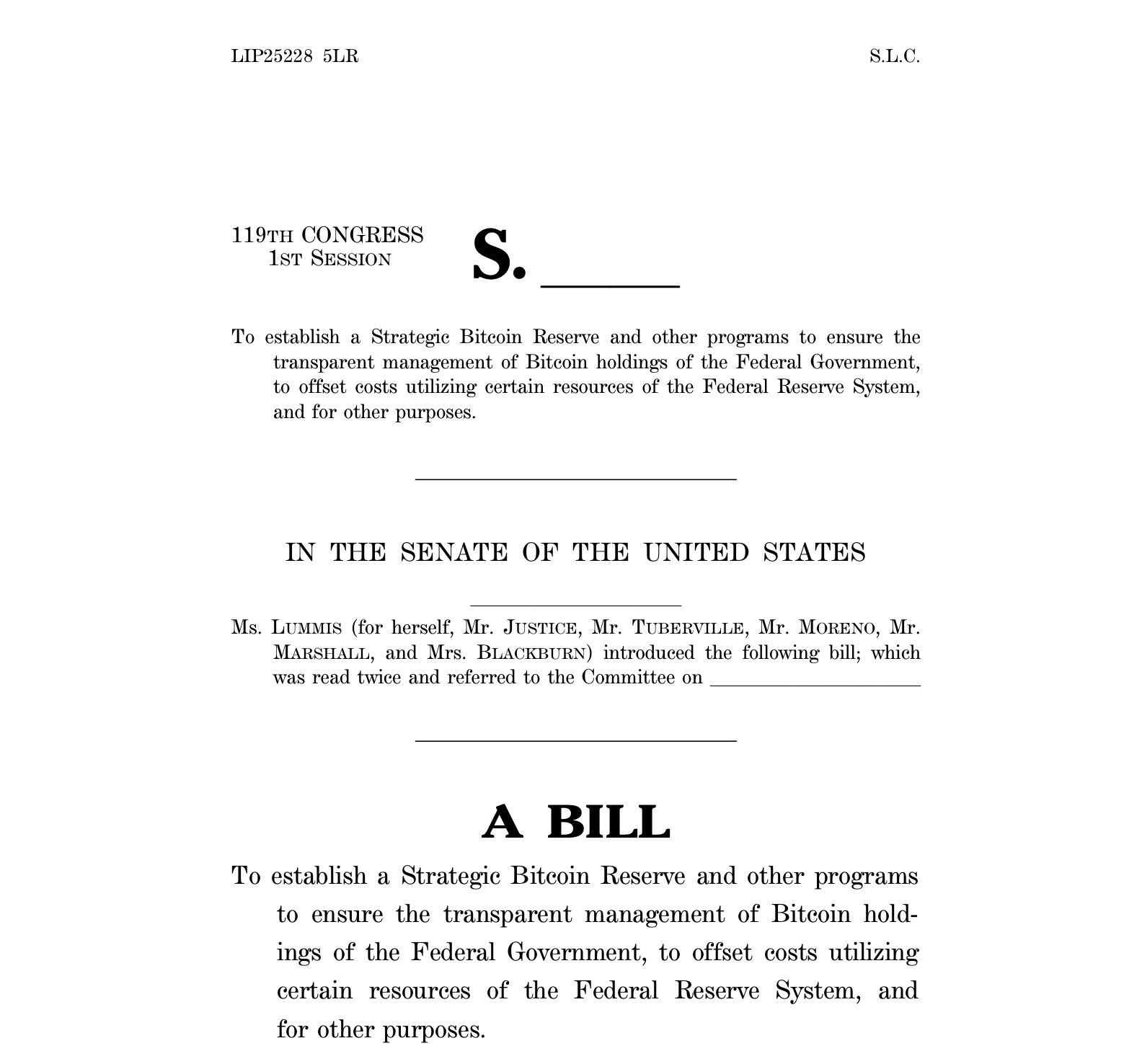
In March 2025, U.S. Senator Cynthia Lummis reintroduced the Bitcoin Act to the Senate, attempting to establish a strategic Bitcoin reserve through legislation. This move not only continues her initial intention proposed in 2024 but also makes key adjustments in details, sparking widespread discussion and market excitement. This article will delve into the historical background of the bill, the modifications in the new version, and the potential profound impact of the plan to purchase 200,000 Bitcoins annually on Bitcoin prices.
History of the Bill and Modifications in the New Version
Cynthia Lummis, a Republican senator from Wyoming, has been an active proponent of Bitcoin policy since 2024. In July 2024, she first proposed the Bitcoin Act of 2024, aiming to establish a "Strategic Bitcoin Reserve" similar to the Strategic Petroleum Reserve through government purchases of Bitcoin. The goal of this proposal was to position Bitcoin as "digital gold," enhancing the U.S. competitive advantage in the global financial system while providing new solutions for national debt. The bill proposed purchasing 1 million Bitcoins (1,000,000 BTC) over five years, accounting for about 5% of the total Bitcoin supply at that time, funded by redirecting Federal Reserve system profits and gold revaluation. However, the 2024 version of the bill was stalled in congressional committees and ultimately "expired" at the end of the 2023-2024 session without passing.
In March 2025, Lummis reintroduced the bill, launching the 2025 version of the Bitcoin Act. The new version retains the core goal of purchasing 1 million Bitcoins over five years but includes several key modifications in detail. These changes aim to respond to previous criticisms, strengthen enforcement, and align with the executive order signed by President Trump in March 2025 to establish a strategic Bitcoin reserve. The main changes in the new version are as follows:
- Stricter purchasing plan: The 2024 version allowed for "up to" 200,000 Bitcoins per year, while the 2025 version explicitly requires "shall purchase" 200,000 Bitcoins per year, totaling 1 million over five years. This change from "flexible" to "mandatory" demonstrates lawmakers' determination to enforce the plan.
- Strengthened holding requirements: The 2024 version allowed for the sale of Bitcoin during a 20-year minimum holding period to repay federal debt instruments, but the 2025 version removed this exception, prohibiting the sale, exchange, or disposal of Bitcoin for any purpose within 20 years. This reinforces the strategic intent of "holding long-term" (HODL).
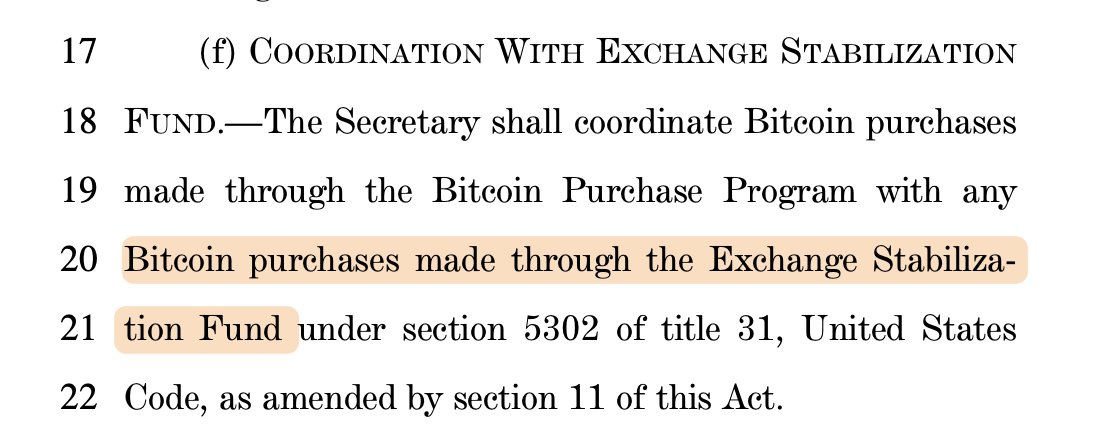
- New coordination with the Exchange Stabilization Fund (ESF): The 2025 version adds coordination provisions with the ESF, allowing the use of this approximately $39 billion reserve fund to support Bitcoin purchases. This provision was not mentioned in the 2024 version, reflecting the new version's diversification of funding sources.
- Use of gold revaluation proceeds: The 2024 version included the proceeds from the Federal Reserve's gold revaluation in the general fund, while the 2025 version specifies that these proceeds (potentially up to $747.3 billion) will be exclusively used for the Bitcoin purchasing plan. This is a significant policy adjustment, highlighting the importance of Bitcoin as a strategic asset.
These modifications not only reflect Lummis's support for Bitcoin policy but also represent a strategic adjustment in the current U.S. political landscape, where enthusiasm for Bitcoin is high (e.g., Trump's support and the community's positive response).
Detailed Interpretation of the New Bill
To better understand the modifications in the 2025 version of the Bitcoin Act, we will analyze these key changes and their underlying logic and impact.
Stricter Purchasing Plan: From "Up to" to "Shall"
The Bitcoin purchasing plan in the 2024 version was set as "up to" 200,000 Bitcoins per year, providing flexibility for the Treasury to adjust the purchase amount based on market conditions. However, this flexibility could also lead to ineffective execution or delays. The 2025 version changes this provision to "shall purchase" 200,000 Bitcoins, totaling 1 million over five years. This change indicates that lawmakers want to ensure the government executes the establishment of the Bitcoin reserve as planned through legal mandates.
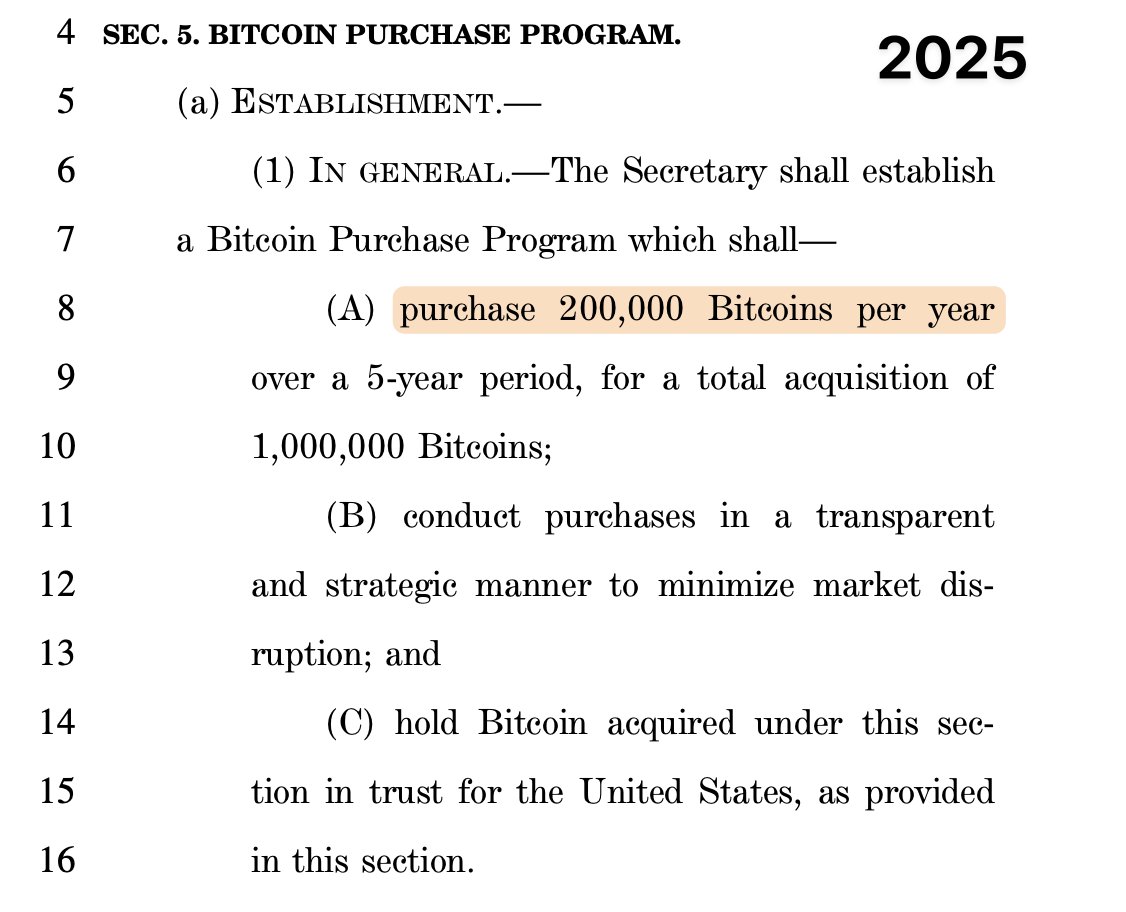
This modification aims to avoid delays and market uncertainty, ensuring the rapid realization of the strategic Bitcoin reserve. Purchasing 200,000 Bitcoins annually represents about 1.04% of the current total Bitcoin supply (approximately 19.2 million), while the total of 1 million accounts for 5.19%. This scale aligns with the U.S. gold reserves (approximately 8,133.5 tons, nearly a quarter of global gold reserves), reflecting the strategic intent of positioning Bitcoin as "digital gold." However, mandatory purchases may put pressure on market liquidity, requiring transparent and strategic approaches (such as phased purchases or over-the-counter transactions) to minimize disruptions.
Strengthened Holding Requirements: Removal of Debt Repayment Exception
The 2024 version allowed for the sale of Bitcoin during a 20-year minimum holding period to repay federal debt instruments, providing flexibility for the government but weakening the commitment to holding Bitcoin as a strategic asset long-term. The 2025 version removes this provision, explicitly stating that Bitcoin cannot be sold, exchanged, auctioned, or disposed of for any purpose within 20 years.
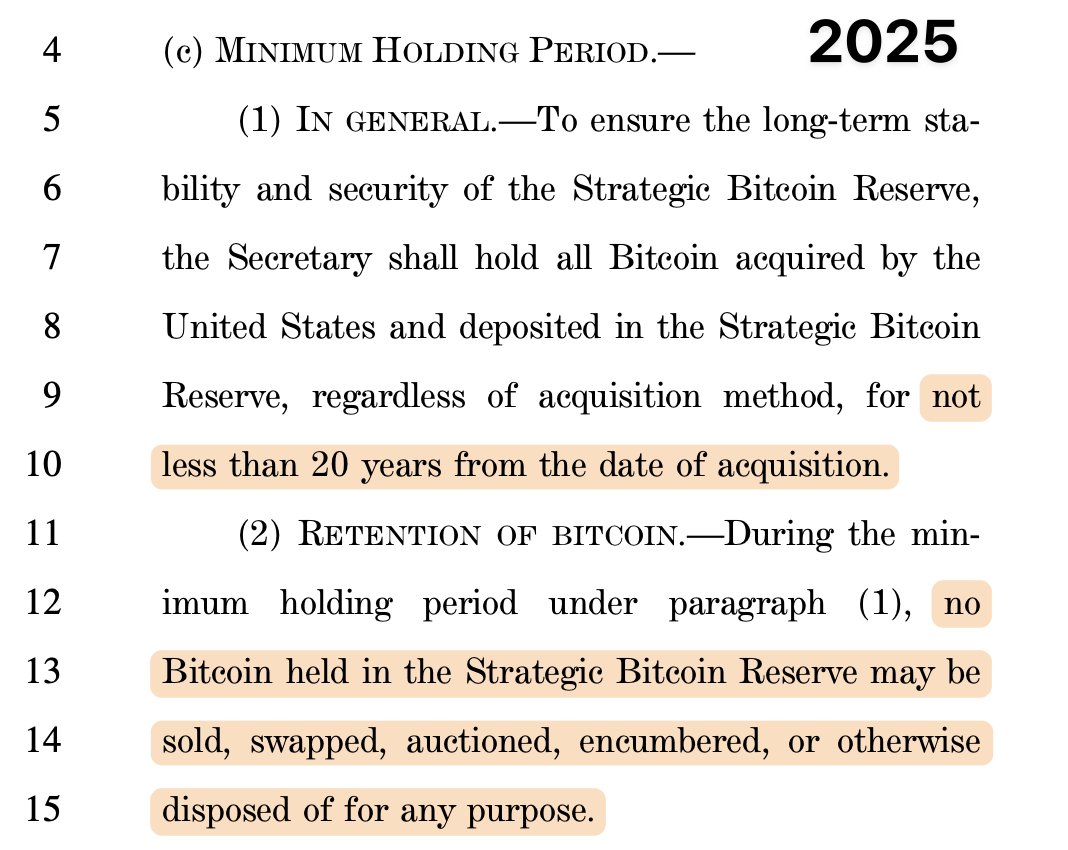
This change reinforces Bitcoin's positioning as a "long-term store of value," consistent with the concept of "digital gold." The 20-year holding period aims to ensure Bitcoin's long-term appreciation potential, providing a stable strategic asset for the U.S. economy. However, this strict requirement may spark controversy as it limits the government's flexibility to use Bitcoin in economic crises, such as repaying national debt or addressing emergencies.
New Coordination with the Exchange Stabilization Fund (ESF)
The 2025 version introduces coordination provisions with the ESF, allowing the use of this reserve fund (approximately $39 billion) to support Bitcoin purchases. The ESF is an emergency reserve fund used by the Treasury to stabilize exchange rates and financial markets, typically employed to intervene in foreign exchange markets or support international financial stability.
This modification expands funding sources, providing additional financial support for Bitcoin purchases. The inclusion of the ESF indicates that the government plans to view Bitcoin as part of the national financial strategy, potentially purchasing Bitcoin directly through executive orders or market operations. However, this move may raise concerns about the use of the ESF, as its original intent was not for cryptocurrency investment but to address financial crises.
Adjustment of Gold Revaluation Proceeds Usage
The "revaluation" of the Federal Reserve's gold refers to reassessing the gold reserves held by the Treasury (approximately 8,133.5 tons) from the statutory price ($42.2222 per ounce) to the current market price (approximately $2,900 per ounce in March 2025). This revaluation will generate approximately $747.3 billion in book profits (market value of about $758.3 billion minus book value of $11 billion).
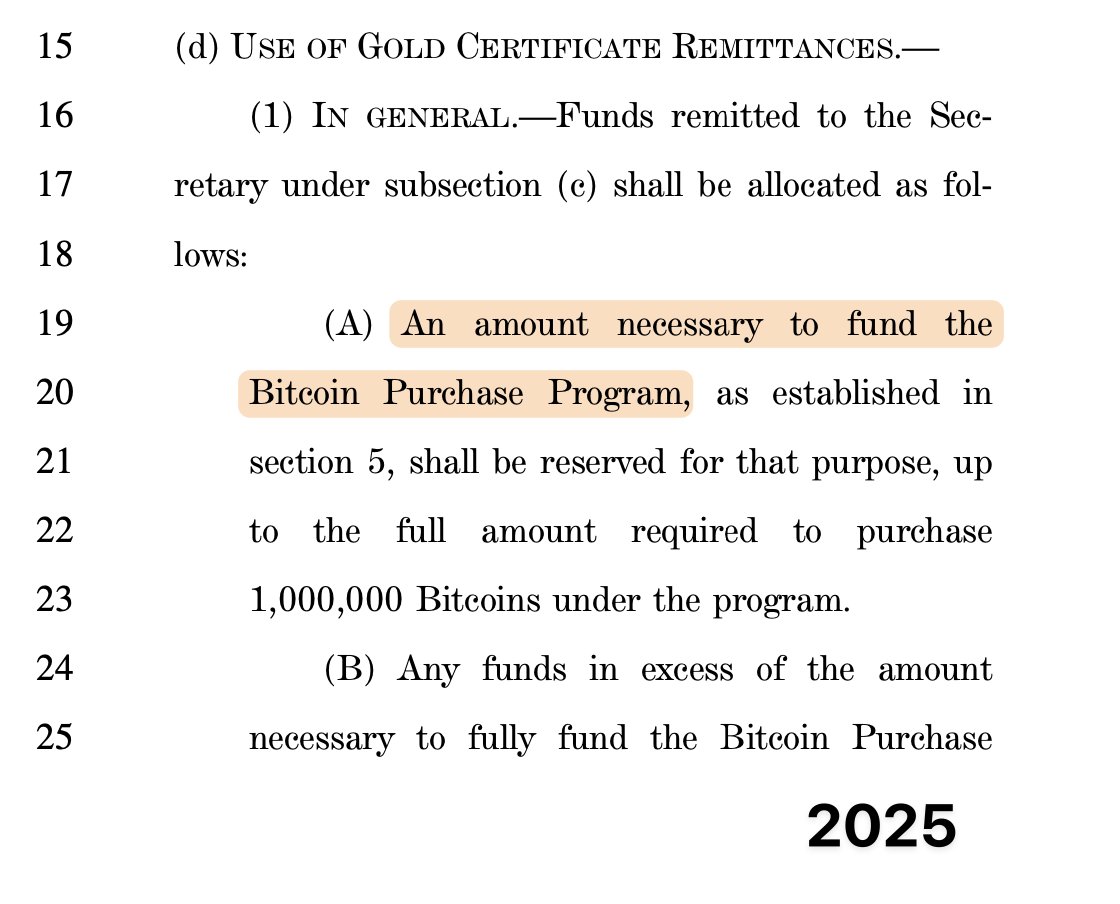
The 2024 version included these proceeds in the general fund, while the 2025 version specifies that they will be used for the Bitcoin purchasing plan. This adjustment reflects strong support for the strategic reserve of Bitcoin and provides a robust funding basis for the bill's "budget neutrality." However, fluctuations in gold prices (which could rise to $3,500 per ounce or fall to $2,500 per ounce) may affect the final available amount, requiring further legislative refinement.
Strictly speaking, the bill does not require directly "selling" (disposing of) gold reserves. Gold will remain in the Treasury's reserves as a national asset. The revaluation is merely an accounting adjustment that reclassifies the market value of gold on the Treasury's balance sheet, with the appreciation portion used for Bitcoin purchases.
However, from an economic perspective, this process is akin to "indirectly selling the value of gold" to buy Bitcoin, as the book appreciation of gold is converted into cash or equivalents for Bitcoin market transactions. These modifications collectively reflect a comprehensive upgrade in the 2025 version of the Bitcoin Act regarding enforcement strength, strategic positioning, and funding assurance, laying a more solid foundation for establishing a strategic Bitcoin reserve.
Where Will the Annual Purchase of 200,000 Bitcoins Push Bitcoin Prices?
If the Bitcoin Act passes, the U.S. government's annual purchase of 200,000 Bitcoins will have a profound impact on Bitcoin prices.
As of March 2025, the circulating supply of Bitcoin is approximately 19.2 million, with a price of $83,000 per Bitcoin, resulting in a total market capitalization of $1.6 trillion. The daily trading volume of Bitcoin typically ranges from $20 billion to $50 billion (assuming $35 billion), while the annual purchase amount for 200,000 Bitcoins is $200,000 × $83,000 = $16.6 billion, totaling $83 billion over five years. This accounts for 1.04% of the total market capitalization (annually) or 5.19% (over five years), which is relatively small, but sustained purchases may trigger market chain reactions.
Supply and Demand Dynamics Analysis
- Increased Demand: The annual purchase of 200,000 Bitcoins accounts for approximately 1.04% of the total supply. If market liquidity is limited, this demand could quickly drive up prices. The supply of Bitcoin is constrained by the halving mechanism that occurs every four years (currently producing 6.25 BTC every 10 minutes), and most Bitcoins are held long-term (HODLers), resulting in lower liquidity.
- Market Reaction: Historical data (such as Japan legalizing Bitcoin in 2017 or institutional adoption in 2020-2021) shows that favorable policies and large-scale purchases can lead to price increases of 10%-50% or more in the short term. The mandatory purchases in the 2025 version of the bill, combined with the Trump administration's executive order, could trigger a "fear of missing out" (FOMO) effect, further driving up prices.
Price Predictions
Based on supply and demand models and market sentiment, we can speculate on the following scenarios:
- Short-term (1-3 months): If the market reacts strongly to the passage of the bill, prices could rise by 10%-33%, reaching $91,300-$110,000 per Bitcoin. Daily purchases of approximately $45.48 million ($16.6 billion / 365 days) account for 0.013% of daily trading volume, but if concentrated purchases occur, they could push high price levels (above $80,000) with shallow order book depth, leading to prices breaking through $100,000.
- Mid-term (1-2 years): As the government continues to purchase and market confidence increases, prices could reach $120,000-$150,000 per Bitcoin (a 45%-81% increase). If institutions and retail investors follow suit, prices could soar further.
- Long-term (5 years): Purchasing 1 million Bitcoins over five years (accounting for 5.19% of the supply), combined with reduced supply and macroeconomic factors (such as inflation or dollar depreciation), could see prices surpass $200,000 per Bitcoin, especially during a bull market cycle.
Final Outlook
If the Bitcoin Act passes, the U.S. government's annual purchase of 200,000 Bitcoins is likely to push Bitcoin prices to new highs, potentially breaking through $110,000 per Bitcoin in the short term, reaching $150,000 per Bitcoin in the mid-term, and possibly exceeding $200,000 per Bitcoin in the long term. However, the actual price levels will depend on market reactions, purchasing strategies, and external economic conditions. This initiative could not only reshape Bitcoin's global standing but also have far-reaching implications for the U.S. leadership in the digital currency space.
免责声明:本文章仅代表作者个人观点,不代表本平台的立场和观点。本文章仅供信息分享,不构成对任何人的任何投资建议。用户与作者之间的任何争议,与本平台无关。如网页中刊载的文章或图片涉及侵权,请提供相关的权利证明和身份证明发送邮件到support@aicoin.com,本平台相关工作人员将会进行核查。


