Written by: Maxxx
A confession from a frontline market maker, a dark forest self-rescue guide for project parties, hoping to be of some help to you :)
Let me introduce myself: I am Max, a post-2000s individual who feels quite old. I was originally a struggling finance student in Hong Kong, but since 2021, I have been in the crypto space (thanks to the industry's rescue). Although I haven't been in the industry for long, I entered it as a project party at the beginning, and later started my own venture to create a developer community and accelerator, so I have always been close to frontline entrepreneurs. Currently, I am responsible for our market maker business line at @MetalphaPro. Thanks to my boss for the recognition, giving me the title of Head of Ecosystem, but in reality, I am just in charge of BD and sales. Over the past year, I have worked with @binance, @okx, @Bybit_Official, and second-tier exchanges, handling listings and subsequent market making for over a dozen coins, which gives me some shallow experience.
Recently, it has been a tumultuous spring, and the topic of market makers is at the forefront. I have always wanted to systematically discuss the unique roles within the market maker industry, and I took this opportunity to organize some thoughts. My business acumen may not be sharp, so please forgive any inaccuracies. This article only represents my own views and is 100% my own work. If you find it helpful after reading, I hope you can follow, like, and help boost the KPIs for workers like me. Thank you.
Starting with the "Observation Label" of GPS…
When I heard that GPS was given an "observation label" by Binance, I was chatting with a project founder I had known for over a year, who planned to list a coin in Q2. This young man is capable and good-looking, but I could hear the exhaustion in his tone. The project had raised several million, achieved some good results, and everything seemed to be going smoothly. However, for the founder, the funds raised were actually debts. After more than a year of constantly pivoting the narrative, the market is so tough. He is trying to close a new round of financing while negotiating with frontline exchanges and watching tokens recently break their initial prices, worrying about whether the exchange's coin price can perform well and how to explain it to investors. The pain, worry, and confusion can only be understood by friends who have worked on projects… Just as we were chatting about various topics, Binance's notice suddenly caught our attention. Although there was no market-making cooperation with the project, we had been in contact with team members over the past two years, and it was a moment of deep reflection.
I won't analyze or comment too much on this matter; it's better to wait for Binance and the project party's notifications and announcements. However, over the past two years, I have indeed seen too many project parties and retail investors being severely harmed by market makers. I wrote this article as an opportunity to help project parties and industry friends. Alright, enough rambling, let's get to the point.
The Business Model of Market Makers: Not as Mysterious as It Seems, Just "Placing Orders"
Market makers are not a new term in crypto; there are also "market makers" in traditional finance. However, this service has a more relaxed name called Greenshoe (because it was first used in 1963 during the IPO of the Boston-based Green Shoe Company). Although the mechanisms are slightly different, the responsibilities are basically the same: providing both buy and sell quotes during an IPO to maintain market liquidity and relatively stable prices. However, due to strict compliance regulations, Greenshoe operations are a standard trading desk business with little "profit margin," and no major trading desk would separately PR this activity. Ironically, this standard business has become a powerful tool in the crypto industry, seen by many as a scythe that controls the market.
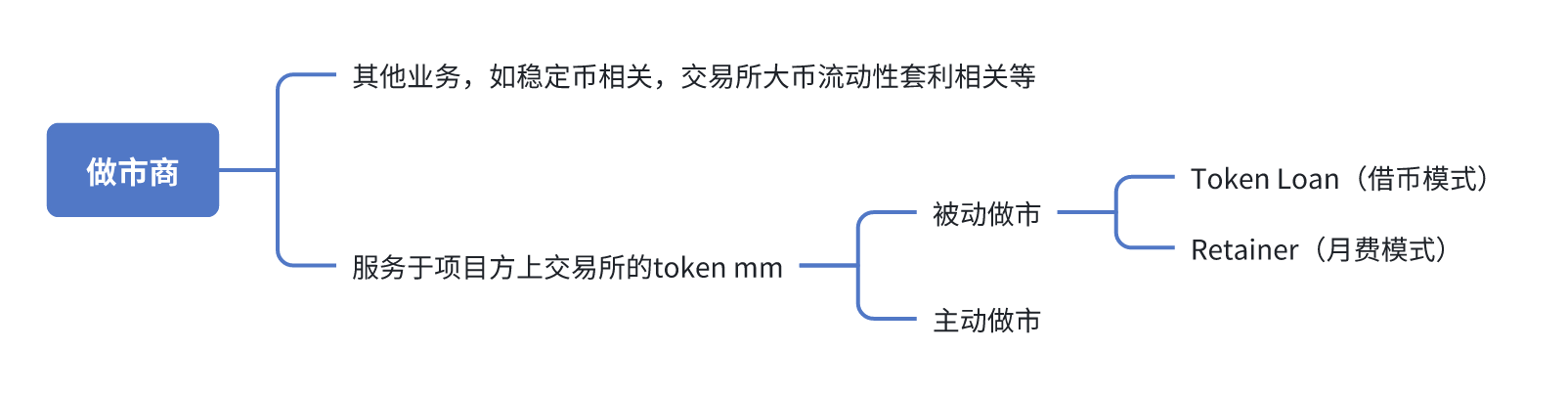
However, if market makers truly operate within industry norms to provide liquidity, there is really no talk of a "scythe." The so-called provision of liquidity mainly involves placing both buy and sell quotes on the trading book. Of course, in the broader sense, there are other categories and services of market makers in the crypto industry, but today we will focus on the narrow category that is most relevant to everyone, which serves the tokens of project parties. This can be roughly divided into several business models:
Proactive Market Makers
Much of the demonization of market makers in the industry comes from the existence and operations of proactive market makers in the early days. In Cantonese, there is a saying "做厨房" (doing the kitchen), which in Mandarin is "做庄" (manipulating the market). Proactive market makers fulfill all the fantasies the market has about "market makers." Generally, proactive market makers collaborate with project parties to directly manipulate market prices, pump and dump, and profit from it, sharing the gains with the project parties. Their cooperation terms vary widely, involving borrowing coins, API access, margin trading, profit sharing, and other models. There are even cases where rogue market makers do not communicate with project parties and directly use their own funds to seize tokens, and after acquiring enough chips, they operate themselves.
What proactive market makers are active in the market? In fact, the market's well-known market makers that are active in PR and events are all passive market makers, at least they must claim to be, otherwise, there will be compliance issues, not to mention marketing boldly (but it cannot be ruled out that some market makers engaged in proactive cases in the early days or may still be doing so secretly).
Most proactive market makers are very low-key and do not have names because they are inherently non-compliant. As the industry gradually standardizes, previously high-profile players like ZMQ and Gotbit have been named by the FBI and fallen into serious compliance troubles. The remaining proactive market makers have also become more anonymous, with some larger ones having done some so-called "successful cases," thus gaining "status" in the industry, with most deals being made through referrals from acquaintances.
Passive Market Makers
Passive market makers, including ourselves and many other competitors, belong to this category. What we mainly do is place both buy and sell maker orders on the order book of centralized exchanges to provide market liquidity. The business model is mainly divided into two types:
- Token Loan
- Retainer
Token Loan Model
This is currently the mainstream and most widely adopted cooperation model. In simple terms, it involves lending tokens to market makers for a certain period, during which the market makers provide market-making services.
A typical token loan deal consists of several aspects:
- Amount of tokens borrowed x%: Generally a percentage of the total supply of the token
- Loan period x months: The duration of the loan, after which the service ends, and delivery will occur according to the agreed option
- Option structure: The delivery price for the market maker at the end of the service
- Liquidity KPI: The market maker will place orders at specified depths, possibly involving different exchanges and price ranges.
How do market makers make money in this model?
Market makers earn money in two parts: one is the spread between the buy and sell orders during the order placement, which is generally a small portion; the other is the options given to market makers by the project party, which is usually the larger portion.
If friends familiar with finance may know, every option has value from the first day of signing, which is a percentage of the value of the borrowed tokens. For example, if I borrowed a total of 1 million U worth of tokens, and the value of this option on the first day is 3%, it means that if I strictly follow the algorithm (delta hedge) to place orders, I can realize a relatively certain profit of 30,000 USD. In general circumstances (excluding extreme situations like the price skyrocketing or plummeting, where effective delta hedging is not possible), the profit from this cooperation for the trading desk would be 30,000 USD plus some money earned from the spread during order placement.
Does it feel like market makers don't earn as much as imagined? But in reality, the profit margin I mentioned is not entirely detached from reality; market makers are currently very competitive, and the prices of competitive options are increasingly devoid of excess.
Retainer Model
This is currently the second relatively mainstream model, where the project party does not lend tokens to the market maker but retains them in their own trading account, and the market maker provides market-making services through API access. The advantage of this model is that the tokens remain in the project party's hands, and all operations in the trading account are open and transparent to the project party. In theory, the project party can withdraw funds from the account at any time, so there is no need to worry about the market maker acting maliciously. However, in this model, the project party needs to prepare tokens and USDT in the account for placing both buy and sell orders, and generally, they need to pay a monthly service fee to the market maker.
In this case, the market maker places orders according to the client's liquidity KPI, earning the monthly service fee. The funds in the account are unrelated to the market maker, and in extreme cases of poor liquidity or price spikes, placing orders may incur losses, which the project party would bear.
I believe both Token Loan and Retainer have their pros and cons. Some trading desks will only focus on one of them, while others, like us, can do both. Project parties should choose based on their needs and project circumstances.
Common Misconceptions
Market makers are responsible for "pumping," "drawing lines," and "building mouse warehouses."
Qualified passive market makers are neutral and do not actively participate in pumping, market cap management, or harvesting.
Market makers providing liquidity means "brushing volume."
The order book of exchanges has two types of orders: maker orders and taker orders. Passive market makers mainly place maker orders, with taker orders being very few. A skilled cook cannot make a meal without rice; no matter how deep the maker orders are placed, if there are no taker orders to execute them, it does not directly increase trading volume. However, if one hand directs the other to execute their own maker orders, known as "self-execution," it poses compliance risks. Major exchanges will strictly investigate such behavior, and if the self-execution ratio is too high, both the market maker's account and tokens may face warnings and actions from the exchange.
So does it sound like passive market makers are not useful?
It may sound like they are not directly responsible for the coin price or trading volume, but good liquidity is the foundation of everything. Small amounts of money care about price trends, while large amounts of money first look at trading volume and depth. A trading pair that is active and has a healthy price is closely related to the project party's product strength and marketing capabilities, and indeed requires close cooperation with market makers. To take a step back, major first and second-tier exchanges rarely allow you to list without a professional market maker; otherwise, the opening is likely to be chaotic, and market makers need to register in advance. Therefore, at this stage, collaborating with passive market makers is still a necessary step for every project party looking to list on major CEXs.
It sounds like market makers just place orders, and the threshold is not high; can project parties do it themselves?
Yes and no. If you indeed have your own trading team and the project is relatively large, some second-tier exchanges may allow you to do it yourself. But if not, or if you need to build a new team, I would recommend leaving professional matters to professionals. On one hand, the cost and risk of building a team may not be worth it compared to finding a reliable market maker. On the other hand, if you are not familiar with market making, placing orders yourself in the face of various extreme market conditions can lead to significant losses.
The Ecological Position of Market Makers: Opening Liquidity is the Most Precious Resource
After explaining the business model, let's talk about the current situation, which may help you understand better.
What will the crypto space look like in 2024-2025? From a liquidity perspective, here’s how I see it:
- BTC has an independent market, rising steadily. The top liquidity is abundant, and although there has been a recent pullback, the foundation remains strong. Miners are happy with mining costs in the 5s and 6s, and traditional institutions rushing in are also pleased.
- The tail end of PVP is fierce, and liquidity was once relatively abundant. @pumpdotfun, @gmgnai, @solana, @base, and @BNBCHAIN have seen small investors losing money to the point of addiction (I contributed a bit, unfortunately), while outliers and insiders are also making money happily.
- The mid-tier liquidity has dried up, peaking with the Trump and Libra waves, almost completely sucking out the liquidity and buying power from the mid-tier, structurally and irreversibly pulling it from within the circle to outside. Tokens with market caps from hundreds of millions to tens of billions are awkwardly positioned, and newly listed tokens on first and second-tier exchanges have no buyers. Trading volume sharply decreases within two months of listing, with most trading volume and depth occurring at the opening, quickly falling below the primary price set by VCs. When VCs unlock, they are likely to lose money, and when team tokens unlock, they are likely to go to zero.
In this cycle, these mid-tier tokens seem to be having the hardest time. But another harsh reality is that over 90% of the so-called "web3 native" professionals in our industry are those who truly earn salaries, attend conferences, and conduct business daily, including VCs, project parties, accelerators, BD, marketing, development, etc. Everyone is engaged in the business of mid-tier tokens. If you look at investment and financing, product development, marketing, and listing on exchanges, these activities are actually centered around these mid-tier project parties on centralized exchanges. Therefore, in this cycle, many professionals have not made money, and life has been tough for them.
Only market makers, in my opinion, hold the most scarce resource of mid-tier tokens: "opening liquidity." Yes, just having liquidity is not enough; it needs to come early, right at the opening. Otherwise, when the project goes to zero, having more tokens won't help. For a project with an opening circulating supply of, say, 15%, there will always be 1 to 2 points, or even more, allocated to market makers. This liquidity that unlocks at the opening is an extremely valuable resource in the current market. Therefore, not only are market makers becoming increasingly competitive, but many VCs and project parties are also stepping in to temporarily build teams to start market making. Some teams even lack basic trading capabilities and just grab the tokens first, as they will eventually go to zero anyway, so they are not afraid of being unable to cash out.
The Dark Forest of Bad Money Driving Out Good: Honest Contributors Can't Compete with "Scumbags"
In this evolving market, a very unique ecosystem for market makers has formed: on one hand, there are more and more market makers, and the quotes have become absurdly competitive; on the other hand, the quality of service and professional capabilities vary greatly, often leading to various after-sales issues. The most common issue is the withdrawal of liquidity and defaulting on contracts. First, let’s clarify that market makers are not prohibited from selling tokens. In fact, if the token price skyrockets, the algorithmic order placement should lean towards selling because the tokens borrowed are settled in USDT with the project party (if you don’t understand, you can revisit the token loan option section). However, a qualified passive market maker should place orders according to the algorithm and not act as a taker to aggressively sell off, as such actions can greatly harm the project.
Why do market makers do this? Returning to the options part we just discussed, if a market maker has obtained a token loan quota and places orders according to the algorithm, if the market remains lukewarm, they should successfully realize the value of the option and earn 3%. However, if they believe the project will go to zero by the settlement date, they can achieve a 100% return by crashing the price at the opening, which is 33 times the normal market making profit. Of course, this is a very straightforward and extreme example; most real operations are much more complex, but the underlying logic is to short the token, selling it while the price is high and liquidity is good, and then buying it back at the settlement date.
Of course, this approach is not only unethical and non-compliant but also carries additional risks. On one hand, market makers cannot fulfill the KPI for liquidity within the contract period because they do not have a healthy inventory; on the other hand, if they bet wrong on the token's direction, they can incur significant losses and be unable to cash out.
Why is Such Behavior Common?
The industry's compliance, at its core, is still in its early stages. In terms of the token loan model, although market makers report service conditions to project parties through daily reports, weekly reports, dashboards, etc., there are also third-party supervisory institutions and tools in the market, but what happens with the tokens in the market maker's account remains a black box. The market lacks effective regulatory measures. After all, the only entity with concrete evidence that can see every trade made by market makers is the centralized exchange itself. However, many market makers are clients of centralized exchanges' V8 and V9, bringing in hundreds of millions in fees and capital to the exchanges each year. The exchanges also have an obligation to protect their clients' privacy, so how could they possibly disclose their trading details to help project parties defend their rights? At this point, I must commend @heyibinance and @cz_binance for their decisive actions. I recall this is the first time detailed trading information from market makers has been fully disclosed, including minute-by-minute timestamps, operational details, and cash amounts. Whether such actions should be taken is worth pondering, but the original intention must be good.
The understanding of market makers by project parties and the entire industry still needs to be strengthened. I am often surprised that many top-tier investors I have spoken with, founders of projects that have raised tens of millions, and even professionals from exchanges do not have a good understanding of the market maker profession. This is also a significant reason why I decided to write this content. Most project parties are actually "first-timers," while market makers are seasoned "scumbags." As a frontline practitioner, I sometimes look at project parties choosing what they believe are "better terms" and ask myself if I am also matching the outrageous terms offered by competitors just to secure the deal. In this dark forest of market makers, maintaining one's bottom line is difficult; the pretentious scumbags are always more attractive than honest individuals. Only when everyone's understanding of the industry aligns can we avoid the continued phenomenon of bad money driving out good.
How to Choose Your Market Maker
Here are a few important questions and tips I believe are essential:
Is it absolutely necessary to avoid proactive market makers?
When project parties ask me this question, I don’t directly say they shouldn’t choose them. If we set aside compliance, I think this is a debatable issue. Some projects have indeed achieved better-looking charts, more trading volume, and more cashing out through close cooperation with proactive market makers. Of course, there are countless examples of things going wrong. I just want to express one point: you need to realize that those who can help you pull in real money will also cut you mercilessly. The market's liquidity is limited, and at the end of the day, you are in an adversarial relationship; the market's money will either be earned by you or by your proactive market maker.
Should you choose token loan or retainer for cooperation?
Currently, the token loan model is still more mainstream, but the market share of retainer is gradually increasing. This is a matter of the project party's taste and needs. For example, project parties with strict control over their tokens may not want external uncontrollable large-scale liquidity.
Try not to choose only one passive market maker.
Don’t put all your eggs in one basket; you can choose 2-4 market makers to compare terms. If one goes down, others can fill the gap. Additionally, market makers often propose various extra value adds to win deals, so selecting multiple can help you receive more assistance. However, to avoid the "three monks have no water to drink" problem, it is advisable to assign different exchanges to each market maker, as mixing them together will significantly increase monitoring difficulty.
Don’t choose your market maker solely based on investment.
Accepting investment from market makers is good, and having more runway is always beneficial. However, you also need to understand that the investment from market makers and VC investments are not the same game. Because they control a significant portion of the opening liquidity, market makers can lock in prices and hedge their tokens that have not yet been unlocked. Therefore, when market makers take a token loan, having a significant portion of token investment positions may not necessarily be a good thing for the project party.
Don’t choose your market maker solely based on liquidity KPIs.
Liquidity KPIs are difficult to verify precisely in practice, so don’t choose market makers based solely on liquidity KPIs. No matter how beautifully written the terms are, they are useless if they cannot be fulfilled. Before borrowing tokens, you are the boss; once the tokens are lent to the market maker, you become the subordinate. They have many ways to deceive you.
Change your mindset: Be a "scumbag" yourself.
Remember that you are the principal. Before signing with a market maker, compare terms extensively, discuss how to monitor, and how to prevent market maker defaults. Choose a plan that suits your project's development. You can use one company's terms to pressure another, comparing back and forth. Ensure that there are no ambiguities in the terms, and if there are unclear points, don’t ponder them yourself; ask for clarification directly.
A Few Reflections
As a newcomer to the industry, I cherish the opportunity to perceive and touch the industry at this depth. I often feel the dirtiness and chaos of the industry, yet I also constantly sense its vitality and energy. I never consider myself to be among the smartest; many of my peers in the industry are excellent and have quickly found their positions. However, many young people are indeed confused. Without the web3 industry, it would be challenging for them to find upward mobility.
I also have a boss with a very strong sense of values and a highly capable trading team supporting us. A stable asset management business allows us not to rely on market-making business to sustain the team but rather to use market-making to build friendships. I have always followed my own pace, using the logic of befriending project parties, missing out on some deals, but also engaging in a few that I am proud of. Some projects, although not turned into business, have led to friendships with the project parties.
I have written extensively, and I felt conflicted about publishing this article. On one hand, I worry that my business acumen is lacking or that my expression may mislead project parties and readers. On the other hand, market makers have always been shrouded in mystery in the industry, and I fear that discussing these matters may overstep boundaries and disturb someone's interests.
However, I truly believe that as the industry develops and compliance gradually becomes mainstream, there will come a day when the role of market makers will no longer be demonized and will return to the light. I hope this article can play a small role in that process.
免责声明:本文章仅代表作者个人观点,不代表本平台的立场和观点。本文章仅供信息分享,不构成对任何人的任何投资建议。用户与作者之间的任何争议,与本平台无关。如网页中刊载的文章或图片涉及侵权,请提供相关的权利证明和身份证明发送邮件到support@aicoin.com,本平台相关工作人员将会进行核查。


