Author: Biteye
Previously, there was Pump.fun, which made tens of millions of dollars a day, and now there is Four.Meme, which CZ is promoting. The casino effect of on-chain launch platforms remains strong. On February 8, the long-quiet DeSci (Decentralized Science) sector welcomed the news that the well-established project Pump.Science will launch on a new platform next week. Following the announcement, $Rif and $Uro both rebounded by 20%. Earlier, Pump.Science co-founder Benjels stated in an interview that 20 new compound tokens would be launched by Christmas 2024.
However, in reality, he has delayed this action until now. Within three months, influenced by external factors such as interest rate cuts, the official tokens $Rif and $Uro of Pump.Science have dropped over 95% from their market cap highs of 240m and 140m, respectively. During the same period, the DeSci financial project BIO, after launching on Binance, has also seen a decline of about 90% from its market cap peak. The DeSci sector, which has been promoted by big names like CZ and Vitalik, is now in dire straits. It seems that this new narrative, which was expected to further achieve mass adoption, is now being criticized by everyone.
Will the new launch platform of Pump.Science spark a resurgence in DeSci?
According to the official documentation from the Pump.Science community, the process for the new launch platform is as follows:
- Users will list a compound along with a token on the Pump.Science platform.
- Users can buy and sell tokens on a Bonding Curve with parameters similar to those of Pump.fun to support research on this compound. 79% of the tokens are issued along the Bonding Curve. When the token market cap reaches 303 Sol (of which 85 Sol is in circulation), the Bonding Curve will close. 82 Sol of liquidity will be migrated to Meteora for trading. 3 Sol will be used to pay for the corresponding worm experiment fees.
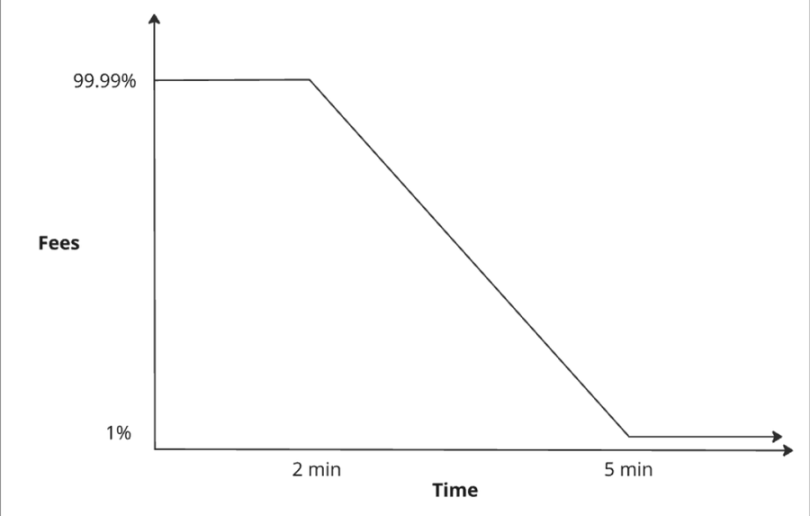
It is particularly noteworthy that the new launch platform of Pump.Science will implement a dynamic fee structure to deter sniper bots and prevent automatic loopholes during the initial token sale. Specific measures include:
- Bot deterrence: The dynamic fee structure is specifically designed to reduce the front-running trades of sniper bots.
- Early risk: The fees for the first 150 slots (approximately 2 minutes) are extremely high (99.99%), which will significantly reduce the number of tokens received by buyers.
- Monitoring activity: Between the 150th and 250th slots (2-4 minutes), the fees will drop rapidly.
Dynamic fee structure curve:
The white paper also states that all new compounds need to allocate a certain share for the builders and holders of $Rif and $Uro. Undoubtedly, the launch of a new token launch platform by Pump.Science is a grand "self-rescue" effort. The struggling DeSci sector urgently needs new attention hotspots and wealth creation effects. Now, hunters on the Sol chain have been lost for too long among the various AI Agents and celebrity tokens, and the BSC chain has seen CZ's clear calls diverting attention. In this crisis-ridden on-chain environment, can the DeSci craze, akin to that of Rif and Uro, be reignited? With new compounds, new developers, and new attention increments joining, can more DeSci gameplay be activated to attract fresh capital? Three months after the grand announcements of DeSci projects, we have indeed reached a critical juncture that will determine whether DeSci will thrive again or fade into obscurity.
90% Overfunding Refund, $Pain-style Pre-sale of New Compound EGS "Full Pattern" Sparks Discussion
At 3:19 AM on February 9, Pump.Science's official Twitter commented on its upcoming compound project $EGS @EGCGxSFN, stating, "Earning trust is the most admirable thing." A look at Twitter reveals that the new compound project $EGS unexpectedly opened a 24-hour pre-sale window on February 7. According to on-chain data, the pre-sale wallet address for $EGS raised 1223 Sol before block height 319172095. More notably, the project team announced via Twitter that they would refund 91.87% of the raised funds, retaining only 100 Sol for token launch and liquidity support. This "high refund on overfunding" strategy during the pre-sale is reminiscent of the previously popular $pain project, but EGS's refund actions and refund ratio have set a precedent for DeSci projects. The EGS project team announced on Twitter, "In 24 hours, with no marketing and no whales, we proved our trust in science." They also announced that EGS would launch with a market cap of 100k, rewarding the diamond hands of DeSci, with the effective pre-sale contributions already yielding about three times the profit.
EGS stands for the compounds Epigallocatechin Gallate and Sulforaphane. EGCG is the core active ingredient in green tea, known as the "king of antioxidants," which inhibits cellular aging by activating the AMPK pathway and clears free radicals to reduce oxidative damage. Research shows that EGCG can extend the lifespan of model organisms such as nematodes and fruit flies by up to 20%, with mechanisms including the inhibition of pro-inflammatory factors and enhancement of mitochondrial function, potentially delaying telomere shortening through epigenetic regulation.
Sulforaphane, derived from cruciferous vegetables like broccoli, acts as a "cell protector" by significantly enhancing cellular antioxidant capacity through the activation of the Nrf2 pathway. Experiments have confirmed that Sulforaphane can extend the lifespan of mice by about 15%, with key roles including promoting autophagy to clear senescent cells, repairing DNA damage, and inhibiting chronic inflammation associated with aging (such as the NF-κB pathway). Both compounds synergistically delay aging through multi-target mechanisms and are among the few natural compounds with clinical translation potential as longevity candidates.
Clearly, the new compound inherits the previous IP monetization logic of Rif and Uro, while the high refund during the pre-sale reduces risk, presenting a 'low threshold, high odds' story that DeSci urgently needs. However, can such a topic-rich pre-sale approach, combined with the DeSci narrative of "trusting science," align with Rif and Uro after the new platform launch? The answer is uncertain. Pump.Science co-founder Benjels candidly stated, "The problem with DeSci is that the narrative is grand, but implementation is difficult." "Users want to support science while also seeking speculative returns; balancing the two is key." In today's market, where price surges are seen as justifiable, the grand narrative of decentralized science has been proven unacceptable to the market. The path to resurgence for the DeSci sector remains long and arduous, requiring more eye-catching strategies to capture sensitive attention within the community. One can only hope that this time, the new compounds from Pump.Science can bring new growth to the battered DeSci sector and provide both wealth and spiritual solace to those diamond hands still persevering in DeSci, as promised in the tweets.
Appendix: Overview of New Compounds from Pump.Science
- Punicalagin & Berberine: Pomegranate polyphenols with strong antioxidant and anti-inflammatory effects; Berberine: an AMPK activator that can regulate blood sugar and improve metabolic health. Together, pomegranate polyphenols support cardiovascular health and anti-inflammatory pathways, complementing the metabolic effects of Berberine.
- Resveratrol & Berberine: Resveratrol, a polyphenol that can activate sirtuins, enhance mitochondrial efficiency, and mimic caloric restriction effects; Berberine: an AMPK activator that can regulate blood sugar and improve metabolic health. Together, Resveratrol and Berberine can activate AMPK and sirtuins, potentially leading to longevity, metabolic control, and enhanced cellular repair capabilities.
- Ginsenoside Rh2: Ginsenoside Rh2, a bioactive compound in ginseng, has anti-cancer, neuroprotective, and anti-inflammatory effects.
- Aspalathin & Caffeine: Aspalathin, a bioactive flavonoid compound found in Rooibos tea, has antioxidant and blood sugar-lowering effects; Caffeine, a stimulant, can enhance mental and physical performance. Together, Aspalathin can counteract the potential negative effects of caffeine on blood sugar and stress hormones, providing a more balanced stimulant response.
- Gossypol & Catechin Hydrate: Gossypol, a polyphenol with potential anti-cancer and metabolic effects; Catechin hydrate, a catechin similar to EGCG, has strong antioxidant properties. Together, these two compounds can jointly regulate cellular stress responses and improve metabolic efficiency.
- Biotin & Berberine: Biotin, a substance essential for fatty acid metabolism, glucose regulation, and skin health; Berberine, a metabolic regulator that can enhance insulin sensitivity. Together, Biotin can complement Berberine's effects by improving lipid metabolism and enhancing mitochondrial function.
- Urolithin A & EGCG: Urolithin A, a metabolite extracted from pomegranate, can promote mitophagy (recycling of damaged mitochondria); EGCG, a green tea catechin, has strong antioxidant and anti-inflammatory effects. Together, EGCG and Urolithin A support mitochondrial function and longevity pathways, potentially enhancing cellular energy efficiency.
- Berberine & Quercetin: Berberine, a metabolic regulator that can enhance insulin sensitivity, lower blood sugar, and support cardiovascular health; Quercetin, a flavonoid with anti-inflammatory, antioxidant, and antiviral properties that promotes nutrient absorption. Together, Quercetin can enhance the bioavailability of Berberine while also complementing its metabolic effects, thereby improving glucose regulation and mitochondrial function.
- Hesperidin & DHM (Dihydromyricetin): Hesperidin, a flavonoid compound found in citrus fruits, can improve blood circulation, reduce oxidative stress, and support vascular health; DHM (Dihydromyricetin), used for liver protection, supporting alcohol metabolism, and neuroprotection. Both compounds can regulate liver enzymes and inflammatory pathways, enhancing detoxification and metabolic recovery.
- EGCG: Green tea catechin with strong antioxidant and anti-inflammatory effects.
- Caffeine: Caffeine, a stimulant that can enhance energy, cognitive function, and endurance, aids liver detoxification and reduces premature death.
- Artemisinin: Artemisinin, extracted from sweet wormwood, has anti-malarial, anti-cancer, and anti-inflammatory effects.
Recently, as Binance Research once again affirmed the DeSci sector, BIO, Rif, and Uro all surged by 20%. It seems that the wind for DeSci is about to rise again. Meanwhile, these compounds are also set to launch on the new Pump.Science platform, making it essential for everyone to continuously monitor the quality tokens among the wide array of token launches, selecting projects that are serious and capable of delivering results. DYOR!
免责声明:本文章仅代表作者个人观点,不代表本平台的立场和观点。本文章仅供信息分享,不构成对任何人的任何投资建议。用户与作者之间的任何争议,与本平台无关。如网页中刊载的文章或图片涉及侵权,请提供相关的权利证明和身份证明发送邮件到support@aicoin.com,本平台相关工作人员将会进行核查。


