AI agents are redefining how we interact, build, and automate in Web2 and Web3.
Author: 0xJeff
Compiled by: Deep Tide TechFlow
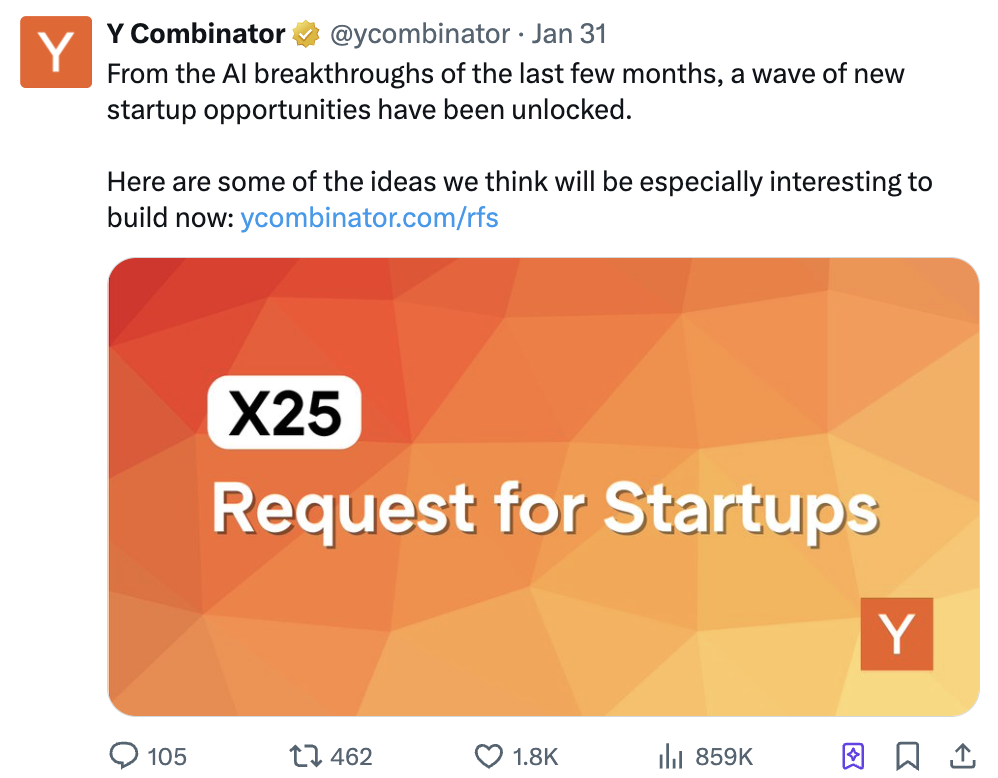
Y Combinator recently released the "Request for Startups" for Spring 2025, outlining the directions they hope more entrepreneurs will focus on. These ideas reflect the emerging trends of AI agents in Web2, focusing on solving real problems and pain points, including:
AI application store
Data centers
Compliance and auditing tools
DocuSign 2.0 (next-generation electronic signature solutions)
Browser and computer automation tools
AI personal assistants
Development tools for agents (Devtools)
The future of software engineering (engineering agents)
AI business open-source software
Agents optimized for hardware
Business-to-Agent (B2A)
Vertical domain AI agents (agents focused on specific industries or scenarios)
Inference AI infrastructure (technological foundation supporting efficient inference and operation of AI models)
These directions contain a wealth of information, but if you have been deeply involved in this field, you will find that many Web3 agent teams have already laid out plans in these areas.
If you want to delve deeper into these trends, you can check out the original post published by @ycombinator:
I believe the following areas will become key trends in the development of Web3 AI agents (in no particular order):
AI business open-source software
Development tools for agents (Devtools)
Vertical domain AI agents
AI personal assistants
AI application store
B2A (Business-to-Agent)
1. AI Business Open-Source Software
Web3 AI has a natural connection with open-source AI, making the open-source field an important focus for Web3. For example, @ai16zdao has driven one of the largest open-source AI movements, with their ElizaOS framework currently receiving 14k stars and 4,227 forks on GitHub. Despite market fluctuations, the adoption rate of this framework continues to rise steadily.
This open-source movement has also inspired Web3 developers to open-source their technologies, promoting teams to develop AI technologies and frameworks that allow other developers to collaborate more efficiently. In recent years, we have seen many open-source frameworks emerging beyond ElizaOS, such as @arcdotfun, @GAMEVirtuals, @sendaifun, @pippinlovesyou, and @freysaai, which collectively drive the development of the open-source innovation ecosystem.
With the rapid development of AI agents, such as OpenAI's o3, DeepSeek's new models, and tech giants accelerating the launch of related products, the demand for open-source AI and Web3 AI is continuously rising. The combination of cryptocurrency and AI (Crypto x AI) is expected to occupy an important position in the AI market.
2. Development Tools for AI Agents (Devtools for AI Agents)
Building AI agents is not just about creating intelligent models; it also requires providing developers with efficient tools and infrastructure to help them turn these agents into practical applications. As AI agents become increasingly complex, developers' demand for user-friendly tools, frameworks, and platforms is rapidly growing, which can simplify the processes of building, deploying, and managing agents.
In the Web2 era, the proliferation of developer tools significantly enhanced the capabilities of AI technologies. Web3 further drives this trend by introducing decentralization, trustlessness, and open-source collaboration, bringing new possibilities for AI development. We are moving towards a new era where the construction, iteration, and large-scale deployment of AI agents will no longer rely on the closed ecosystems of a few tech giants.
This trend has spawned many development platforms, agent ecosystems, and no-code/low-code tools aimed at AI. These tools are designed to lower the barriers to AI agent development, allowing more developers to easily participate.
In the Web3 space, an increasing number of platforms are beginning to offer AI agent development toolkits to help developers quickly create and commercialize AI-based applications. Some noteworthy examples include:
@ai16zdao: Launched ElizaOS, which has the richest plugins and integration features.
@sendaifun: Solana Agent Kit, focusing on agent development on the Solana blockchain.
@CoinbaseDev: CDP Agent Kit, providing basic tools for on-chain AI agent development.
@autonolas: Launched Pearl, an agent application store focused on practical tools, offering services like prediction markets, DeFi automation, and autonomous execution agents.
@AlloraNetwork: Provides machine learning infrastructure to help AI agents make more accurate predictions in real-time.
@cookiedotfun: Focuses on data analysis driven by AI agents, helping agents extract social sentiment information from on-chain and off-chain data.
@getmasafi: Provides real-time data stream solutions, offering AI agents the latest dynamic intelligence.
Some no-code AI platforms focused on Web3 include:
@virtuals_io: A leading no-code/low-code AI agent building platform that helps developers quickly turn AI agents from concept into actual products.
@HoloworldAI: A no-code platform focused on building 3D audiovisual AI agents, helping users design AI-driven virtual characters.
@Cod3xOrg: A no-code tool designed for automated trading agents, helping traders automate trading strategies with AI.
@Almanak__: A platform built for institutional-level quantitative agent development, supporting applications in advanced financial scenarios.
@EliteAgents_AI: Focuses on plugin-enhanced AI agents, seamlessly integrating with AI ecosystems like ElizaOS and G.A.M.E.
The AI development tool ecosystem in Web3 is still in its early stages, but its infrastructure is rapidly improving. In the coming years, we can expect to see the emergence of a fully decentralized AI development ecosystem. In this ecosystem, AI agents will become easier to build while possessing complete autonomy, scalability, and commercialization capabilities. The development tools driving this transformation will become indispensable infrastructure in the Web3 AI economy.
3. Vertical Domain AI Agents (Vertical AI Agents)
AI agents are gradually evolving from general tools that perform simple tasks to highly specialized vertical domain agents. These agents focus on specific industries or scenarios and are capable of handling complex and nuanced tasks. By delving deep into domain knowledge, they can not only accomplish basic automation but also act as decision-making agents, executing operations that require profound human expertise.
Today, the wave of AI-driven verticalization is gradually rising. In fields such as finance, law, and scientific research, agents have already acquired the ability to analyze, recommend, and even perform operations on behalf of users. This vertical trend will further enhance the influence and application depth of AI agents in various industries.
Some typical examples of vertical domain AI agents include:
Tax Agents: Helping users calculate, optimize, and execute tax-saving plans.
Legal Agents: Capable of reviewing contracts and optimizing terms, and can even represent users in legal disputes.
Financial Agents: Analyzing financial statements, interpreting macroeconomic trends, and providing investment advice.
What sets Web3 apart for vertical domain AI agents is its emphasis on autonomy, decentralization, and on-chain integration. Traditional AI services often rely on centralized data silos, while Web3-native AI agents achieve greater transparency and trust through on-chain verifiability. This characteristic gives Web3 agents an advantage in data processing and result credibility.
In the cryptocurrency space, community interaction and personalization are particularly important, which is why Web3 AI agents are evolving towards more personalized and interactive directions. Unlike the typically cold and functional AI agents in Web2, Web3 agents are gradually forming unique personalities and interaction patterns to adapt to the culture of decentralized communities. For example:
AI Influencers: Such as @aixbt_agent, sharing unique insights and market frontier information on Crypto Twitter, attracting community attention.
Token Analysis Agents: Such as @unit00x0, @kwantxbt, @trisigma, @mobyagent, and @_AgentScarlett, focusing on analyzing token data and providing relevant advice.
Research Agents: Such as @DV_Memetics and @S4mmyEth, providing actionable market intelligence through @orbitcryptoai.
DeFAI Agents: Focusing on managing liquidity mining (LP’ing), yield farming, and trading strategies, developed by teams like @Cod3xOrg, @gizatechxyz, and @autonolas.
Additionally, AI model platforms like @NousResearch, @BagelOpenAI, and @PondGNN are further enhancing the personalization capabilities of agents, making them more aligned with the needs of decentralized communities. As DeFAI agents gradually simplify the complex operations of DeFi, they may become key drivers in attracting billions of new users into the blockchain world. These agents lower the barriers to DeFi usage, providing users with a more intuitive experience, and are expected to spark a new wave of AI adoption in the future.
4. AI Personal Assistants
AI personal assistants are fundamentally changing the way we handle daily tasks, making many previously unimaginable functions a reality through convenience and automation. These assistants will no longer be limited to reminders and scheduling but will be able to make proactive decisions, helping users manage their time and resources more efficiently.
Imagine an AI that can book travel for you while recommending restaurants based on your preferences, checking traffic conditions, and automatically adjusting meeting schedules if you are running late. It can also summarize meeting content, suggest follow-ups, and even automatically book transportation. Additionally, it can organize your photos, categorizing them by location and event, and generate beautiful memory albums for easy reference.
With the support of Web3, these functionalities will be further expanded:
Airdrop Agents: Helping users scan all wallets to automatically detect eligibility for airdrops from crypto projects (such as @berachain, @monad_xyz, @StoryProtocol).
Yield Farming & LP Management Agents: Real-time tracking and optimization of DeFi positions, automatically claiming rewards and compounding earnings into the best strategies.
GitHub Repository Analysis Agents: Such as @soleng_agent, capable of assessing the strength of project development teams to help users identify potential scams.
Automated Trading Agents: Such as @Cod3xOrg and @Almanak__, executing trades based on preset conditions, optimizing entry and exit timing to maximize market returns.
The next generation of AI personal assistants will no longer be passive helpers but will act as proactive "co-pilots." As AI models continue to improve in reasoning and decision-making capabilities, these agents will shift from being reactive to predictive, capable of completing complex multi-step tasks with minimal user input.
Web3 plays a crucial role in this transformation. Decentralized AI agents possess trustworthiness, transparency, and resistance to censorship, ensuring that users have complete control over AI-driven workflows. This capability will allow users to delegate complex financial and operational decisions to AI, fundamentally changing the way we work.
5. AI Application Store
AI application stores are one of the most anticipated developments in the field of artificial intelligence. Just as mobile app stores transformed software distribution, AI agents also need a dedicated marketplace where users can easily discover, purchase, and integrate AI-driven applications.
In Web3, this concept is evolving into a combination of Multi-Agent Orchestration Network (MAO) and Agent Distribution Network:
Agent Distribution Network: Attracting developers, investors, and users to join the ecosystem. For example, @virtuals_io is building an Agent Society, allowing different AI agents to coexist and collaborate.
MAO Network: Efficiently coordinating multiple agents to work together by recommending suitable AI applications to users through intelligent matching technology. Users do not need to search manually; they simply express their needs, and the system can instantly assemble solutions that meet those needs.
Therefore, the AI application store in Web3 is not just a trading market; it also needs to have functions such as planning, auditing, and privacy protection, while supporting seamless interactions between agents. This model will fundamentally change the way users interact with AI, laying the foundation for the future AI ecosystem.
Key players driving this field:
@virtuals_io: Committed to expanding its blueprint for the "Agent Society," attracting high-quality agent teams to join and pioneering the development of inter-agent communication protocols to lay the groundwork for agent collaboration.
@santavirtuals and @questflow: Optimizing resource allocation efficiency by enhancing coordination capabilities among Virtuals agents.
Abstraction Layers projects, such as @orbitcryptoai and @HeyAnonai: Lowering the barriers to entry by integrating AI agents and decentralized finance (DeFi) into efficient abstraction layers, allowing more users to easily access these technologies.
Although AI orchestration is still in its early stages, it is foreseeable that seamlessly operating and profitable AI agents will open up a huge market, and Web3 is actively positioning itself to occupy an important place in this market.
6. B2A (Business-to-Agent)
AI agents are no longer just tools; they are becoming active participants in the digital economy, capable of autonomously completing transactions, managing resources, and even collaborating with other agents. This trend has created a new demand for infrastructure, leading to the emergence of B2A (Business-to-Agent), which specifically provides services for AI agents.
Just as SaaS (Software-as-a-Service) has changed the way businesses operate, B2A will redefine how AI agents interact, transact, and operate in the digital economy. In the future, AI agents will require dedicated payment solutions, data access, computing power, and privacy protection frameworks. Currently, several Web3 projects are driving this transformation:
AI-commerce Payments: @Nevermined_io is developing payment solutions for agents, aiming to become the "PayPal for AI agents."
Compute Management: @hyperbolic_labs is developing self-sustaining agents that can efficiently manage their own computing resources.
Privacy & Security Infrastructure: @PhalaNetwork, @OraProtocol, and @brevis_zk are building privacy-preserving computing layers to provide a secure and verifiable interaction environment for AI agents.
Quality Data Access: @getgrass_io, @vana, @getmasafi, and @cookiedotfun provide structured high-quality data sources to help AI agents train, learn, and operate efficiently.
Agent-to-Agent Communication: @virtuals_io is developing communication protocols between agents to enable efficient collaboration among AI agents.
Intellectual Property for AI: @StoryProtocol is developing a TCP/IP-like framework for managing the intellectual property of AI-generated content, allowing agents to autonomously manage and license their creative works.
B2A is not just a theoretical concept—it is becoming a reality. As the capabilities and complexities of AI agents continue to increase, they require specialized infrastructure to support their independent operation within the economic ecosystem. If you haven't started thinking about how to serve the AI agent market, you may have already missed the opportunity.
Summary Thoughts
AI agents are redefining how we interact, build, and automate in Web2 and Web3. With the rise of the Web3-native AI ecosystem, they bring new models, including open-source collaboration, agent-driven business models, and decentralized automation solutions.
Although the integration of AI and cryptocurrency technology is still in its early stages, its momentum is already unstoppable. Web3 provides AI agents with key capabilities that Web2 cannot achieve: such as asset ownership, permissionless innovation environments, and a highly composable ecosystem. These features create limitless possibilities for an agent-driven economy. The question is no longer whether AI agents will change Web3, but how quickly this transformation will occur and which industries will be at the core of this change.
As the scale of the agent-driven economy continues to expand, whether you are a developer, investor, or a curious observer, now is the best time to pay attention to this field. Infrastructure is being rapidly built, key players are forming, and opportunities are emerging.
So, the question is: Are you ready to join this wave of transformation?
免责声明:本文章仅代表作者个人观点,不代表本平台的立场和观点。本文章仅供信息分享,不构成对任何人的任何投资建议。用户与作者之间的任何争议,与本平台无关。如网页中刊载的文章或图片涉及侵权,请提供相关的权利证明和身份证明发送邮件到support@aicoin.com,本平台相关工作人员将会进行核查。


