Artificial intelligence agents are in the most exciting new phase of their emergence, marking the moment when great companies are born.
Written by: Sarai Bronfeld
Translated by: MetaverseHub
The development of artificial intelligence agents will fundamentally change the way people work and reshape the landscape of startups. In the past year, the number of AI agent-based startups has surged from single digits to dozens each month.
In Israel, there has been a significant increase in startups focused on building AI agents, emphasizing enabling others to integrate and customize these agents to meet the needs of various scenarios.
Many of these companies are leveraging Israel's strengths in cybersecurity, data science, and enterprise software to create AI agents that can solve problems in vertical industries, such as medical diagnostics and predictive security.
At the same time, horizontal applications like workflow automation and personalized customer engagement are also emerging.
As people begin to examine more of these AI agent-led startups, they will notice that they are following certain common patterns.
For example, startups initially assisted by general artificial intelligence are transforming into complete "AI organizations."
With each significant advancement in the field of AI agents, we are getting closer to the trend predicted a few years ago: more and more companies relying on AI automation are beginning to emerge, with humans only responsible for making key strategic decisions.
This momentum has been building for several years, but it now feels like a turning point.
OpenAI's CEO Altman predicts that this year will be the year when AI agents truly join the workforce. By 2027, at least half of companies will launch some form of AI agent.
And this is just the beginning.
In the near future, we may see an entire economy composed of these AI-first organizations. If one wants to build a truly lasting company, they must recognize this direction of development.
Perhaps in the future, companies will employ AI agents, with humans working alongside AI agents or even competing with them.
What will happen next?
Here are five evolutionary stages where AI agents may emerge:
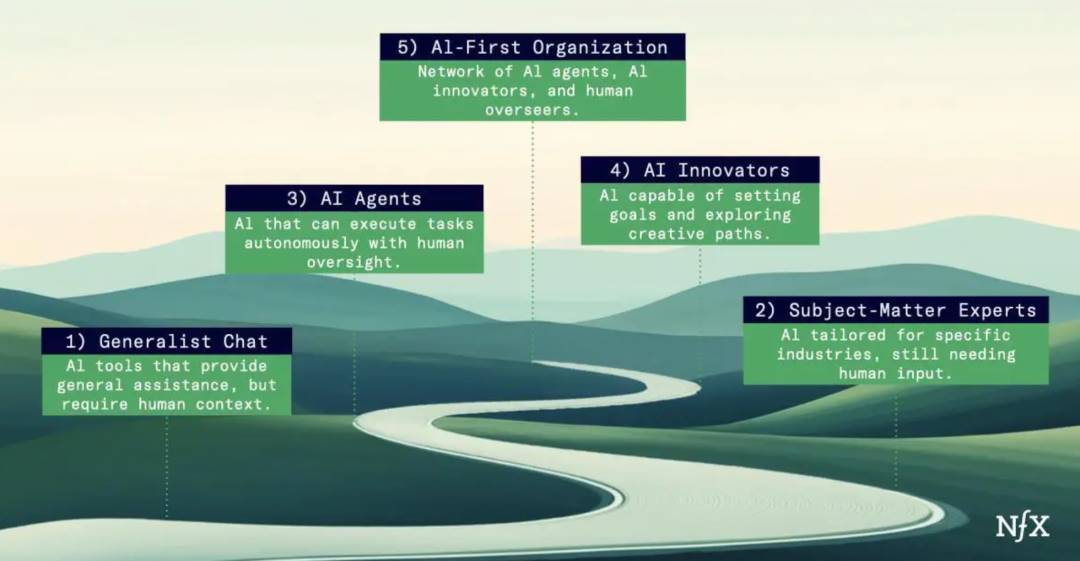
01. General Chat
The first wave of AI collaborators consists of foundational models (general LLMs, such as ChatGPT or Claude). They break through the user experience, helping people understand the broad capabilities of AI.
However, AI is merely a tool, and humans still lead in injecting context, reasoning, and empathy into AI.
As early adopters say, these general tools are all "masterless masters." This has shifted the landscape of AI startups toward the first evolutionary stage.
02. Domain Experts
General AI can read and write and perform tasks under the right guidance. However, general AI tools still perform poorly in super-specific industry environments.
Shortly after the rise of general AI, we began to see the emergence of true AI "experts" in specific fields.
AI seems capable of solving problems without excessive human prompting, with chat still being the primary interface for these systems, but many companies have built additional industry-specific features on top of the chat functionality.
Law is one example, with companies like EvenUp and Darrow showcasing the power of AI trained on specific legal data corpora.
These AIs can understand the nuances of legal language and generate professional-grade legal materials.
03. AI Agents (Current Stage)
Many excellent companies are still operating at the level of AI domain experts.
However, in the past year or so, there has been a noticeable shift from chat-based value propositions to action-based value propositions.
General AI tools and domain experts are true "co-drivers," capable of creating new connections, generating articles, or providing new materials. But humans still need to take action to make these tools truly effective.
Since April 2023, we have begun to see AI capable of performing some more advanced tasks.
The most notable examples of AI agents are in the field of code generation, such as OpenAI's code interpreter or Cognition's AI programmer Devin.
But this concept has far exceeded the realm of code generation and has entered a more complete "job description."
There are now more and more AI agents dedicated to performing specific tasks. The bundling and combination of these tasks have enormous potential to translate into real services.
For example, NFX-supported Enso is pioneering a market for AI agents aimed at small and medium-sized enterprises.
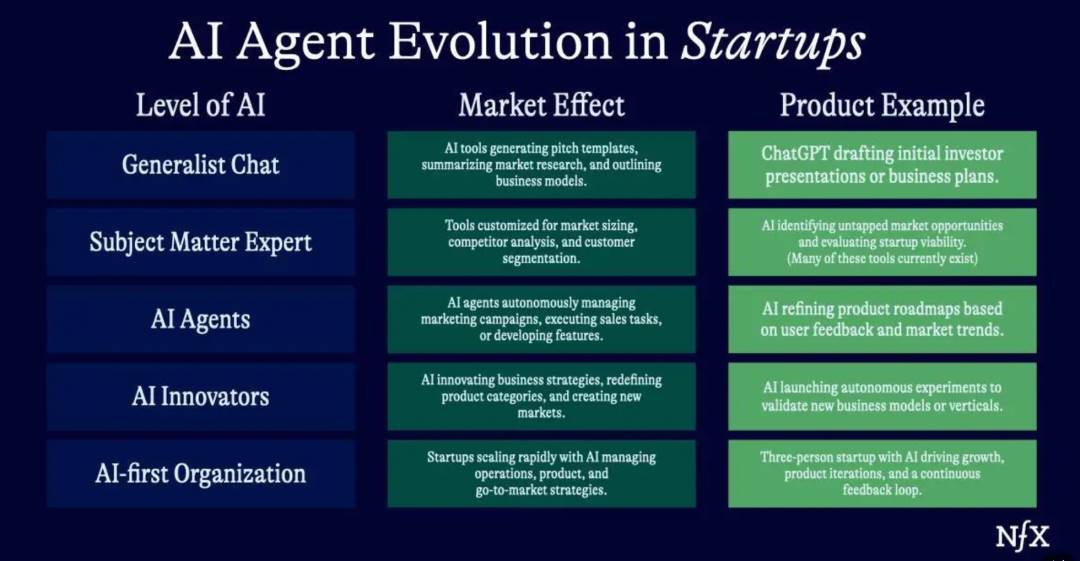
Once people continue to refine AI's ability to complete tasks and take action without extensive human oversight, there will be no turning back.
04. AI Agent Innovation
Once AI agents can consistently perform tasks, we will soon see agents with innovative capabilities. If people allow AI to generate and explore new avenues of knowledge, its value will rise to a whole new level.
This can be viewed through the lens of how the human brain solves problems and exercises creativity.
Humans have a task-oriented "if-then" brain preset that helps them execute tasks and solve problems.
But we also have an active subconscious that kicks in when you are not focused on solving a problem, such as when you are showering or walking.
Have you ever experienced that after struggling with writing or problem-solving, you easily resolved the issue after taking a break?
This is the result of your subconscious freely exploring new creative approaches. Most new, creative ideas emerge in this state.
AI innovative agents will be able to engage in this subconscious exploration. They will not be constrained by "if-then" logical statements, which can lead to narrow thinking.
Imagine asking a group of AI agents to develop a software feature on Monday, and by Wednesday, you find that the agents have improved your initial requirements based on trial-and-error experience and market analysis, developing a better feature.
When the goals themselves are somewhat abstract (increase sales, improve software performance, make users love my application), planning the objectives and mapping the path will be key to the next stage of AI agent development.
This is also a crucial factor in making AI agents truly mature members of the workforce.
Pure automation without critical thinking is the low-hanging fruit in the economy. But it does not address the biggest, most valuable problems; creativity does.
The key unlock lies in trust. People need to have confidence in AI agents to make strategic decisions, not just task-oriented decisions.
Some trust must be built through technology. People need two things: explainability and infrastructure. These two elements may even become industries in themselves.
For example, NFX-supported Maisa is refining the "proof of work" for AI agents, which is a key factor in establishing trust in the entire agent ecosystem.
Another NFX-invested company, Emcie, is developing the infrastructure needed to create hyper-specific AI agents for individuals and businesses.
This trust will develop culturally. The more people see AI making intelligent decisions and creating better outcomes, the faster the future will come.
The early adopter group will be key. Small and medium-sized enterprises or companies that cannot afford to hire human labor to meet their needs will take the first step, while other parts of the ecosystem will watch and follow.
It will touch all industries. For example, in education:

05. AI-First Organizations
With the arrival of agent AI workers, AI innovation, and systems of trust and explainability, we will ultimately see the rise of true AI organizations.
These organizations are a collection of AI agents and AI innovators capable of undertaking a wide range of actions.
This is the kind of AI often heard about in science fiction.
In the worst case, you can read about such AI in Daniel Suarez's "Daemon" or find it in Naomi Kritzer's "Improving Life Through Algorithms."
These agents can make decisions in complex environments with many potential goals worth achieving.
The difference here is that AI itself will be able to self-select which goals are optimal and design paths to achieve those goals.
AI will take most of the actions, and you will work alongside AI, reviewing and auditing the paths it takes.
Imagine a self-managing supply chain that can oversee the entire process from production to delivery, resulting in an automated financial trading company composed of many AI agents.

People do not expect all of this to happen immediately; it will occur step by step.
As trust and technology develop, AI will begin to take on larger and larger tasks. In fact, we are still in the technological window period for AI agent systems.
Those who truly understand this are still the builders and hobbyists who are working hard.
But soon, an AI-dominated organization will emerge, and people will experience a "ChatGPT" moment. Before ChatGPT appeared, how many people truly understood the capabilities of AI?
If you know where people are headed, you will be one step ahead.
In Israel, the AI agent market is thriving, with startups fully leveraging local expertise in machine learning, cybersecurity, and automation.
We see more and more companies building foundational agent platforms for others to customize, such as Enso.
Startups here have begun to tackle vertical challenges in fintech, logistics, and healthcare, positioning themselves as significant contributors to the rapidly evolving AI ecosystem.
AI agents are here, AI innovators are here, AI organizations are here.
So now ask yourself, what is preventing these things from entering my field? How can I remove the barriers? Or, once they are removed, how will I become a major beneficiary?
Not every company should focus on building AI agent infrastructure.
But you can understand how the overall economic benefits in your field will transform as people unleash these new pools of labor.
You can also think about what psychological impact this will have on teams—what will it be like to manage AI employees? Or conversely, what will it be like when humans are managed by AI?
At NFX, our job is to study how transformative technologies work. These shifts are timely, and as technology changes, certain skills will become more important or diminished.
We also need to address the psychological changes and the new opportunities that arise from them.
Artificial intelligence agents are in the most exciting new phase of their emergence, marking the moment when great companies are born.
免责声明:本文章仅代表作者个人观点,不代表本平台的立场和观点。本文章仅供信息分享,不构成对任何人的任何投资建议。用户与作者之间的任何争议,与本平台无关。如网页中刊载的文章或图片涉及侵权,请提供相关的权利证明和身份证明发送邮件到support@aicoin.com,本平台相关工作人员将会进行核查。


