Why is this turmoil considered a game between the left and the right, and how might it trigger political unrest and economic risks? Here are some recent observations and thoughts.
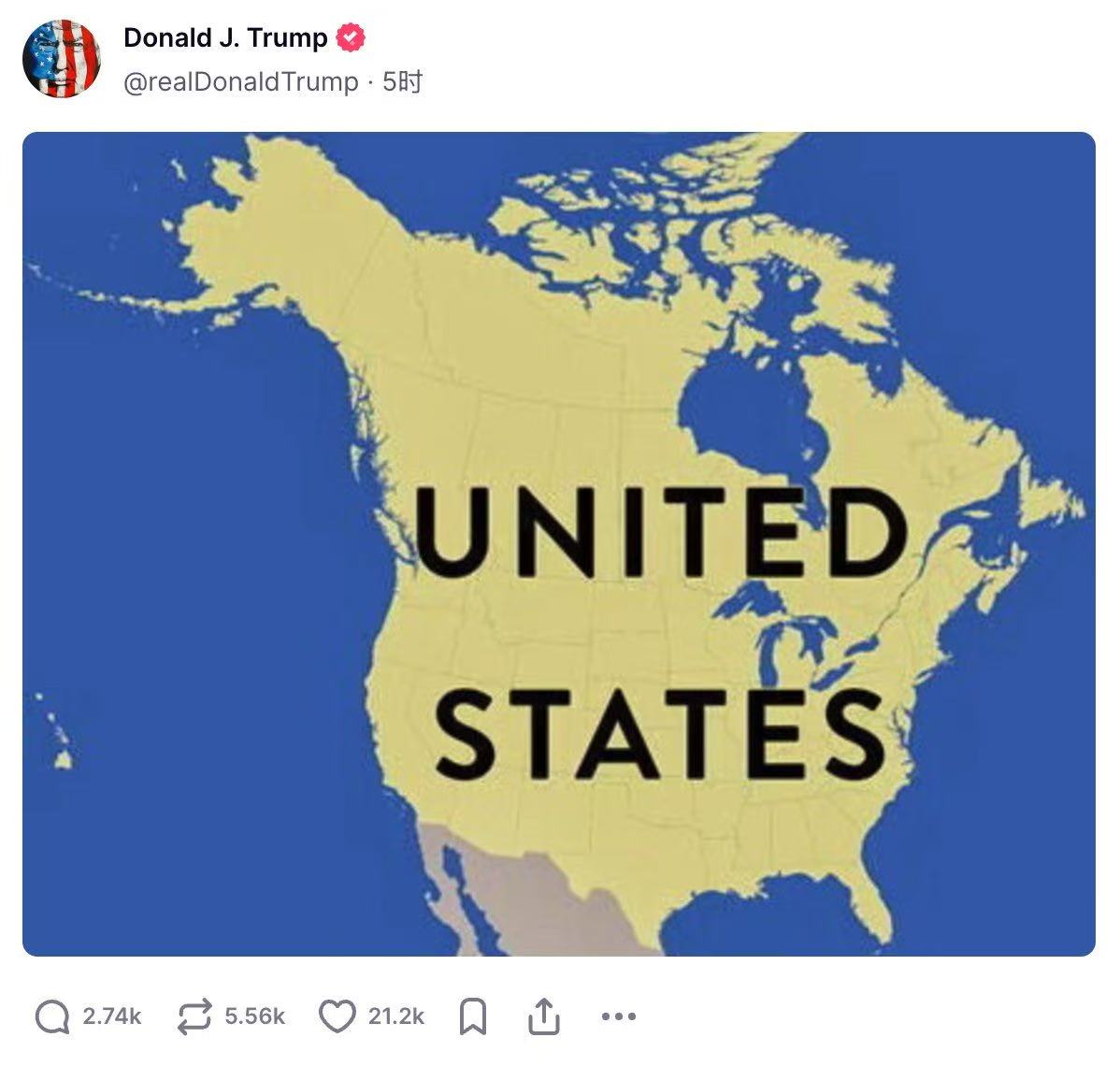
Recently, Trump has not yet taken office (January 20), but a lot has happened. He has threatened to seize territory (Greenland), take control of waterways (Panama Canal), and annex (Canada). This has left some leftists completely stunned and scared; to be honest, no president has ever been this outrageous! As shown in the image below.
Trump proposed similar ideas in the last term, but this time he has directly expressed interest in Greenland, the Panama Canal, and Canada, which is quite rare. This also reflects the core of his "America First" strategy. Such bold territorial expansion ideas not only continue his usual extreme pressure negotiation style but also directly reflect the dominant position of current American right-wing political and economic views and their attempts to shape the global landscape.
Let me discuss some differences between the left and right and their economic development ideas, so you can understand the potential crises and opportunities within.
Right-Wing Perspective: National Interest First and Geoeconomic Expansion
Within the right-wing framework, Trump's statements reflect his extreme emphasis on traditional geopolitics and national interests. The right typically emphasizes nationalism, believing that the core goal of a nation is to protect its own interests and enhance its economic and military dominance. From this perspective:
1️⃣ Strategic and Resource Value of Greenland
The geopolitical importance of the Arctic is increasingly prominent due to climate change. The opening of Arctic shipping routes makes Greenland a key node in controlling this emerging transportation hub. If the U.S. controls Greenland, it could not only break Russia's advantage in the Arctic but also gain access to abundant natural resources, including oil, natural gas, and potential rare earth reserves, thus reducing dependence on Chinese rare earths. This strategy aligns with the right's economic nationalism, emphasizing securing resources to ensure national independence and economic growth.
2️⃣ Economic and Strategic Significance of the Panama Canal
The Panama Canal, as a core passage for global trade, is a crucial hub connecting the Pacific and Atlantic Oceans. Controlling the canal can not only reduce U.S. logistics costs but also strengthen its global economic hegemony. The right believes that control over critical infrastructure is part of national security, rather than merely commercial interests.
3️⃣ Extreme Pressure and Negotiation Strategy
Trump's expansionist rhetoric resembles a "bluffing" extreme pressure strategy aimed at forcing opponents to compromise in negotiations. This style aligns with the right's "zero-sum game" worldview, which sees international relations as a competition where only strong measures can secure benefits for the country.
Left-Wing Perspective: Importance of International Cooperation and Global Governance
In contrast to the right's emphasis on national interests, the left focuses more on international cooperation and multilateralism, stressing global win-win scenarios and equitable development. From the left's perspective, Trump's expansionist rhetoric has left them anxious, especially regarding concerns and fears about economic development, including many American multinational corporations that may be adversely affected. The left's perspective includes:
1️⃣ Undermining International Rules and Trust
The left typically believes that international order needs to be maintained through rules and cooperation, rather than relying on power and coercion. Trump's blatant coveting of other countries' territories not only undermines the basic principles of international law but also weakens America's moral leadership globally.
2️⃣ Ignoring Environmental and Local Rights
Resource development in Greenland could have immeasurable environmental impacts, while the right's pursuit of economic interests often overlooks these long-term consequences. The left is more concerned with ecological protection and the rights of indigenous peoples, believing that development must occur within a framework of sustainable development.
3️⃣ Anti-Globalization and Isolationist Tendencies
Trump's policies reflect a trend of anti-globalization, which runs counter to the left's advocacy for open markets and multinational cooperation. The left believes that through trade and collaboration, countries can achieve shared prosperity, rather than solving economic issues through territorial expansion or resource plundering.
Thus, from the recent game between the left and the right, it can be seen that the contradictions have intensified to an extreme. Anyone with a bit of economic knowledge knows that free trade is key to achieving global prosperity. However, when globalization is hindered or competition between nations intensifies, territorial expansion or resource competition often becomes a natural choice for national policy, akin to the "law of the jungle" in nature, where the weak are preyed upon by the strong. This contains strong economic motives: in a closed environment, expansion can ensure more resources and markets, reducing competitive pressure. However, such right-wing expansionist policies are extremely unstable and require the cost of exploiting smaller countries as leverage, which may lead to more international conflicts and instability. This is also a key factor behind the recent stock market turmoil.
In summary, 2025 is a year of both crisis and opportunity amid turmoil. Trump's policies represent a profound challenge to the era of globalization and a bold revision of traditional American strategy. However, behind these policies lie deep concerns about global economic disorder, intensified geopolitical conflicts, and environmental and social development. The future direction of the global economy will depend on whether this power politics can achieve effective balance with international cooperation and rules. In 2025, both danger and opportunity coexist; it is crucial to seize opportunities in the first half of the year. Once policies begin to take effect in the second half, it may mark the beginning of turmoil! 🧐
免责声明:本文章仅代表作者个人观点,不代表本平台的立场和观点。本文章仅供信息分享,不构成对任何人的任何投资建议。用户与作者之间的任何争议,与本平台无关。如网页中刊载的文章或图片涉及侵权,请提供相关的权利证明和身份证明发送邮件到support@aicoin.com,本平台相关工作人员将会进行核查。


