Yinghao, SevenX Ventures (twi: @linsajiao)

TL;DR
Xterio has a clear positioning and vision:
An integrated Web3 gaming ecosystem that combines infrastructure, research and development, operations, assets, and platforms.
A fully covered, research and operation integrated, end-to-end Web3 gaming industry chain.
A cross-terminal, cross-category Web3 gaming factory.
Xterio's products include:
Game chains, gaming platforms, self-developed games, and game publishing.
Each product segment has achieved impressive results.
Xterio is an active explorer in AI gaming:
One of its flagship games, Pailo, integrates large language models and AI generation technology, creating a game world where players can deeply interact with high-quality AI Agents.
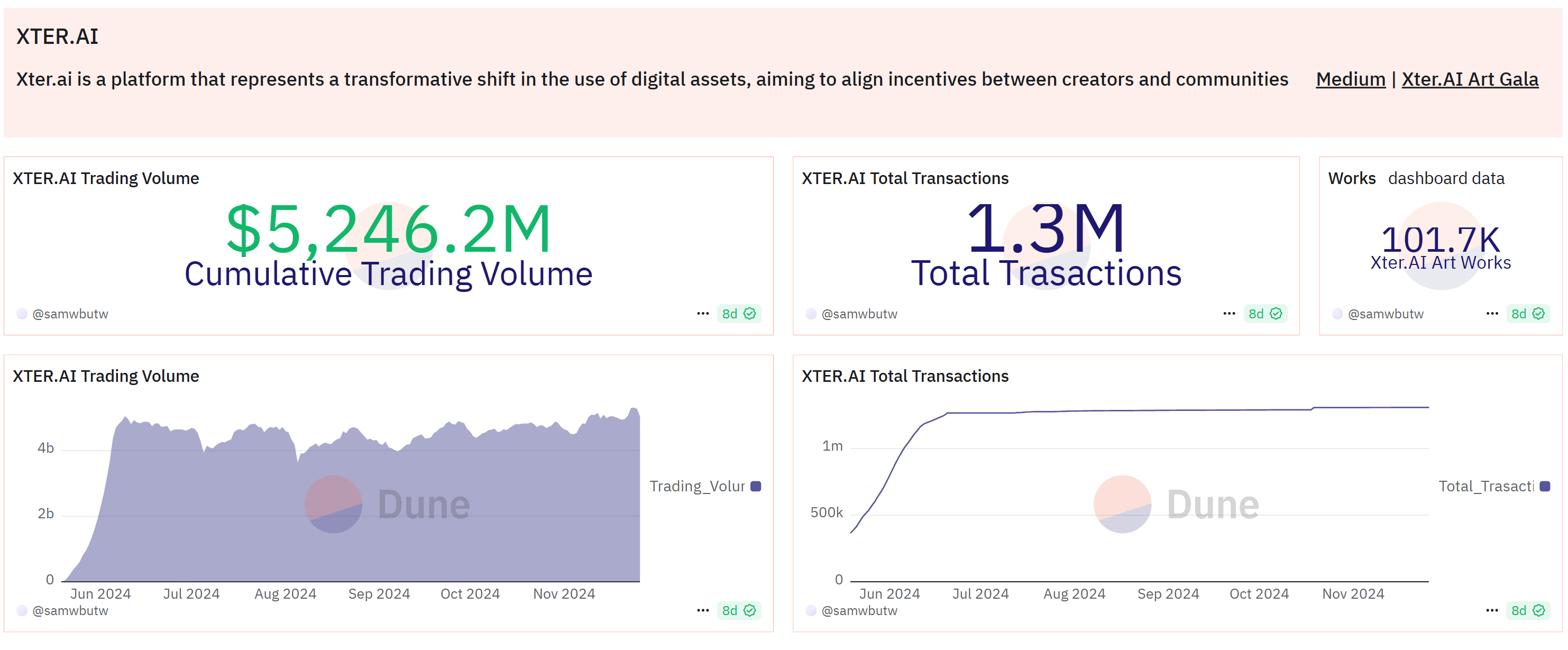
Xterio also applies AI generation technology to NFTs, with users having generated over 100,000 works using Xter.ai.
Xterio already possesses the core elements to achieve valuation premiums:
It is expected to establish a leading position in the industry during this bull market, breaking the ceiling on Web3 gaming project valuations.
As the commercialization process deepens, Xterio will demonstrate potential comparable to traditional gaming giants.
The Garden of Forking Paths: Dual Perspectives on the Dilemmas and Breakthroughs of Web2 and Web3 Games
Before discussing Xterio, let’s step outside the project and take a look at what is happening in the Web3 and Web2 gaming industries. In Borges' "The Garden of Forking Paths," time is depicted as an infinitely branching network, where each decision point leads to different parallel universes. Today's gaming industry resembles this metaphorical garden: Web3 and Web2 games seem to be on parallel paths, yet they continuously intertwine at critical nodes of industry evolution, reflecting upon each other.
As an investment institution deeply engaged in this field for a long time, we have found that the dilemmas of Web3 games are concentrated at the track level, while the dilemmas of Web2 games lean towards the industry level; the two appear unrelated yet are closely connected.
The "Track Level" Dilemma of Web3 Games
Developers and Product Breakthroughs
Web3 games are facing a dual squeeze of talent and products. Research shows that only 7% of game development studios show a strong interest in Web3 technology, and there are fewer than 50,000 full-time practitioners, in stark contrast to the 3 million practitioners in the traditional gaming industry. This talent scarcity directly impacts product quality. According to Footprint data, there are only about 2,000 active games on mainstream game chains, while over 100,000 new traditional games are added globally each year, highlighting a significant disparity.
Even more concerning is product quality. Most Web3 game studios have between 10-30 employees, and due to limitations in manpower and funding, the quality of games is generally unsatisfactory. The types of games are also overly homogeneous, mainly concentrated in fewer than 10 categories such as RPG and SLG, while traditional games on the Steam platform boast over 100 subcategories. This lack of product strength prevents Web3 games from breaking free from simple gameplay mechanics like gold farming and airdrops, making it difficult to attract genuine players.
The Curse of Narrative
The narrative of Web3 games has fallen into a homogenization dilemma. Recently, a large number of projects have upgraded their positioning to platforms or game chains, even layering concepts like modularization and RaaS, flooding the market with dozens of similar game chains. At the same time, various projects are racing to layout stories of traffic migration from Web2 platforms, from Telegram to Line, Discord, and TikTok, attempting to replicate the successful model of "hit content - traffic platform - publisher."
Even more thought-provoking is the emergence of concepts like "tap to earn." This model is simpler than "play to earn," further weakening the entertainment essence of games and transforming them into mere money-making tools. The distortion of narrative has not brought breakthroughs to the industry; rather, it has caused Web3 games to deviate further from the correct development path.
Commercialization and Funding
The commercialization of Web3 games faces dual challenges of traditional models failing and new models being unstable. The mature payment models of traditional games (direct purchases, in-game purchases, advertising, etc.) are difficult to implement in the Web3 environment, primarily because users cannot receive sufficient positive feedback from their gaming experiences. Meanwhile, the unique asset sale and token sale models of Web3 are struggling due to the economic systems failing to close the loop.
The deteriorating funding environment exacerbates this issue. In 2024, the average funding amount for Web3 games dropped below $3 million, with most projects having a lifespan of less than 18 months. This financial pressure, combined with the uncertainty of business models, makes it difficult for projects to achieve sustainable development. From angel rounds of $500,000 to $2 million, to Series A rounds of $3 million to $8 million, and Series B rounds of over $8 million, the entire funding chain appears extremely fragile.
These three dilemmas form a vicious cycle that is hard to break: talent scarcity leads to insufficient product quality, insufficient product quality makes commercialization difficult, and commercialization difficulties further restrict talent attraction, ultimately affecting the healthy development of the entire industry. Breaking this cycle requires simultaneous efforts in improving product quality, innovating business models, and optimizing the funding environment.
What is happening in the Web2 gaming world? Are their dilemmas the same? Let’s take a look.
The "Industry Level" Dilemma of Web2 Games
Industry Chain Integration: From Fragmentation to Unification
The issue of fragmentation in the Web2 gaming industry chain is becoming increasingly prominent. For example, in game development, statistics show that in 2023, the number of independent game studios worldwide exceeded 50,000, but 90% of these studios earn less than $1 million annually. In the game publishing sector, small and medium-sized publishers occupy 80% of the market share, but the average annual output of a single publisher is only 2-3 titles, leading to inefficiencies in the market. The supporting service sectors such as game engines, cloud services, and advertising monetization also exhibit high levels of fragmentation, severely restricting industry development.
The efficiency loss caused by industry chain fragmentation is particularly evident. A 2023 industry report indicated that independent game developers typically need to negotiate with 3-5 publishers to finalize cooperation, a process that often takes 6-8 months. Even more concerning is the revenue-sharing issue; surveys show that small and medium developers usually have to cede 50%-70% of their revenue share when collaborating with publishers. Taking the phenomenally successful independent game "Hollow Knight" as an example, despite global sales exceeding 3 million copies, the development team ultimately received only 35% of the total revenue due to high revenue-sharing costs in the publishing phase.
The drawbacks of this fragmentation have been confirmed in multiple cases. The highly acclaimed "Star Citizen" faced funding difficulties in its early development due to an inability to find suitable publishers, ultimately having to turn to crowdfunding. Another typical case is "Subnautica," which achieved a 95% positive rating on Steam in its first month but, constrained by a 70/30 revenue-sharing agreement with its publisher, the development team was nearly unable to profit after deducting costs, only turning the situation around later through self-publishing.
In contrast, companies with integrated industry chains show clear advantages. Tencent Games has created a phenomenal product with annual revenues exceeding $2 billion by integrating development, publishing, and esports event operations for "League of Legends." NetEase, relying on a complete industry chain layout, achieved a remarkable 23% year-on-year growth in gaming business revenue in 2023, from game development to publishing, and from cloud services to esports events. These success stories indicate that industry chain integration can not only enhance operational efficiency but also provide a better development environment for game creators.
Industry chain integration has become an inevitable trend in the development of the gaming industry. miHoYo started purely as a game developer and gradually built a complete industry chain that includes development, publishing, and community operations; the success of "Genshin Impact" confirms the correctness of this strategy. A complete industry chain can not only reduce costs in intermediate links but also ensure consistency in product quality and continuity in user experience. In the future, competition in the gaming industry will no longer be a contest of individual links but a competition of industry chain integration capabilities. Companies that can achieve a full industry chain layout will undoubtedly gain an advantage in this transformation.
Integration Trend: The Momentum of Full-Terminal and Multi-Category
Newzoo's latest data shows that by 2024, the market share of PC games has dropped to 23%, down 8% from five years ago, and console games have also decreased from 31% to 27%. This downward trend reflects the severe challenges faced by traditional PC game models. The once-glorious "World of Warcraft" has seen its MAU drop from a peak of 12 million to less than 5 million, and the Steam platform has experienced an embarrassing situation where 65% of new games have an MAU of less than 1,000. All of this points to a reality: the era of purely relying on PC games has ended.
However, companies focused on mobile games are also facing developmental bottlenecks. Surveys show that only 23% of users aged 45 and above choose mobile as their primary gaming platform, and this age limitation restricts the further expansion of the mobile gaming market. Technical limitations are also evident, with the average gaming duration of MMORPG mobile games being less than half that of PC games. Growth data more directly reflects this dilemma: the once rapidly growing miHoYo saw its growth rate drop to 9% in 2023, down from 45% in 2021.
In the face of this dual dilemma, gaming companies are beginning to seek breakthroughs. PC game giants are entering the mobile platform, with Activision Blizzard successfully increasing its mobile revenue share to 35% through "Call of Duty: Mobile." At the same time, mobile game companies are actively laying out the PC game market, with miHoYo developing "Honkai: Star Rail" and Lilith investing in console games, reflecting this trend of bidirectional integration.
The rapid iteration of game categories further promotes this integration. On the Steam platform, survival games occupied four spots on the revenue chart in 2021, but by 2023, only one remained; MMORPG games in the mobile market dropped from five in 2020 to two in 2023. Instead, new categories are rising, such as the emergence of anime-style idle games and simulation management games. The speed of this change has put companies betting on a single category to the test.
Market data confirms the advantages of a diversified strategy. In 2023, NetEase, which adopted a multi-category layout, achieved a 23% revenue growth, while Perfect World, which focused on MMORPGs, saw a 15% decline. Tencent achieved steady growth through its layout in multiple categories such as MOBA, FPS, and survival games; miHoYo also started from anime mobile games and gradually expanded into open-world RPGs and strategy games, maintaining a good development momentum.
The future of the gaming industry clearly belongs to comprehensive companies that can achieve full-terminal coverage and multi-category layout. This trend is not only an adaptation to market changes but also a response to user demands. More and more users expect a seamless gaming experience across platforms and wish to try different types of games in various scenarios. Companies that can meet these demands will undoubtedly hold an advantageous position in future market competition.
Swimming Against the Current: Xterio's "Industry Chain Solution"
Through the above observations, we can see that the Web2 and Web3 gaming worlds are undergoing transformations at different stages: the Web2 gaming industry is upgrading and reorganizing its industry chain based on high-quality content, mature business models, and a large user base, while the Web3 gaming industry is still in the process of constructing its most basic industry chain structure. These two seemingly parallel worlds actually contain important insights.
Another Perspective on Web3 Games
The dilemmas faced by Web3 games, while seemingly localized, require solutions from the perspective of the transformation of the Web2 gaming industry. Currently, Web3 games are confronted with the dual challenges of micro industry chain structural imbalance and inability to integrate with the Web2 gaming industry chain.
However, Web3 games possess unique advantages that naturally lend themselves to an integrated industry chain structure:
Integration of Infrastructure and R&D: Customized performance, nodes, ecosystem tokens, and other infrastructure are needed.
Integration of R&D, Publishing, and Operations: Content and asset publishing need to be synchronized, with operations centered around assets, tokens, and communities.
Xterio's Vision
The emergence of Xterio brings new hope to the industry. As a startup with a background in major Web2 gaming companies, Xterio has proposed a clear vision:
To build an integrated Web3 gaming ecosystem encompassing infrastructure, R&D, operations, assets, and platforms.
To create a fully covered, integrated research and operation, end-to-end Web3 gaming industry chain.
To develop a cross-terminal, cross-category Web3 gaming factory.
In the latest industry research, Xterio was rated as the "most anticipated Web3 gaming project" by over 60 senior players in the Web3 gaming space. Its uniqueness lies in constructing the Web3 gaming ecosystem from the perspective of the Web2 industry chain, bringing a more scientific production framework to the entire track and pioneering a higher-dimensional construction approach.
This method retains the innovative characteristics of Web3 games while addressing their shortcomings in the industry chain, providing new ideas for the healthy development of the entire industry. Xterio's practice demonstrates that solving the dilemmas of Web3 games from the perspective of industry chain integration is not only feasible but may also be an inevitable direction for development.
Just like the garden in Borges' writing, the development paths of Web3 and Web2 games will eventually converge at some temporal and spatial node. At this convergence point, Web3 games will inherit the industrial wisdom of Web2 while creating their own new realm. Xterio stands as a pioneer at this intersection.
Transformation: Xterio's Product Exploration
Over the past two years, Xterio has continuously solidified its product core while expanding its product extension. "The gentleman transforms like a leopard, and his writing is magnificent" — Xterio has formed a product/business matrix supported by four major pillars: game chains, gaming platforms, self-developed games, and game publishing.
Product/Business Segments
Product/Business Content
Game Chains and Infrastructure
A game-specific rollup built on ETH and BNB, utilizing the Optimism "Superchain" technology stack.
Providing top-notch tools for games, including on-chain solutions, data analysis, real-time operations, and multiplayer support.
Gaming Platform
The ultimate portal for Web3 games, integrating game discovery, asset publishing, asset management, and content creation.
Includes modules such as game gallery, NFT marketplace, wallet, identity system, and community.
Self-Developed Games
Multiple self-developed games spanning various platforms and types.
Includes Age of Dino, Overworld, City Shadows, Palio, and Blackdawn.
Game Publishing
Providing comprehensive publishing services for nearly 100 high-quality game partners.
Including user acquisition, brand marketing, platform relations, media promotion, leading NFT publishing platform, and crypto social media influence.
Game Chains and Platforms
Xterio is building a comprehensive blockchain gaming infrastructure ecosystem. Technically, it has engaged in deep cooperation with AltLayer and EigenLayer to jointly develop the "SuperChain" Rollups solution based on Optimism technology. This solution not only provides high-performance transaction processing capabilities but also shares liquidity with other SuperChain-based layer two networks (such as Base), enhancing the interoperability of the ecosystem.
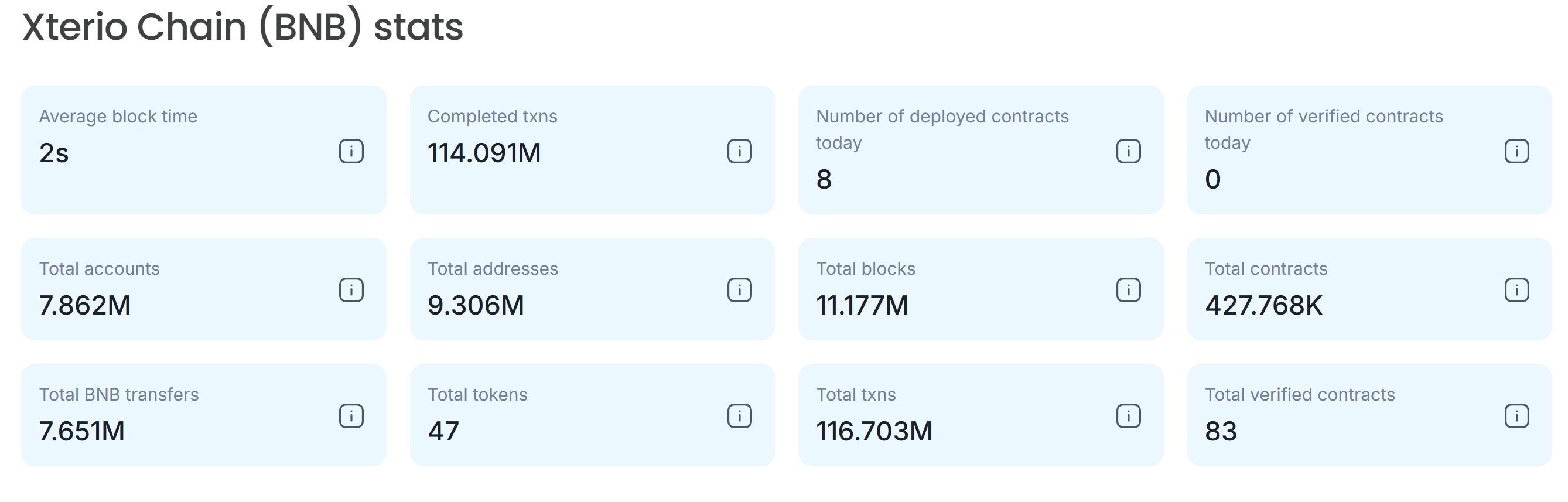
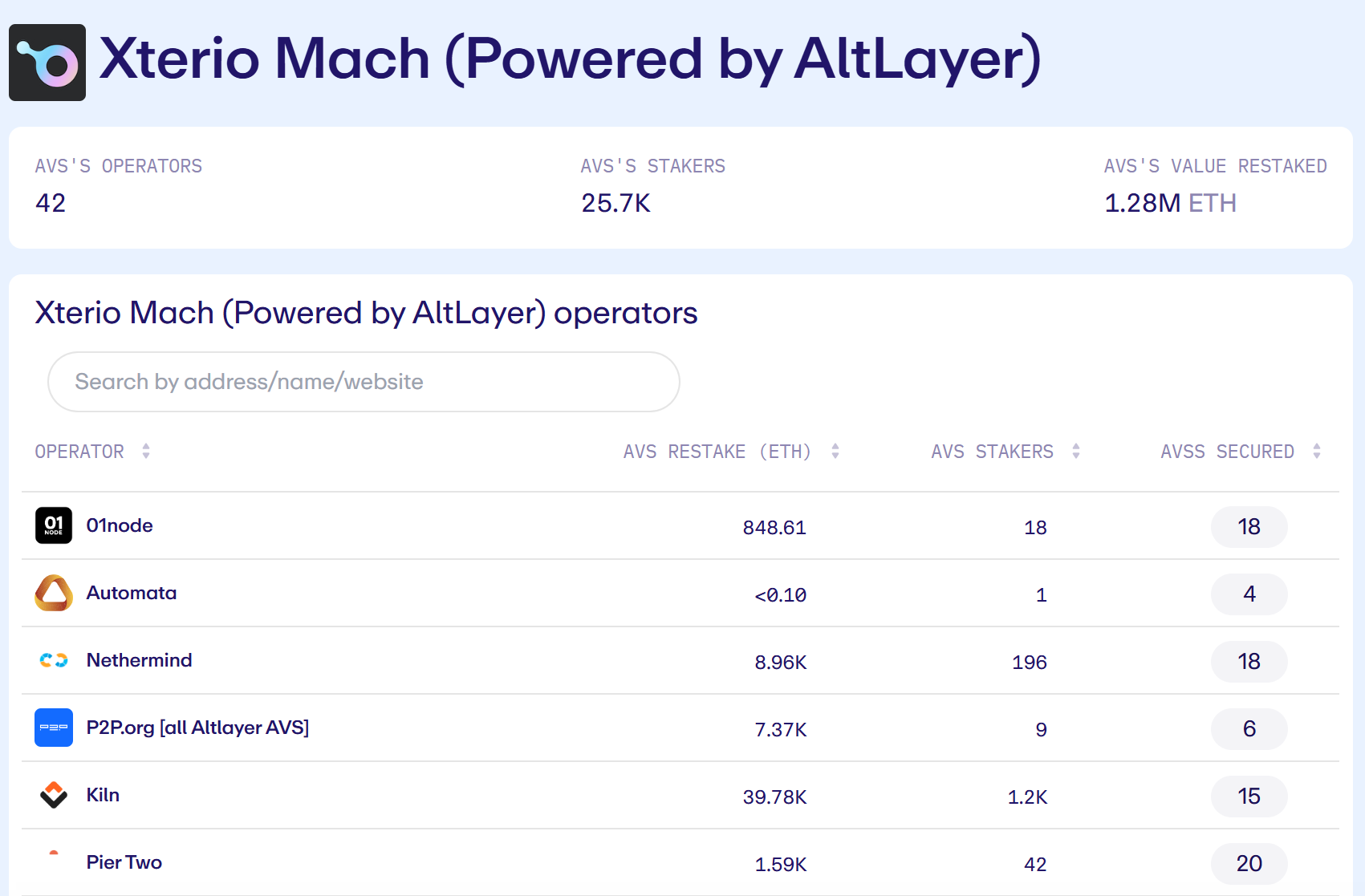
The most innovative aspect is the adoption of the MACH (Modular Asynchronous Confirmation Handling) technology framework, allowing Xterio Chain to compress transaction confirmation times to under 10 seconds while maintaining high security, which is revolutionary for real-time gaming applications. Notably, Xterio is the only gaming project among the first batch of AVS from EigenLayer, having received approximately 1.28 million ETH in restaking support, which not only supports performance optimization but also builds a secure and reliable comprehensive gaming platform by sharing Ethereum's economic security attributes.
In terms of platform construction, Xterio has developed into a Web3 gaming hub with 8 million active users, providing comprehensive services for players and developers:
For Players:
One-stop service system: including NFT trading market, digital wallet management, game library, and a complete identity system.
Innovative account system: utilizing abstract account (AA) technology, allowing users to manage digital assets with just an email and OTP verification.
Secure payment system: partnering with MoonPay and LayerZero to provide diverse payment options.
Asset protection: employing MPC technology to safeguard user assets, supporting cross-chain asset management.
Mobile adaptation: fully compliant with mobile regulations, ensuring a complete service experience.
For Developers:
Complete technical solutions: providing intuitive API interfaces, scalable infrastructure, and comprehensive data analysis tools.
Cross-platform support: covering both mobile and desktop, offering SDKs for Unity and Unreal Engine.
Economic support: built-in royalty execution systems and marketing toolkits to help developers maximize revenue.
Multi-chain deployment: supporting user base expansion across different blockchain ecosystems.
In terms of NFT infrastructure, Xterio has built the most comprehensive NFT publishing platform in the market, offering the following core functionalities:
NFT Platform Features:
Smart contract system: providing customized and open-source minting smart contracts with built-in royalty execution mechanisms.
Comprehensive whitelist system: including native whitelist features, bidding systems, lottery systems, and application systems.
Data and community: offering on-chain data analysis, KOL collaborations, DAO organization connections, and guild management functionalities.
Marketing support: providing customized PR activities, marketing event planning, and social media community management services.
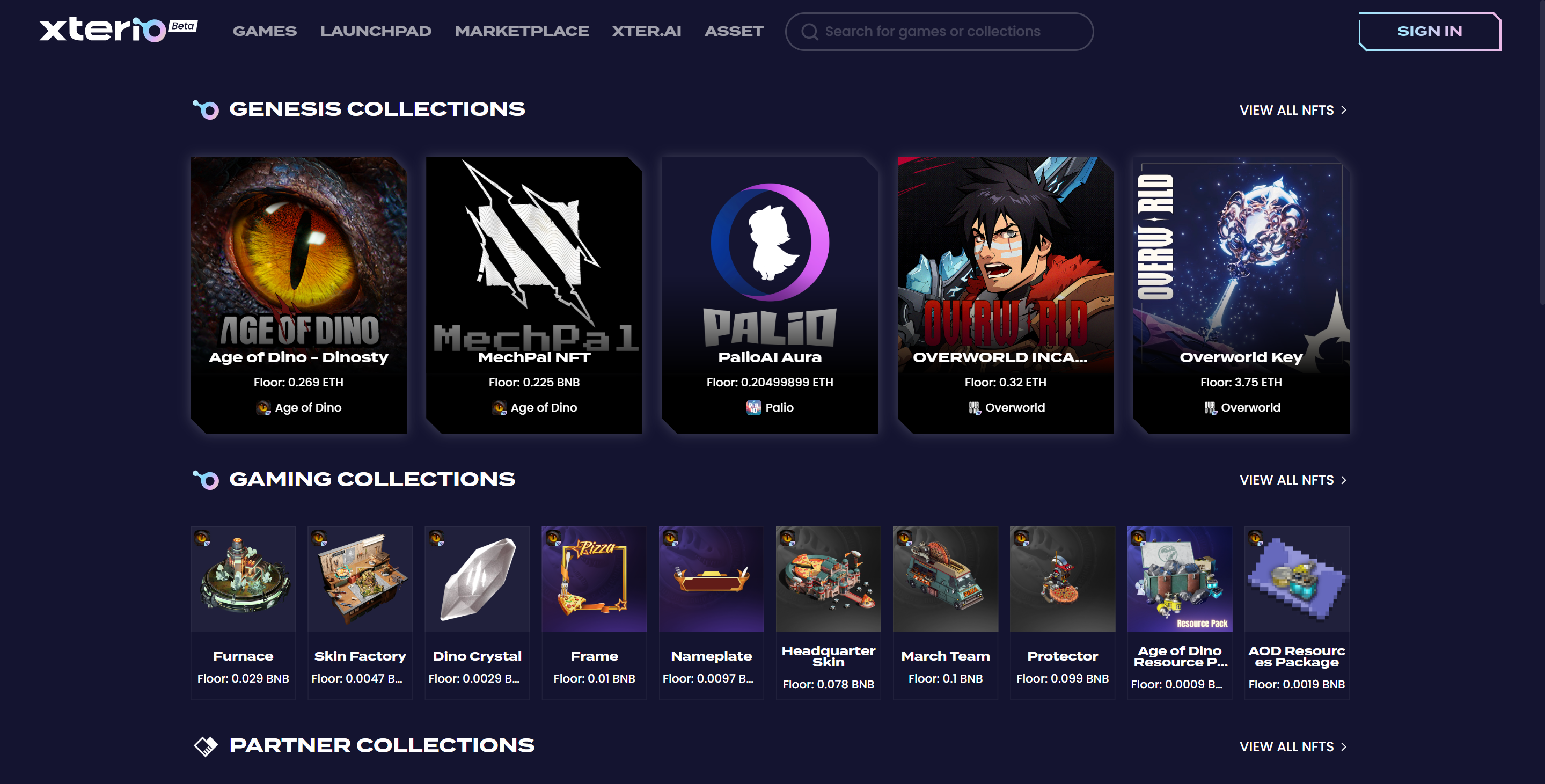
With its comprehensive features and diverse services, Xterio's NFT platform achieved sales exceeding 5,000 ETH in the first half of 2024, firmly securing its position as the top publishing platform. Among the dozens of projects launched on the launchpad, over 100,000 independent users participated, with most projects minting out within seconds to 72 hours. The success of the issuance is attributed to Xterio's powerful functionalities, such as supporting custom smart contract minting, whitelist management, bidding, and lottery systems, while also providing on-chain data analysis and optimization services. By integrating DAOs, guilds, KOLs, and blue-chip communities, the platform effectively enhances the market penetration of projects. Additionally, Xterio supports precise outreach to multi-chain users and provides PR marketing activities and community operation support, such as customized promotions on Twitter and Discord.
Through collaboration with nearly 100 projects, Xterio has become one of the most powerful publishers at the intersection of Web2 and Web3.
Self-Developed Games and Third-Party Game Publishing
In terms of gaming content, Xterio's content matrix is divided into self-developed games and third-party cooperative games.
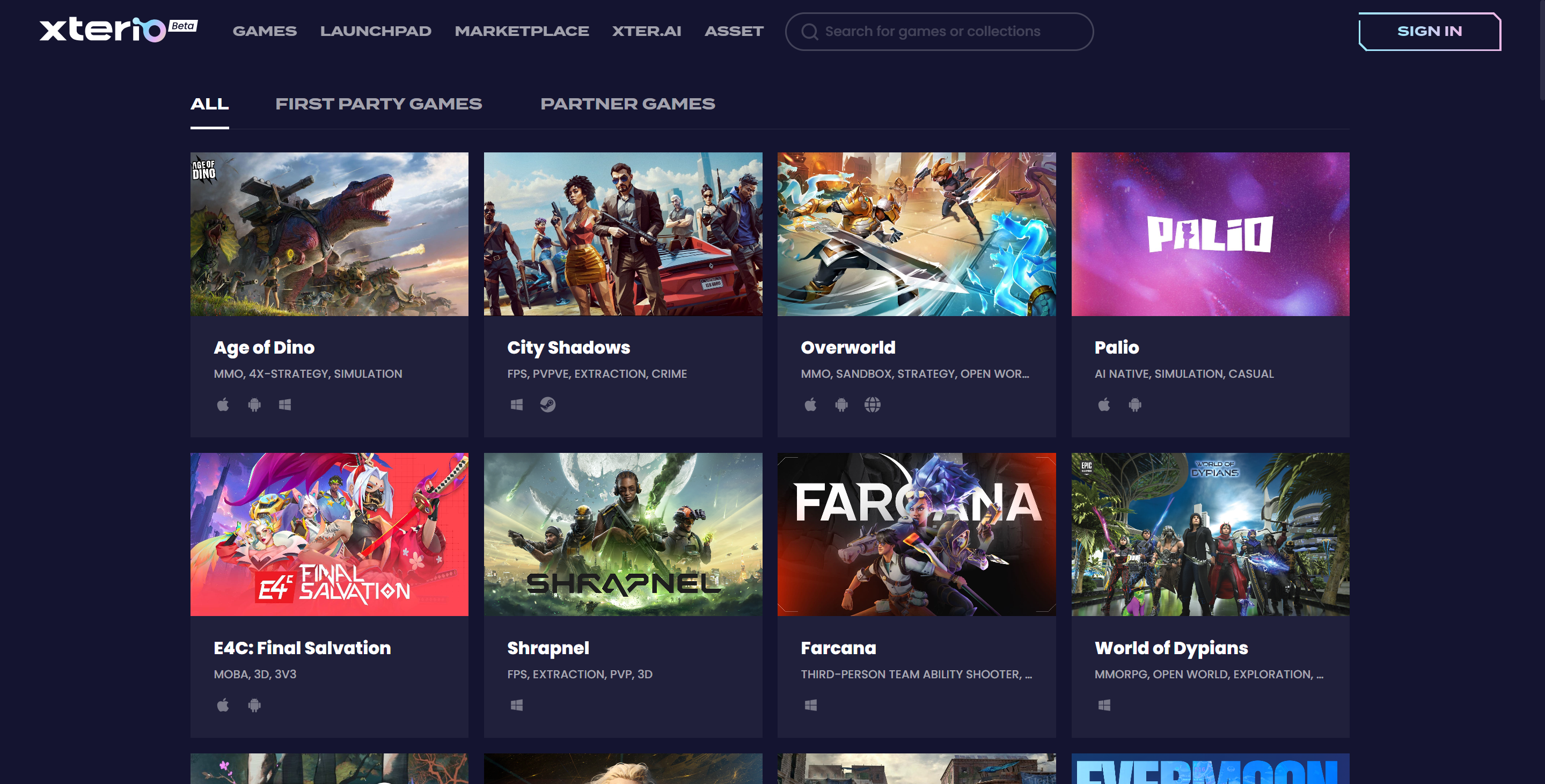
Self-developed games include five titles: Age of Dino, Overworld, City Shadows, Palio, and Blackdawn:
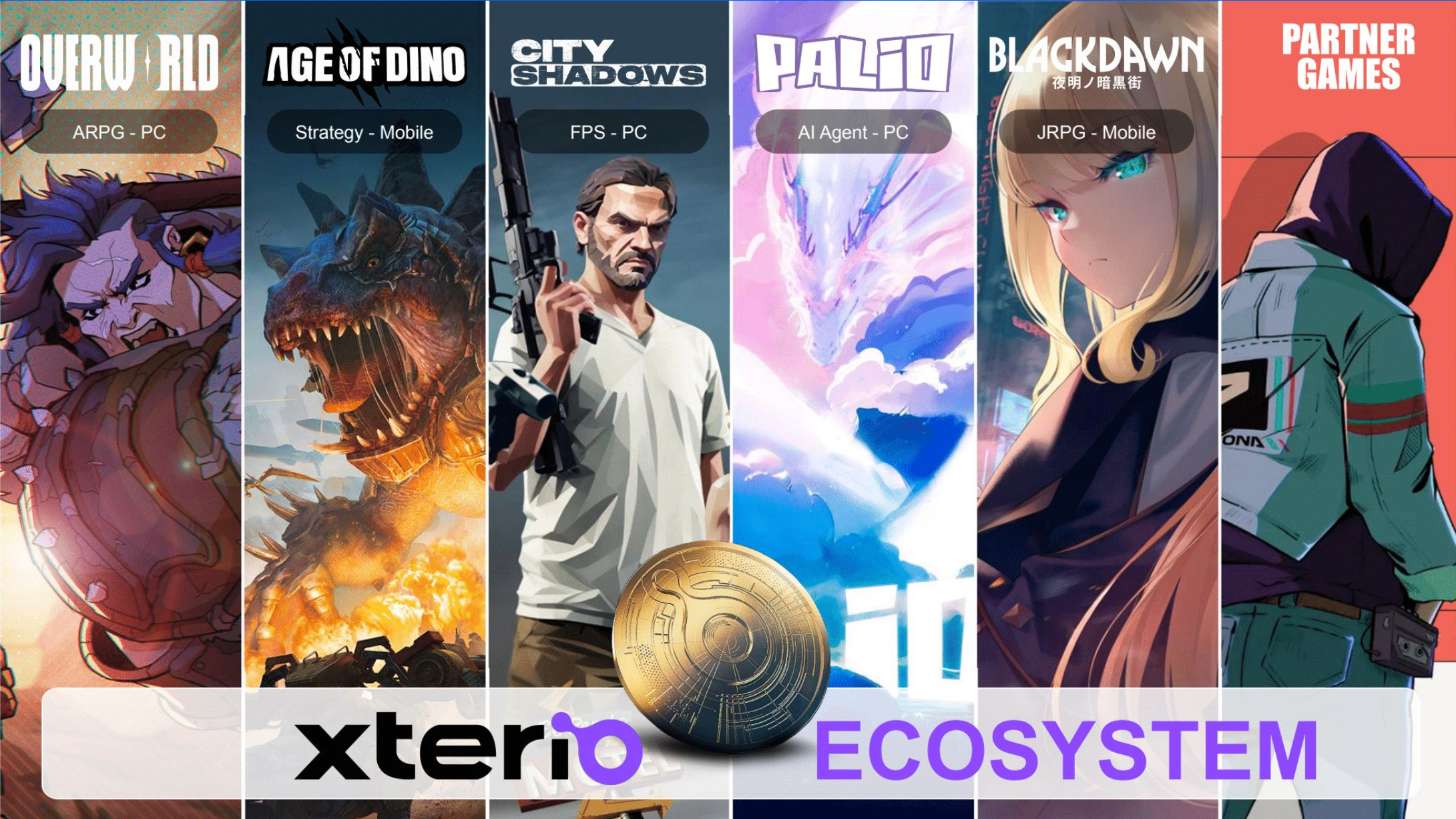
The flagship product, Age of Dino, has consistently captured players' attention over the past year. As an innovative cross-platform strategy game, Age of Dinosaurs completed $8 million in seed round financing, receiving support from major investors including Xterio, Animoca Ventures, and SevenX Ventures, while also attracting participation from renowned investment institutions such as Hashkey Capital, Game 7, and GSR Markets.
In terms of game design, AoD cleverly integrates core gameplay elements of strategy simulation (SLG) and role-playing (RPG). Players can manage a dinosaur base, explore unknown areas to collect resources, and engage in strategic confrontations with AI-driven hostile forces and mutated dinosaurs, all woven into an engaging game world. In terms of accessibility, AoD achieves seamless connectivity between mobile (iOS, Android) and PC platforms, and innovatively launched a Telegram mini-program version, allowing players to enjoy the game anytime, anywhere.
In terms of market performance, AoD demonstrated strong potential upon launch, generating over $300,000 in total revenue in its first week. In terms of business model innovation, AoD breaks the traditional strategy game reliance on official skin releases for revenue, fully opening up skin creation rights to the player community. From operational data, the average spending per paying user reached $110, far exceeding three times that of other blockchain games in the same category. Notably, the game achieved a balance between traditional players' fiat currency recharge income and blockchain users' on-chain income from the very beginning of its launch.
On the social level, AoD demonstrates exceptional cohesion. A recent event, the Institute Battle, serves as a typical case: this large-scale battle attracted nearly 10,000 players online simultaneously for 8 hours. In this intense competition, various guilds showcased remarkable organizational and strategic execution capabilities, with individual players even making significant expenditures exceeding $20,000 in a single instance. Such levels of investment are rare in the blockchain gaming field, fully reflecting players' high recognition of the game.
Choosing the SLG category reflects Xterio's profound market insight. The latest industry report shows that strategy games surpassed $8 billion in revenue in 2023, with new user installations reaching 700 million and a growth rate maintaining a high level of 23.5%. Within the strategy game sector, SLG's installation share has exceeded 52.1%. In terms of commercial performance, the average spending per user in this category reaches $11, with heavy players' annual consumption potentially exceeding $1 million. More importantly, SLG games generally maintain stable operations for 6-8 years, as evidenced by "Clash of Clans," which has been operational for nearly 10 years and has accumulated over $10 billion in revenue, fully demonstrating the commercial potential of this sector.
It is worth mentioning that the Web3 adaptation of mature Web2 game types has always been a challenge, especially for the SLG category. The complexity of game production combined with the difficulty of user acquisition has deterred many Web3 game teams from attempting it. However, breaking through this bottleneck could continuously bring Web2 users into the Web3 ecosystem, which is precisely the direction AoD is striving for.
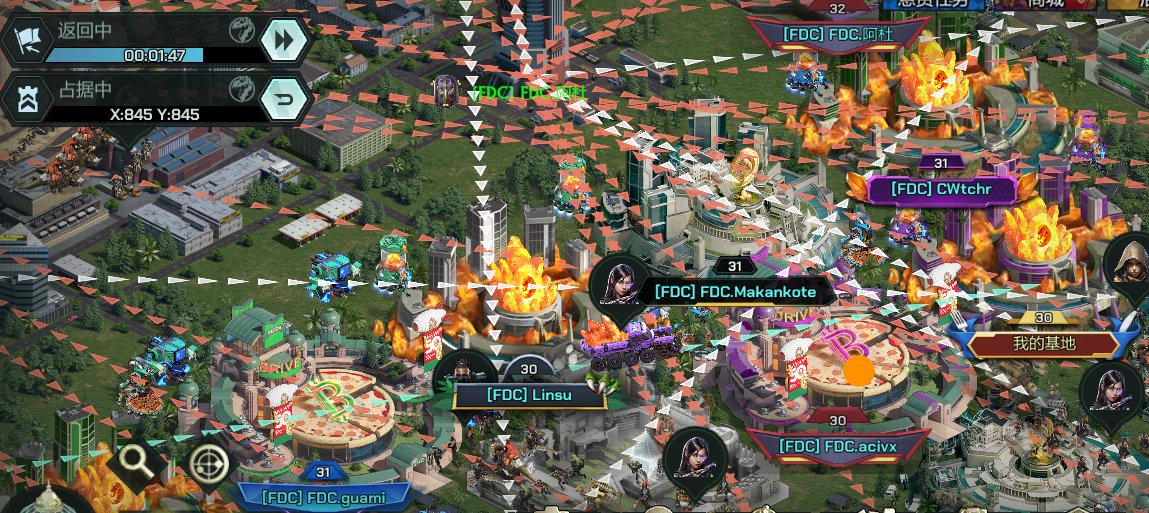
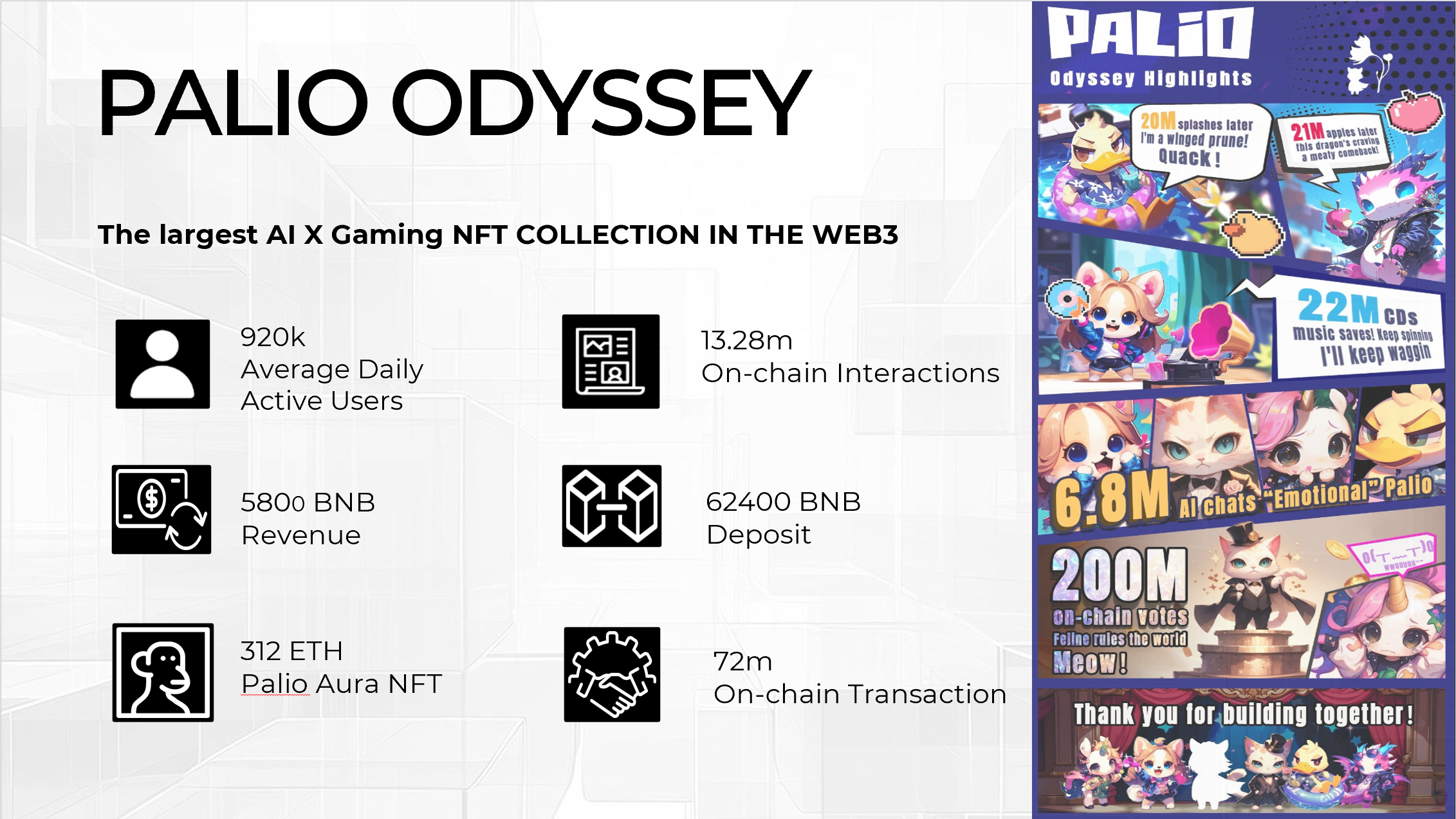
Another game, Palio, represents Xterio's innovative exploration in the AI gaming field. This fantasy 2D simulation game, spanning both PC and mobile platforms, centers around the concept of "creating your unique AI companion," showcasing unique charm in its game design.
On the technical side, Palio has invested significant resources in developing a dedicated "emotional engine," aiming to give non-player characters (NPCs) in the game an unprecedented sense of realism. Through deep collaboration with Reka, the team has perfectly integrated large language models with AI-generated content technology, creating a vibrant virtual world. Here, players can not only build and explore freely but also engage in deep emotional interactions with AI characters, experiencing genuine and natural social interactions.
Palio's innovative concept has received a warm market response. In the "Meet Your Anima" event launched in April this year, the game exhibited astonishing user attraction—attracting 200,000 new users on the first day and peaking at 450,000 daily users by the fifth day, bringing a total of 7 million new wallet users throughout the event. These impressive figures not only validate the accuracy of the product positioning but also demonstrate the immense growth potential of AI gaming in the Web3 space.
In addition to self-developed games, Xterio has collaborated on nearly 100 third-party games:
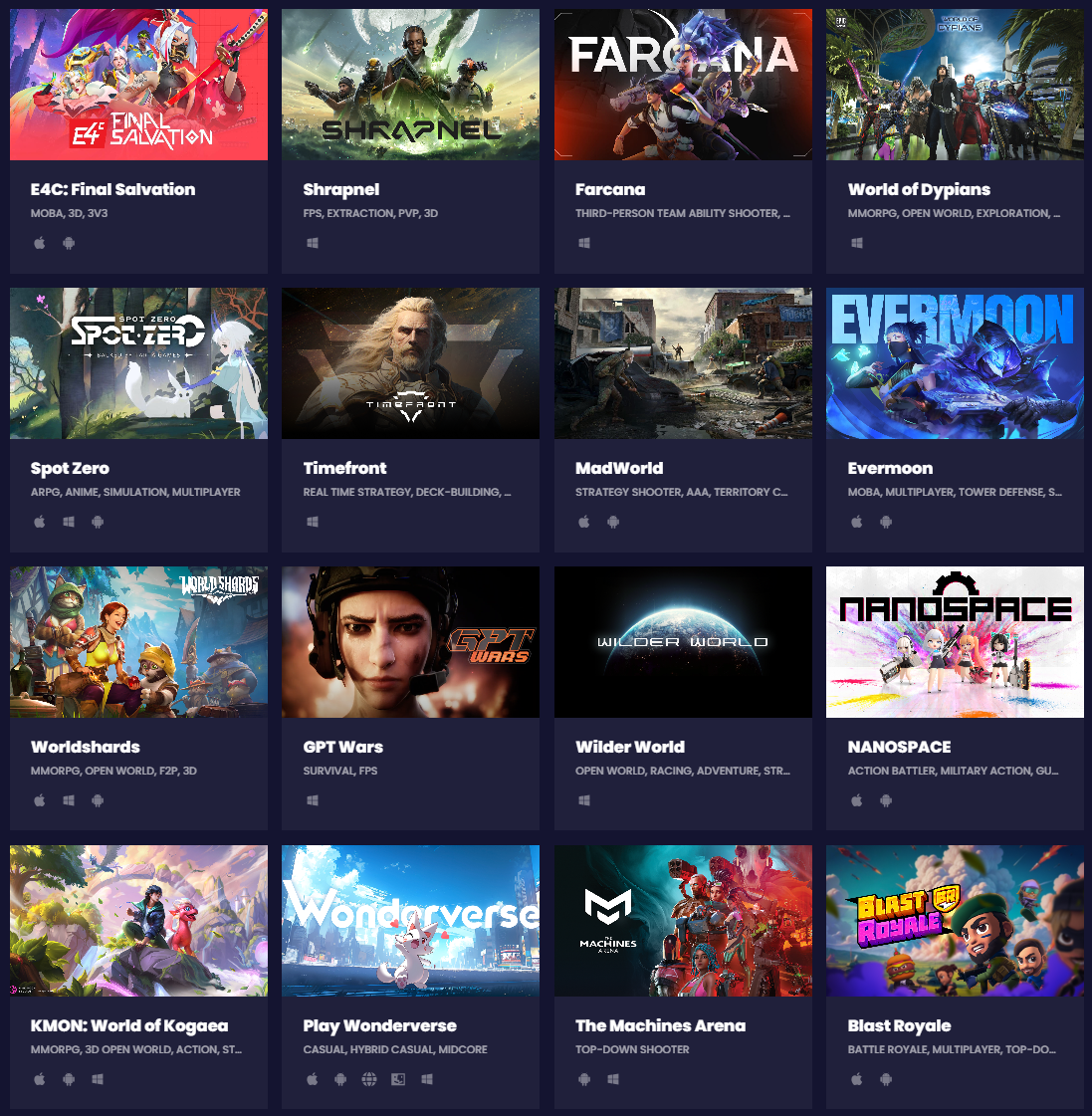
Among the games Xterio collaborates with, several notable characteristics can be observed:
Xterio supports both major titles and is adept at leveraging its deep selection expertise to back emerging and independent works, such as the multiplayer shooting game Nyan Heroes with over 20k downloads on the Epic store, the Roguelite RTS card game Apeiron attracting over 140K wallet users, and the extraction shooter game Shrapnel led by Mark Long, a former team member of Halo, Call of Duty, and Star Wars.
These games come from global markets, including North America, Europe, and many Chinese developers, such as the strategy design game Mad World by former EA and PlayStation team members, the simulation management game Moonfrost developed by the former Stardew Valley team, and the strategy game Fableborne, which currently has over 100k UAW on Dappradar; as well as the MOBA game E4C: Final Salvation developed by a team led by a former CEO of Riot Games Asia Pacific, and the 2D APRG game SpotZero by the former Bilibili and Paper Games team.
These games are distributed across multiple platforms, including PC, mobile, and web versions, such as the PC PVP shooting game Lowlife Forms and the mobile MMORPG Worldshards.
The diversity of genres encompasses almost all mainstream categories in Web3, including the MOBA game Evermoon, shooting game Farcana, MMORPG World of Dypians, SLG game Outer, party game Party Icon, 2D idle game PotK, ARPG Blade of God X, and open-world game Wilder World.
They are willing to experiment with new interactions, including gameplay from Xter.AI, AI games, full-chain games, and Twitter plugin games, such as AI Arena, which involves users in the AI model training process, the full-chain strategy game LEAGUE OF THRONES, and the Twitter plugin game NANOZAP.
Publishing is a traditional strength of the Xterio team, with core team members having previously worked at FunPlus and NetEase, both of which are top global publishers. Coupled with practical experience from multiple Web3 publishing projects, Xterio has built a scientifically systematic publishing service framework, which serves as the ultimate solution for cross-terminal and cross-genre game publishing, aiming to bridge the gap between Web2 and Web3 games.
Xterio's publishing services are divided into four parts:
Financial support and expertise. Xterio provides financial support to partner projects, aiding studios in profitability and development. The experienced team at Xterio offers comprehensive support across various fields, including production, marketing, operational maintenance, and Web3 expertise.
Production assistance. Xterio helps partner projects enhance market competitiveness. Xterio can assist in optimizing user experience/interface, improving performance, resolving technical issues, integrating analytics, social and marketing tools, and refining in-game economic systems and token economies.
Specialized marketing. Xterio can mobilize extensive marketing resources to provide comprehensive marketing services for partners, including driving user acquisition and distribution, managing platform relationships and placements, optimizing store materials, localization support, creating optimized advertisements, and maintaining continuous interaction with users before and after launch.
Post-launch operational maintenance and performance enhancement. Xterio utilizes its self-developed analytics tools to improve user experience, retention, and monetization capabilities for partner projects, thereby building long-term product success.
Tokens and Business Flywheel
In April 2024, Xterio reached a strategic partnership with BNB Chain, integrating BNB as the payment medium for fuel fees on Xterio Chain. The development blueprint for Xterio Chain focuses on incorporating AI and Web3 technologies into game development. Xterio plans to create a blockchain ecosystem centered around AAA-quality games through its native token XTER.
XTER is designed as a universal payment tool within the ecosystem, directly serving the consumption needs of various gaming scenarios, with four core functions:
Thoughtfully designed integration: integrated into first-party games for on-chain transactions, purchasing digital assets, unlocking in-game activities, participating in exclusive events, and accessing rare mints.
Dynamic ecosystem roles: specifically designed for cross-platform and partnerships outside the Xterio ecosystem, enhancing the token's versatility and reach through cross-chain bridging.
Participation rights: enjoy targeted benefits and rewards within the Xterio gaming world. Use tokens to vote on new features, game updates, and community activities.
Investment and incubation: tokens earned and spent within the platform ecosystem help return value to XTER.
As Xterio continues to launch new game content and expand its user base, each newly launched game will create additional demand for token usage. Given that the total supply of XTER is fixed and accompanied by a clear deflationary plan, this sustained growth in demand is expected to tighten the supply-demand relationship gradually, likely driving long-term appreciation of the token's value.
In terms of business model, Xterio has three pillars:
Platform revenue: The Xterio platform can generate income through Xterio Chain fuel fees, NFT publishing platforms, trading markets, and UGC tools.
Game revenue: NFT sales, in-game transactions, in-game purchases.
Token revenue: Partner games issuing their tokens, with Xterio holding a significant share.
This diversified business model enables Xterio to capture value across various segments of the Web3 gaming industry chain, significantly reducing the risks associated with a single business model. Notably, the platform commits to reinvesting profits into ecosystem development, including technology research and development, game development, token buybacks, and ecosystem marketing, to ensure the platform's sustainable growth.
All that rises will converge: Xterio's Value and Potential
As Nietzsche said in "Thus Spoke Zarathustra," "All that rises will converge." When a project possesses sufficient upward momentum, various positive factors—whether an excellent team, a mature business model, innovative technological capabilities, or a vast market space—will perfectly converge at some point in time. We believe that Xterio is at such a critical juncture.
Timeless OG Team
Xterio's team demonstrates a unique competitive advantage in today's fast-paced Web3 startup environment. Founder and CEO Michael Tong has 25 years of experience in the gaming industry, having served as Chief Strategy Officer at FunPlus and Chief Operating Officer at NetEase, making him one of the most seasoned founders in the Web3 gaming field. Co-founder and COO Jeremy Horn has 15 years of experience in the gaming industry, having held positions as Vice President at FunPlus and Jam City, and has worked as a producer at Gameloft, Origins, and Ubisoft. CFO Ryan Cheung brings 15 years of capital market experience, having served as CFO at Weidian and Youku, providing the team with rich financial management expertise.
The uniqueness of this team is not only reflected in their resumes but also in their distinctive thinking framework. Over the past two decades, they have personally experienced and participated in three major transformations in the gaming industry, accumulating a profound understanding of the gaming sector. It is this industry accumulation that enables the Xterio team to construct a Web3 gaming ecosystem capable of transcending cycles from a high industry perspective.
Another significant feature of the Xterio team is its remarkable international character. The founding team comes from different countries, with deep industry roots in the Asia-Pacific, Europe, and the United States. Notably, the core members of the team have worked at companies like FunPlus and NetEase, which are global gaming giants with products covering hundreds of millions of users across more than 200 countries. This global gene allows Xterio to excel in the Web3 field, with its partner network covering over 10 countries worldwide, achieving comprehensive coverage of the Web3 player community.
The "big company" background of the team is equally impressive. Core members hail from top gaming companies such as Electronic Arts, Zynga, and Blizzard. This experience not only brings mature market insight but also accumulates rich experience in resource integration and capital operation. As Web3 gaming enters a more formal era, this elite team, tested by high failure rates, becomes increasingly valuable.
Behind this strong team is an extremely diverse investor support. Xterio has secured $80 million in funding, with investors including Binance Labs, Foresight Ventures, KuCoin Ventures, Web2 gaming companies like FunPlus, traditional gaming funds like Makers Fund, Web3 gaming funds like Animoca Ventures, and all-track Web3 funds like SevenX Ventures. Additionally, well-known public chains, guilds, and numerous top-tier funds have joined in. This layered investment structure perfectly reflects Xterio's strategic vision in industry chain integration.
Comprehensive Data Milestones
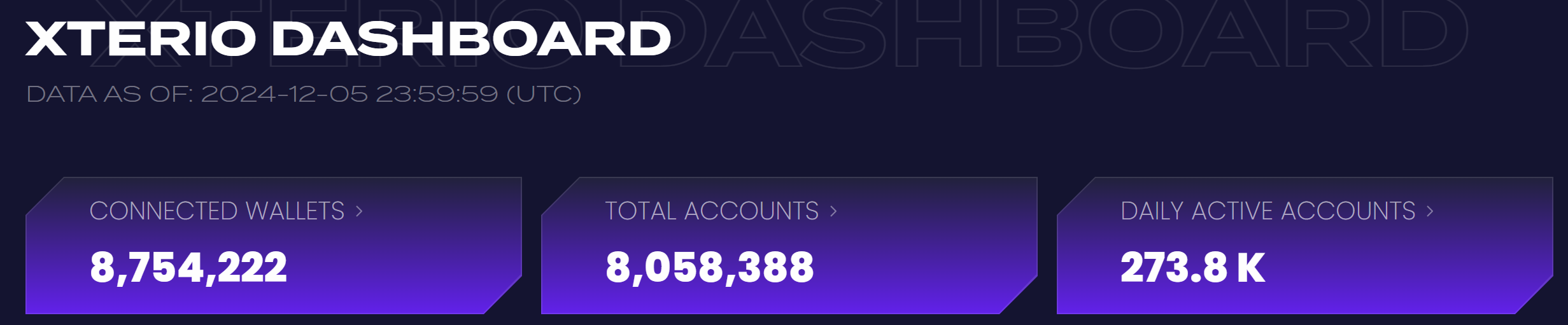
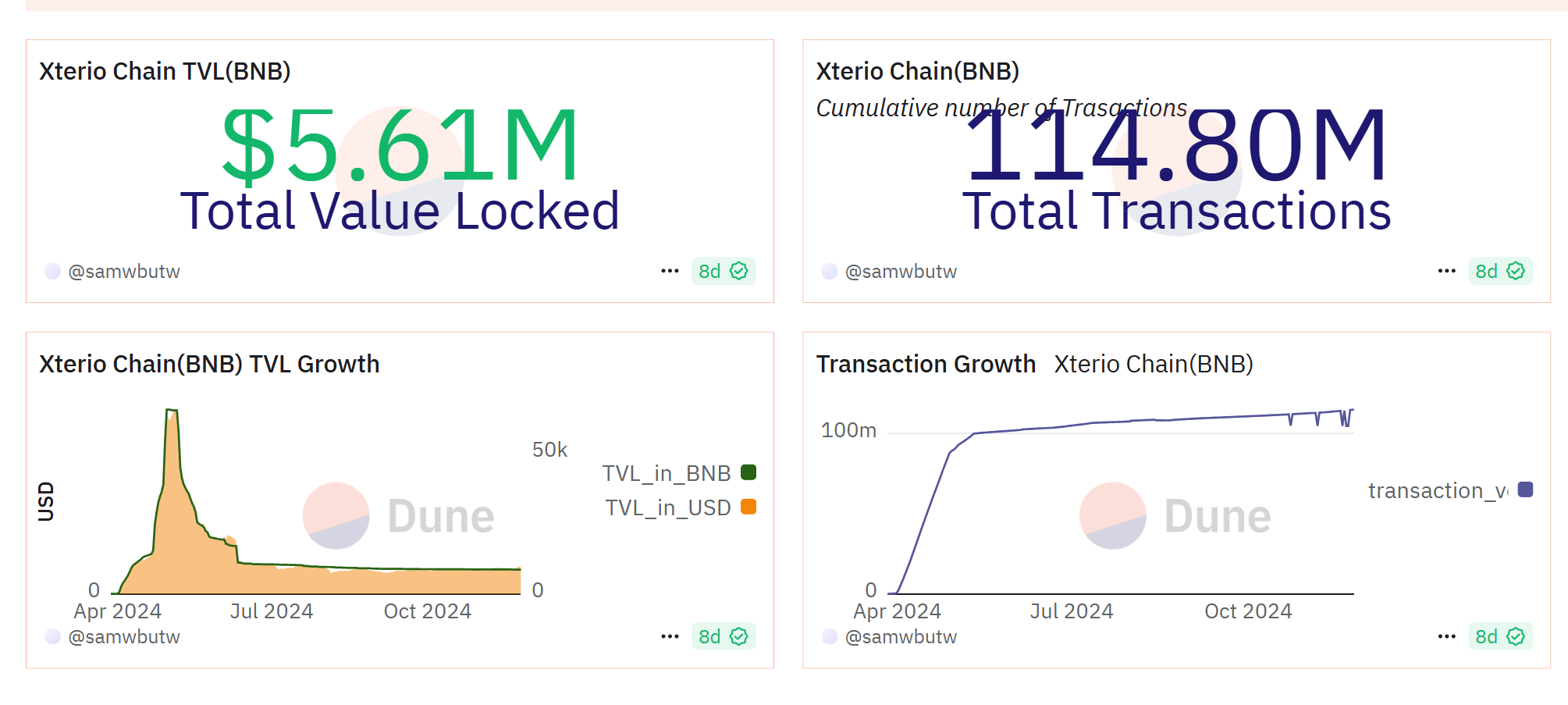
In just over two years, Xterio has achieved significant milestones across all dimensions, including platform, games, users, and assets. On the blockchain side, Xterio Chain has accumulated over 8 million wallets/addresses, with daily active addresses exceeding 270,000 and total transaction counts surpassing 110 million; there are over 26,000 stakers with a staking volume exceeding 1.28 million ETH. On the platform side, Xterio has issued over 47 NFT series, with a total mint count exceeding 7.5 million.
In terms of games, the flagship game AOD generated over $300,000 in revenue during its first week of open beta, with an APRU of $110. This level is not only 300% of similar Web3 games but also reaches the level of some Web2 SLG games, with individual users making maximum deposits exceeding $20,000. The AI platform Xter.AI has generated 100,000 works, with total transaction counts exceeding 1.3 million and total transaction volume exceeding $50.
This milestone is just the beginning, and we look forward to Xterio achieving even more impressive results in the next phase.
The Imagination of Xterio's Value
Finally, we would like to look ahead to the potential of Xterio's value. Overall, we believe that Xterio is not only a leading project of the new generation of Web3 games but also possesses the success factors of traditional gaming companies, with the potential to further unlock the value ceiling of the Web3 gaming sector in subsequent market cycles.
We categorize the key success factors (KSF) of leading Web2/3 gaming companies into three dimensions:
KSF
Web2 Gaming Companies
Web3 Gaming Companies
Business Coverage
All aspects from R&D to user end
IP, content, publishing, operations, community, etc.
All aspects from infrastructure to asset end
Adding game chains, other infrastructures, tokens, and other in-game assets
R&D Capability
Closed-loop track record of top works
Sustainability of top works
Discovery and definition of PMF for Web3 games
Organic integration of Web3 and Web2 games
Publishing Capability
Effectively reach and retain massive users
Commercial closed loop and improve profit margins
Dual-track publishing of content and assets
Dual-track operation of content and assets
First, a comprehensive business layout is needed, which requires mastering the complete chain from IP operation, content R&D to global publishing, operations, and community management. In the Web3 gaming field, this integrated layout must also extend to infrastructure construction and asset management. The former includes infrastructure like game chains, while the latter encompasses the operation of tokens and in-game assets, forming a more three-dimensional business matrix compared to traditional gaming companies.
Secondly, top-notch R&D capability is fundamental. While the success of a single product cannot be guaranteed 100%, excellent gaming companies have established scientific R&D systems that enhance the probability of success through the law of large numbers, continuously creating S-level products. For Web3 gaming companies, the greater challenge lies in exploring true product-market fit (PMF). It is worth noting that Web3 characteristics will ultimately become optional modules for games rather than existing as independent categories; the organic integration of the two is the inevitable direction for industry development.
Third, strong commercialization capability is indispensable. An excellent publishing system can maximize content value, improve capital efficiency, and ensure that profits are retained within the company to the greatest extent. In the Web3 gaming field, this commercialization presents a dual-track characteristic: in addition to traditional content publishing, it also requires reasonable allocation of tokens and game assets to ensure the rights and interests of ecosystem participants such as communities, players, and operators, building a healthy operating system based on asset consensus.
If Xterio can continue to accumulate these KSFs, what position will it hold in the industry? We believe Xterio will become a third-generation leader in Web3 gaming projects:
Characteristics
Business Model
Shortcomings
First-Generation Web3 Gaming Projects
Produce blockbuster content
Establish early PMF for Web3 games
Centered on asset sales and token incentives
Complete the closed loop within one cycle
Asset sales
Token sales
Thin content, average playability
PMF not fully established, single business model
Users difficult to retain long-term
Short lifecycle
Second-Generation Web3 Gaming Projects
Continuously launch multiple contents
Maximize PMF centered on incentives
Possess certain ability to transcend cycles
Solidify communities and build platforms or ecosystems
Asset sales
Token sales
Traffic operations
Non-industrialized content production, unstable content quality
PMF lacks substantial breakthroughs, single business model
Low user quality, circle-breaking ability unverified
No integrated industry chain formed
Third-Generation Web3 Gaming Projects
Integration of infrastructure, R&D, operations, assets, and platforms
Explore PMF beyond incentives
Mature R&D, incubation, and publishing capabilities
Diversified business models, connecting with Web2
Asset and token sales
User payments
Traffic operations, publishing revenue sharing
Infrastructure services
Commercialization, PMF, and circle-breaking effects require longer time for validation
First-generation projects successfully ignited the market with blockbuster content, establishing an initial business model through asset sales, gold farming, and token sales, bringing considerable returns to participants during bull markets. However, these projects often struggle to maintain long-term user retention due to insufficient content depth, average playability, and particularly immature business models, resulting in short game lifecycles.
Subsequently, a new batch of project teams entered the market with more substantial funding, beginning to scale the production of Web3 games. They innovated and optimized asset mechanisms, launched a series of high-quality content, and gradually formed the prototype of Web3 game studios. These studios fixed traffic through guilds and communities, providing cold start, growth, and large-scale publishing services for other projects, making the business model more diversified. However, projects in this phase still failed to achieve breakthroughs in the essence of games; although user scale improved, quality still needed enhancement, and they struggled to attract traditional gamers. Due to the team's origins from independent developers, they also faced challenges in industry chain integration.
As a representative of third-generation Web3 gaming projects, Xterio enters the market with a professional legion's posture. Relying on strong financial strength and shareholder background, combined with the systematic methodology of gaming giants, they have established a complete R&D, incubation, and publishing system. Although there are differing opinions in the market regarding the integration of Web2 and Web3, Xterio remains committed to exploring high-quality game content, attempting to attract traditional players through innovative business models and excellent playability. More importantly, from its inception, Xterio has integrated the concept of industrial upgrading from the traditional gaming industry into its development strategy, starting from infrastructure to create an integrated ecosystem covering infrastructure, R&D, operations, assets, and platforms. This comprehensive layout makes its business model more three-dimensional, allowing monetization through both content and assets while also generating revenue through traffic services, publishing services, and infrastructure services. In the current market, several projects have adopted a similar model of public chain platforms + content matrix + publishers, and Xterio, as a new force, is steadily moving towards becoming a new industry leader.
Regarding these three periods of Web3 gaming projects, although there is currently no very effective valuation framework (the sector is immature, and the effectiveness of fundamentals is low), we can observe that the valuation framework and factors are continuously shifting from virtual to real:
Valuation Framework
Valuation Factors
First Generation
Traffic-driven
User numbers, asset values, market volume, etc.
Second Generation
Narrative-driven
Niche track selection, narrative imagination space, on-chain data, etc.
Third Generation
Commercialization/PMF-driven
The above, plus revenue, profit, IP value, etc.
The valuation of first-generation projects primarily relies on three core factors: user scale, asset value, and market volume. However, these indicators are closely related to short-term market conditions, exhibiting high volatility, leading to a lack of stability in project valuations, which can easily create bubbles and result in significant pullbacks in the short term.
The valuation logic of second-generation projects begins to revolve around "narrative upgrades." The valuation factors of these projects are mainly related to niche track selection, narrative imagination space, and on-chain data generated as infrastructure. Although these projects begin to produce some fundamental data, as narratives become crowded, homogenized, and rotate, bubbles gradually get squeezed out. When narratives reach a peak stage, valuations also return to rational levels.
For third-generation projects, we believe that the core of their valuation should shift towards commercialization capability. As high-quality games attract more users and achieve a commercial closed loop, publishing businesses begin to generate stable cash flow, and quality IP gains player recognition, the valuation of Web3 gaming projects starts to exhibit sustainability. Considering that games are an important carrier for the large-scale application of Web3, we believe that the value imagination space and premium capability of such projects will gradually align with the traditional gaming industry.
Through the analysis of leading publicly listed gaming companies in China, the U.S., Asia, and Europe, we can observe several key characteristics that influence the valuation of traditional gaming companies: integrated R&D and operations, super-large-scale operations, diversified business/full industry chain layout, quality IP reserves, and technological platform capabilities are all important sources of valuation premium. In contrast, companies with a single business, limited categories, and terminal constraints often struggle to achieve significant premiums.
Based on these market rules and industry development trends, we hold a positive attitude towards Xterio's prospects. From the current Web3 gaming landscape, Xterio already possesses the core elements to obtain valuation premiums and is expected to establish a leading position in the industry during this bull market. More importantly, as its commercialization process deepens, Xterio demonstrates the potential to benchmark against traditional gaming giants. We look forward to Xterio becoming the Tencent and NetEase of Web3 gaming.
In the Bible, the "Exodus" tells the epic story of Moses leading the Israelites through the desert to the Promised Land. Today's Web3 gaming industry is experiencing its own "Exodus" moment. Early Web3 games are like those imprisoned in Egypt, bound by rudimentary graphics, mechanical gameplay, and a single token incentive. Xterio is like the Moses of the new era, leading the industry on a hopeful journey. They redefine Web3 gaming from the perspective of the industry chain, separating the "Red Sea" for the industry and opening new paths.
The journey through the desert is never smooth. But it is these trials that strengthen our belief in the existence of that "Promised Land"—a new gaming world where Web2 and Web3 perfectly merge. There, games will become carriers of digital value, players will become co-builders of the ecosystem, and developers will create value with the support of a complete industry chain.
This is not only an evolution of the industry but also an awakening of digital civilization. Let us witness this great "Exodus" journey together, witnessing Web3 gaming under Xterio's leadership as it moves towards that land full of infinite possibilities.
免责声明:本文章仅代表作者个人观点,不代表本平台的立场和观点。本文章仅供信息分享,不构成对任何人的任何投资建议。用户与作者之间的任何争议,与本平台无关。如网页中刊载的文章或图片涉及侵权,请提供相关的权利证明和身份证明发送邮件到support@aicoin.com,本平台相关工作人员将会进行核查。


