Nexus completed a $25 million Series A funding round in June.
Written by: KarenZ, Foresight News
This week, the supercomputer project Nexus launched a new testnet. Nexus founder and CEO Daniel Marin stated that just two hours after the release of the new testnet, it attracted active participation from 10,000 users.
So, what exactly is Nexus? How does it operate and how can one participate?
What is Nexus?
Nexus is inspired by large-scale projects such as the scientific experiment SETI@home developed by the University of California, Berkeley (which utilizes globally networked computers to search for extraterrestrial intelligence (SETI)) and Stanford University's Folding@home (a distributed computing project aimed at helping scientists develop new therapies for various diseases by simulating protein dynamics). It envisions building an internet based on verifiable computing that connects computing devices scattered around the world (such as large GPU farms, computers, mobile phones, etc.) to collectively form a supercomputer.
Additionally, by utilizing Nexus zkVM, Nexus connects computing supply with proof demand, allowing anyone to connect their devices to the network, participate in computing, and earn corresponding rewards.
Nexus founder and CEO Daniel Marin graduated from Stanford University with a degree in computer science and has won awards in the International Physics Olympiad twice. The chief scientist, Jens Groth, is the inventor of paired zkSNARKs and has served as the research director at DFINITY and a professor of cryptography at University College London.
Nexus's engineering and research team also comprises many experts with rich experience in cryptography and computer science. Furthermore, the advisors listed on the Nexus official website include eight individuals, such as Yevgeniy Dodis, the director of the cryptography department at New York University, Chelsea Komlo, chief scientist at Zcash, Zhenfei Zhang, an Ethereum cryptographer, Giuseppe Persiano, a cryptographer at Google, Daniel Vogel, co-founder and CEO of Bitso, and Gengmo Qi, a partner at Dragonfly.
In terms of funding, Nexus Labs completed a $25 million Series A funding round in June 2024, led by Lightspeed Venture Partners and Pantera Capital, with participation from Dragonfly Capital, Faction Ventures, and Blockchain Builders Fund.
How does Nexus operate?
As mentioned, Nexus Network is a large-scale parallel proof network that tightly connects computing devices globally to collectively form a supercomputer. The Nexus zkVM serves as the core of this network, capable of proving any computation. The zkVM is a virtual machine that uses zero-knowledge cryptography to determine whether a computation has been executed correctly without accessing any private or personal information.
According to the official description, Nexus zkVM is a modular, scalable, open-source, highly parallel, proof-optimized, contributor-friendly zkVM written in Rust, focusing on performance and security. The core components of Nexus zkVM include: Nexus Prover, Nexus Virtual Machine (NVM), and Nexus proof compression mechanism (recursive SNARK proof compression sequence). Because Nexus zkVM is designed to support a large number of parallel computations, it significantly enhances proof generation speed.
Specifically, Nexus Network operates by arranging a set of prover clients, each of which can access the Nexus zkVM. Each connected prover is assigned a work unit, which is the program to be proven. The prover client continuously reports progress to Nexus throughout the proof process and continues to wait for new task assignments after completing the proof.
Is Nexus secure?
Regarding security, according to the Nexus FAQ document, the Nexus network program cannot access files on users' computers and networks. The proof environment, the program to be proven, and the program inputs always communicate through an encrypted secure network connection. Additionally, the proof uses a virtual machine to prevent the program from directly accessing your files, devices, peripherals, etc. When communicating with the Nexus network, the web version of the prover executes the virtual machine in a sandboxed browser environment that cannot access other applications, files, or data on the system.
So, what information does Nexus collect? The Nexus terms of use and data privacy page states that, apart from the email address connected to the user's account, Nexus may collect and track usage data from user machines, geographic location, bandwidth, clock speed, hash rate, throughput, and/or other measurement data (collectively referred to as telemetry data).
How to participate?
The new Nexus testnet has added points and account features. This means that contributors can currently compete for rankings on the leaderboard. The current testnet will last until December 14 at 01:00.
Currently, users can participate in the Nexus Network in two ways: one is to contribute computing resources directly through the web interface (supporting both desktop and mobile); the other is to provide computing resources to the network via the command line tool Nexus Network CLI. Connecting to the network using the CLI can achieve better performance and provides the opportunity to submit one's own programs for others to prove.
Contributing computing resources directly through the web interface does not require any technical knowledge. The specific steps are:
Visit beta.nexus.xyz;
Click "Connect";
Enter your email to connect ProverID and create a Nexus account (email confirmation is required, but the author has not yet received the confirmation email).
Alternatively, you can add your email in the Profile section at the bottom left to track NEXUS points. Users can also connect multiple devices to one email.
But please note: If you close the webpage, points will not accumulate. Additionally, clearing the cache will generate a new ProverID, and users will not be able to access previous points. Moreover, the ProverID displayed here is not complete; it only shows the first few digits or letters. If you want to see the complete ProverID, you can check the localId field in developer mode.
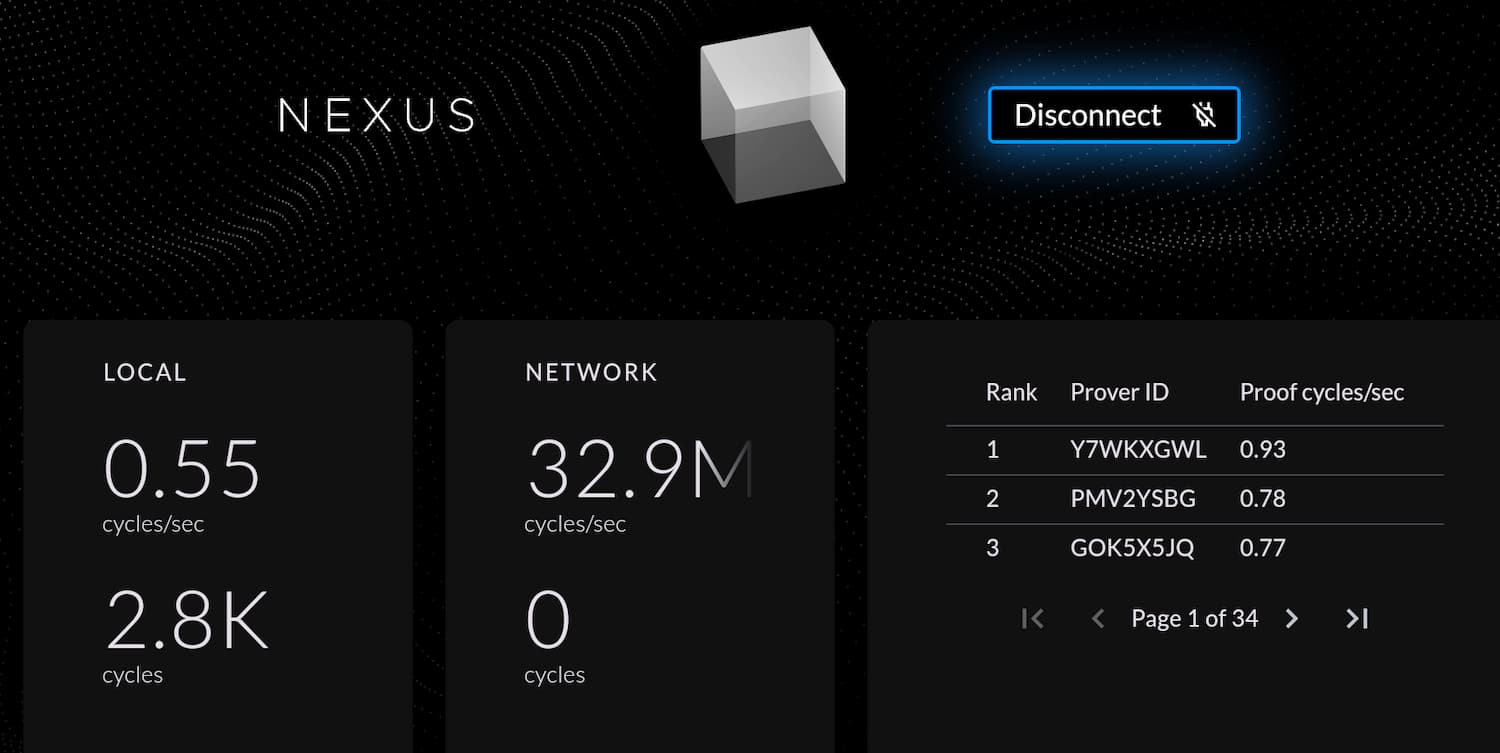
- Providing computing resources to the network via Nexus Network CLI. Nexus states that using the CLI to connect to the network can achieve better performance and allows users to submit their own programs for others to prove.
The operating systems supported are Linux, macOS, and Windows, and users can use VPS servers for continuous operation. The specific process can be referenced in the official documentation.
免责声明:本文章仅代表作者个人观点,不代表本平台的立场和观点。本文章仅供信息分享,不构成对任何人的任何投资建议。用户与作者之间的任何争议,与本平台无关。如网页中刊载的文章或图片涉及侵权,请提供相关的权利证明和身份证明发送邮件到support@aicoin.com,本平台相关工作人员将会进行核查。


