For a mature trader, the necessary financial tools can help you preserve profits and achieve stable appreciation during a bull market.
Author: TechFlow

“Bull markets are the main reason ordinary investors lose money.”
Graham's statement applies to any trading market, whether in stocks or cryptocurrencies. The frenzy of a bull market makes everyone fear missing out, leading retail investors to flock in. After a feast of capital, someone has to pick up the tab. Will you be that person?
As the saying goes, knowing how to sell makes you a master, but selling too early still hurts. Thus, most traders find themselves in a situation where they "get stuck when buying and sell too early." They regret buying too little when prices rise and regret not selling when prices fall, suffering every moment.
In addition to adjusting mindset strategies, for a mature trader, the necessary financial tools can help you preserve profits and achieve stable appreciation during a bull market.
The question arises: Do you really understand the terms like "seagull, shark fin, Martingale, dual currency win…" that appear in the product list of exchanges?
Let me vent a little. Despite the numerous crypto financial products launched by major exchanges, whether simple earning products or complex structured options, there still isn't a straightforward explanation that helps beginners understand the operational mechanisms, sources of income, and which trading needs they apply to.
Don't believe it? Let's do a simple test to see if investors really understand the CeFi products of major cryptocurrency exchanges.
1. Simple Earning and On-chain Earning
【Multiple Choice】 Xiao Li plans to invest in financial products on the OKX platform. He sees two products: simple earning and on-chain earning. Which of the following statements is correct?
A. Simple earning supports flexible deposits and withdrawals, while on-chain earning usually has a lock-up period.
B. The yield of on-chain earning is generally higher than that of simple earning, but the risk is also relatively higher.
C. The funds of simple earning are mainly used for internal platform allocation, with income coming from leveraged lending, while on-chain earning directly participates in staking and lending on the blockchain network.
D. If Xiao Li wants the safest investment method, simple earning would be a more suitable choice.
Correct Answers: B, C, D
Analysis:
Option A is incorrect:
Simple earning and on-chain earning are both liquid products, both support flexible deposits and withdrawals, and have high capital flexibility, although the redemption time may vary slightly.
Option B is correct:
On-chain earning directly participates in staking or lending on the blockchain network, generally offering higher yields but requiring the assumption of additional risks such as verification node risks and network risks.
Option C is correct:
The funds for simple earning are mainly used for platform lending and other businesses, while on-chain earning funds flow on-chain, participating in AAVE lending or on-chain staking.
Option D is correct:
Simple earning is more suitable for novice users with a low-risk preference.
Strategy Analysis:
Both are liquid financial products that balance yield and liquidity, suitable for low-risk management of idle funds. Recently, the yield of OKX on-chain financial products has once exceeded 40%.
2. Grid Trading
【Single Choice】 Xiao Wang set up a grid trading strategy for BTC/USDT on OKX with the following parameters:
Investment Amount: 1000 USDT
Price Range: 95000-100000 USDT
Number of Grids: 10
Profit per Grid: 0.5%
Assuming the BTC price fluctuates completely within the set range (i.e., from 95000 to 100000 and back to 95000), what is the theoretical total profit, not considering transaction fees?
A. 5 USDT
B. 25 USDT
C. 50 USDT
D. 100 USDT
Correct Answer: C
Analysis:
Basic parameter calculations for the grid:
Price Range: 95000-100000 USDT, range span of 5000 USDT
Number of Grids: 10
Price Interval per Grid = 5000/10 = 500 USDT
Profit per Grid: 0.5%
Principle of grid trading:
The system will evenly distribute 10 grids within the 95000-100000 range. When the price rises, it sells for profit; when it falls, it buys. Each time the price crosses a grid line, a trade is triggered.
Profit Calculation:
Complete up and down fluctuation = Rising process + Falling process, each grid will complete a buy and sell cycle.
10 grids × 0.5% profit/grid × 1000 USDT = 50 USDT
Strategy Points:
This strategy is suitable for volatile markets and not for one-sided trending markets. The more grids there are, the smaller the profit per grid, and the higher the transaction frequency.
3. Martingale Strategy
【Single Choice】 Xiao Li uses the Martingale strategy to trade BTC/USDT on OKX, with the following parameter settings:
Initial Position: 0.01 BTC (approximately 970 USDT)
Position Multiplier: 2 times
Number of Additional Buys: Up to 4 times
First Order Entry Price: 97000 USDT
If the price continues to fall and triggers all additional buys, and the price rises back to 97000 USDT for closing, which of the following options is closest to the total invested capital, not considering transaction fees?
A. 3880 USDT
B. 7760 USDT
C. 15520 USDT
D. 31040 USDT
Correct Answer: D
Detailed Analysis:
Martingale strategy capital calculation:
Total investment: 0.31 BTC ≈ 31040 USDT
First Position: 0.01 BTC ≈ 970 USDT
Second Position: 0.02 BTC ≈ 1940 USDT
Third Position: 0.04 BTC ≈ 3880 USDT
Fourth Position: 0.08 BTC ≈ 7760 USDT
Fifth Position: 0.16 BTC ≈ 15520 USDT
Explanation of the additional buying process:
Each additional buy is double the previous position.
After 4 additional buys, a total of 5 positions are opened.
Positions grow exponentially: 1x → 2x → 4x → 8x → 16x
Strategy Points:
The "Martingale strategy" is a trading strategy based on a gambling method popular in France in the 18th century. The main principle of this strategy is to double the bet after each loss, so when the gambler wins (each time considered a 100% win/loss), they not only recover previous losses but also gain profits equal to the first bet amount.
The Martingale strategy is suitable for short-term volatile markets and not for trending down markets. It is recommended to use it during sideways fluctuations.
Novices are not advised to use this strategy; strict stop-loss discipline must be followed, and the timing of each additional buy must be controlled.
4. Smart Arbitrage
【Single Choice】 Xiao Zhang sets up a smart arbitrage strategy on OKX with the following parameters:
Investment Amount: 10000 USDT
Spot Position: Buy 0.1 BTC (price 98000 USDT)
Contract Position: Short 0.1 BTC (20x leverage)
Current Funding Rate: 0.02% (every 8 hours)
Assuming the position is held for 7 days, and the BTC price eventually returns to 98000 USDT, which of the following options is closest to the total profit, not considering any transaction fees or additional margin?
A. 35 USDT
B. 41 USDT
C. 52 USDT
D. 63 USDT
Correct Answer: B
Detailed Analysis:
Funding fee profit calculation:
Contract Value: 98000 × 0.1 BTC = 9800 USDT
Single Funding Fee Profit: 9800 × 0.02% = 1.96 USDT
Daily Funding Fee: 1.96 × 3 = 5.88 USDT/day
Total Funding Fee Profit for 7 Days: 5.88 × 7 = 41.16 USDT
Strategy Analysis:
The smart arbitrage strategy is a method aimed at obtaining stable profits by hedging against market price fluctuations. The core principle is to use a delta-neutral strategy by holding opposite and equal-sized positions in the spot and contract markets to hedge against price change risks. Users mainly achieve profits through the funding fees collected during the holding period (e.g., profits under positive funding rates).
It's like running a small "rental" business, avoiding the risk of price fluctuations through hedging, and mainly relying on collecting contract rent (funding fees) to make money.
5. Seagull
【Single Choice】 Regarding the OKX Seagull options product, which of the following statements is correct?
A. Seagull options are most suitable for investors expecting a significant market rise.
B. When the price breaks through the barrier price upper limit, the highest profit can be obtained.
C. When the price is between the exercise price and the barrier price, a fixed profit can be obtained.
D. When below the exercise price, all principal will definitely be lost.
Correct Answer: C
Detailed Analysis:
- A is incorrect: Seagull options are suitable for investors holding a "neutral bullish" view on the market, not for those expecting a significant rise.
- B is incorrect: When breaking through the barrier price upper limit, the profit is usually zero.
- C is correct: This is the core profit feature of Seagull options, where a fixed profit can be obtained within the range.
- D is incorrect: The specific loss extent depends on the product's specific terms, and it is not necessarily a total loss of principal.
Strategy Analysis:
You can think of it as a "range betting game." You set a price range (upper and lower limits), and as long as the price fluctuates within this range, you can make money. However, if the price exceeds this range too much, you will incur losses. It's called "Seagull" because the profit graph resembles the shape of a seagull spreading its wings.
The OKX Seagull product is divided into bullish seagull and bearish seagull. Bullish seagull supports users to invest USDT to earn USDT, while bearish seagull supports users to invest BTC/ETH to earn BTC/ETH.
Overall, Seagull options are a strategy suitable for expecting market fluctuations, pursuing stable profits rather than windfall gains.
6. Dual Currency Win
【Single Choice】 Xiao Wang purchased a BTC/USDT Dual Currency Win product on OKX. Which of the following statements about this product is correct?
A. Regardless of how the BTC price changes at maturity, the principal will be returned in USDT.
B. The product yield is fixed, and a guaranteed annualized return can be obtained at maturity.
C. If the BTC price is below the trigger price at maturity, the principal will be converted to BTC at the trigger price.
D. The product term is usually between 3 months to 6 months.
Correct Answer: C
Detailed Analysis:
- Why is option C correct?
This is the core mechanism of the Dual Currency Win product. When the BTC price is below the trigger price, the principal will be converted to BTC at the pre-agreed trigger price.
- Reasons why the other options are incorrect:
A is incorrect: At maturity, you may receive either USDT or BTC, depending on the market price.
B is incorrect: The agreed yield can only be obtained if the price is above the trigger price.
D is incorrect: The product term is usually short, generally between 1 to 14 days.
Strategy Analysis:
Dual Currency Win is like a "conditional fixed deposit":
You deposit one currency (like USDT), agree on a term (like 7 days), and if the maturity price is above the target price, you get back USDT; otherwise, it converts to another currency (like BTC).
Essentially, it is a short-term (1-14 days) structured financial product. This strategy is suitable for those who want to hold USDT to earn high interest and also want to buy BTC at a low price during a pullback, believing in the long-term development of BTC.
7. Shark Fin
【Single Choice】 Xiao Li purchased an OKX Shark Fin options product with an initial investment of 10,000 USDT. Which of the following descriptions of this product's features is correct?
A. Regardless of market fluctuations, the maximum loss at maturity is 2,000 USDT.
B. When the price reaches the barrier price, the product is immediately terminated, and the entire principal is lost.
C. The product offers 100% principal protection, and in the worst-case scenario, you can get back the entire principal.
D. The product yield is fixed, and a guaranteed annualized return can be obtained at maturity.
Correct Answer: C
Detailed Analysis:
- Why is option C correct?
Shark Fin options are typically principal-protected products. Even if the barrier price is reached, the principal is still protected, which is the most important safety feature of the product.
- Reasons why the other options are incorrect:
A is incorrect: The product is principal-protected, so there will be no loss of principal.
B is incorrect: Reaching the barrier price only affects the profit portion, and the principal will not be lost.
D is incorrect: The yield is not fixed; it depends on price performance and whether the barrier price is reached.
Strategy Analysis:
Shark Fin is like a "protected betting game":
You invest a sum of money (like USDT), set a bullish or bearish direction, and if you guess correctly, you earn high returns. If you guess wrong, there is a guaranteed return protection. The profit graph resembles a shark's fin, hence the name Shark Fin.
This strategy is suitable for conservative investors who prioritize the safety of their principal.
So, dear crypto investors, how many points did you score?
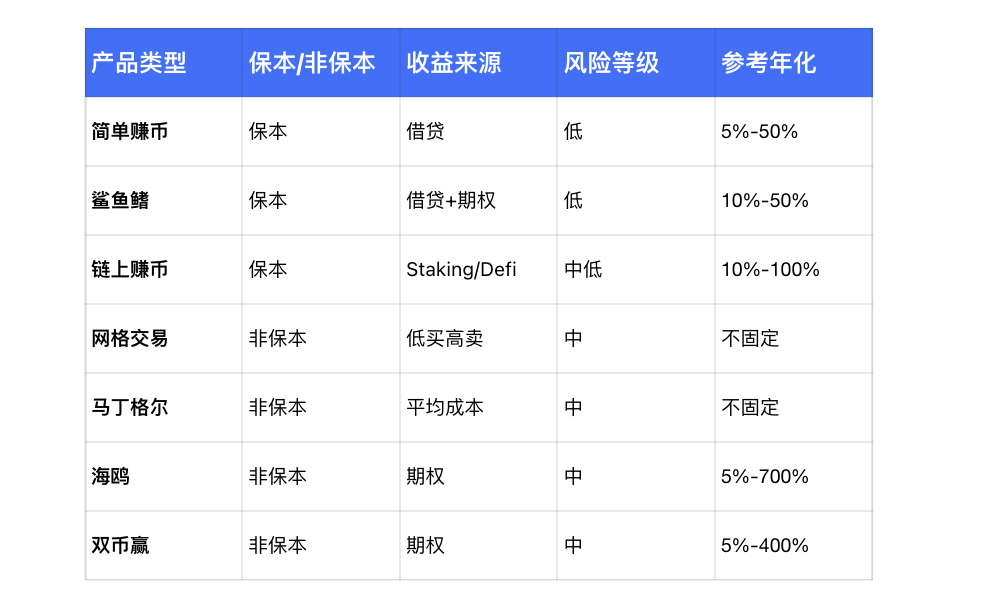
Finally, let’s summarize the characteristics of the above products:
免责声明:本文章仅代表作者个人观点,不代表本平台的立场和观点。本文章仅供信息分享,不构成对任何人的任何投资建议。用户与作者之间的任何争议,与本平台无关。如网页中刊载的文章或图片涉及侵权,请提供相关的权利证明和身份证明发送邮件到support@aicoin.com,本平台相关工作人员将会进行核查。


