Dismissing government officials is not necessarily a way to improve efficiency.
Written by: Francis Fukuyama
Translated by: BitpushNews
Author's Bio: Francis Fukuyama: Senior Fellow at the Freeman Spogli Institute for International Studies (FSI) at Stanford University, Director of the FSI Center for Democracy, Development, and the Rule of Law. He is the author of "The End of History and the Last Man," "The Origins of Political Order," and "Political Order and Political Decay": From the Industrial Revolution to the Globalization of Democracy.

Francis Fukuyama
Background:
On November 12, local time, U.S. President-elect Donald Trump announced that American entrepreneur Elon Musk and Indian-American entrepreneur Vivek Ramaswamy would jointly lead the proposed "Department of Government Efficiency" (DOGE) after he takes office, with Musk overseeing government spending. Foreign media NBC reported that despite the name, the "Department of Government Efficiency" (DOGE) is not a U.S. government agency, and it is unclear how the organization will operate.
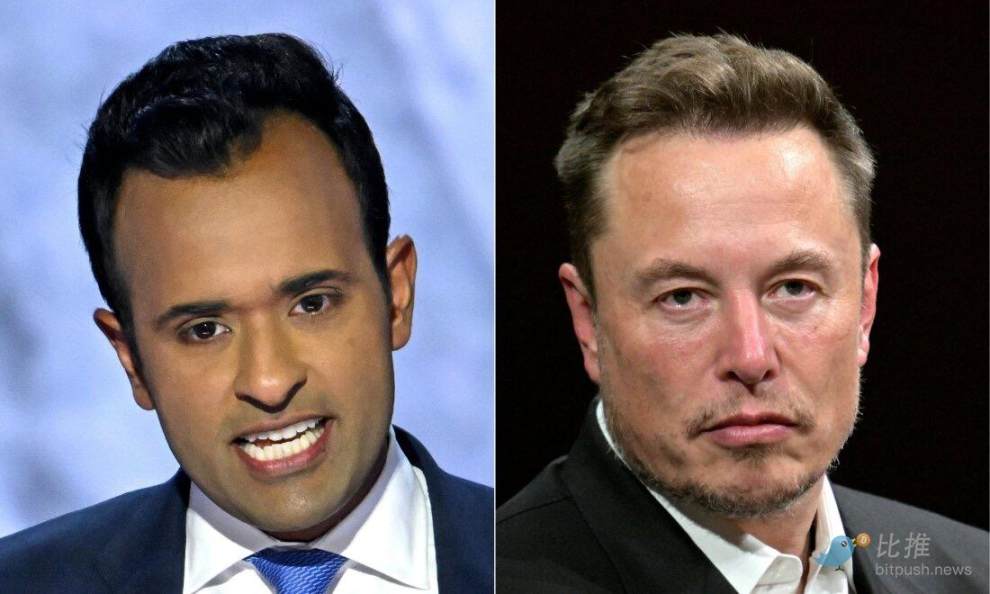
On the same day, Trump stated on social media that the "Department of Government Efficiency" would "pave the way for dismantling the government bureaucracy, cutting unnecessary regulatory burdens and wasteful spending, and reorganizing federal agencies."
The main text:
Dear Elon Musk,
Congratulations on your candidate Donald Trump's resounding victory, to which you contributed significantly. I know you have been appointed as the efficiency czar of the new government, a position that will be very important, as the federal bureaucracy does indeed need reform. However, I have some suggestions regarding what to keep in mind while serving in this role.
I believe you know that you will find working in government to be vastly different from working in the private sector. The main difference is that government personnel are subject to a great deal of rules. For example, you cannot start firing employees on the first day like you would at Twitter. Federal employees are protected by a series of work rules established by Congress. Trump plans to eliminate these protections by reinstating executive orders from his first term to create a "Schedule F" category that allows the president to dismiss any employee at will. However, this move will be met with strong opposition and may take months to remove the legal barriers to action.
In any case, dismissing government officials is not necessarily a way to improve efficiency.
It is widely believed that the federal bureaucracy is bloated and overstaffed. This is not the case:
The number of full-time federal employees today is roughly the same as it was in 1969, around 2.3 million. Although the government now spends more than five times what it did then, the workforce size has not changed. In fact, we could even argue that the government is understaffed, as it has faced pressure to reduce its workforce for decades. For example, the Centers for Medicare and Medicaid Services oversees $1.4 trillion in spending, accounting for one-fifth of the entire federal budget, but has only 6,400 full-time employees. These staff must check for Medicare fraud, assess and certify thousands of healthcare providers, and ensure timely payments to tens of millions of Americans. If these personnel are cut, fraud and waste in the Medicare system may increase rather than decrease. The office responsible for caring for millions of refugees entering the U.S. has only 150 employees. By increasing the IRS's staff, the government expects to gain an additional $561 billion over the next decade.
The government compensates for its understaffing by hiring a large number of contractors (including your company SpaceX). It is easier to dismiss contractors than regular federal employees, but who will do the work of the contractors? In fact, bringing these functions back into the government could save costs, as federal employees are paid less, but this would require hiring more people and could lead to a decline in service quality.
Deregulation is indeed part of the plan to improve government efficiency. Deregulation has clear goals, especially in the construction industry—based on your experience building factories in the U.S., you should already know this.
We have too many permitting rules that slow down or completely halt infrastructure projects, such as the National Environmental Policy Act (NEPA), which requires writing environmental impact statements that can be thousands of pages long and take years to complete. Additionally, federal and state laws allow for private lawsuits to enforce environmental laws, which are both costly and time-consuming. This is why it takes nearly a decade to get approval for offshore wind farms and why it can take years to build transmission lines to move electricity from Texas to California. Therefore, any measures that can simplify this process will be highly welcomed. This will be one of the easiest results for the new government to achieve, positively impacting various areas from affordable housing to climate adaptation. (However, you should recognize that much of the excessive regulation occurs at the state level, which you cannot control. Of course, this is why you moved Tesla from California to Texas.)
However, to improve government efficiency, another type of deregulation is also needed.
People blame the bureaucracy for overregulating the private sector, but the bureaucracy itself is also overregulated. Americans do not trust the government, and thus a plethora of rules have been established over the decades that bureaucrats must follow. The Federal Acquisition Regulation (FAR) is an example, containing hundreds of pages of rules governing everything from the procurement of F-35 fighter jets to office supplies, which government officials must adhere to. Hiring new employees is also very difficult; for instance, my students often have to wait months to get an interview for federal government vacancies. Moreover, there are many diversity, equity, and inclusion (DEI) requirements that do not necessarily reward true talent, and I believe the Trump administration would be eager to abolish these rules.
Many conservatives believe that government bureaucrats have too much discretion and use it to implement a liberal agenda, thus evading democratic control, and in some cases, this does happen. But the reality is quite the opposite: bureaucrats spend too much time complying with hundreds of rules set by Congress rather than using their independent judgment to make decisions that benefit citizens. They need to be freed from these constraints and evaluated based on their results rather than the degree to which they avoid risk, which is how Silicon Valley and the private sector operate.
It is clear that if you believe officials lack the training and skills to use power wisely, you cannot delegate more power to them. Here we have another issue: young people are reluctant to enter federal agencies.
The average age of government workers is 47; only 7% of the workforce is under 30, while 14% is over 60. In the age of artificial intelligence, there is an urgent need for young workers to fill vacancies. But young people are unwilling to work in federal agencies. Compliance with complex hiring rules makes job searching slow and difficult, and saying one works for the government—this hardly brings them any social status.
In this context, you cannot achieve efficiency by dismissing employees. Government work needs to be attractive to young, tech-savvy individuals; they need the flexibility to move in and out of federal government jobs without being constrained by the government service pay scales established 70 years ago when most employees were clerks and typists.
So that is the problem. You can never manage the government like a company, but you can do many things to improve government efficiency, and the key is to avoid blunt measures like mass layoffs and shutting down entire agencies.
Remember, Rick Perry, appointed by Donald Trump, wanted to close the Department of Energy, but he did not realize that one of the most important functions of the Department of Energy is to manage the national laboratory system, which is responsible for nuclear weapons, energy research, and other issues. You will also encounter the problem that Congress has a say in how the government operates. Even if the department is controlled by Republicans, they will have a voice in different regions of the U.S. and may not allow you to violate regulations they previously approved.
We need to cut the government's regulation of many parts of the private sector, but we also need to relax regulations on the government itself, allowing those who work for the government to truly fulfill their responsibilities. If Donald Trump wants to help the American people, he needs to recognize that government is an effective and necessary means to achieve goals, not an enemy that needs to be dismantled.
Sincerely,
Francis Fukuyama
免责声明:本文章仅代表作者个人观点,不代表本平台的立场和观点。本文章仅供信息分享,不构成对任何人的任何投资建议。用户与作者之间的任何争议,与本平台无关。如网页中刊载的文章或图片涉及侵权,请提供相关的权利证明和身份证明发送邮件到support@aicoin.com,本平台相关工作人员将会进行核查。


