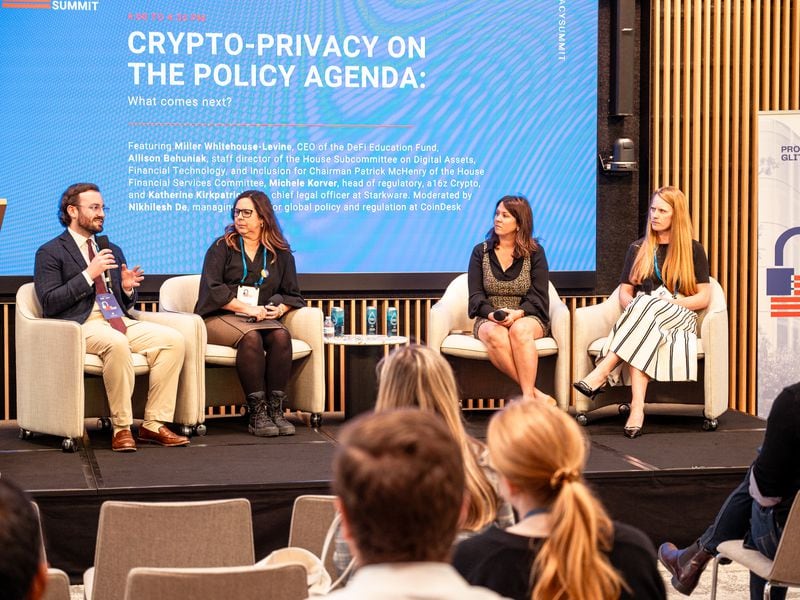
What role do privacy tools play in crypto, and how does this discussion develop? Those were some of the questions at a panel I moderated last week at the DC Privacy Summit.
PS: I'll be in Dubai for Binance Blockchain Week on Wednesday and Thursday. Let's catch up if you're also there.
You’re reading State of Crypto, a CoinDesk newsletter looking at the intersection of cryptocurrency and government. Click here to sign up for future editions.
Last week, I moderated a panel at the DC Privacy Summit, hosted by Project Glitch and the Coinbase Institute, on what comes next in the ongoing discussions about privacy and crypto – through, naturally, the lens of Tornado Cash and the Department of Justice's case against developer Roman Storm. I want to share some of the thoughts the panelists – DeFi Education Fund's Miller Whitehouse-Levine, a16z Crypto's Michele Korver, House Financial Services Committee's Allison Behuniak and Starkware's Katherine Kirkpatrick Bos – discussed during the 30 minute session.
Roman Storm's case is still winding its way through the U.S. legal system. A trial is scheduled for sometime in December. However it resolves, there's still a broader question about the role Tornado and similar services play in cryptocurrency.
Privacy – at least in a crypto context – has a fairly negative connotation at the moment. The U.S. Treasury Department previously moved to consider whether it should classify mixers – tools which are designed to obfuscate the trail of crypto transactions – as a "primary money laundering concern" due to their role in laundering and terrorist financing. Tornado Cash's most famous user is the Lazarus Group, a North Korean government hacking group.
This negative connotation needs to be acknowledged and discussed, said Kirkpatrick Bos, the chief legal officer at Starkware, during last week's panel. Advocates for privacy tools also need to acknowledge that some of the arguments in favor of privacy tools – purchasing legal goods or services without people knowing about them, for example – may not be persuasive when stacked up against criminal activity.
Whitehouse-Levine, the CEO of the DeFi Education Fund, said that the most concerning aspect about the Tornado Cash debate is that it's playing out in court, rather than in Congress or through a regulatory agency's rulemaking authority.
"I think [it's] a bad way to go about policy making, regardless of whether one is supportive of that policy or not," he said.
Behuniak, the staff director for a House subcommittee, said it could take "dozens of round tables" with lawmakers before they're comfortable holding a more formal hearing on an issue like the role of mixers and privacy tools in crypto.
An increasing number of lawmakers are willing to have a discussion about the benefit of mixers and what tradeoffs may be involved, she said, "but it will take time."
"But at a small scale, I think we have made some progress in expanding the number of members [of Congress] that care about this issue," she said.
On the industry side of this issue, companies need to have some certainty about what exactly regulators are thinking and what prosecutors are alleging, said Korver, a16z Crypto's head of Regulatory.
"Businesses need to have certainty whether they have obligations to do X or Y, and whether they can be held criminally responsible for it," she said. "There's a difference between getting that wrong, interpreting the guidance wrong for your business model, and having a conversation with regulators where they may be convinced – or if they aren't, that you may get a really painful fine, [versus] actually taking away somebody's liberty and charging them criminally."
In Storm's case, there's now an open question of how exactly Financial Crimes Enforcement Network (FinCEN) guidance about money transmitters applies. Attorneys have argued that the DOJ's charges against Storm would seem to go against this guidance.
This is playing out in the broader market structure debate in Congress, Behuniak said.
"Certainly absent legislation, if the SEC continues to pull in certain intermediaries, that doesn't just come with SEC obligations, that also comes with Bank Secrecy Act obligations," she said. "I think when it is determined what intermediaries should be captured, and then what exactly those requirements should be, I do think that conversation will receive more attention than it has."
Whatever legislation may happen – market structure or stablecoin legislation or something else entirely – may not solve all of the problems at issue but should still mark progress, Kirkpatrick Bos said.
Humans generally do want some form of privacy, Whitehouse-Levine said. People don't want others to read their journals, homes have blinds and so on: "That's why I think it's a fundamental human right."

Wednesday

If you’ve got thoughts or questions on what I should discuss next week or any other feedback you’d like to share, feel free to email me at nik@coindesk.com or find me on Twitter @nikhileshde.
You can also join the group conversation on Telegram.
See ya’ll next week!
免责声明:本文章仅代表作者个人观点,不代表本平台的立场和观点。本文章仅供信息分享,不构成对任何人的任何投资建议。用户与作者之间的任何争议,与本平台无关。如网页中刊载的文章或图片涉及侵权,请提供相关的权利证明和身份证明发送邮件到support@aicoin.com,本平台相关工作人员将会进行核查。


