Recently, BTC has once again broken through the $70,000 mark, and the market's greed index has reached 80. Meme coins often serve as the vanguard in every bull market, such as $GOAT, which saw its price surge over 10,000 times within 5 days. By analyzing the trading data of the current top 25 Meme coins, we have identified several noteworthy market characteristics and evolving trends.
Market Layering and Liquidity Layering
In terms of the number of holders, SHIB, DOG, DOGE, MEME, and DEGEN all have over 800,000 addresses, with SHIB leading the pack at 1.51 million addresses, approximately 400,000 more than the second-place DOG. At the same time, these projects also account for a significant portion of the overall market trading volume.
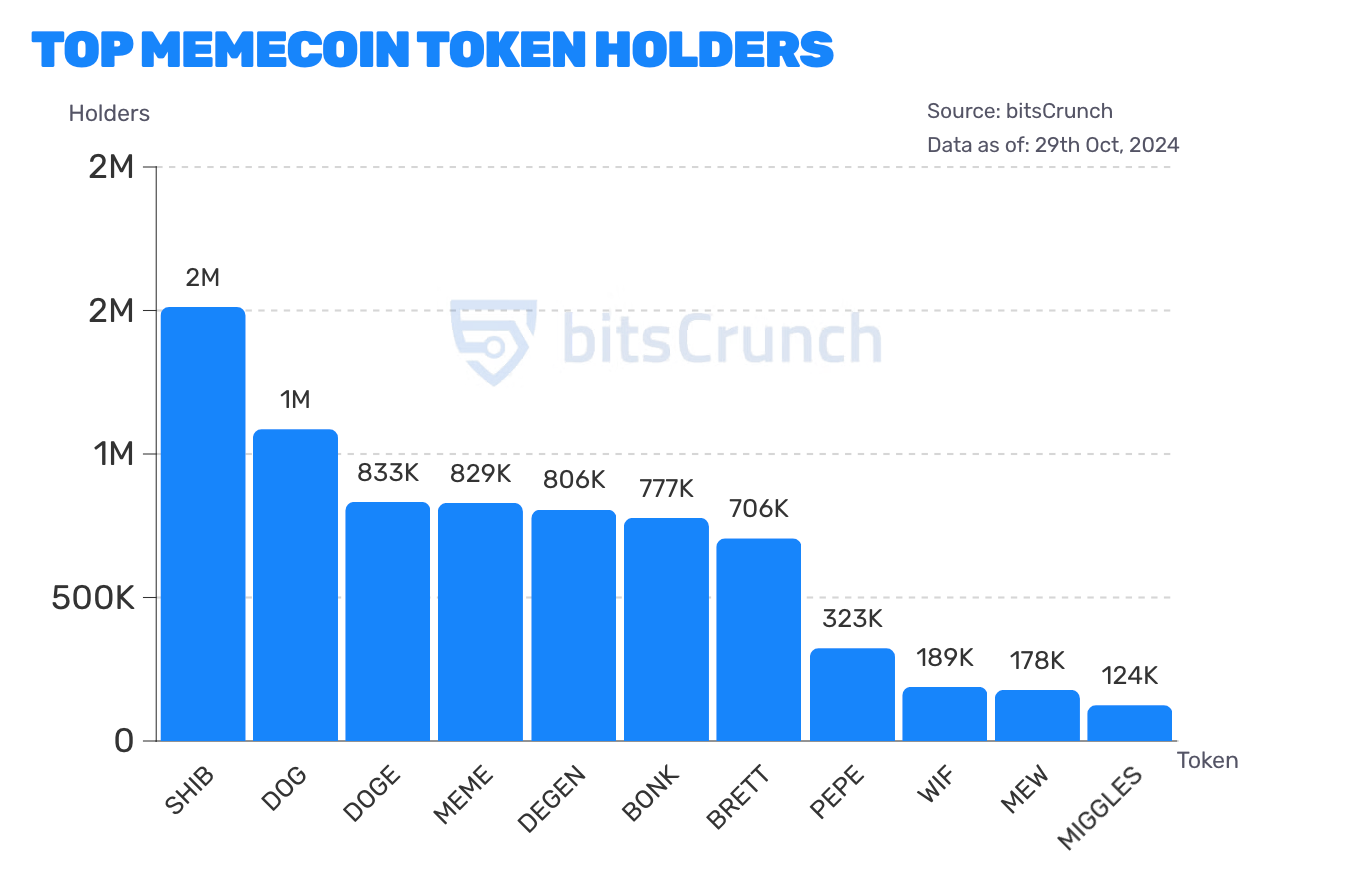
BONK and BRETT have over 700,000 holding addresses, while projects like PEPE and WIF have 320,000 and 180,000 addresses, respectively. However, it is noteworthy that the 30-day growth in the number of holding addresses for these two projects is 3.02% and 4.86%, surpassing all previously mentioned Meme coins with the highest number of holders.
According to bitsCrunch data, MEW and MIGGLES are the only two remaining Meme coins with over 100,000 holding addresses, and MIGGLES has seen a growth of 26.55% in the past 30 days. Tokens like HIGHER, FLOKI, POPCAT, MOCHI, PONKE, MOODENG, and MYRO fall into the 50,000-100,000 holding address range, but their liquidity is relatively limited.
Market Sentiment Indicators: Price Volatility Analysis
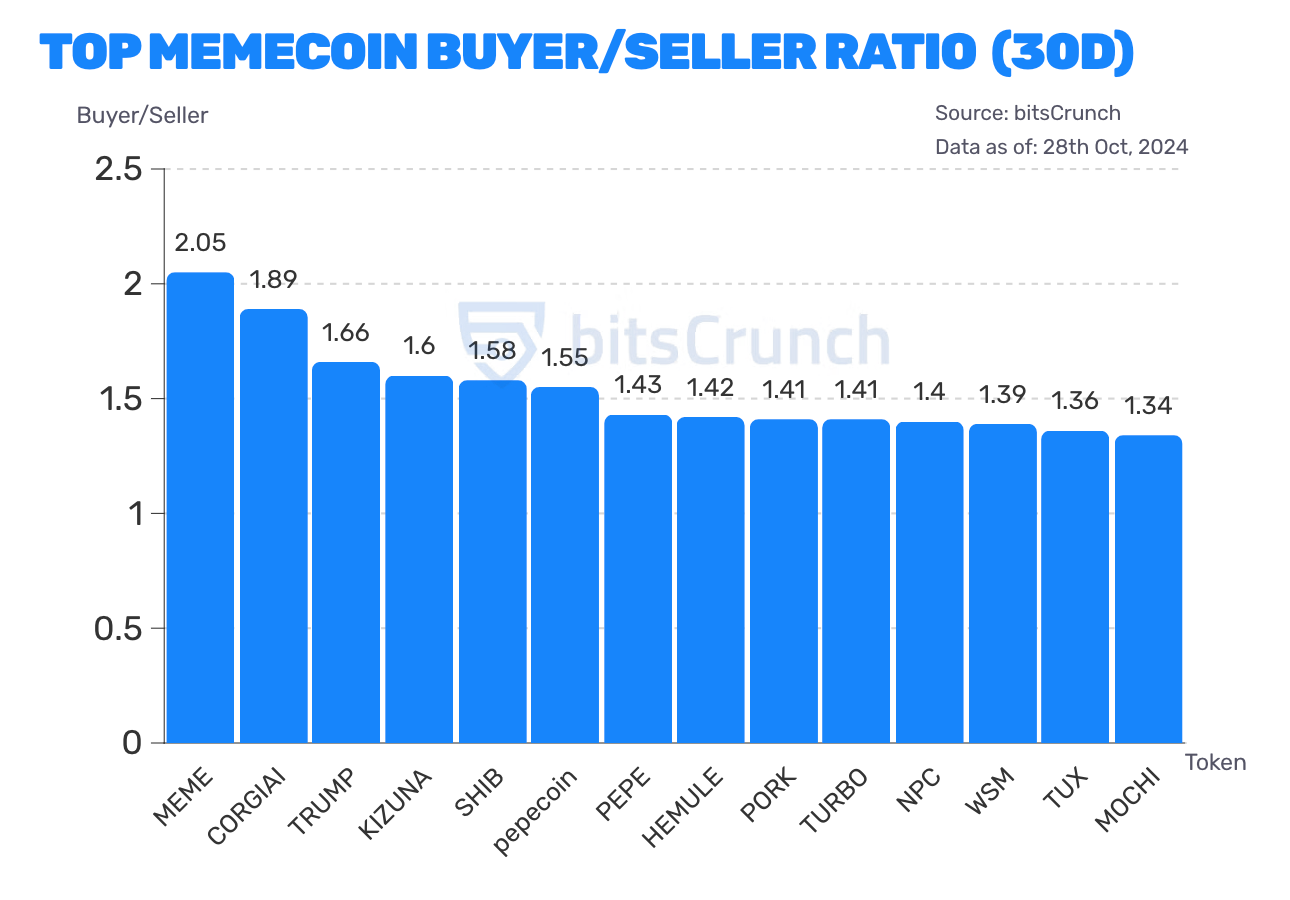
The prices of Meme coins show a strong correlation with social hot topics. According to the buy-sell comparison index, TRUMP has an index of 1.66, with a price increase of 15.9%. This is highly related to the recent U.S. political election events.
SHIB and WIF had the highest trading volumes in the past 7 days, at $70.2 billion and $67.3 billion, respectively, far exceeding the third and fourth places. By comparing trading volume and price volatility, we find that projects with high trading volumes (like SHIB and DOGE) have relatively mild price fluctuations, while projects with lower trading volumes tend to be more volatile.
This indicates that large-cap Meme coins are gradually acquiring "store of value" attributes, with investors showing a stronger tendency to hold them. Many investors have adopted a "buy the dip" strategy, further strengthening the head effect. In contrast, small-cap Meme coins tend to play a more speculative role, with stronger short-term speculation. Liquidity layering will become more pronounced, which may lead to increased market polarization.
The ratio of address and price changes reflects the immediate changes in liquidity. HIGHER and MOODENG experienced short-term liquidity increases of 2.32% and 1.98%, respectively. Such abnormal liquidity inflows often signal potential price volatility.
Conversely, TURBO and PONKE experienced liquidity outflows of -0.31% and -0.13%, respectively. This slow but steady liquidity outflow may indicate a gradual weakening of market confidence.
For investors, this means a need to more cautiously assess the liquidity risks of projects rather than merely focusing on price fluctuations. In this rapidly evolving market, the importance of risk management may outweigh the pursuit of returns.
Trading Security Data Analysis
From the current market data, authenticity verification and contract security assessment have become the primary steps in investment decision-making. The rampant manipulation in the Meme coin trading market often hides two possibilities: first, project teams attempt to create trading activity to climb the DEX Screener trend list; second, bots are engaged in market manipulation. Therefore, it is essential to identify genuine community interactions before trading.
Through contract analysis of the holding addresses of Meme coin projects, several risk issues have been identified: one is excessive centralization of authority, the second is the lack of liquidity locking, and the third is a significant overlap of holding addresses.
Specifically, a core address frequently interacts with multiple dispersed addresses. This pattern is particularly common in some emerging projects with abnormal 24-hour price increases, often signaling the risk of centralized control. Additionally, it is necessary to monitor whether there are complex fund flows between multiple large holding addresses, which may indicate the operation of a large speculative group behind the scenes.
Therefore, for newcomers to Meme coins, it is crucial to observe the degree of dispersed holdings, which is typically more common in mature projects like SHIB or PEPE. However, it is worth noting that even in such projects, the top 100 addresses still control the vast majority of the supply.
Social Influence Analysis System
Generally, a successful Meme coin project requires endorsement from at least 3-5 KOLs with over 100,000 followers on average. However, this metric is changing.
Currently, high follower counts are no longer a decisive factor. For example, although HIGHER has only received support from KOLs of moderate size, its ability to rise is even stronger. This reflects a market shift towards de-KOLization. The timing of KOL endorsements significantly impacts project trends. Projects that receive multiple KOL endorsements concentrated in a short period often perform worse than those with endorsements spread over different periods.
Key Indicator System
Based on statistical analysis of successful cases, we summarize the following key indicator system:
Trading Volume Indicator: A robust project should achieve an organic trading volume (excluding bot trading) of $500-$1,000 within the first hour of launch. This figure is below the industry-accepted threshold of $1,000-$2,000, but we find that a lower initial threshold is conducive to the project's sustained development.
Market Cap Threshold: $100,000 is a critical psychological barrier. Data shows that 87% of successful projects begin to see substantial growth only after surpassing this market cap. However, it is important to note that this threshold varies across different sectors. For example, AI-themed Meme coins often require a higher initial market cap.
Supply Distribution: The proportion of holdings by the founding team is an important indicator. Statistics show that when the founding team's holdings are below 5%, the project's survival rate significantly increases. This may be because lower team holdings reduce the risk of sell pressure and increase community confidence.
Risk Warning Mechanism
First, basic indicator monitoring. Real-time tracking of trading volume, holding distribution, price volatility, and other basic data, setting alarm thresholds for abnormal fluctuations.
Second, on-chain behavior analysis. Monitor large address movements, especially interactions with known risk addresses. At the same time, track changes in liquidity pools to warn of potential sell-off behaviors. Establish a dynamic stop-loss system, setting different stop-loss ratios based on the project's different development stages.
Third, social signal monitoring, establishing a KOL database to identify potential market manipulation signals. Pay special attention to abnormal activity on social media, look for opportunities on new public chains, and diversify the investment portfolio.
免责声明:本文章仅代表作者个人观点,不代表本平台的立场和观点。本文章仅供信息分享,不构成对任何人的任何投资建议。用户与作者之间的任何争议,与本平台无关。如网页中刊载的文章或图片涉及侵权,请提供相关的权利证明和身份证明发送邮件到support@aicoin.com,本平台相关工作人员将会进行核查。


