First Impressions of Japan's Crypto Scene
When I first started learning about Bitcoin, I enjoyed watching English documentaries related to it. One documentary on YouTube titled "Bitcoin Big Bang: Mark Karpeles" left a deep impression on me, and you can still find it today. The film mainly tells the story of Mt. Gox, an online trading site for Pokémon cards established in 2010, which was later transformed into a Bitcoin exchange after being acquired by Frenchman Mark Karpelès in 2011. As Bitcoin gained popularity, Mt. Gox quickly became the largest Bitcoin trading platform in the world, handling 70% of global Bitcoin transactions at one point. In February 2014, Mt. Gox announced that approximately 850,000 Bitcoins (worth about $473 million at the time) had been stolen and suspended all Bitcoin withdrawals. On February 28, 2014, Mt. Gox filed for bankruptcy protection. The rapid rise and fall of Mt. Gox left me with my initial impression of Japan's crypto industry.
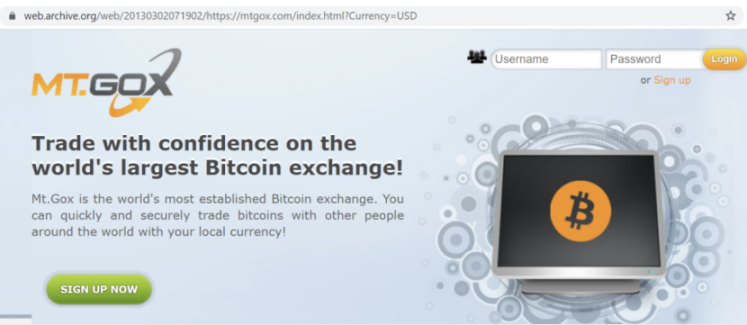
I don't know if it was a coincidence or fate, but this year, the Tokyo EDCON conference (Community Ethereum Development Conference) was held in the Shibuya district, where Mt. Gox was located. Out of curiosity, I was fortunate enough to apply as a volunteer for the EDCON conference and traveled to Tokyo to learn about the current state of Japan's crypto industry ten years after the collapse of Mt. Gox.
Macroscopic and Microscopic Views of Japan's Crypto Industry
Before heading to Japan, I saw two significant recent news stories about Japan's Web3 industry. One was that Japanese tech giant Sony acquired the Amber Japan exchange, entering the crypto trading service industry. The other was from Simon Gerovich, CEO of the Tokyo Stock Exchange-listed company Metaplanet Inc (stock code 3350:JP), who stated that he wanted to emulate the U.S. publicly traded company Microstrategy by issuing low-interest bonds to purchase and establish Bitcoin-backed corporate asset reserves. Watching these major players enter the market gave me the impression that, after a decade of ups and downs in the crypto industry and market education, the local population in Japan has a high level of awareness and acceptance of Bitcoin and crypto assets.
Upon arriving in Tokyo, I indeed found that many offline shared workspaces or bars prominently featured the word "Crypto." There were many Worldcoin offline Orb iris verification points in Tokyo and beyond. My friends and I visited a crypto shared workspace called "Centrum," located in the heart of Shibuya. It was tucked away on the fourth floor of a shopping mall, and you had to find a door covered in murals to enter the space. Ordinary shoppers could easily overlook it. It felt like a "test" where only those eager to jump into the crypto rabbit hole would find it.
Once inside, we noticed that there weren't many people working; it was very quiet. The staff member was very enthusiastic in introducing that they were helping Worldcoin with account verification, but appointments needed to be made in advance via the app. The store had many promotional flyers for various cryptocurrencies and information pages for offline meetups.
Based on my experience living in Tokyo for about a week, I found that crypto payments are not yet widely used in Japan. Almost everyone in Japan has a transportation card, such as Suica or Pasmo, which makes it very convenient for public transport and shopping. When the balance runs out, you can easily recharge it at a 7-11 or FamilyMart convenience store. The cash register systems in these stores are connected to major global banking networks. Web3 stablecoin crypto payments clearly cannot compete directly with these traditional Japanese financial giants.
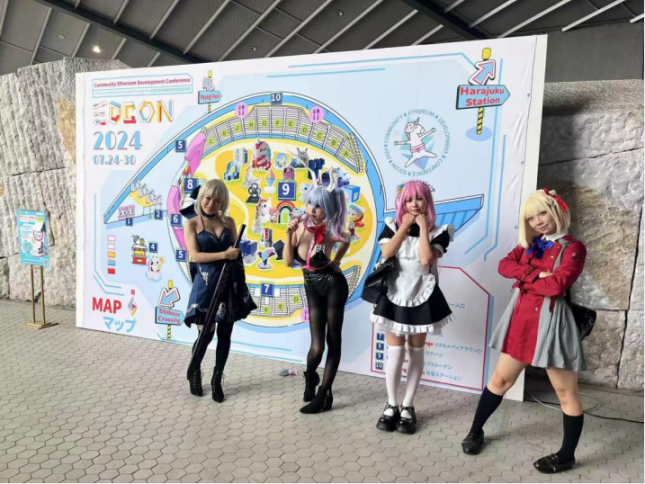
Returning to my impressions of the EDCON venue in Tokyo, I noticed that local Japanese people do not seem to care much about cryptocurrencies. Locals attending EDCON likely made up only about 20%-30% of the total attendees, which included many elderly people coming to grab free merchandise. Additionally, I did not see many well-known Japanese Web3 projects exhibiting. Since the EDCON venue was provided for free by the Shibuya government, they also actively recommended some exhibiting projects, such as the well-known anime IP Ghost in the Shell. The team members candidly stated that they were "requested" by the government to exhibit and promote, and that their project had little to do with crypto or Web3. The highlight of the EDCON conference was the active participation of Japanese crypto venture capitalists. Keisuke Honda, a former star player of the Japanese national football team, has established a local venture capital fund after retiring and expressed his hope to support more small and medium-sized enterprises and entrepreneurs in Japan. There are also two local professional crypto exhibition organizations, IVS (Infinity Ventures Summit) and WebX, which hold blockchain week events in Japan every year and maintain many connections with Korean crypto VCs, such as Hashed.
Japanese DAO Organizations and Crypto Socializing
At the EDCON venue, I met active community members from Nouns Japan, whose booth was very prominent at the entrance of the venue. They also brought a large amount of merchandise, such as sunglasses and T-shirts, to sell on-site.
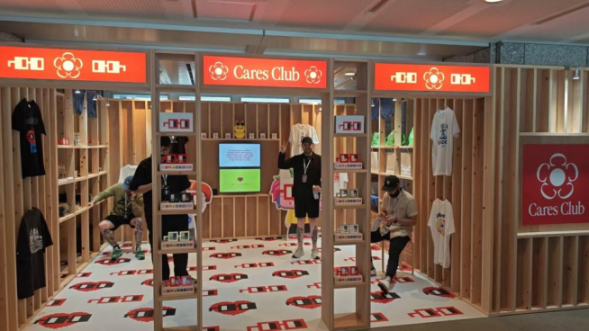
Aside from that, there was only DAO TOKYO, an organization that held Web3 gatherings under the DAO name. Last year, a piece written by Professor Wang Chao titled "These DAOs are Changing Japan" made me look forward to seeing more local Japanese DAO organizations. However, at the actual EDCON venue, there was no separate panel discussion on DAO themes, and not many people were talking about or showing interest in DAOs.
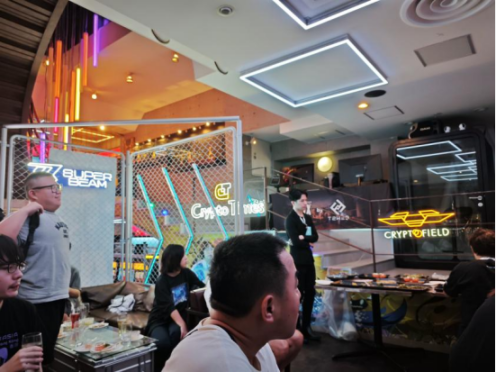
Someone once told me that you can see the real side of Japanese people at izakayas in the evening. I didn't go to an izakaya, but I went with friends to an offline gathering hosted by Arweave/AO at the Tokyo Crypto Lounge GOX, which indeed had a very different atmosphere from the serious vibe of EDCON during the day. Upon entering, there were three crypto slot machines, and the neon colors of punk aesthetics caught my eye. Several computer monitors displayed cryptocurrency prices on the walls, creating an atmosphere reminiscent of an amusement park and casino.

We gathered under the projection screen, where the host and speakers were actively sharing the latest updates about Arweave/AO. Free snacks and drinks were provided on-site. The attendees were organized to play a QR code scanning icebreaker game, and the overall atmosphere was great. Japanese people tend to prefer quieter socializing, gathering in small groups to sit close together and communicate softly, valuing privacy. I once read a report stating that 50%-60% of those participating in cryptocurrency investments in Japan are middle-aged men from Tokyo, and based on the crowd at this gathering, I found that to be quite credible.
Japan's Unique Crypto Path
My brief visit to Tokyo allowed me to see many industry builders actively exploring the development direction and path of Japan's crypto industry. There is strong support from the Shibuya government for small and medium-sized startups, active funding from local crypto VCs, and traditional tech giants like DMM Group and Sony exploring cross-industry opportunities. Various overseas public chains and project teams also place great importance on developing local communities in Japan, believing that the Japanese market and its potential should not be underestimated. For example, Zksync held many peripheral activities and workshops at the EDCON venue.
On the other hand, I also observed that in Japan's finely-tuned and efficient society, it is still early for cryptocurrencies and virtual assets to find widely accepted scenarios, and there is a long way to go. Having experienced the bubble economy of the 1990s and the collapse of Mt. Gox, the Japanese people generally hold a skeptical, cautious, and conservative attitude towards the speculation and hype surrounding crypto assets.
Overall, the development of Japan's crypto industry gives me a peculiar feeling. It does not belong to the speculative paths of meme coins or air coins, as the government has strict regulations on virtual assets. However, it also does not blindly follow the directives of certain overseas public chain foundations; it has its own thoughts and pace of development.
On August 21, 2024, the Mt. Gox bankruptcy committee began repaying some creditors in the form of BTC and BCH through designated crypto trading platforms. This symbolizes that Japan's crypto industry is rising again from the previous collapse and ruins, continuing on its uniquely Japanese path of crypto development.
Appendix:
YouTube video "Bitcoin Big Bang: l'improbable épopée de Mark Karpeles"
https://www.coindesk.com/business/2024/07/01/sony-buys-ambers-japan-unit-to-enter-the-crypto-market-reports/
Coindesk news, Sony acquires Amber Group's Whalefin exchange in Japan
https://www.youtube.com/watch?v=m1T_xKX6Eto
Tokyo-listed company Metaplanet Inc begins large-scale Bitcoin purchases.
https://metaplanet.jp/
Wang Chao's "These DAOs are Changing Japan"
免责声明:本文章仅代表作者个人观点,不代表本平台的立场和观点。本文章仅供信息分享,不构成对任何人的任何投资建议。用户与作者之间的任何争议,与本平台无关。如网页中刊载的文章或图片涉及侵权,请提供相关的权利证明和身份证明发送邮件到support@aicoin.com,本平台相关工作人员将会进行核查。


