Ethereum's rebound performance is better than Bitcoin's.
Author: Mu Mu
The Federal Reserve has finally completed its first rate cut since March 2020, shifting from a tightening cycle to an easing cycle.
On September 18th, local time, the Federal Reserve announced a 50 basis point cut in the federal funds rate target range to a level between 4.75% and 5.00%. Federal Reserve Chairman Powell stated that the 50 basis point rate cut was a "strong action."
The crypto market seemed to welcome the dawn. On September 19th, Bitcoin's trend fluctuated greatly, rising from a high of $59,000 to over $63,000, with a daily increase of 6%. On September 23rd, it further broke through to near $64,600. Ethereum also rose from $2,200 to over $2,400 and broke through the $2,600 mark on September 23rd. The overall market value of crypto assets also rose by 6% after the rate cut, reaching $2.3 trillion.
After the first rate cut, the market generally expects further cuts in the fourth quarter. Apart from emergency rate cuts during the crisis, a 50 basis point rate cut by the Federal Reserve is not common. The last significant rate cut occurred in 2020, when faced with the impact of the COVID-19 pandemic, the Federal Reserve implemented an aggressive rate cut policy, lowering rates to near zero. At that time, the price of Bitcoin did not immediately soar, but it broke through the $30,000 mark by the end of the year.
Historically, rate cuts typically drive up Bitcoin prices. Will the crypto asset market repeat history after this rate cut?
The "Boot" of Rate Cuts Lands
Since the second half of this year, Bitcoin has been on a roller coaster ride in the crypto asset market, maintaining a low-level fluctuation after entering August, with the U.S. federal funds rate becoming a focus of attention in the crypto market.
A rate cut refers to the Federal Reserve lowering the federal funds rate, which is the benchmark interest rate for interbank lending in the United States. Rate cuts mean lower borrowing costs, making it easier for businesses and individuals to obtain loans, thereby stimulating economic activity, increasing employment, and controlling inflation. Rate cuts reduce the cost of funds, stimulate economic activity and investment, and make investors more inclined to high-risk, high-return assets, such as stocks and other crypto assets like Bitcoin.
From 2008 to 2022, the U.S. federal funds rate has been maintained in the extremely low range of 0-0.25%. A mild upward trend began in 2016, but it never exceeded 2.25%.
During the prolonged inflation resistance in the United States, the Federal Reserve continued to raise the federal funds rate, raising it a total of 7 times from March to the end of the year in 2022, with a cumulative increase of 425 basis points. By December 2022, the Federal Reserve raised the target range for the federal funds rate to 4.25%-4.50%, the highest level since the 2008 global financial crisis.
As of September 8, 2024, the Federal Reserve's target range for the federal funds rate is 5.25%-5.50%. From the chart, the current U.S. federal funds rate is at its highest level in over a decade.
The pace of rate hikes finally stopped in September. On September 18th, the Federal Reserve announced a 50 basis point cut in the federal funds rate target range to a level between 4.75% and 5.00%. Federal Reserve Chairman Powell stated that the 50 basis point rate cut was a "strong action." He emphasized that a significant rate cut does not indicate that a U.S. economic recession is imminent. Rather, the rate cut is more of a preventive action aimed at maintaining the stability of the economy and labor market.
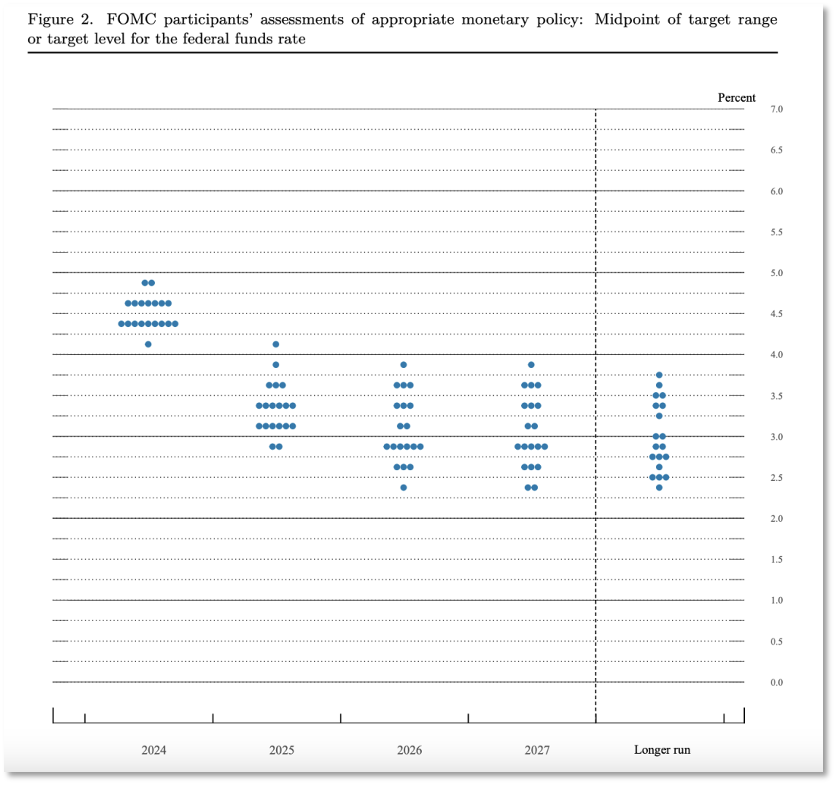
Federal Reserve dot plot
The dot plot shows that the median expectation of the 19 policymakers for the year-end Federal Reserve rate in 2024 falls between 4.25% and 4.5%. This means that overall, they believe that there will be an additional cumulative rate cut of 50 basis points by the end of the year.
ETH Outperforms BTC in Rebound
After the rate cut by the Federal Reserve, the three major U.S. stock indexes collectively fell on September 18th, and the rate cut did not meet expectations for boosting U.S. stocks. In contrast, the performance in the crypto asset sector was more optimistic, especially for the top two assets by market value, Bitcoin and Ethereum, both of which have entered the sequence of assets in U.S. stock ETFs last year and this year.
On September 19th, following the rate cut news, Bitcoin (BTC) rose, reaching over $63,000 from a high of $59,000, with a 6% increase within the day. Ethereum (ETH) also rose from $2,200 to over $2,400 and broke through to over $2,600 on September 22nd.
However, Ethereum's overall performance is better than Bitcoin's, with a 7-day increase of 16.3%, far exceeding Bitcoin's 7-day increase of 9.7%.
In addition, SOL also achieved an increase of over 20% on the day of the rate cut news, while meme coin DOGE increased by 3%, and Bitcoin's ecosystem tokens ORDI and SATS achieved nearly 10% increases.
As crypto asset prices collectively rose, Bitcoin spot ETFs also ended 8 consecutive days of net outflows. Since September 12th, Bitcoin spot ETFs have seen 4 consecutive days of net inflows, indicating that confidence from off-exchange funds is gradually recovering.
Many market professionals are optimistic about the rate cut by the Federal Reserve, believing that it will boost Bitcoin and the crypto market. Anthony Scaramucci, founder of the hedge fund Sky Bridge, believes that this is good for asset prices in the U.S. and globally. With a series of rate cuts by the Federal Reserve and clearer regulation of U.S. crypto assets, Bitcoin is expected to reach a new high of $100,000 by the end of the year.
In theory and based on historical patterns, rate cuts do tend to drive up Bitcoin prices.
In 2019, the Federal Reserve cut rates in July, September, and October, lowering the federal funds rate target range to 1.5%-1.75%. Before the rate cuts, the price of Bitcoin had already risen from about $4,000 at the beginning of the year to $8,000. After the rate cut news was announced, the price of Bitcoin reached a high of $10,000 in July, but then fell back.
In 2020, faced with the impact of the COVID-19 pandemic, the Federal Reserve implemented a more aggressive rate cut policy, lowering rates to near zero. Despite this, the price of Bitcoin did not immediately soar, but broke through the $30,000 mark by the end of the year.
However, despite the "loosening" effect of rate cuts, it has also cast a shadow of economic recession. Some Federal Reserve officials are concerned that too rapid rate cuts may lead to a rebound in demand, keeping inflation high. Republican presidential candidate Trump believes that this shows that the U.S. economy is in bad shape. "Assuming they are not playing politics, such a large cut indicates that the economic situation is very bad."
Peter Cardillo, Chief Market Economist at Spartan Capital Securities, believes that the Federal Reserve's move is clearly dovish, mainly due to concerns about an overly weak labor market. Although the stock market reacted positively after the rate cut news, market sentiment may change in the coming days, and investors may begin to worry about the economic outlook.
Compared to traditional financial markets such as stocks, CryptoSea founder Crypto Rover is more optimistic about the future development of Bitcoin. He stated, "The last time this happened, the bull market for Bitcoin began." Lark Davis, founder of Wealth Mastery, also has a positive outlook on the long-term trend of Bitcoin, emphasizing that "if history repeats, the next 6-12 months will be crazy."
In any case, the rate cut cycle has begun. Among the 19 officials at the Federal Reserve, 7 believe that there should be an additional 25 basis point rate cut in 2024, 9 believe there should be an additional 50 basis point rate cut in 2024, and 7 believe there should be an additional 75 basis point rate cut in 2024, with only 2 officials believing that there should be no further rate cuts in the remaining meetings of 2024.
Employment market data will shape the pace and endpoint of future rate cuts. With the passage of time and the continuity of rate cuts, market liquidity will become more active, and some funds are likely to flow out of bonds and banks into stocks, crypto assets, and other markets.
免责声明:本文章仅代表作者个人观点,不代表本平台的立场和观点。本文章仅供信息分享,不构成对任何人的任何投资建议。用户与作者之间的任何争议,与本平台无关。如网页中刊载的文章或图片涉及侵权,请提供相关的权利证明和身份证明发送邮件到support@aicoin.com,本平台相关工作人员将会进行核查。


