Although TVL is an important indicator, the quality and quantity of protocol integrations often better predict future development trends.
Author: James Glasscock
Translation: DeepTechFlow
This article will delve into how DeFi relies on its most valuable asset - people - to achieve prosperity and drive key strategies and valuable experiences for sustainable community growth.
Successful DeFi protocols view the community as a powerful growth lever. This article delves into the strategies, challenges, and successful experiences that shape its ecosystem. By focusing on incentives, metrics, contributions, and governance, we reveal some subtle but far-reaching lessons that are meaningful for many projects. This article shares insights from mature protocols that have faced challenges, continued to evolve, and continue to lead the future of DeFi.
In the process of writing this article, we had in-depth discussions with six core DeFi contributors who generously shared valuable insights. Mastery lies in the details, and this article only provides some initial observations. If you are eager for a deeper understanding, feel free to join these communities and actively participate.
@DeFi_Made_Here - Instadapp Fluid, providing efficient lending services
@wagmiAlexander - Aerodrome and Velodrome, trading and providing liquidity on the Base and Optimism networks respectively
@MattLosquadro - Synthetix, a liquidity layer for on-chain derivatives
@omgcorn - Yearn, a decentralized automatic yield aggregator
@amplice_eth - Gearbox Protocol, a leverage layer for DeFi
@kmets_ - Aladdin DAO, providing flexible farming, leverage, and stability products through Concentrator, CLever, and f(x) Protocol
In these discussions, we focused on projects with TVL ranging from 70 to 700 million US dollars during August 2024. As the scale of the projects expands, their needs and opportunities continue to evolve. In the future, we will explore the unique dynamics in larger-scale protocol ecosystems.
Over the past few years, I have been dedicated to helping build the Reserve protocol ecosystem. During this time, our on-chain TVL has grown from zero to over 200 million US dollars, especially during bear markets. However, this process has not been smooth sailing. Writing this article has given me the opportunity to reflect from a broader perspective and share these experiences with everyone, hoping to be helpful to you.
This article is suitable for:
Cryptocurrency projects and community leaders who want to expand their toolset and enhance community-driven growth.
Job seekers who want to enter the cryptocurrency field and make substantial contributions.
Community experience enthusiasts who want to create a space where people are happy to gather and collaborate.
The Essence of Community
Contribution is the core and vitality of the community. In the complex field of DeFi, products are still in the experimental stage, and the initial value lies in the depth of participation rather than the breadth of quantity.
Drawing on the insightful article "1-9-90 Community and Brand Building" by Gearbox co-founder @ivangbi_, the community can be divided into three levels:
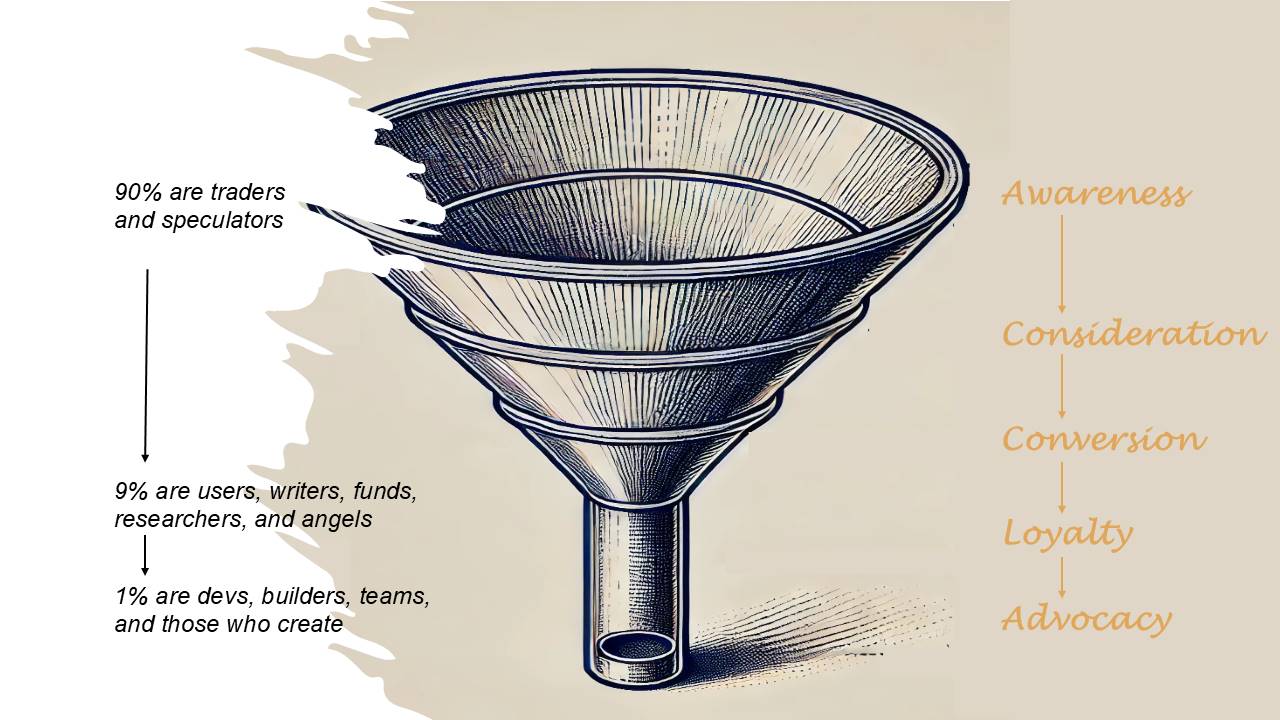
1% consists of developers, builders, and teams, who are the creators.
9% consists of users, authors, funds, researchers, and angel investors, who are keen observers in the field and make some comments. Although not part of the team, they are not just newcomers passing by.
90% consists of random traders and speculators, who usually do not read documentation. They pay attention to headlines, buy and sell cryptocurrencies, but do not care about in-depth research. They are not foolish, just not attached to any investment. For them, fundamentals are usually irrelevant, and they only care about price trends.
When using the funnel model analogy, 90% are at the top of the funnel, 9% are in the middle, and 1% are at the bottom.
We apply the 1-9-90 model to the standard marketing funnel, mapping from initial awareness to enthusiastic support.
In most cases, community building needs to start with the 1% and 9%, and then gradually progress. For emerging DeFi platforms that have not found product-market fit, it requires a combination of technical education and continuous practical exploration, and only those who are curious and entrepreneurial are willing to invest in this. A few dedicated and high-quality contributors often outperform thousands of ordinary enthusiasts.
Key contributions include:
Developers: Creating data dashboards, collateral plugins, or new infrastructure.
Deployers/Integrators/Applications: Using code, assets, or incentive mechanisms to combine and release new products.
Liquidity Providers/Arbitrageurs: Depositing assets into pools or treasuries to earn fees or returns.
Borrowers: Providing collateral and applying for loans.
Leverage Yielders: Amplifying returns through deposit and borrowing cycles, manually or with one-click operations.
Minters: Depositing collateral to mint leveraged tokens or stablecoins.
Token Stakers/Lockers: Locking governance tokens to gain higher governance rights and rewards.
Governors: Proposing suggestions, electing committees, guiding token issuance, and supporting protocol upgrades.
Traders: Engaging in spot or derivative trading.
Researchers/Speakers: Providing analysis and education through various media.
Although the above list is not comprehensive, it is important to emphasize that these people are true "users," not just bystanders or speculators. In many DeFi communities, this core group often accounts for only 10% or less of the total members (i.e., 1-9-90 model's 1 and 9). A significant portion of contributors are attracted through business development activities, which also reflects the close connection between community building and business development. For ecosystem builders, the key is to create an environment to identify and elevate these important participants.
Healthy Metric Analysis
Low-priority metrics include engagement on the X platform, YouTube views, Reddit post count, Discord participants, attendance at community phone meetings, and feedback from token holders who actually do not use the protocol. Focusing on these surface-level metrics may create the illusion of engagement but ultimately lead to misleading conclusions.
As the saying goes, "If you want to make the wrong decision, ask everyone." Conversely, if you want to make the right decision, you should rely on data. The protocols surveyed in this article are all aiming to achieve a sustained Total Value Locked (TVL) of 1 billion US dollars as the next important milestone. Although TVL is undoubtedly the most popular metric, it is multi-faceted and complex. Some parts of TVL may have utilitarian aspects, so it is important to delve into its components. Here are some aspects worth considering:
- Liquidity and capital supply
- Listed assets
- Quality and quantity of integrated applications
- Trading volume
- Outstanding loans
- Monthly active users (MAUs)
- Revenue and/or profit
In our discussions with the surveyed projects, the quality and quantity of integrations are seen as key factors driving community growth. However, the most important goal is still to maintain a stable number of monthly active users, which is a more realistic measure of sustained engagement. Although building these integrations requires significant investment and has a high conversion cost, each high-quality integration can provide additional compounded value. Each new integration opens up larger trading channels, drives the growth of monthly active users, and ultimately increases Total Value Locked (TVL), revenue, and even profit.
As @DeFi_Made_Here puts it, "In the early stages of development, the influence of 10 to 20 core users far exceeds that of thousands of regular users. A small and focused team can create initial momentum and expand the user base to hundreds or even more."
Misconceptions and Motivations
There is a significant difference between surface-level engagement and genuine community building.
Communities that focus solely on atmosphere or speculation often struggle to convert participants into actual users of the protocol, ultimately leading to long-term failure. Genuine community building requires deeper support and sustained contributions at various stages of user engagement, especially in the middle and lower stages. Several projects have pointed out that key community building is often driven by business development teams in private, high-signal Telegram groups with other protocol partners. Projects typically have hundreds of such groups, each focusing on different protocol partners.
In incentive mechanisms, balancing external and internal incentives is crucial. External incentive activities, such as learning to earn tasks or low-threshold airdrops, often attract short-term, utilitarian participants. These activities typically lose 90% or more of users once the incentives disappear. Fine management through multiple touchpoints, providing long-term rewards, and conducting attribution tracking can effectively increase user retention.
Similarly, incentivized Key Opinion Leaders (KOLs) can help spread information, but caution should be exercised - many KOLs act like mercenaries, which often reflects in the quality and authenticity of their efforts. In contrast, carefully designed and enduring community content plans, such as the plan in f(x) Protocol, break this trend and thrive in closely-knit communities.
Internal incentives, such as a clear mission, unique products, transparency, and a positive developer experience, are key to sustaining long-term engagement. Fully on-chain protocols directly create value for users through transparent incentive mechanisms and enhance network effects. Aerodrome excels in this aspect, ensuring that all actions are closely related to the protocol and not influenced by off-chain intermediaries.
Some protocols have pointed out that retroactive funding and rebates are powerful tools that combine external rewards with intrinsic motivation contributions.
Governance and Power Dynamics Coordination
There is often a gap between the appearance of community governance and actual decision-making power. When a few entities hold dominance, the community's role becomes a facade, raising concerns about whether the project is truly committed to decentralization. This is a common issue, and potential solutions include how Tokens are allocated, such as through fair launches, adjusting the timing of governance votes to align with on-chain incentives, or establishing official delegation programs. Some interesting methods will be discussed later in this article.
Human Factors in Community Building
Emerging systems rely on building a trusted brand, which starts with nurturing the community. Announcements and tweets alone are not enough to build a thriving community. Early users need personalized guidance and meaningful support.
Focus should be on one-on-one interactions with individuals or projects that have the potential to become long-term contributors. As these relationships deepen, the scale naturally expands - from 20 people to 40, then to 80, and so on.
Team members with strong social influence who can explain the project in clear and understandable language are valuable marketing tools. While this role is typically taken on by the founders, it does not necessarily have to be. As @wagmiAlexander puts it, continuous and clear communication is key: "Even though the code is immutable, ultimately it's people who decide everything."
Intentional Design of Community Spaces
There should be a clear intent when building community spaces. In situations of limited resources, attracting speculators can divert attention from actual growth factors, leading to inefficiency. This not only weakens the vitality of the community but also diminishes the influence of true value creators. While speculators have their place, their emotions fluctuate with unpredictable market changes - where only the actual application of the project is something you can influence. Over 90% of effort should be directed towards educating real users and gathering product feedback. Builders and innovators cannot thrive in noise; conversations lacking information weaken valuable network effects. As the project matures, encourage the community to create spaces autonomously.
Beware of Overzealous Venture Capital
In a recent All-In Podcast, venture capitalist David Sacks pointed out, "One big change in our industry is that in 2020 and 2021, we had a bubble. Because the federal government injected $10 trillion of liquidity into the economy to deal with Covid, a lot of capital poured into this industry." This wave of capital not only inflated the market but also drowned the venture capital industry in a lot of cash. As a result, the barrier to entry lowered, allowing some inexperienced and opportunistic individuals to call themselves venture capitalists.
Announcing funding or flaunting partnership logos does not represent genuine community participation. Projects overly reliant on this form of publicity may expose a lack of actual user engagement. Some venture capitalists adopt a "cast a wide net" strategy, focusing more on short-term exits rather than long-term sustainable development. Their focus is on quick financial returns rather than the long-term success of the protocol.
In contrast, venture capitalists who actively participate in governance, continue to hold after the Token vesting period, provide analysis, and facilitate ecosystem collaboration, become important allies for projects. When seeing dazzling funding announcements, we should pause to evaluate how past and present investors have helped the project achieve real user growth. If you are the one making the announcement, remember that the most valuable potential contributors and partners may delve into the project deeply, rather than relying solely on press releases.
Experience and Achievements in Governance
Governance is indeed important, but in the early stages of a project, builders and users are the cornerstone of Total Value Locked (TVL) growth, which in turn injects vitality into governance. For example, three years ago, when Yearn reached its peak TVL of one billion US dollars, governance participation was 50 to 100 times higher than it is now. Governance typically sits at the bottom of the development funnel.
Looking at it from a different perspective, imagine a water source on the African savanna, where elephants, lions, antelopes, zebras, hippos, and crocodiles all gather. The water source thrives under the regulation of natural laws. In this metaphor, water symbolizes TVL (Total Value Locked) - without water, the number of "governors" would decrease.
Before participants have governance capabilities, they first need to become active users or contributors. When TVL is low, engagement decreases, power becomes concentrated in the hands of a few, weakening the cohesion and governance capabilities of the community. To build a strong community, the focus should be on increasing TVL, which will naturally enhance governance capabilities. Although this article does not delve into governance models, I would like to point out some interesting methods worth exploring.
Protocols like Velodrome and Aerodrome adopt a fully on-chain approach, integrating governance and rewards through mechanisms such as veTokenomics. This allows participants to vote on emissions and share fees and rewards. The decentralized front end can autonomously decide whether to include the protocol's new version in the future. This model discards traditional DAO governance forums or Snapshot voting, forming a "pull" system led by participants, rather than relying on an externally driven "push" system. Aerodrome has fostered a community culture where everyone looks forward to voting and reward days every Wednesday. Aladdin DAO's f(x) protocol also adopts a similar approach.
In DAOs, delegation of Token voting is crucial, although there are some criticisms, delegation voting is an effective way to expand participation for small Token holders who do not frequently participate in governance. Synthetix has been successful in establishing a Representative Council, elected by SNX Token holders, consisting of 4 to 8 members. The Spartan Council is responsible for leading protocol changes, the Ambassador Council handles external partnership proposals, and the Treasury Council manages grants and payments. Any community member can run for a council seat, with a term of 4 months and a monthly stipend of 2,000 SNX.
In early 2024, Pyth Network cleverly airdropped PYTH Tokens to governance-savvy individuals from Synthetix. Eligible recipients were those who had voted on proposals or made significant contributions to governance. To claim these Tokens, participants had to stake within a specific timeframe, incentivizing them to engage more deeply in governance. Unclaimed Tokens would be returned to the Synthetix treasury, ensuring that only those truly involved in governance, rather than speculators, could benefit.
Unfortunately, none of the protocols I have come across have proposed innovative methods for governance communication or dashboards. Most protocols still use traditional methods: submitting proposals on discussion forums, voting through Snapshot or Tally, and providing regular updates on 𝕏 and Discord. It seems that we are all navigating in similar decentralized environments.
The litmus test for governance. In the early stages of governance, I would like to quote @MattLosquadro: "The biggest litmus test is whether the project leaders can be fully or partially vetoed by the community in the governance process. This helps to maintain active participation from community members."
Pleasant Surprises Along the Way
Despite the existence of many combinable infrastructures, @omgcorn points out, "Interestingly, some protocols choose to build from scratch rather than leverage existing, validated, and audited code. Adopting mature systems and integrating their network effects should be an obvious choice, but this may reflect that we are still in the early stages of development." Furthermore, choosing to build instead of buying may be because new protocols need to demonstrate the actual utility of their Tokens. As core innovations gradually mature and enter a more stable state, and understanding of network effects deepens, current hesitations may disappear.
The success of communities and Total Value Locked (TVL) is closely related to their responsiveness and adaptability. Although recent developments in DeFi have been relatively slow, innovations such as liquidity staking Tokens and yield farming have surged. Take Pendle, for example, it is a protocol that seized market opportunities at the right time, successfully establishing itself in the market, almost reaching blue-chip status. @amplice_eth emphasizes, "It's not just about innovative products, liquidity, or oracles, it's also about being a DeFi veteran who deeply understands market dynamics, able to seize opportunities."
"Aerodrome chooses to focus on the actual utility of the Token, the immutability of the system, and decentralization, rather than catering to venture capital or exit liquidity," says @wagmiAlexander. By establishing a community based on transparency, openness, and practicality, and continually providing progress updates, Aerodrome has sparked strong productivity. Its "Flight School" program is a testament to this commitment. Conversely, operations that are opaque and benefit only a few, especially in a bear market, often erode community trust.
However, there is an elite path based on values, which can form value-driven sub-communities, welcoming anyone willing to work for a place. Almost every project has a sub-community that provides real value through capital, product feedback, governance, or narrative influence. Some communities are formal and public, while others operate quietly behind the scenes, with a few key contributors informally taking on these roles.
For example, Aladdin's community boosters, Yearn's secret admirers, Synthetix's Representative Council, Club Gearbox DAO, and Aerodrome's pilots, partners, and sky marshals. These sub-communities cultivate a deeper sense of belonging, and their culture spreads to the wider community. To ensure the attraction of the most loyal supporters, some of these sub-communities are not public and require a clear commitment to the project's values before an invitation.
It is unrealistic to simply push a product to the market and expect automatic success. To succeed early on, careful guidance and support for the first wave of users are needed to generate initial momentum. A good developer experience is crucial, and rapid and high-quality feedback from the community significantly promotes growth. Recognition and acknowledgment of the early contributors are key to expanding network effects.
The community is not a monolith, but gathers on different platforms such as GitHub, Discord, governance forums, Telegram groups for BD partners, Twitter/𝕏, Farcaster, YouTube, or Reddit. While specific interactions are needed for each platform, focusing and discarding unnecessary parts are equally important due to limited resources. You cannot be everywhere, and it is better to succeed in one or two places than to perform mediocrely in five.
Talent Cultivation System
Building the right team is one of the biggest challenges when expanding any project. In conversations with various protocols, I have noticed a common trend: talent in business, operations, data, and marketing fields is often not recruited directly from outside the community; they are usually actively contributing before formally joining. This approach is effective because it attracts people who truly identify with the project's mission. These individuals have a deep understanding of the project's goals and can make a significant impact from the start. @amplice_eth emphasizes, "The people we want to hire already understand and believe in the importance and uniqueness of the product, which is exactly what we are actively looking for."
@wagmiAlexander, whose crypto journey started as a volunteer in the Solidly community and has worked in the political field, shares an important insight: "In the political field, those who obtain full-time positions are often those who have been involved early, delivered results, and persevered. Rather than focusing on resumes and titles, it's more about the contributions you have made."
If you can't find the right skills in your talent pool, it may mean that you haven't cultivated the ideal community. As @kmets_ said, "The community is a talent cultivation base." Internal recruitment from the community can reduce risks, such as avoiding the introduction of bad actors. In a remote working environment like DeFi, internal referrals are particularly important.
However, finding engineering talent for DeFi protocols presents unique challenges. While it's important to find people who can immediately contribute, it's also necessary to design products for new users, not just for seasoned users familiar with the field. In smaller DeFi communities, the talent pool for software engineers may be limited. In such cases, stepping out of the community and adopting traditional web2 recruitment methods becomes necessary.
As the Total Value Locked (TVL) in the ecosystem increases, stakeholders are better able to integrate community engagement with recruitment, continuously enhancing network effects, which becomes a major advantage. This phenomenon is particularly evident in the largest DeFi protocols, L2, and alternative L1 solutions. Sponsorship programs also provide important opportunities to identify, test, and cultivate new talent, preparing for future challenges - a trend we will delve into in future articles.
The community plays a crucial role in talent acquisition. Whether directly providing technical talent or serving as a social proof, it can ignite the spark to attract suitable talent to join the project.
Offline Events: Making Them Count
The purpose of hosting events varies from person to person - some see it as brand building, others as user acquisition, and some as consensus building - all of these perspectives may be valid. Conferences like ETH Denver and Token2049 not only feature main stage speeches and hackathons but also host hundreds of side events, providing protocols with opportunities for personalized and meaningful interactions with the community. Some protocols also host regional meetups in cities like Berlin, Buenos Aires, or Lagos. For project leaders, the key question is: where should time and resources be invested?
From conversations with several protocol leaders, it's clear that the return on investment for these events varies. Some choose not to participate at all, believing that events that can be replaced by YouTube videos are not very valuable. However, some have learned to leverage the local culture and environment to make events both fun and memorable, closely aligned with their project's core values.
For example, at the Shielding Summit privacy event held at EthCC in Brussels, participants discussed privacy funds, policies, and technologies on a remote island. Some attendees wore masks, symbolically echoing the event's anonymous theme. At Celestia Game Night at Devconnect in Istanbul, participants randomly met while playing "Super Smash Bros.," sparking more authentic and interesting conversations than the common "where do you work?" Even cultural exchanges in traditional Turkish baths made the experience difficult to replicate elsewhere.
Although the Reserve ecosystem is not the focus of this article, I want to mention two events that emphasize consensus building. At the ReGov event in ETH Denver, veTokenomics enthusiasts gathered to distill useful signals from the noise through practical collaboration and improve governance design. Similarly, in San Francisco, the Monetarium - a three-day gathering focused on long-term stability, exploring alternative forms of currency to address global inflation. These two events perfectly combined themes, participants, values, and locations, creating unique offline experiences that could have an impact of billions of dollars in just a few days.
Finding the right balance is not easy. Noisy clubs and spacious venues may diminish opportunities for in-depth conversations, while small dinners or impromptu gatherings often lead to more intimate and impactful discussions. Co-hosting events with partners not only promotes the exchange of ideas but also shares logistical and financial burdens. Combining events with business development goals, especially product launches, can enhance their impact. Synchronizing event timing with new feature releases can make events not just parties but a strategic part of growth.
The most impactful events are often relaxed and intimate. Small gatherings are more likely to spark in-depth conversations, especially when you bring together people from different fields such as engineers and artists. Hosting multiple small discussions rather than one large conference can create a more engaging and creative atmosphere. Of course, choosing the right attendees is crucial - whether as an organizer or participant, the worst-case scenario is when attendees do not align with your goals, leading to a lackluster event.
Expanding into International Markets
Many of the projects mentioned in this article have contributors and partners worldwide. However, their international influence is mainly achieved through differentiated products and English communication. Although some projects have attempted multilingual promotion, the results are often unsatisfactory or distracting. Considering limited resources, focusing on English remains the most effective strategy, as it covers the vast majority of the DeFi community.
Nevertheless, if you plan to expand into other languages, French, Spanish, Portuguese, and Chinese are the most commonly mentioned key areas. Some projects have found that even occasional tweets in the local language can create a sense of identification and excitement in these communities. Of course, if your marketing strategy relies on a specific region, customizing communication content for that audience becomes particularly important.
Conclusion
In this article, I shared insights from senior developers of protocols with TVL ranging from 70 million to 700 million, which have stood the test of time in the DeFi industry. While their methods may not be equally effective for you, the 1-9-90 framework can provide a valuable priority guide for community building if you are willing to try.
This reminds us that a few high-level contributors are often more valuable than thousands of fans or critics. These core members, closely linked by shared intrinsic values (preferably on-chain), often have a more lasting impact, despite requiring higher initial investment.
Interacting directly and personally with the community - 20 carefully crafted private messages often produce faster results than tweets sent to 20,000 followers. While this approach is not easily scalable, it is indispensable in the early stages of building a vibrant and healthy community.
A strong community is not only a rich source of recruitment but also particularly suitable for attracting non-technical talent. If your project has not attracted talent from the community, it may be necessary to rethink how to better integrate community building with recruitment efforts.
Although TVL is an important metric, the quality and quantity of integrated protocols often better predict future development trends.
Core contributors are a powerful means of attracting external attention and enhancing user loyalty by openly and deeply sharing product features and advantages.
When choosing community platforms, it's not necessary to be everywhere - sometimes less is more. Focusing on cultivation on platforms where core users and active participants are most engaged naturally brings new opportunities and a broader community. Key figures deeply involved create an organic chain reaction, driving the development of the entire ecosystem.
Governance participation also increases with the growth of TVL. As long as user participation is ensured and TVL increases, governors will naturally join in.
Event strategies should align with your goals, whether for brand awareness, attracting loyal users, or building consensus. Creating unforgettable experiences, rather than content that can be replaced by simple YouTube videos, is essential.
免责声明:本文章仅代表作者个人观点,不代表本平台的立场和观点。本文章仅供信息分享,不构成对任何人的任何投资建议。用户与作者之间的任何争议,与本平台无关。如网页中刊载的文章或图片涉及侵权,请提供相关的权利证明和身份证明发送邮件到support@aicoin.com,本平台相关工作人员将会进行核查。


