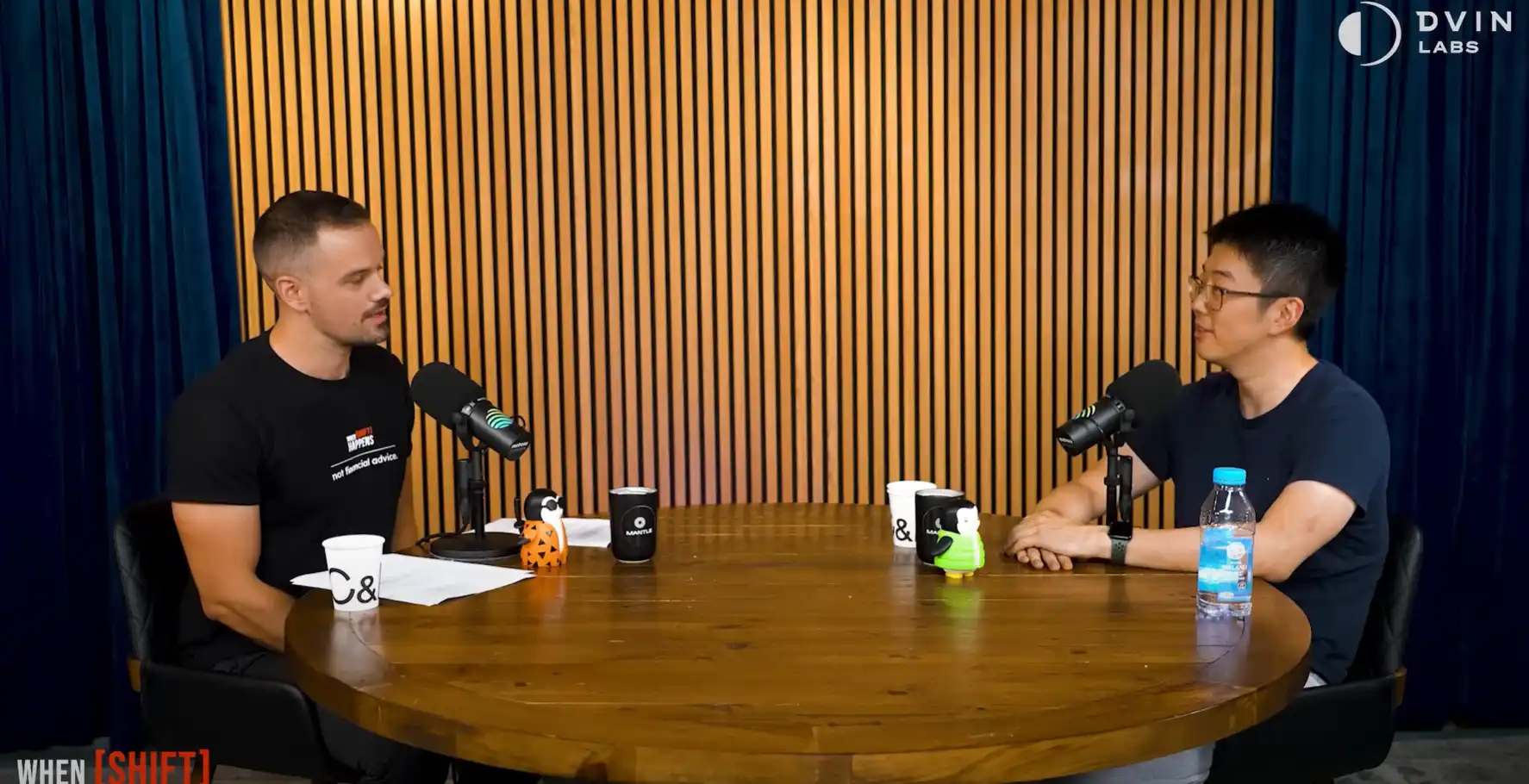
Video Source: "The Secret to Winning in Crypto (from a Top Investor) - Alliance Founding Partner | EP86"
Guest: Qiao Wang, Founding Partner of Alliance DAO
Translation: zhouzhou, Ismay, BlockBeats
Editor's Note: In this podcast, Qiao delves into the essential qualities of great founders and investors, emphasizing the importance of perseverance, unique market insights, and a high level of integrity in the crypto industry. He shares his investment strategy, analyzes the difference between investment and trading, and expresses his optimism about Solana. Additionally, Qiao summarizes the key traits that stand out in the Alliance DAO accelerator.
The following core questions are raised and discussed in this podcast:
- Key qualities of great founders and investors
- Qiao's personal investment strategy
- Predictions for the future crypto market
TL;DR:
Key qualities of great founders and investors: Qiao emphasizes that perseverance, unique market insights, and a high level of integrity are crucial for success. He also points out that autistic traits are advantageous for crypto founders, enabling them to demonstrate independent thinking and focus in complex environments.
Personal investment strategy: Qiao explains his decision to sell Ethereum and favor Solana, believing that Solana has greater potential, and delves into the difference between investment and trading.
Standing out in Alliance DAO: Founders must demonstrate a high level of independent thinking, focus, and problem-solving abilities, particularly valuing those who can reject traditional wisdom and adhere to their own beliefs.
Outlook for the crypto market's future: Qiao mentions his prediction for Bitcoin's price in the next 12 months and states that market sentiment and volatility will be significantly influenced in election years.
Balancing work and health: He shares his views on health and work, believing that while work may bring stress, social interaction is crucial for longevity. Additionally, exercise and sleep are key to maintaining health and working efficiently.
The following is the original dialogue (edited for readability and comprehension):
Personal Experience
Kevin: Do you have any unique childhood stories that explain your success today?
Qiao Wang: I was born into a good family, although not well-off. My parents assured me that they would send me to college, and encountering such a family was the first stroke of luck in my life. The second stroke of luck was meeting my wife, who truly understands and supports me. She has her own career and ambitions but also takes good care of me and our children.
Kevin: Do you think you could have come this far on your own?
Qiao Wang: What really helped me go further were some childhood experiences. Due to financial constraints, I couldn't take on too much risk, although I took on more risk than the average person, such as entering the cryptocurrency field at an early age. But I always wanted to take on more, it's just that the family's financial situation made me have to be cautious.
Kevin: What stopped you? Was it some kind of psychological concern?
Qiao Wang: Yes, I would think, what would my parents do if I started a business right after graduating from college? I couldn't disappoint my parents, so I chose a relatively stable job in the Wall Street finance industry, which paid quite well for my age at that time.
Kevin: What was your job at that time?
Qiao Wang: I did quantitative trading, mainly writing software for low-level distributed systems, which is actually why I later became interested in cryptocurrency. The advantage of quantitative trading is its statistical advantage, so the profits are relatively stable, which allowed me to earn a good amount of money at a very young age.
Kevin: Do you think you owe a lot to your wife for providing you with a lot of support?
Qiao Wang: Yes, especially for her support in both psychological and financial aspects, which allowed me to fully immerse myself in the cryptocurrency field later on, both from an investment and professional perspective. I believe that risk tolerance has two aspects: willingness to take risks and the ability to bear risks. I have always been willing to take risks, but what really gave me the ability to take risks was my wife's support.
Kevin: You mentioned that your work in the finance industry was the opportunity for you to enter the cryptocurrency industry. What initially attracted you to the world of cryptocurrency?
Qiao Wang: What initially attracted me was the volatility of the market. The moment I truly understood the value proposition of cryptocurrency was when I was a trader. At that time, I arbitrated through different gambling platforms and I particularly liked low-risk, high-return trading strategies. It was these experiences that gradually made me realize the importance of cryptocurrency.
Kevin: At that time, you transferred a large sum of money to an offshore platform. What does that have to do with cryptocurrency?
Qiao Wang: At that time, I transferred about $20,000 to several offshore gambling platforms, and the money was stuck in the banking system for a whole six months. This made me realize that I needed Bitcoin. When I finally got the money back, I immediately transferred it to a bank in Japan, which was the bank behind the famous Mt. Gox at that time. After that, the price of Bitcoin started to rise, and for many people, the first "magic moment" was seeing the price rise and their wealth increase.
If I had entered the cryptocurrency field in 2011 or during the peak of the market in 2014, I might have given up for several years. But in 2017, I decided to fully immerse myself in cryptocurrency, which was another peak period. In fact, before 2017, most of my wealth was already in cryptocurrency, but in 2017, I decided to invest my career in it and started working at Messari.
What Kind of Developer Team Can Succeed
Kevin: Last week, Thomas, co-founder of Kamino, mentioned that you were one of their most steadfast supporters when Solana plummeted to $8. How did you know that Solana would rebound when everyone else was feeling low?
Qiao Wang: This reminds me of the Ethereum DAO hack incident in 2016, which led to a split in the Ethereum community, but a small group of developers remained passionate about Ethereum and continued to develop applications on it. This perseverance made me believe that Ethereum would overcome the difficulties. Similarly, after the FTX crash, I saw a small group of Solana developers who were passionate and persistent, which gave me confidence in Solana.
Kevin: As an investor and founder, have there been similar moments that helped you build this belief, allowing you to stick with Solana after the FTX crash?
Qiao Wang: Of course, for example, with Solana, Ethereum, or Bitcoin, you can think of them as a "living organism." As long as the number of people involved reaches a certain "critical mass," it can survive. I also saw a similar situation during the "civil war" of Bitcoin in 2017. In the end, the part of the Bitcoin core community persisted, while other forks, such as Bitcoin Cash or SegWit2x, did not gain enough support.
Kevin: Does this mean that in a bear market, even with only a small number of enthusiastic users, a project can eventually achieve "escape velocity" and succeed?
Qiao Wang: Exactly. In a bear market, even if you only have 50 or 100 users, the support of these loyal users is enough to keep the project going and eventually achieve a breakthrough. Many of the projects we support have also experienced peaks and troughs. But even in the trough, they always have a small group of loyal users who truly like their product. Even if the number of daily active users is declining, perhaps only 10 to 100 users use it every day, these core users drive the team to continuously iterate the product. Eventually, these projects achieve "escape velocity" (i.e., the product achieves massive success).
One successful example is the NFT market "Tensor". In the past one or two years, it only had about 100 to 1000 users, and obviously not everyone was a regular user. As an entrepreneur, if you have a whole year or two without growth, without gaining enough market appeal, what is your instinctive reaction? Is it to give up or to pivot? But in the end, their team persisted in their product and achieved a breakthrough.
Kevin: We often have a bias, thinking that high valuations in the crypto space should be accompanied by a large number of users, because the way this industry is built leads people to make such associations. However, the fact is that even without many users, you can still achieve a breakthrough in the future.
Qiao Wang: In Web 2, when you build a product, people usually tell you that you should achieve 10% or 20% growth every week. But for those truly successful products, their growth curve is very smooth, like gradually increasing exponential growth. In the crypto space, the products that eventually succeed and are loved by people almost never follow this growth trajectory. Their growth trajectory is more like a step function, first growing, then remaining stable for a period of time, then experiencing a burst of explosive growth, and then entering another stable period.
For example, like Coinbase, they always experience significant growth during bull markets, while they basically remain stable, or even decline, during bear markets. Most crypto products that support speculation are like this, and this is determined by the nature of the crypto market. But even those products that are not inherently speculative, like Farcaster, have experienced a similar growth pattern. They had almost no growth for a long time, and then suddenly in December last year, the number of users increased tenfold, from 10,000 daily active users to 100,000.
Kevin: What kind of person do you think is a great crypto investor?
Qiao Wang: To stand out in the primary market, you need to have a natural skepticism about the world, question consensus, and think about which of the things people commonly say are wrong.
Kevin: If a person is naturally optimistic, they might be a better founder, because to be a great founder, you need to have an excessive optimism, even a bit of delusional confidence. To be a great investor, you might need to be skeptical of everything, even a bit cynical. How do you think these two should be balanced?
Qiao Wang: Optimism and questioning consensus or independent thinking are two independent concepts. In fact, some of the most outstanding founders I have worked with are very contrarian thinkers, and they also question consensus. Because the essence of entrepreneurship is to discover an insight into the market or users, something that others do not understand. The first step in entrepreneurship is to understand what others do not understand. Therefore, the best founders and the best investors both possess the trait of contrarian thinking.
Kevin: Naval believes that in this era of unlimited leverage, judgment is the most important, he refers to judgment as similar to wisdom, being able to foresee the long-term consequences of your actions. How do you cultivate this kind of judgment?
Qiao Wang: By taking practical action. As a trader, I learned from the "lessons" of the market. You have to lose money first to learn how to make the right judgments. If you never take action, that is, if investors never truly "get into the game," then you will never learn. The best way to learn is twofold: one is active humility, and the other is forced humility. You have to take action to improve your judgment.
Personal Investment Strategy
Kevin: So do you lean more towards investing or trading?
Qiao Wang: Both can work, the key is to find the way you are good at.
Kevin: What are the key skills needed for short-term trading and long-term investing respectively?
Qiao Wang: The core of both is questioning consensus. At the same time, trading is essentially studying history, you have to analyze past patterns and find patterns that are statistically effective. The advantage of short-term trading is that you can quickly get feedback from the market. If you trade 10 times a day, you will have 300 trading samples in a month, and then you can evaluate whether your strategy is effective. Long-term investing, on the other hand, is difficult to get quick feedback, it may take several years to know if your investment is successful.
Many people think that Buffett and Charlie Munger are value investors, but in fact, their strategy has evolved over the past 90 years. Buffett initially focused on companies with low P/E ratios and low P/B ratios, looking for undervalued companies. After meeting Munger, his investment philosophy changed. Munger believed that it is much better to invest in a great company at a reasonable price than in an ordinary company at a low price, which is more like growth investing rather than traditional value investing. In the crypto space, I think this approach is also applicable, you should focus on protocols or tokens that grow over time, whether it's on-chain transaction volume, total value locked (TVL), or market attention.
Kevin: Do you think this growth investment strategy is more suitable for the crypto space?
Qiao Wang: Yes, especially in the crypto market, growth not only means financial growth, but also narrative changes and increased market attention. Even if a project is not making much money now, if it already has enough market attention and may receive more attention in the future, then it is a project worth investing in. So where will money ultimately flow? It is likely to flow to the places that attract the most attention, rather than the places that are judged to be good businesses based on rational analysis.
For example, Lido, many people think that it should perform very well, but in reality, it hasn't. This idea is actually very simple, basically people invest their money in the places that excite them about the future, not necessarily the companies that are currently performing the best.
The reason I had confidence in Solana at its lowest point was because I personally tried these products. I started using Solana's products in 2021, and I used them for over a year until the FTX crash. At that time, these products were still rough, but you know, you can execute trades in about 100 milliseconds, very smoothly, and the fees are very low. You can feel that the products in the Solana ecosystem are no longer limited by the blockchain.
We often say, why do you have an iPhone but not Apple stock? We always think we are looking for future products, future technologies. The same applies to investing, ask yourself, "What do I like?" The answer is actually right in front of you. I really like DeFi because you can experience these products firsthand. I think, in the entire crypto space, there are two truly magical moments. The first is the experience of sending a Bitcoin transaction for the first time. The second is DeFi, because you are not just making payments, but you can engage in two-way transactions.
Kevin: How do you deal with market cycles?
Qiao Wang: Most of the assets in my investment portfolio are Bitcoin, Ethereum, Solana, and Coinbase stock. Occasionally, I do some short-term trading, by short-term, I mean timeframes of a few months, similar to narrative-driven trading, rather than holding for the medium to long term. So I bought into certain assets very early, which most people probably know, that was my short-term trading.
Kevin: What about the long term?
Qiao Wang: In the long term, I looked at the top 300 tokens, focusing on their supply and market cap's excess supply, where excess supply is the proportion of unlocked tokens, which is a very important factor. I also look at whether these projects have real appeal and a user base, and ultimately, I think the tokens that meet these criteria are Bitcoin, Ethereum, Solana, and certain stablecoins.
Kevin: How do you allocate among these four assets?
Qiao Wang: I lean more towards Bitcoin and Solana, I think Ethereum is relatively overvalued. And from the unique data I have, more and more founders and entrepreneurs are choosing Solana over Ethereum. In terms of developer activity, Solana has more potential. Therefore, I have a larger allocation to Solana than Ethereum. As for Bitcoin, it is a pure PMF—it is the best store of value, an unconfiscatable store of value, and there is currently no project that can challenge it.
Kevin: Do you adjust your investment strategy based on market cycles? Or do you stick to core positions, such as those four major tokens, because you believe you cannot outperform the market through short-term strategies, and therefore decide to hold these tokens for the long term?
Qiao Wang: I do try to play with market cycles, but it's really difficult. I tweeted about my experiences in previous cycles. In the first cycle, I held onto Bitcoin all the way until it dropped by 80%. In the second cycle, because of the "trauma response" from the previous experience, I sold at around 40%-50% off the peak, which was in 2017. In the third cycle, I sold at around 30% off the peak. So I did slightly better in each cycle, but you can never sell at the absolute top. However, in the previous cycle, I almost bought in near the bottom.
So, I have indeed gotten better over time, but it took about 15 years. Even if I try to play the cycles, I won't sell all my assets, and I won't go all-in at the bottom. I might sell 20% to 30% of my holdings at the market top, and then double down at the market bottom. The reason for doing this is that if I make a wrong judgment at the top, the opportunity cost of the loss will be greater.
Kevin: As a cryptocurrency investor, what stages do typical investors go through?
Qiao Wang: Typically, when experiencing market cycles for the first time, you will hold onto your assets all the way until their value almost goes to zero. For example, in my first experience, Bitcoin dropped by 80%. But at that time, I was lucky to only hold Bitcoin.
Kevin: It sounds like you made the right choice, at least not going "all in" on other tokens, but focusing on Bitcoin and Ethereum?
Qiao Wang: Yes, in the first cycle, I only held Bitcoin because I didn't know much about other tokens at the time. Later in the second cycle, I started buying some altcoins, but even then, I still knew that the only valuable ones were Bitcoin and Ethereum. So when I decided to sell at the top, I got rid of those altcoins and switched to Ethereum.
Kevin: Some people believe that they can outperform Bitcoin and Ethereum by investing in small-cap tokens, but how difficult is this in reality?
Qiao Wang: Every cycle is different. In the previous cycle (2021), it was indeed easy to outperform Bitcoin and Ethereum because it was the biggest asset bubble in all markets. But in this cycle, the situation is completely different. I think from now on, it will be very difficult to outperform Bitcoin, Solana, and Coinbase stock, unless there is another currency or fiscal stimulus similar to what happened before.
How do you view altcoins and memes?
Kevin: Will the "altcoin season" you mentioned still occur?
Qiao Wang: There used to be altcoin seasons, but this time it might be different. The two conditions for an altcoin season are: 1. a small number of tokens; 2. a large amount of capital flowing into the market. But the current situation is that there are too many tokens, with thousands of tokens being created every day, and there is not enough capital entering the market. Therefore, it may not see a large-scale surge in altcoins like before.
Kevin: What is your view on memes? Will they continue to exist in the future?
Qiao Wang: I don't think memes are just a cyclical phenomenon; I think they will continue to exist. However, the key to survival in this market lies in the virality of memes and the presence of leaders. Take WIF for example, its innovation lies in the "hat" meme, which can be added to any other meme or avatar, leading to viral spread. But for long-term survival, support from CEXs like Binance is also needed.
Kevin: Do you still hold WIF?
Qiao Wang: In terms of risk-adjusted returns, I'm not sure if it will outperform Solana. I now compare everything to Solana. If the total market capitalization of the entire cryptocurrency market continues to rise, WIF may rise along with Solana, or even perform better. But if the market conditions deteriorate, the risk of meme coins will be higher than mainstream tokens, so I tend to maintain a relatively conservative investment strategy.
Kevin: As an investor in Alliance, how do you view Pudgy Penguins?
Qiao Wang: Pudgy Penguins and the NFT community have a very unusual model, they are not traditional businesses. They start by building a community, attracting users, and then launching products, such as toys and games. This model is very unconventional, but it is becoming more and more common today.
Kevin: Do you own Pudgy Penguins NFTs?
Qiao Wang: I used to, but I sold them later because the price dropped. As an investor, I consider whether these NFTs can outperform Solana.
Kevin: What is your view on NFTs as an investment category?
Qiao Wang: The issue with NFTs is that their non-fungible nature and high entry prices make it very difficult to attract new capital, so it's also difficult to outperform other assets.
Kevin: So in this situation, market liquidity is a key factor, right? There are already many tokens, meme coins, and a large number of NFTs in the market, and people need to make choices among these options.
Qiao Wang: Yes, that's absolutely correct.
Kevin: If your goal is to outperform Solana, why do you still hold Ethereum?
Qiao Wang: For me, holding Ethereum is not for financial reasons. I feel some emotional connection to Ethereum, after all, I have been involved in the early development of Ethereum since 2014. It feels really bad to completely abandon a project that I have been involved in from the beginning. For me, Ethereum is like an NFT community, full of emotional connections.
Investing in Pump.Fun due to autism?
Kevin: What did you see in Pump.Fun, one of the most successful protocols today (in terms of revenue and market share), that others did not notice when deciding to invest?
Qiao Wang: When the team first joined our accelerator, they were not building Pump.Fun at the time, they were working on other products, but those products were not successful. In fact, they pivoted at least twice before coming up with the idea for Pump.Fun.
So, in early-stage investments, especially in consumer-facing products, you are almost always betting on the founder, not the idea. I saw that the founder had a high degree of autism tendency. This is not a coincidence; to be a great founder of a consumer-facing product, you really need a certain degree of autism tendency.
I think this is a cause-and-effect relationship, not just a simple correlation. These people with artistic talent can think independently and often go against the consensus. They are not distracted by the consensus on the internet or other people's opinions, and can observe with a calm mind.
Kevin: Do you think you have a certain degree of autism traits?
Qiao Wang: I think I might have some.
As an investor, for consumer-facing products, autism has almost become a "necessary condition" for me to select founders. The founders I value often have a certain degree of autism traits, and preferably some childhood trauma, although they usually won't tell you about these in the first two meetings.
Kevin: So autism plus childhood trauma is the "alpha" factor for success, right?
Qiao Wang: That's right, to be a successful founder, you need two things: thinking and action. Autism is the source of thinking, and action comes from trauma, because you have something to prove.
Kevin: What is Alliance DAO?
Qiao Wang: We invest in founders who have a high degree of autism traits and may have childhood trauma.
Kevin: Why did you create Alliance DAO?
Qiao Wang: After leaving Messari, I realized that I really enjoy the process of starting from 0 to 1 in entrepreneurship, but I don't like the expansion stage from 1 to 10. 0 to 1 is about discovering user needs and trying various methods to solve problems. I thought, how can I experience this 0 to 1 process 50 times in a year? So, I decided to create an accelerator.
Kevin: Do you use hackathons to find more founders with autism traits?
Qiao Wang: Yes, we hope to invite any founders who have created great things in the crypto field to be judges.
Conditions for Excellent Founders
Kevin: As a founder in the crypto field, how can you increase your chances of survival in a bear market?
Qiao Wang: The simplest way is if you don't have any skills in other industries and can't switch careers. This is actually the true story of many crypto founders; they don't understand any other industry. In the last bear market, many founders switched to the AI field, and these people are very smart, able to become experts in a new field in a short time.
Kevin: As an investor, do you prefer founders who can quickly switch from one industry to another, or those who focus on the crypto field?
Qiao Wang: It depends on the specific situation.
Kevin: Another key factor for success is having a co-founder. How do you find a good co-founder?
Qiao Wang: Statistically, the most ideal co-founder configuration is two people who have worked closely together in the past, either in a job or on a project. The second ideal configuration is two friends who, although they have not worked together, trust each other and understand each other's strengths and weaknesses. The worst configuration is someone you just met, or a stranger you found through an online co-founder matching platform.
Kevin: You mentioned trust, which is one of the most important factors in a co-founder relationship. What do you think is the second most important?
Qiao Wang: The second most important factor is complementary skills. If two founders have different key skills, it greatly increases the team's chances of success.
Kevin: I've learned a lesson that in the early stages of entrepreneurship, founders often don't know what game they are playing because they are not familiar with the industry. It's only when you delve deeper that you begin to understand the rules of the game, and then you can define which skills are necessary.
Qiao Wang: This is indeed part of the entrepreneurial process, learning through trial and error.
Kevin: You also mentioned integrity, and Warren Buffett and Naval have said that when choosing who to work with, look for people with high intelligence, high energy, and high integrity. Why do you think integrity is the most important quality that world-class founders must possess?
Qiao Wang: Integrity is like a multiplier, it's either a positive 1 or a negative 1. Intelligence and work ethic are absolute values, the higher the better, but if you lack integrity, this multiplier becomes a negative 1. Even if you are very smart and hardworking, if you lack integrity, your final result will be negative. That's why people like SBF fail; he is very smart and hardworking, but lacks integrity, ultimately destroying himself and those around him.
Kevin: Where do you think this "negative integrity" comes from?
Qiao Wang: People change, especially when they become rich quickly, money will change you.
Kevin: How do you quickly discover if someone's integrity is questionable?
Qiao Wang: It's difficult. I'm still trying to design some questions for our accelerator application to help identify people with low integrity. But to be honest, it's easy for liars to slip through. So we usually screen out those who are not so speculative, avoiding those who are purely opportunistic in pursuit of high valuations.
Kevin: Many people would say that money and fame are not good reasons for entrepreneurship. What do you think about this?
Qiao Wang: I have seen many successful founders who wouldn't tell you they are in it for the money in the early stages. But over time, they start to admit that they do want to make money through entrepreneurship, and I actually prefer this honesty.
Elections will Stimulate Crypto Market Fatigue
Kevin: You previously tweeted that the longer the Bitcoin price stagnates, the stronger the fatigue of crypto developers and investors. What do you think this reflects?
Qiao Wang: The meaning of that tweet is that people will feel something regardless of whether the price goes up or down. Even if the price drops, people still feel alive. But when the price stagnates for a long time, everyone will feel fatigued. I can feel this; for example, at the end of last year when the price rose, people felt good and energetic. Now when I talk to the same people, they complain that the crypto industry has not made any substantial contributions to society, saying they want to quit, and so on.
Kevin: How do you communicate with these people?
Qiao Wang: I tell them the price will rise after the December elections.
Kevin: Do you believe this statement?
Qiao Wang: I think the elections will indeed cause some fluctuations. Trump's re-election may be beneficial for both the short and long term of cryptocurrencies. On election night, the price may fluctuate by about 5% based on the results.
Kevin: If Trump is not re-elected, will the price drop?
Qiao Wang: It might, but even if the price drops, people will still feel the vitality of the market.
Focus is a Superpower
Kevin: You once wrote a tweet unrelated to crypto: "It's not difficult to be excellent nowadays, because most people are very fragile." Can you elaborate on this?
Qiao Wang: I think most people are psychologically and physically fragile. Psychologically, most people lack the ability to think independently; they are always seeking conformity rather than pursuing the truth, and the rise of social media and smartphones has exacerbated this phenomenon. Since 2012, cases of ADHD, suicide, depression, and anxiety have increased significantly.
Kevin: I have also been affected by ADHD, and social media has had a big impact on me. I've talked to Blockchain.com founder Nicola Kerry before, and he said he can't even concentrate enough to read an article now.
Qiao Wang: Being able to focus for a long time has become a "superpower". In the past, most people could focus for at least 45 minutes, but now most people can't even do that.
Kevin: How do you maintain focus?
Qiao Wang: I actively limit my time on TikTok. I don't use Instagram, Facebook, or Snapchat; the only social media I use is Twitter. Even so, Twitter is also very addictive.
Kevin: What do you watch on TikTok?
Qiao Wang: I like to watch soccer, especially videos of Cristiano Ronaldo and Lionel Messi. TikTok's algorithm is very smart; after watching a few videos, it completely understands what you want to see.
Kevin: You mentioned that people in the crypto field are interested in longevity; can you elaborate on this?
Qiao Wang: Actually, at that time I was joking, but indeed many people in the crypto field are very interested in "longevity". I think outside of cryptocurrency, longevity is the field that overlaps the most with the crypto community. You won't see many crypto professionals interested in nuclear energy, climate change, or space exploration, but almost all of them are interested in health and longevity.
Kevin: But we can also criticize this trend. I've talked to some crypto OGs, and although they talk about "longevity", in reality, they don't even go to the gym. Ultimately, "longevity" is not just about living longer, it should also be about living better, right?
Qiao Wang: That's right, the definition of longevity is not just about living longer, but also includes healthy life expectancy. In other words, it's not just about increasing the length of life, but also about improving the quality of life.
Kevin: But this is not a coincidence; if there really was a magical pill that you could take to live forever without needing to go to the gym, everyone would definitely choose that pill.
Qiao Wang: But we don't have that kind of medicine yet; it's scientifically clear that the best "medicine" we currently have is to go to the gym and exercise.
Kevin: That's right, my view on longevity is, first, I need enough sleep, eat clean and healthy, and going to the gym is a must.
Qiao Wang: For me, the most important things are in this order: first, sleep; second, going to the gym; then work, and finally, healthy eating.
Kevin: So, where does work rank on the "list" for longevity?
Qiao Wang: Work is also important for longevity. Although work can bring some stress and reduce lifespan, it also has some positive effects, such as giving you the opportunity to interact with interesting people. Social interaction is a key factor for longevity, so it's a balance. However, I can say these things because I fully focused on work in my early 20s, and I don't regret it.
Kevin: How was your health in your early 20s?
Qiao Wang: At that time, I was very unhealthy. I don't know if you know that ferritin is a marker of inflammation; my ferritin level reached 1400, while the normal level for men is around 200. Even 200 is not the optimal level; the optimal level is between 70 and 100. People with ferritin levels over 1000 are usually those with cancer or severe inflammation. My body was almost entirely inflamed at that time, and I even suspected I had cancer at one point. In my late 20s, the situation was really bad. Today, my cardiorespiratory function is much better than when I was in my early 20s.
Kevin: Have you done any groundbreaking work in the health and longevity field?
Qiao Wang: I occasionally make some angel investments, but not too many.
Kevin: Do you have any beliefs that most people would not agree with?
Qiao Wang: I do have some ideas that most people may not agree with in public, but they might agree with me in private. I think the current political situation is very absurd, especially in recent years, so-called "modern liberals" have had a negative impact on society.
Kevin: Can you elaborate on that?
Qiao Wang: I think Harris is a Marxist; the first specific policy she announced was rent control, which is simply a display of financial illiteracy. I believe many people would agree with my point of view in private, but in public, they might stand with her because of her identity - as a woman and a minority. This is something I believe is harmful to society; many of the ideologies of modern leftists, in my opinion, are more like a religious belief, very absurd.
Kevin: The Democratic Party has actually put forward someone who is ignorant in economics, and she might become president. Where do you think the system went wrong, leading to no better choices?
Qiao Wang: Lately, I often hear people say they are going to vote for Trump because he is "not so bad," but there are actually better choices. The problem is, people's reason for voting is because he is "not so bad," which indicates that there may be some deeper issues behind one of the most important positions in the world, the President of the United States.
Kevin: So, what is your biggest prediction for the next 12 months?
Qiao Wang: The price of Bitcoin will rise, and the increase will be significant.
Kevin: How much do you think it will rise to?
Qiao Wang: $100,000.
Kevin: Where do you think the peak of this cycle for Bitcoin will be?
Qiao Wang: I'm not sure; the range is quite wide.
Kevin: What is the range of your prediction?
Qiao Wang: Between $100,000 and $420,069, because we might be living in a simulated world. The endpoint of the last cycle was $69,420, so if the next one can reach $420,069, that would be perfect.
免责声明:本文章仅代表作者个人观点,不代表本平台的立场和观点。本文章仅供信息分享,不构成对任何人的任何投资建议。用户与作者之间的任何争议,与本平台无关。如网页中刊载的文章或图片涉及侵权,请提供相关的权利证明和身份证明发送邮件到support@aicoin.com,本平台相关工作人员将会进行核查。


