Strive for a 2-4x return and exit quickly.
Author: INSIGHTFUL
Translator: DeepTechFlow
Preface
In this bull market, meme tokens continue to attract a lot of attention, with retail investors seeing this as their only chance for success in this cycle. Despite the potential for huge returns, the corresponding risks cannot be ignored.
This article aims to help you formulate trading rules and profit strategies to increase the likelihood of profit, rather than completely giving back all the paper gains and expecting the next 100x return.
Reasons for the popularity of meme tokens
Meme is the most authentic and straightforward representation in the cryptocurrency world. Traditionally, meme tokens are closely associated with retail traders, but this cycle has not seen a full return of retail traders. Nevertheless, meme tokens have garnered more attention in the early stages of this cycle than before.
Currently, the market is dominated by experienced crypto traders, many of whom are in their second or subsequent cycles. Current market participants typically:
Focus on maximizing profits.
Realize that over 90% of "fundamental" projects are actually memes, lacking real value and destined to fail.
We have seen many examples that demonstrate:
The significant wealth creation potential of memes.
Examples of multiple billion-dollar, venture-backed "fundamental" projects slowly declining due to long unlocking periods.
Given these factors, it is understandable that many people tend to choose memes. They have proven to be powerful wealth creators and do not require the false cloak of "innovative technology."
The strong rebound of PEPE and WIF after the May 2020 pullback highlights the change in perception of memes in this cycle. Unlike in the past, the strength of memes in the past usually signaled market tops and high trader confidence, but today's memes show resilience in overall market pullbacks and periods of low confidence.
Meme tokens with large market capitalization, such as $PEPE and $WIF, have almost become a safe haven for users in uncertain times. The super cycle of memes has clearly begun.
Risk management: Position size relative to the investment portfolio
We divide it into the following four categories:
4 digits (1,000 to 9,000)
5 digits (10,000 to 100,000)
6 digits (100,000 to 900,000)
7 digits (1,000,000 to 9,000,000)
Trading with a portfolio of less than 4 digits
The question for a million-dollar problem is: "I have little capital, how can I succeed in shitcoin/Memecoin?"
The honest answer is that the opportunity is very small, especially for beginners. However, here are some guiding principles to increase your chances of success:
Firm investment: Allocate a large portion of the portfolio to investments with strong beliefs and reasonable reasons.
Quick exit: Strive for a 2-4x return and exit quickly. Avoid holding on for too long when most of the investment is concentrated in one investment.
Selective investment: Focus on logic and rationality, not charts and candlesticks. Allocate 20-25% of funds to an investment, taking enough risk to potentially move on from this stage.
Bull market opportunities: In a strong bull market with high risk appetite, narratives can provide momentum for successful investments.
Step one: Accept reality
Understand that it is not possible to succeed overnight with small amounts of capital like $100. Do not rely solely on cryptocurrencies to cover living expenses. Treat cryptocurrencies as a secret project, a skill you master behind the scenes.
Step two: Master a specific area
With limited capital, focus on improving trading skills rather than just making money. Accumulate capital until you can identify opportunities proficiently. Choose a niche (such as swing trading, small market cap, mid-market cap, large market cap) and study it in depth. Practice through simulated trading and accumulate capital through Web3 side jobs (such as web development, community management, or graphic design).
Step three: Start trading with savings capital
Once you are confident in your trading skills and have accumulated some capital, start investing slowly. On Ethereum, if you can accurately identify opportunities, one ETH is enough. Be selective in trading, strictly aim for profits, and stop losses quickly.
Step four: Long-term investment
After building a stable investment portfolio, allocate a significant portion of the funds to long-term promising projects. Hold onto the project until your belief weakens. Even a 3-5x return on a significant portion of the investment portfolio is very substantial. While small investments in high-risk projects may bring large returns, the goal is to follow rational principles.
Trading with a portfolio of less than 5 digits
If you have a low five-digit capital, follow the same strategy as a portfolio with less than four digits, but reduce the position size for each trade to 10-15%. Be extremely selective. With this capital, you can comfortably engage in chart trading, buying at support levels and selling at resistance levels for major upward-trending coins. As you approach a high five-digit capital, focus more on chart trading and closely monitor trading volume.
Trading with a portfolio of less than 6 digits
Maintaining and expanding a six-digit investment portfolio is challenging. Your goal is to protect profits and deploy capital in valuable opportunities. The journey to seven digits will be slow and requires a commitment to the long-term process. If you can get in early, consider investing in new major upward-trending coins. Compare the number of holders/market cap with coins that have recently performed well and see if most people on Twitter are already paying attention to it.
Risk management: How to manage trading risks
- Set stop-loss conditions for each trade:
Identify and mark major support levels on the chart. If the price touches these levels, stop the loss promptly and move on.
Avoid assets depreciating to zero. If the trade does not meet expectations, exit promptly.
Invalid conditions may occur for various reasons, such as slowing trading volume, loss of major support levels, or reasonable FUD.
- Plan exits in advance:
Before entering a trade, determine in advance where you will exit if the trade does not go as planned.
Based on your goals and risk tolerance, consider setting stop losses for old coins. For new and highly volatile coins, you can adopt a "10x or bust" strategy.
- Monitor hype and sentiment:
For meme tokens, pay attention to hype and market sentiment on Telegram and Twitter.
Evaluate overall market sentiment, especially focusing on major coins and their derivatives. If major coins decline, related coins may decline even more sharply.
- Evaluate utility coins:
For utility coins, monitor the dynamics of the development team to ensure they continue to release updates.
Look for upcoming catalysts that the market has not yet priced in.
Examples of poor risk management:
- Holding assets without taking profits in a timely manner, resulting in a huge paper gain turning into a loss.
Here are some specific examples:
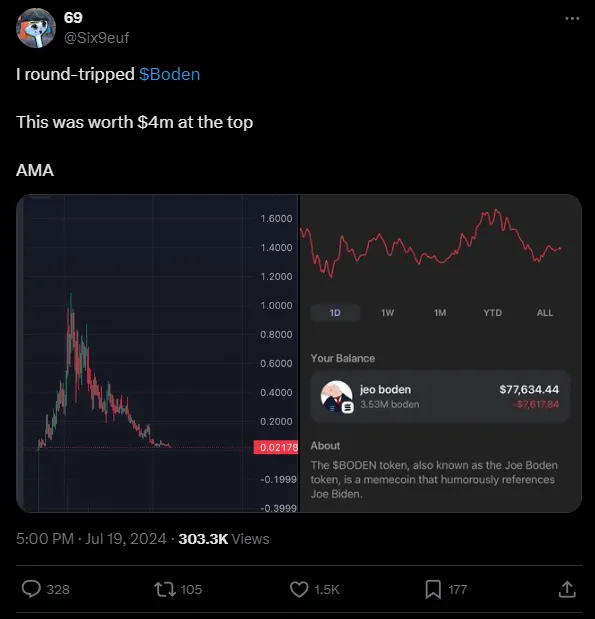
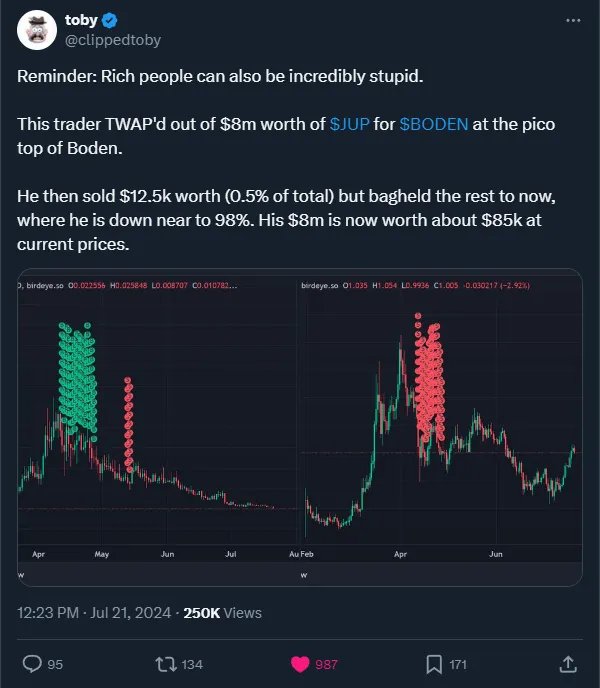
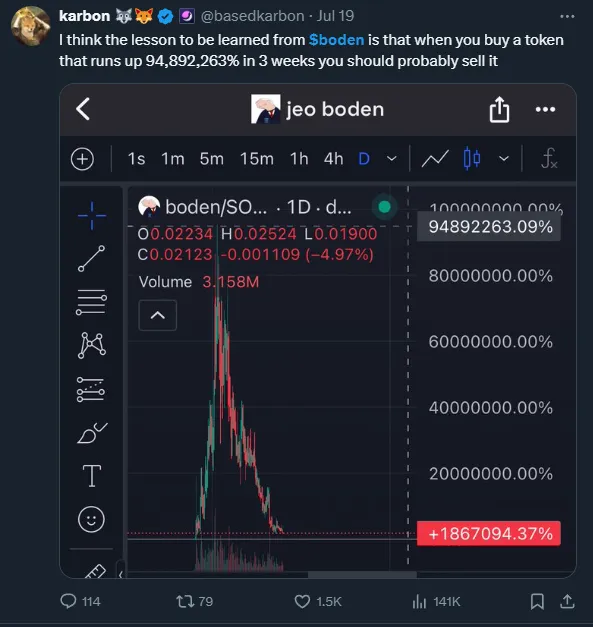
Taking a step back can help you gain a more comprehensive perspective.
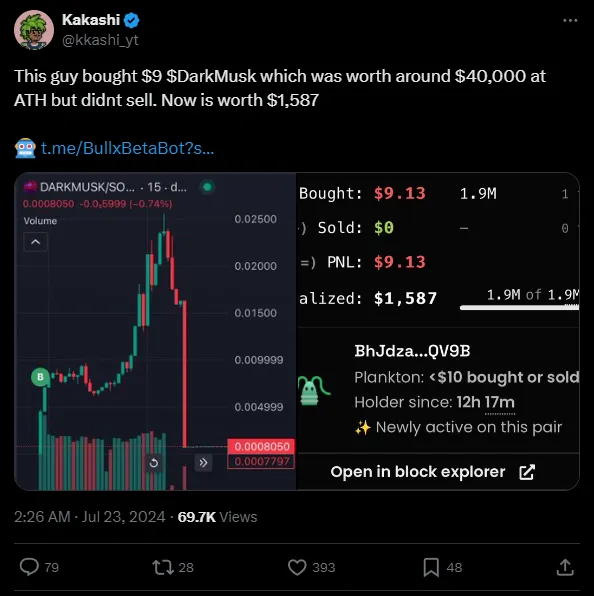
Turned $9 into $40,000 and then fell back to around $1,600.
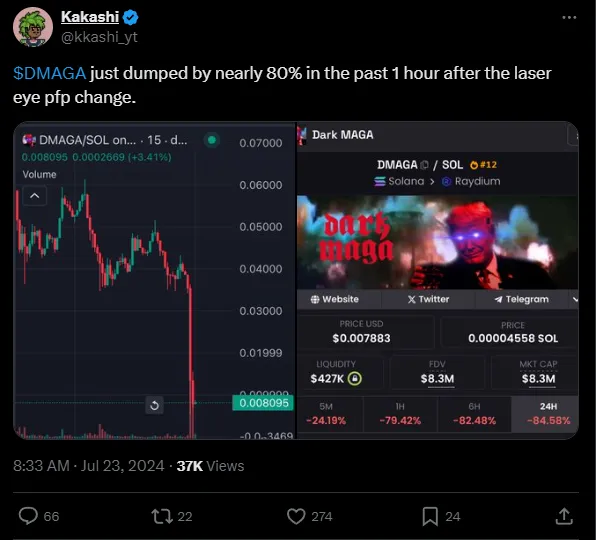
Elon Musk temporarily changed his Twitter avatar to a laser eye. While this was a powerful catalyst, the price quickly dropped when he changed his avatar again. Things change very quickly, and if you haven't taken profits in advance, you can't hedge at the best time.
Psychological framework and self-questioning
- Reduce risk during price volatility:
Take profits promptly during significant price fluctuations to reduce overall risk.
Ask yourself if the people talking about the coin are known for pumping and dumping.
- Identify reasons for the coin's rise:
Identify the reasons for the coin's rise. Is it purely speculative, or is it related to developers of previously successful projects?
Recognize that peaks are often marked by widespread hype from influencers or significant events (such as listing on Binance).
If you feel excited and start taking screenshots, that may be a signal to sell.
- Profit gradually:
Regularly taking profits is crucial. What matters is the actual profits you retain, not just the paper gains.
Example strategy: Sell 25% at a 3-4x return to cover the initial cost, then sell another 25% at each 2-3x return.
Retain 10-20% as a "moon bag" to maintain investment and avoid regrets after selling.
Useful principles
- Learn from mistakes:
First-hand experience is the best teacher in trading. The lessons learned from losses are invaluable.
Advice about taking profits or checking contract addresses may not fully resonate until you make a mistake.
The pain from mistakes will serve as a powerful warning in the future.
- Value in simplicity:
Simple things are often overlooked because they seem not complex enough.
Observe the largest fluctuations during market rebounds to understand the most attention-grabbing direction.
For example, dollar-cost averaging into the excellent performing $MOG in June and July 2024 showed consistent outstanding performance.
Identify holdings that are underperforming during market rebounds to adjust your focus.
- Avoid overtrading:
Overtrading will slowly deplete your investment portfolio. Frequent position changes will reduce clarity of thought.
Maintain discipline: do research, build conviction, choose positions, and stick to them.
- Learn to love selling:
Selling is psychologically harder than buying because you fear missing out on huge gains.
Consistent profits are often more rewarding than expecting unlikely returns.
Every day you hold a position, you are actually choosing it over other potential opportunities.
- Stable profits are better than big wins:
Pursue multiple 3-5x returns rather than expecting a 100x return.
Scenario #1: Holding out for 10-100x returns often leads to missing out on smaller but more stable profits.
Scenario #2: Consistent 3-5x returns can significantly compound over time.
- Avoid re-entering profitable trades:
After achieving a 2-4x return, close the position and consider re-entering after a pullback.
The excitement of victory can lead to overconfidence and positive bias, increasing the risk of losses.
Removing the trade from the watchlist after closing it can help avoid emotional re-entry.
- Be cautious of trusting your emotions:
In cryptocurrency, the right decisions often feel wrong. Selling during hype or buying during a pullback may be contrarian but can be profitable.
Recognize that emotions like excitement and fear can mislead you, so decisions should be based on rational analysis.
免责声明:本文章仅代表作者个人观点,不代表本平台的立场和观点。本文章仅供信息分享,不构成对任何人的任何投资建议。用户与作者之间的任何争议,与本平台无关。如网页中刊载的文章或图片涉及侵权,请提供相关的权利证明和身份证明发送邮件到support@aicoin.com,本平台相关工作人员将会进行核查。


