Original Title: "Review: museums of the future, Dubai and Tokyo"
Written by: Vitalik Buterin
Translation: Mars Finance, Eason
In the past year, I have had the privilege of visiting the Museum of the Future in Dubai and recently visited the National Museum of Emerging Science and Innovation in Tokyo (referred to as "Miraikan" in Japanese, which translates to "Future Museum"). Both of these museums were highly recommended by my close friends and collaborators, and I believe they are both attempting to address a crucial issue: having concrete and positive imaginations about the technologically advanced future, rather than just the 3478th "Black Mirror"-style Hollywood dystopia.
What shocked me the most when visiting these two museums was how different their visions were. They are by no means contradictory: there is no logical impossibility between the specific technologies and structures envisioned by the futurists in Dubai and Tokyo, nor is there such a strong contradiction. However, at the same time, they feel very different and prioritize very different directions. This naturally raises a question: what can we learn from and appreciate in each, and is there a synthesis between the two?
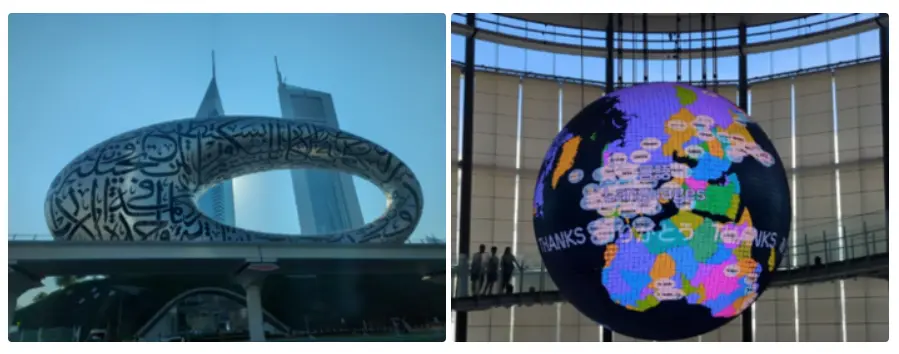
Left Image: Exterior of the Museum of the Future in Dubai. Right Image: A giant sphere inside Miraikan in Tokyo, displaying the world's major languages.
What I Liked About the Museum of the Future in Dubai
When you begin your visit to the Museum of the Future, the first thing you encounter is a simulated space elevator that takes you from the Earth's surface in 2064 to a space station in geostationary orbit. You can see information screens and panels that show you all the space stations around the solar system, on planets, around planets, and at Lagrange points.
After that, you will see various exhibits in other scientific and technological fields. One major theme is meditation, health, and healthcare, showcasing infrastructure that makes it easier for people to enter altered mental states. What impressed me the most was the biotechnology section, which presented a vision of enhancing the resilience of the biosphere through genetic engineering, enabling plants and animals to thrive in more diverse environments.
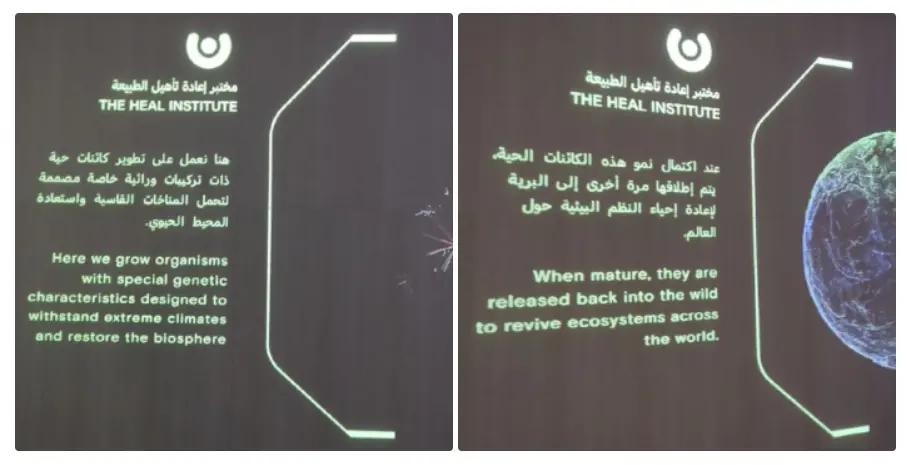
It's worth, um… pausing to think about this scene. This is very different from the Western traditional environmentalist mindset. In the West, nature is the Garden of Eden, originally beautiful and pristine, now corroded by industrial technology. The primary moral imperative is preservation, reducing the harm we would naturally cause. In Dubai, the situation is the opposite. The default state of nature, at least as they are used to it, is a barren wasteland. Human ingenuity and artifice can not only mitigate the harm caused by other human ingenuity and artifice, it can actually go further and improve the environment beyond what it was when we started.
Miraikan has nothing quite like this. There is an exhibit addressing significant environmental issues facing the Earth, but its tone is much more traditional: these are problems caused by humans, and we need to be mindful and find ways to reduce our footprint. There are multiple exhibits addressing improving the lives of those with poor vision or hearing (or none at all). But the solutions they propose are mostly adjustments, attempting to make the world more gentle and friendly to those with these conditions: guiding people with robots, writing business cards in braille, and so on. These are genuinely valuable things that can improve the lives of many people. But they are not the things I would expect to see in a future museum in 2024: solutions that truly restore sight and hearing, such as optic nerve regeneration and brain-machine interfaces.
The way Dubai addresses these issues deeply resonated with me, while Tokyo's approach did not. I don't want the future to be 1.2 times better than the present, I don't want to live 70 years of comfortable life, I want it to be 10,000 times better. I believe in the Nietzscheanism that Scott Alexander describes in his recent blog post, warning against making the primary goals of life "I don't want to make anyone angry" and "I want to take up less space," and that these goals are best achieved by being dead rather than alive. If I were to become frail and sick for medical reasons, living in an environment that makes me comfortable despite these disadvantages would certainly be an improvement. But what I truly want is technology to fix me and make me strong again.
Nevertheless, the Museum of the Future in Dubai also has some things that feel lacking and limiting, and Miraikan does a good job of addressing these shortcomings. So now it's time to shift the focus and talk about what I think makes Miraikan great.
What I Liked About Miraikan in Tokyo
Upon entering Miraikan for the first time, the first exhibit is about the Earth's crises: global warming, and various environmental issues related to excessive pollution or low basic resource quantities. Following that, you will see various art forms that heavily utilize artificial intelligence, mimicking various patterns we see in the natural world. Then, a giant sphere repeatedly plays a short informational video called "Entering the Diverse World," showcasing various statistical data about different regions of the world and how people live in those regions. After that, there is a hands-on exhibit demonstrating the inner workings of basic low-level internet protocols.
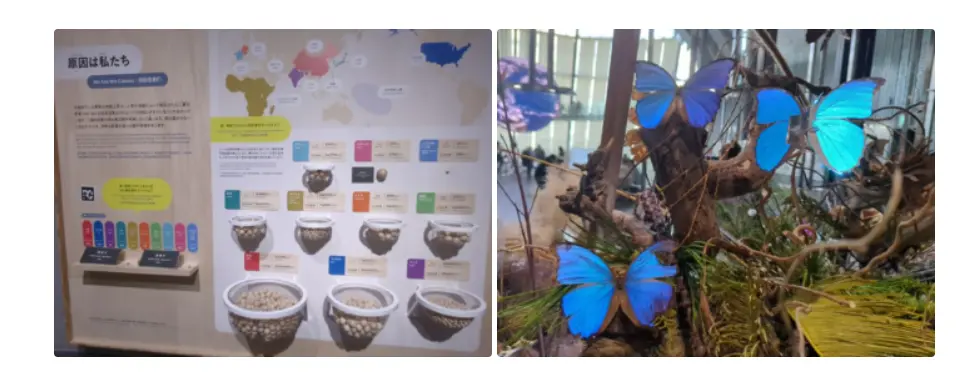
Left Image: Chart showing different countries' contributions to global carbon dioxide emissions. Right Image: Replicas of natural butterflies and robotic replicas of butterflies.
What particularly impressed me about these exhibits is the way they invite active learning and engagement. All the informational exhibits strive to present information in a practical way that makes it easier for people to understand the important details and consequences of each issue. The section on overfishing includes a complaint: "I like sushi… but we might not be able to eat sushi casually in the future, right?". At least two exhibits end with interactive sections that pose questions related to the content and invite people to provide their own answers. The exhibit on addressing Earth's resource issues takes the form of a game.
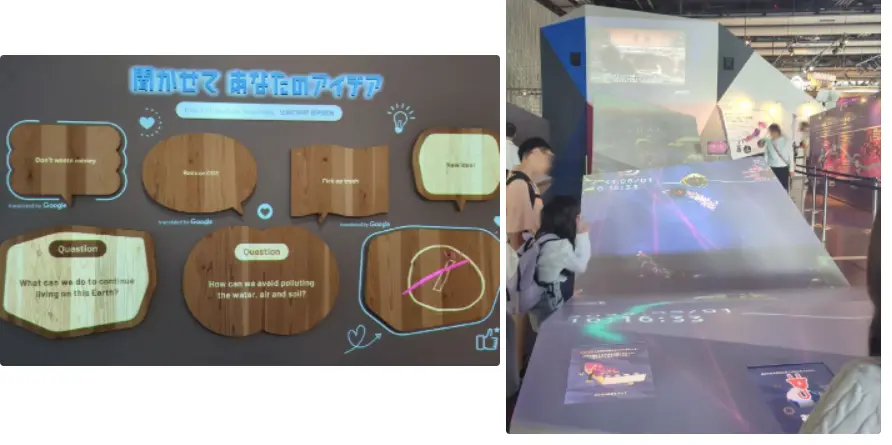
Left Image: A billboard inviting museum visitors to submit their answers to "How can we avoid pollution?" and "What can we do to continue living on this Earth?" and displaying recent visitor responses. Right Image: A game themed around navigating the minefield of ecological challenges towards a bright future in 2100.
In this regard, the tone of the two museums is starkly different. The Museum of the Future in Dubai gives the impression of consumerism: this is the wonderful future we are about to have, and you just need to sit back and enjoy the future we have built for you. Miraikan gives the impression of inviting you to participate: we won't tell you too much about the future, but we want you to think about these issues, understand what's happening behind the scenes, and be part of building a shared future.
The main type of technology that I found lacking in the Museum of the Future in Dubai is social technology, especially governance. The only explicit description of governance structures I found in the imagined world of Dubai in 2064 was a passing mention in the description of the primary space station on Mars: "Operator: Global Space Administration, SpaceX." On the other hand, at Miraikan, the museum's structure emphasizes collaborative discussion, and you will frequently see references to language, culture, government, and press freedom.
Are These Two Visions Compatible?
At first, these two visions may seem completely different, and even potentially moving in opposite directions in terms of their themes. But the more I think about it, the more I feel that they actually complement each other very well: one fills in the gaps of the other. I don't want the world of 2100 to be the same as today's world, at most 20% better than it is now. Civilizations that do have an overwhelmingly mindset of trying to get by with fewer resources will find themselves constantly under pressure from external forces and from within their own societies wanting to push our boundaries more strongly. But at the same time, the more our society develops radically beyond historical norms, the more it is necessary to ensure that everyone is involved, both in understanding what is happening and in participating in the process of discussing and achieving this goal.
The posts I write attempting to make advanced topics in cryptography more easily understood are written in this spirit: we do need advanced tools, but we also need them to be understandable and usable to ensure that more people can work together and to ensure that the future empowers people, rather than becoming a series of iPhone interfaces built by a few, with the rest of us only able to access them in standardized ways.
Perhaps the ideal Museum of the Future that I hope to see is a museum that combines the bold imagination of the Museum of the Future in Dubai with the hospitable spirit that only the Museum of the Future in Japan can bring.
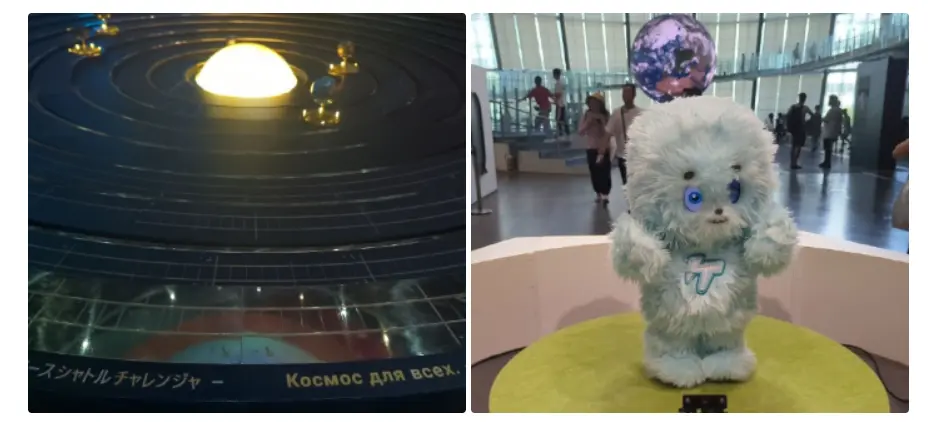
Left Image: "The Universe Belongs to Everyone," Museum of the Future in Dubai. Right Image: Future robots deliberately designed to be cute and friendly, rather than threatening.
免责声明:本文章仅代表作者个人观点,不代表本平台的立场和观点。本文章仅供信息分享,不构成对任何人的任何投资建议。用户与作者之间的任何争议,与本平台无关。如网页中刊载的文章或图片涉及侵权,请提供相关的权利证明和身份证明发送邮件到support@aicoin.com,本平台相关工作人员将会进行核查。


