The current single-layer L1 architecture is like an ancient rural road, which is unable to cope with the increasing number of vehicles and pedestrians as the village rapidly develops into a bustling city.
Fuel is a modular execution protocol within Ethereum that operates on a permissionless and trustless second layer, targeting low-cost, high-throughput value transfer transactions.
Currently, traditional single-layer L1 (Layer 1) blockchain architecture performs poorly when handling a large number of concurrent transactions, leading to bottlenecks, transaction delays, and high fees. In addition, traditional architecture also faces technical challenges and limitations in achieving cross-chain interoperability.
In more vivid terms, the current use of general computing systems or single-layer L1 architecture is like an ancient rural road. While it was once sufficient to meet the transportation needs of a small village, it is now unable to cope with the increasing number of vehicles and pedestrians as the village rapidly develops into a bustling city. Nowadays, this road is often congested, and maintenance and expansion have become increasingly difficult.
This complex environment is similar to the modern urban transportation system, which needs more than just simple road widening. It requires the establishment of an efficient multi-dimensional transportation network, including highways, subways, bus systems, and pedestrian streets, all seamlessly connected to ensure smooth operation.
Solutions like Fuel are designed to address scalability issues and ensure efficient parallel processing, state management, and cross-chain interoperability. The proposed design is akin to a modern transportation system that can flexibly adapt to the evolving transportation needs of the city, ensuring that every user can reach their destination quickly and safely.
Therefore, to realize the future of Rollup centralization, an architecture specifically designed for Ethereum Rollup requirements is needed. Fuel's design combines the Bitcoin UTXO model, Solana's parallelism, Ethereum's security, Move's asset-oriented design, and Cosmos' interoperability and virtual machine customization, creating the ultimate Ethereum Rollup operating system.
In simple terms, Fuel adopts a unique approach different from the existing blockchain design paradigm. Fuel focuses on the modularization of the execution layer, achieving long-term scalability by minimizing state growth. Fuel also introduces FuelVM and the new programming language Sway, overcoming the limitations of the Ethereum Virtual Machine (EVM). The original intention of Fuel's design is to provide an execution environment for highly configurable Rollups, powered by a highly optimized Rollup design.
Core Features:
FuelVM: Fuel introduces the new FuelVM, supporting efficient transaction processing and built-in security measures to surpass the limitations of EVM. FuelVM adopts a global shared memory architecture, allowing all contract calls to share global memory, achieving cross-contract data transfer without the need for storage space. FuelVM allows users to specify the contracts involved in transactions, enabling the virtual machine to handle other transactions while executing non-disputed state access transactions, achieving complete parallel processing. Additionally, FuelVM supports native asset systems, allowing the minting of UTXO-based native assets through opcodes and adopting a multi-dimensional resource pricing model to optimize block utility and promote network decentralization.
Modular Blockchain Structure
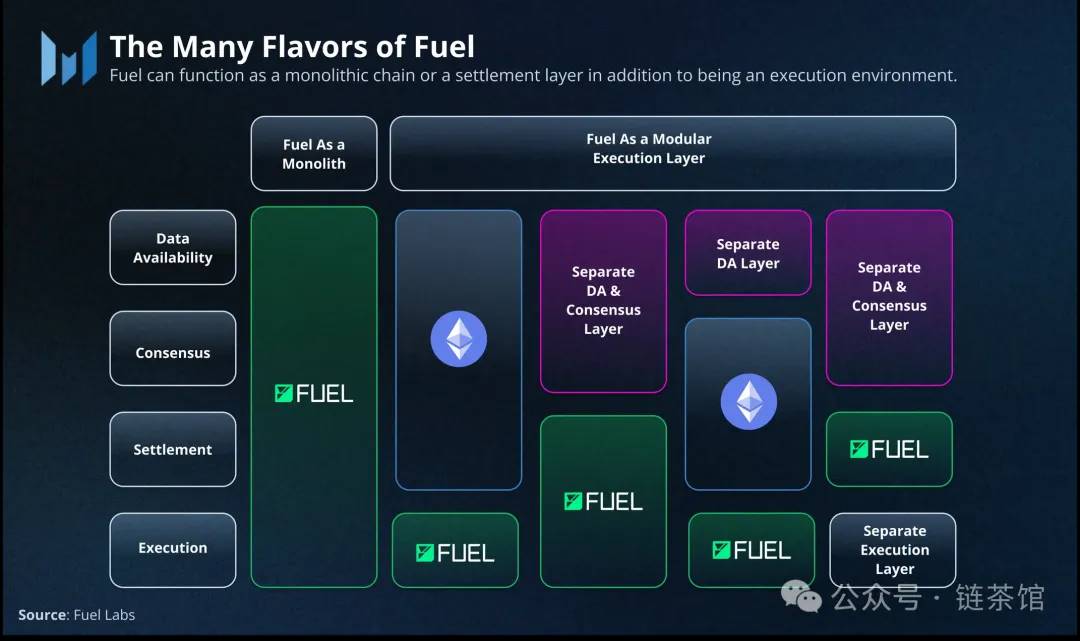
Fuel, as the execution layer, can be flexibly configured in combination with other blockchain layers such as Ethereum and Celestia, for example, as an optimistic rollup on Ethereum. This modular and diverse blockchain configuration enhances its flexibility and scalability.
- UTXO Model
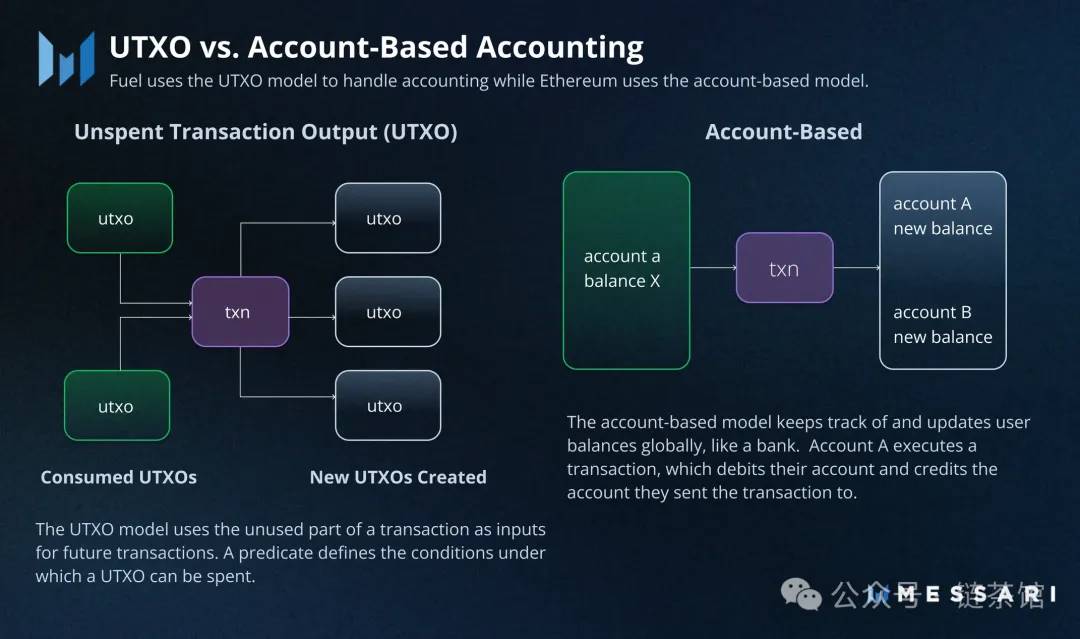
Fuel utilizes the Bitcoin Unspent Transaction Output (UTXO) model, which differs from the traditional account model. Fuel inherits the Bitcoin UTXO model as its accounting model. In the UTXO model, there is no concept of wallets or accounts; each UTXO represents a certain amount of tokens, and the purpose of transactions is to consume previously created UTXOs and create new ones. The Fuel UTXO model is more versatile, representing not only token transfers but also smart contract states. Each contract UTXO carries the state and balance of the contract, uniquely identified by the contract ID. This model allows for parallel transaction execution, ensuring transaction execution order compliance through a strict access list, thereby improving transaction processing efficiency.
Parallel Processing: Through a strict access list, Fuel allows for parallel processing of independent transactions, greatly increasing throughput.
Sway Programming Language: The Fuel team has developed the Sway programming language. Built on Rust, Sway combines the characteristics of Solidity to provide a concise development experience for the high-computational demands of the Fuel environment. Sway inherits Rust's syntax, enabling developers to write secure and efficient smart contract code, and incorporates top-level contract storage and blockchain mechanisms, providing a more secure programming environment. The Fuel team has also developed the Sway toolchain Forc, including a package manager, VSCode extension, testing infrastructure, and blockchain resource manager, to support developers using Sway.
Scripts and Predicates: Fuel supports scripts and predicates, allowing for the calling of multiple contracts in a single transaction and reducing state bloat by conditionally checking the availability of UTXOs.
Account Abstraction: Through UTXOs and predicates, Fuel achieves stateless account abstraction, allowing for the programming definition of transaction verification conditions.
Based on these developer-friendly technologies, multiple teams are already building projects on Fuel.
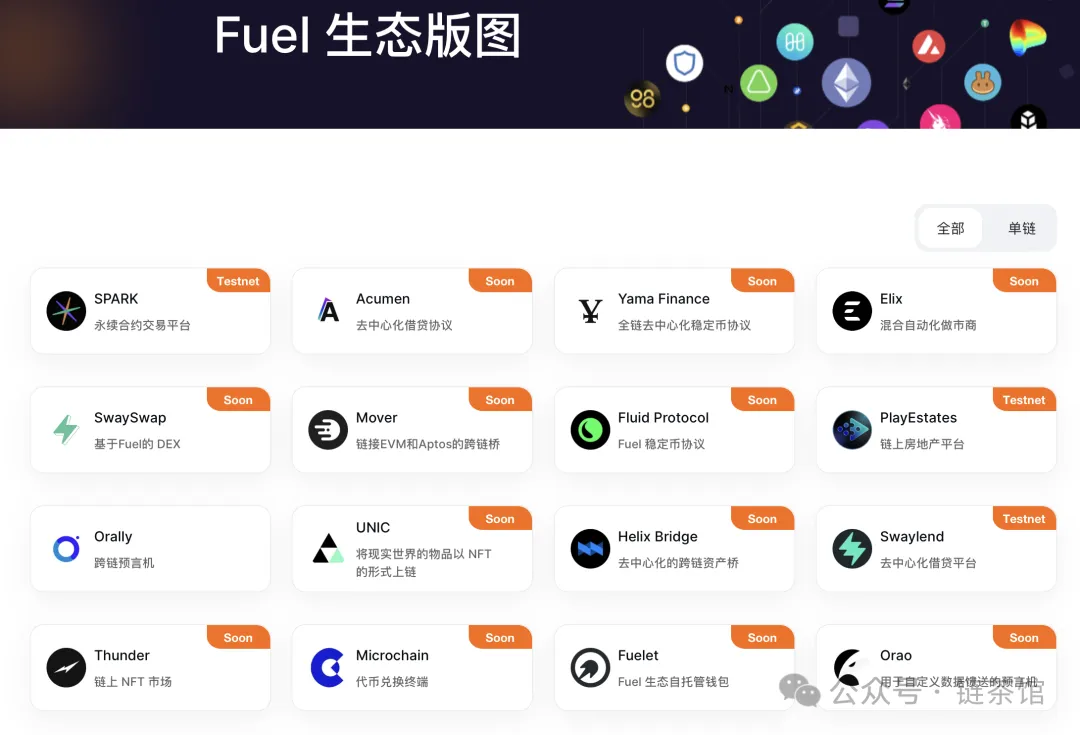
Elix is focused on providing efficient trading and low slippage DEX. The team has drawn on mature mechanisms such as centralized liquidity pools on Curve to enable users to trade under ideal conditions. As Elix will use Fuel, it can leverage parallel processing, resulting in faster transaction speeds and higher security.
Spark is a DeFi super app based on the Fuel network, aiming to revolutionize financial services through its comprehensive service suite. The v1 version of Spark introduces a multi-collateral cross-margin system, supports deposits of various assets, and implements complex liquidation protocols to ensure trading flexibility and risk management. Spark supports long-term and short-term perpetual contracts with up to 2000 TPS, providing a comprehensive SDK and API, supporting non-custodial interaction with order books, and promoting integration and innovation. The Fuel network enables Spark to utilize its high throughput and security to deliver complex financial services.
The Acumen Protocol is a non-custodial interest rate protocol that uses algorithmically set rates to enable open financial applications. It connects cryptocurrency with traditional finance, allowing DeFi users to access attractive, stable, and uncorrelated returns, while creating a fair environment for small and medium-sized enterprises (SMEs) and entrepreneurs to thrive. As a modular execution layer, Fuel provides the blockchain infrastructure for the Acumen platform, ensuring performance and security when handling a large number of debt and asset tokenization transactions.
Thunder is an NFT marketplace that allows batch transactions to be completed in a single transaction at minimal cost. For experienced NFT traders, this marketplace offers a more seamless trading experience, achieving fast transactions through parallelization.
In preparation for the upcoming Fuel mainnet release, Fuel launched the Fuel Points Program on July 8th.
Participants can deposit eligible assets into the pre-deposit smart contract through the Fuel Points Program portal. These assets will be held in the Fuel pre-deposit smart contract on Ethereum until the launch of the Fuel mainnet. After depositing the assets, participants will receive Fuel points daily based on the dollar value of the deposited assets.
Participants can earn 1.5 to 3 points per dollar value of deposited assets daily, depending on the type of assets deposited. For example, when depositing ETH, a user can earn 1.5 points per dollar of ETH deposited each day. The dollar value of the assets is determined hourly by a price oracle (such as the DeFiLlama API), and points are calculated based on this value. For instance, if a user deposits 1 ETH when the price is $3500, the user will receive 3500 × 1.5/24 = 218.75 points per hour.
Points can be monitored through the portal, and early depositors will receive more points. Currently accepted assets include ETH, WETH, EETH, rETH, rsETH, WBETH, USDT, USDC, USDE, sUSDE, ezETH, and stETH. The point multiplier for different assets may change, and specific information will be released by FuelNetwork on the X platform. After the release of the Fuel mainnet, participants will need to bridge the pre-deposited assets to the mainnet within 14 days of the release, otherwise the points will be confiscated.
Overall, Fuel can be considered a project worth long-term investor attention, especially with the support of capital, the application of the Layer-2 new token model, and the positive news of the mainnet launch. The ecological development and ongoing funding plans of Fuel bring new ideas and creativity to its ecosystem, which is relatively prosperous at such an early stage of the project. However, the performance of Fuel in the competitive Rollup market will need time to validate after the mainnet launch. Let's continue to monitor its future development.
免责声明:本文章仅代表作者个人观点,不代表本平台的立场和观点。本文章仅供信息分享,不构成对任何人的任何投资建议。用户与作者之间的任何争议,与本平台无关。如网页中刊载的文章或图片涉及侵权,请提供相关的权利证明和身份证明发送邮件到support@aicoin.com,本平台相关工作人员将会进行核查。


