Andrew Bosworth has already announced that he wants to "use artificial intelligence to build the entire Meta".
By: Mu Mu
The continued losses of Reality Labs have made the path of Meta's metaverse even more difficult than SpaceX's "journey to Mars". The bold reform is still ongoing.
Recently, Meta announced a major restructuring of Reality Labs, the department responsible for the metaverse and virtual reality business, splitting it into two departments: "metaverse" and "wearable devices". The future plan is also divided into two parts, with the metaverse department focusing on the development of the Quest series of VR headsets, and the wearable devices department focusing on smart glasses products.
The restructured Meta has increased the weight of wearable devices in its internal business. Meta's CTO, Andrew Bosworth, emphasized that the market response to the Ray-Ban Meta smart glasses launched by Meta was "much more successful than expected".
The sales of this smart glasses have shown Meta the enhancement brought by AI to XR hardware, and after tasting the sweetness, it quickly integrated it into Reality Labs, hoping to use AI and new hardware development to turn around the department's current loss situation.
Reality Labs Adds "Wearable Devices" Business
Meta's metaverse business department, Reality Labs, has experienced "consecutive losses for two quarters". In the first quarter of this year, Reality Labs grew by 30% year-on-year, but still incurred a loss of 3.85 billion, while the previous quarter was 3.5 billion US dollars. It is estimated that since 2019, Reality Labs has accumulated losses exceeding 50 billion US dollars (approximately 350 billion RMB).
The consecutive losses of Reality Labs have cast a shadow over Meta's metaverse vision, not only facing internal operational pressure and shareholder questioning, but also subjecting Mark Zuckerberg's metaverse dream to ridicule from the outside world.
After continuous layoffs, the reform of Reality Labs is still ongoing. The department will undergo a major restructuring, with the original department being split into the "metaverse department" responsible for the Quest headset product line, the social platform Horizon, and related technologies, and the "wearable devices" department covering Meta's other software and hardware products, including the smart glasses in collaboration with Ray-Ban.
This is the largest restructuring Meta has undergone since its renaming in 2020.
Meta's CTO, Andrew Bosworth, explained the purpose of this restructuring in an internal memo to employees: the company continues to focus on the development of MR and the metaverse, hoping to create a more integrated product experience through Meta AI.
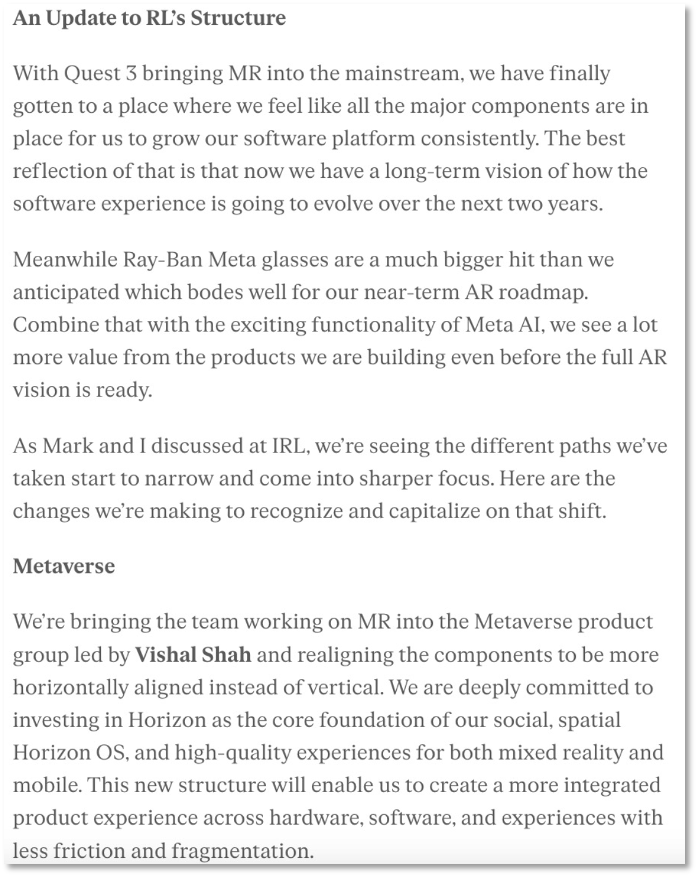
Partial content of Meta's internal memo
From Andrew Bosworth's internal memo, it is evident that smart glasses, wearable devices, and AI are key words. The traditional business lines of Reality Labs, such as the Quest series headsets and the metaverse social platform Horizon, are no longer prominent.
The reality is indeed so, as the shipment volume of the new generation Meta MR headset Quest 3 has been reduced.
In October last year, Guo Mingchi, an analyst at Tianfeng International focusing on the XR hardware market, pointed out that the initial estimated shipment volume of Quest 3 in 2023 was over 7 million units, but due to expected weak demand, the estimated shipment for 2023 was reduced to 2-2.5 million units, and the shipment volume for 2024 was about 1 million units.
Faced with reality, Meta has to find a new way out for Reality Labs. Zuckerberg has said that the vision of the metaverse is too big, and he expects Reality Labs to be profitable by 2030. The existence of this department is currently seen as a "long-term investment in future planning".
Now, wearable devices have been added as a new business to Reality Labs, largely because AI smart hardware has released potential profit points. Bosworth revealed in the memo that the market response to the Ray-Ban Meta smart glasses launched by Meta was "much more successful than expected".
AI Features Drive Sales of New Meta Hardware
"Wearable devices" are not new, but adding the word "smart" forces us to mention the enhancement brought by AI to hardware functions. The considerable sales of the Ray-Ban Meta smart glasses mentioned by Bosworth are largely due to the blessing of AI.
The first-generation product of these glasses, Ray-Ban Stories, was released in September 2021 and had only sold 300,000 pairs by February 2023, with a monthly active user base of only 27,000, less than 10% of the total sales.
After Meta's collaboration, Ray-Ban Meta and the VR headset Meta Quest 3 were unveiled in September 2023, and the shipment volume in Q4 of 2023 alone exceeded 300,000 pairs, almost catching up with the total sales of the first generation. The Verge predicts that the sales of this product may have exceeded 1 million pairs.
In contrast, the sales performance of Meta Quest 3 released at the same time did not meet expectations. RoadToVR compiled the sales performance of Quest 2 and Quest 3 on the Amazon platform during last year's Black Friday period (one month), with a total sales volume of about 240,000 units, of which Quest 2 accounted for 70.2%, far exceeding Quest 3.
Meta also mentioned in a blog post that the Ray-Ban Meta product has achieved better-than-expected market performance, "the sales speed of the glasses is faster than our production speed", and the team is currently working on launching more new styles.
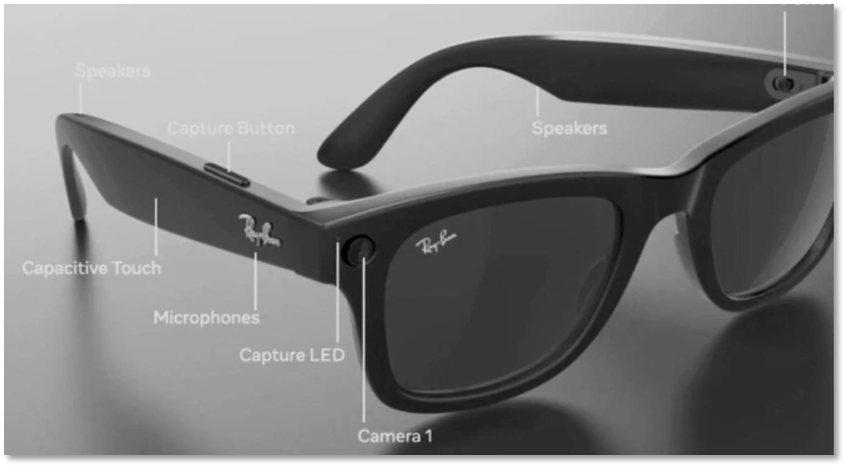 Appearance of Ray-Ban Meta smart glasses
Compared to the first generation, Ray-Ban Meta's appearance has hardly changed, and this turnaround victory is truly brought about by AI.
In terms of hardware functions, Ray-Ban Meta has undergone a comprehensive upgrade, including the camera, storage space, speakers, microphone, standby time, and weight.
However, these are all optimizations of existing hardware, and the real breakthrough in functionality came with the introduction of AI features in April 2023. The "Hey Meta" voice command can directly wake up the AI assistant of Ray-Ban Meta, allowing the glasses to perform functions such as object recognition, real-time translation, and weather inquiries.
Meta is using "AI+" to prolong its metaverse grand plan. Not only the Ray-Ban Meta smart glasses, but also on June 2nd this year, Meta's entire AI department underwent a restructuring, with the original Facebook AI Research Institute (FAIR) being integrated into Reality Labs.
FAIR can be said to be one of the most influential star laboratories in the field of AI, founded by Yann LeCun (the creator of convolutional neural networks and Turing Award winner) in 2013. The influence of this laboratory in the field of deep learning frameworks is almost ubiquitous.
If XR hardware is the physical support for humans to enter the metaverse, then AI is the brain. Researching AI at FAIR not only allows Reality Labs, which develops hardware, to ride the AI wave, but also directly adds intelligence to Meta's virtual reality hardware in terms of functionality.
Andrew Bosworth has already announced that he wants to "use artificial intelligence to build the entire Meta".
免责声明:本文章仅代表作者个人观点,不代表本平台的立场和观点。本文章仅供信息分享,不构成对任何人的任何投资建议。用户与作者之间的任何争议,与本平台无关。如网页中刊载的文章或图片涉及侵权,请提供相关的权利证明和身份证明发送邮件到support@aicoin.com,本平台相关工作人员将会进行核查。


