12 startups have successfully "graduated" from Alliance, among which the majority are projects in the popular RWA, AI, and DePIN tracks.
Written by: Deep Tide TechFlow
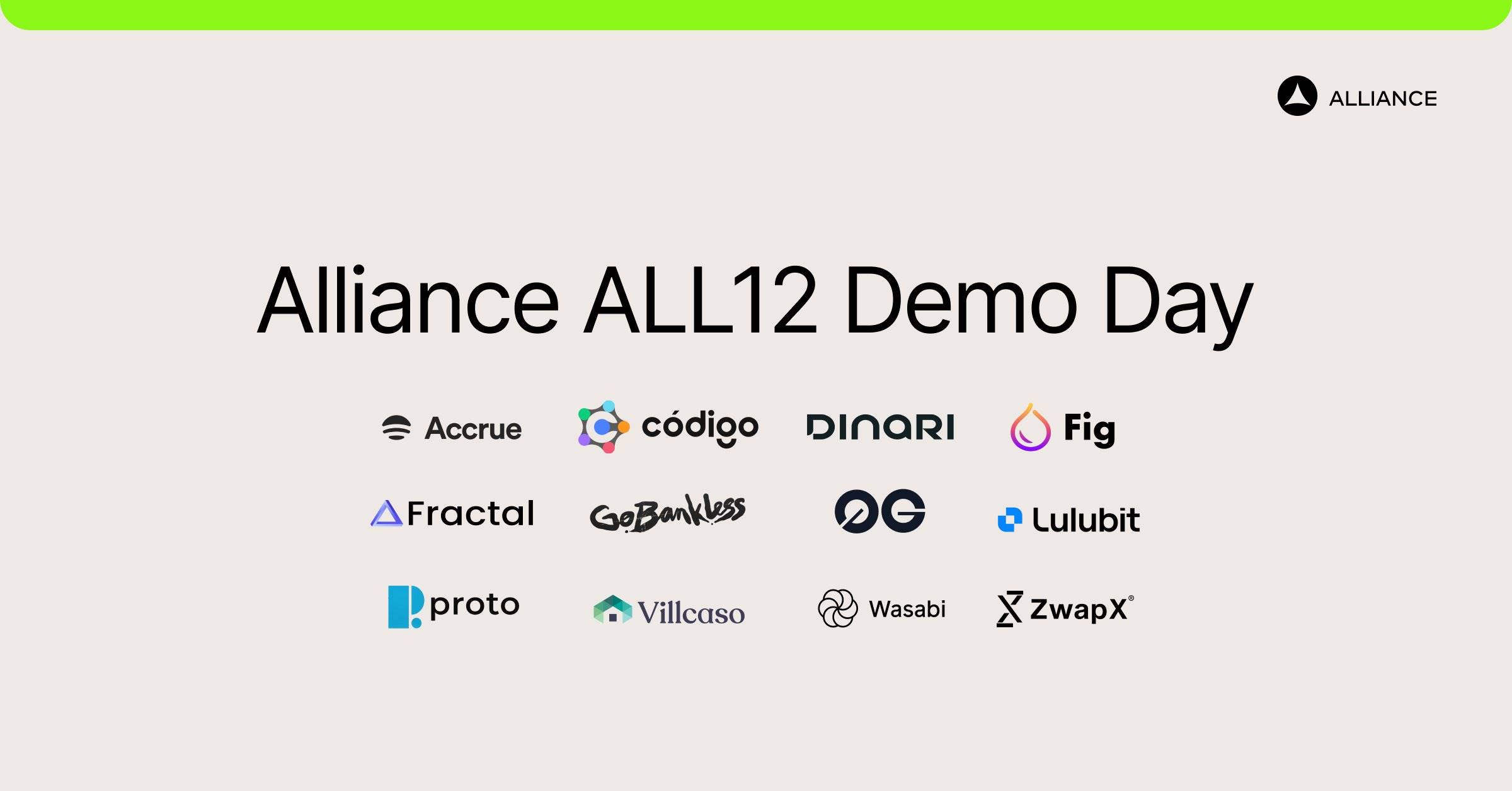
In this market with uncertain fluctuations and a slightly weary market sentiment, Alliance is taking the latest batch of incubated projects to the market.
As the largest accelerator in the crypto world, Alliance has incubated well-known projects such as Tensor, Pendle, and Synthetix. The recently popular crypto consumer applications Fantasy.top and Pump.fun were also incubated by Alliance. Fantasy.top and Pump.fun are now among the top ten crypto protocols in terms of fees and generated revenue, surpassing many established L1 protocols.
Last week, 12 startups graduated from Alliance, among which the majority are projects in the currently popular RWA, AI, and DePIN tracks. The selection of incubated members reflects Alliance's close understanding of market hotspots and industry narratives.
In addition to focusing on current hot narratives, several projects in this batch are dedicated to expanding the crypto market in Asia, Africa, and Latin America, reflecting the current trend of the crypto field expanding into third world countries.
Here are the introductions of these 12 startups:
1. Villcaso
Product Direction: Tokenization of US Real Estate
Project Twitter: https://twitter.com/Villcaso
Introduction:
Villcaso tokenizes US real estate on-chain in a compliant manner, allowing global users to participate in US real estate investment by holding Villcaso's on-chain token $USH (US Housing). This solves the issues faced by non-US residents when investing in US real estate, such as policy compliance and high entry barriers.
2. GoBankless
Product Direction: Cross-border Crypto Payments in Africa
Project Twitter: https://twitter.com/gobanklessapp
Introduction:
GoBankless builds a compliant stablecoin cross-border payment system for small and medium-sized enterprises in Africa. The project helps SMEs convert cash into stablecoins. Through on-chain cross-border payments, GoBankless helps African SMEs avoid the high 20% fees and lengthy settlement times of Swift, addressing a major pain point for African SMEs. Currently, GoBankless serves over 400 express delivery companies and 49 bank branches in Africa.
3. Wasabi Protocol
Product Direction: Trading of NFT and MEMECOIN Derivatives
Project Twitter: https://twitter.com/wasabi_protocol
Introduction:
Wasabi Protocol is a Web3 long-tail asset derivatives exchange built on Blast Chain, providing users with leveraged trading of high-volatility assets (such as NFTs, MEMECOIN), as well as services like NFT options, asset pledging, and fractionalized NFT trading. It is the first project to offer derivatives trading for ERC721s and ERC404 assets, actively addressing the liquidity issues of cultural memecoins. Within a few months of its launch, Wasabi has attracted over 30,000 users, with a platform trading volume exceeding $200 million.
4. Lulubit
Product Direction: Fiat-to-Crypto Exchange for Central America
Project Twitter: https://twitter.com/lulubitapp
Introduction:
With a $70 billion market size, the Central American crypto market is currently dominated by high transaction fees and poor user experience on P2P networks. To address this pain point, Lulubit provides fiat-to-crypto exchange services for Central American users, allowing them to buy or sell cryptocurrencies directly using bank accounts and debit cards. In less than a year, Lulubit has attracted over 18,000 users. The product currently serves residents of Panama and Guatemala, and will soon expand to other regions in Central America.
5. ZwapX
Product Direction: Tokenization of Luxury Watch Trading
Project Twitter: https://twitter.com/zwapxofficial
Introduction:
Traditional luxury watch trading platforms such as Chrono24 and Montro have been plagued by fraudulent activities due to imperfect authentication technologies, leading to the need for deposit escrow systems to combat fraud.
ZwapX addresses this issue by having customers deposit their watches instead of funds. After registering watch information, users can send their watches to ZwapX's warehouse in Geneva, where professionals will inspect the authenticity and condition of the watches. Once confirmed, ZwapX will exchange the watches for corresponding on-chain tokens, which users can choose to hold or freely trade. Upon successful transactions, funds are immediately delivered to the seller, and buyers can convert the tokens back to physical watches at any time or use them as collateral in DeFi.
6. Fractal Payments
Product Direction: Stablecoin Cross-border Payments
Project Twitter: https://twitter.com/FractalPayments
Introduction:
Fractal Payments is a global cross-border payment platform that supports settlement in stablecoins. Its transaction fees are 3 times cheaper and settlement speed is 6 times faster than Swift. Traditional cross-border payment solutions face issues such as high fees, slow processing times, and complex usage thresholds.
Fractal Payments is fully licensed in the EU and currently supports payments in over 60 countries/regions. This allows businesses to price transactions in fiat while settling quickly and at low cost using on-chain stablecoins. Currently, Fractal Payments has been widely adopted by applications such as Zerion.
7. Codigo
Product Direction: AI Code Generation Platform
Project Twitter: https://twitter.com/CodigoPlatform
Introduction:
The availability of AI models largely depends on the quality of the training data. However, obtaining training data is difficult because the relevant fields usually lack well-classified data, resulting in varying model quality. Currently, Codigo is dedicated to helping users easily access high-quality training data. The Codigo platform incentivizes users with tokens and provides high-quality datasets for clients through data crowdsourcing and centralized review, while also offering specialized model training services for the high-risk AI finance sector. It is worth mentioning that Codigo's initial focus was on encrypted source code, which is rich in data and of excellent quality. Their beta tool generated over 4 million lines of code in just 6 months.
8. Accrue
Product Direction: Cross-border Payments in Underdeveloped Areas of Africa
Project Twitter: https://twitter.com/useaccrue
Introduction:
Accrue provides virtual payment card creation services for users in Africa. On the Accrue platform, African users can recharge virtual cards with USD stablecoins through various channels, including banks, and use USD stablecoins for transaction settlements. This method reduces the cost of cross-border settlements in Africa by nearly 10 times and shortens settlement times from 2 weeks to within 5 minutes. Accrue is currently available in 7 countries/regions and integrated into Opera, Africa's largest payment wallet app. Since its launch, Accrue has processed over $5 million in transaction volume.
9. Fig
Product Direction: Tokenization of CeFi Options
Project Twitter: https://twitter.com/FigPlatform
Introduction:
Fig focuses on the CeFi options market, which is much larger than the perpetual contract market, by tokenizing complex options to help users easily invest in options for on-chain portfolios and generate returns using complex hedging strategies. Within 4 months of its launch, Fig's options trading volume has exceeded $50 million, and its ecosystem TVL has surpassed $10.2 million.
10. 0G
Product Direction: On-chain Data Availability Solution for AI
Project Twitter: https://twitter.com/0G_labs
Introduction:
0G Labs is the first modular AI chain, building a programmable data availability solution aimed at addressing the significant data storage and throughput requirements for on-chain AI operations. The data is divided into publishing and storage phases. According to official information, this architecture performs 50,000 times faster and costs 100 times less than leading data availability solutions such as Celestia.
11. Proto
Product Direction: Building On-chain Google Maps using DePIN Devices
Project Twitter: https://twitter.com/dp_proto
Introduction:
Proto's DePIN network uses token incentives to provide mapping services for emerging economic regions based on geographical data uploaded by users' phones. By uploading geographical data from users' phones, it can address the issue of delayed information updates in large map operators like Google in rapidly changing geographical areas such as Mumbai and Bangalore in developing countries. Within a few months of its launch, Proto has achieved 75% Google Maps coverage in Bangalore and provided new coverage in areas where Google Maps cannot reach.
12. Dinari
Product Direction: Tokenization of US Stock Securities
Project Twitter: https://twitter.com/DinariGlobal
Introduction:
Dinari is a Web3 securities asset trading platform that tokenizes securities into dShares using smart contracts, allowing users to trade traditional securities such as stocks, bonds, and ETFs on-chain. Currently, Dinari operates only on Arbitrum, supporting payment of transaction gas using stablecoins such as USDC, USDC.e, and USDT, without the need for native tokens like ETH.
免责声明:本文章仅代表作者个人观点,不代表本平台的立场和观点。本文章仅供信息分享,不构成对任何人的任何投资建议。用户与作者之间的任何争议,与本平台无关。如网页中刊载的文章或图片涉及侵权,请提供相关的权利证明和身份证明发送邮件到support@aicoin.com,本平台相关工作人员将会进行核查。


