Author: Pan Zhixiong, Co-founder of ChainFeeds
EigenLayer has just released the whitepaper for its protocol token EIGEN, introducing many novel and complex concepts such as Intersubjective, Work Token, Token Forking, slashing-by-forking, and Intersubjective staking, which have quickly become the focus of community discussion.
The original intention of the EigenLayer protocol design is to generalize the use of Ethereum nodes, allowing these nodes not only to execute other business logic to increase revenue, but also to increase income for users participating in ETH consensus. However, while increasing the utility of nodes, it also brings risks. Among these risks, in addition to directly observable objective risks, there are also some uncertain areas between subjective and objective. Although this uncertainty cannot be fully guaranteed through cryptography and mathematics, it is based on "social consensus." This is what is called "Intersubjective," which I prefer to translate as "social consensus."
Expanding from this, precisely because it is "social consensus," their protocol token also needs to be forkable, which requires the design of a dual-token isolation model that can be forked, as well as the logic of initiating challenges. It is more like Ethereum has implemented a complete set of network logic. It has (social) consensus and nodes, can fork, but it is not a blockchain.
In addition, I also recalled some anecdotes related to Work Token and Weak subjectivity as a supplement.
What is a Work Token
The concept of Work Token has been discussed since around 2018, and it became more widely known due to Kyle Samani of Multicoin Capital. In short, in the model of Work Token, service providers can only obtain the right to perform work for the network by staking the native tokens of the network.
In other words, nodes not only need to provide tokens, but also provide services in order to receive rewards. Of course, with the popularization of on-chain liquidity and DeFi protocols in recent years, the tokens that nodes need to stake can be provided by third parties, without the need for the nodes themselves to allocate a large amount of assets. This has evolved into the current model of EigenLayer: users provide ETH, Liquid Restaking Protocol provides liquidity, and node operators provide hardware and AVS provides business logic.
In 2018 or earlier, the industry classified tokens in various ways, with the most common classifications being: store of value (such as Bitcoin), security tokens, utility tokens, and work tokens.
For an introduction to Work Token and other token models, it is recommended to start with Multicoin's article: https://multicoin.capital/2018/02/13/new-models-utility-tokens/
What is Intersubjective?
First, let's define two key terms: Objective and Subjective. Errors in blockchain and decentralized networks can be classified into the following four types based on their nature:
Objective errors: These errors are based on data and cryptography, and can be explicitly verified, such as the execution process of the Ethereum Virtual Machine (EVM).
Intersubjective errors: These errors involve social consensus among groups. When certain behaviors or judgments go beyond this consensus, they are considered Intersubjective errors.
Unobservable errors: These errors are known only to the victim, and others cannot observe them.
Subjective errors: These errors are completely based on personal experiences and viewpoints, resulting in outcomes without consensus.
EigenLayer believes that unobservable errors and subjective errors are difficult to correct, and therefore proposes using ETH to avoid objective errors and using EIGEN to avoid Intersubjective errors.
The concept of Intersubjective can be seen as a state between "objective" and "subjective." This word is composed of "Inter" (meaning "between" or "mutual," as in "interactive" and "internet") and "Subjective." Therefore, Intersubjective refers to a subjective state formed among individuals, a consensus formed within society through interaction.
If you were to ask ChatGPT what Intersubjective means, it would tell you a very difficult-to-understand Chinese translation: "mutual subjectivity."
For example, in the financial market, it is generally not accepted to state "1 BTC = 1 USD." This type of consensus error can be classified as an Intersubjective error. Therefore, to explain Intersubjective, we can understand it as "social consensus," that is, a common acceptance of certain ideas or facts within a group.
Although there are subtle differences between "social consensus" and Intersubjective in academic and professional discussions—Intersubjective focuses more on describing the shared process of individual subjective experiences and knowledge, while "social consensus" focuses more on the results of collective decision-making and action.
ETH Objective, EIGEN Subjective?
A brief review of the EigenLayer protocol: users can deposit ETH into the Liquid Restaking Protocol, and these protocols will stake these ETH to operate Ethereum validation nodes, which will also run various AVS middleware services (such as oracles, cross-chain bridges, data availability, etc.) to provide services for end applications.
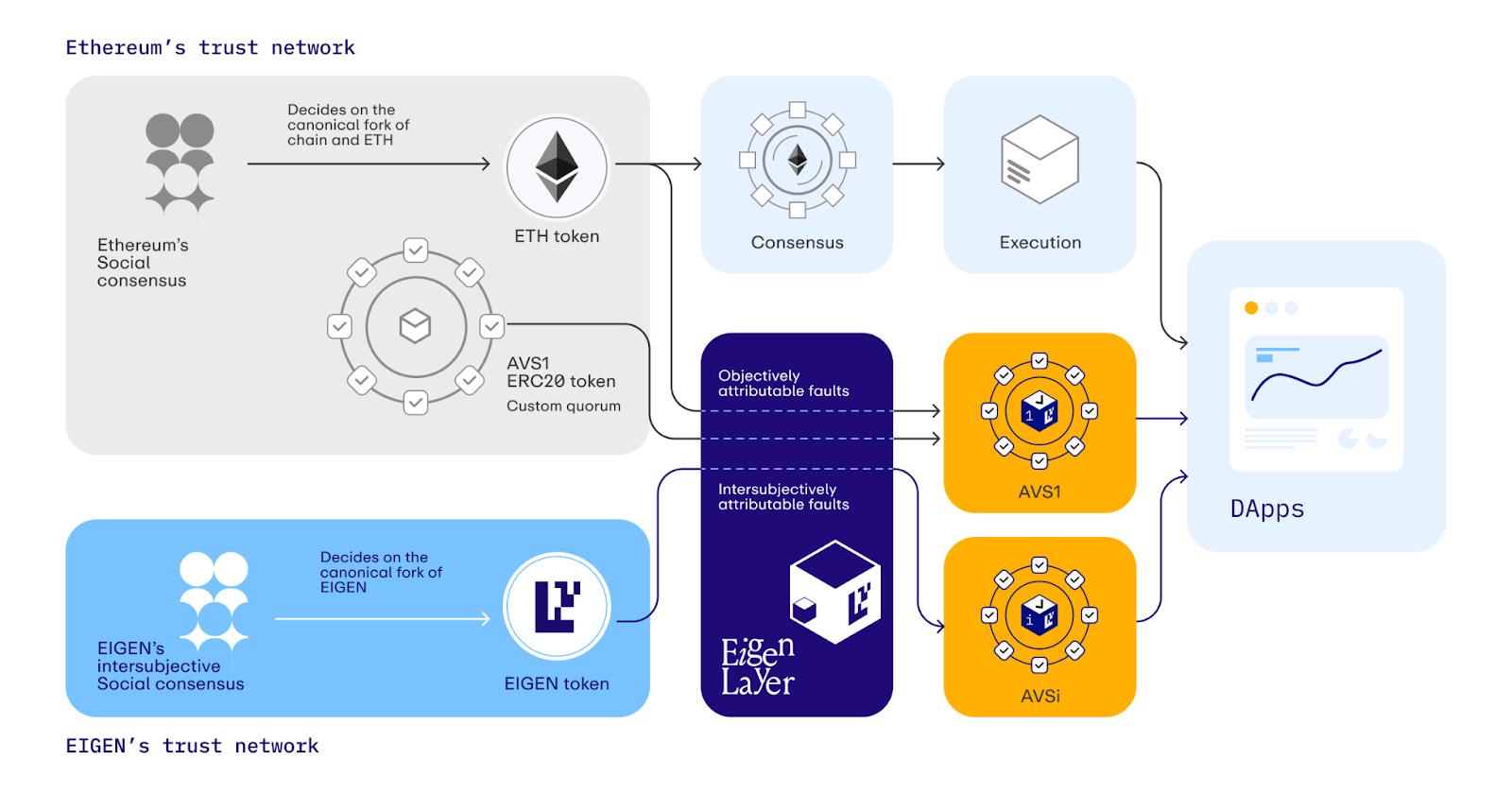
For AVS, it can also be divided into two types: objective and Intersubjective. Objective AVS is based on cryptography and mathematics, can be quantified and verified explicitly, and in the EigenLayer design, these AVS can rely on the ETH from Restaking as security. Intersubjective AVS, such as oracles, because off-chain data cannot be verified on-chain, can only rely on social consensus among nodes, and data recognized by a sufficient number of nodes is considered trustworthy.
In summary, Restaking ETH will serve as the work token for objective AVS in the EigenLayer protocol, and EIGEN will serve as the work token for Intersubjective AVS.
Can protocol tokens also fork?
Token Forking is also a novel concept. The characteristic of blockchain being forkable usually refers to open-source code or the network itself, i.e., the chain. In theory, ERC-20 tokens are not forkable, at least not inherently. This is because tokens, as smart contracts, rely entirely on the objective properties of the EVM.
However, EigenLayer believes that within their framework, the forkability of tokens is a safeguard, even if it is a rare occurrence. If the number of malicious attackers in the EigenLayer network exceeds half, regular users can fork the tokens in this way, and then all users and AVS can choose the corresponding tokens based on their own situation, essentially allowing social consensus to determine which token is the most orthodox. They also refer to this concept as slashing-by-forking, which is also derived from a article written by Vitalik Buterin 9 years ago.
To support this forkability, a significant amount of logic needs to be added. For example, if the token is forkable, can EIGEN still be used as collateral for lending protocols? Therefore, they have designed a dual-token isolation model, where EIGEN cannot be forked, but another type of token, bEIGEN, can be forked. They have also designed the process of initiating a fork challenge, as well as compensation logic.
Ethereum's Weak Subjectivity
In fact, Ethereum's PoS consensus has long had a concept called "Weak Subjectivity" (also invented by Vitalik Buterin), which is a concept between "objective" and "subjective." This attribute is only present in PoS consensus blockchains.
For PoW networks, due to the real cost of computational power competition, the longest chain is the most secure, making it completely "objective." For PoS networks, the cost of block production is negligible, and the cost of attack is also very low. Therefore, for nodes that have just joined the network, they need to retrieve social information and find this "weak subjectivity" before objectively participating in the PoS process. So, there are some "subjective" factors before entering the correct network.
However, for nodes that have already entered the correct Ethereum network to participate in consensus, all consensus processes and EVM execution processes are objective, guaranteed by cryptography and mathematics, such as the determinism of EVM input and output, and the rules for cases like double-signing that would result in slashing.
免责声明:本文章仅代表作者个人观点,不代表本平台的立场和观点。本文章仅供信息分享,不构成对任何人的任何投资建议。用户与作者之间的任何争议,与本平台无关。如网页中刊载的文章或图片涉及侵权,请提供相关的权利证明和身份证明发送邮件到support@aicoin.com,本平台相关工作人员将会进行核查。


