Author: Zen, PANews
On May 3rd, UXLINK will launch its first airdrop event with the theme "In UXLINK We Trust." The airdrop will distribute 4 sets of themed NFTs, including LINK, TRUST, FRENS, and MOON, based on the performance of Odyssey and contributions to the UXLINK community. With a user base of over 5 million, if the initial airdrop covers 10% of the users, over 500,000 people will receive UXLINK's governance token $UXLINK, potentially making it the largest airdrop participation of the year so far.
"Social Monster" Emerges: Seven Million Users in One Year
UXLINK is the first trust-centered social hub in Web3, launched in April last year, and reached a milestone of one million users after over half a year of its launch. With the explosive growth potential of the recommendation mechanism based on familiar relationships and the bull market trend dominated by Bitcoin, UXLINK has shown a flywheel effect since the end of last year, emerging as a "social monster" with high growth potential.
In late April, a large-scale Web3 airdrop event, AIRDROP2049, hosted by UXLINK and co-organized by OKX Ventures, Web3port, and Trusta Labs, gained widespread attention and participation. As an ecological project of UXLINK, AIRDROP2049 attracted over 200,000 global visits within three days of its launch and has now attracted over 400,000 participants. The #AIRDROP2049 tag has been viewed over 1 million times on X platform.
Earlier, between February 1st and February 22nd this year, UXLINK attracted 970,000 new Web3 wallet registrations and a total of $78 million in assets deposited in just three weeks. During a two-week joint activity with OKX Web3 wallet, over 230,000 OKX Web3 wallet addresses were created and linked to UXLINK, demonstrating the unique "super traffic" effect of familiar social applications.
As of April 30th, according to UXLINK's official website data, UXLINK has covered over 95,000 groups, with 5.38 million verified users and 7.73 million users within groups, making it the world's largest social platform based on Web3 groups.
In addition to continuously attracting new users, UXLINK's outstanding business growth has also attracted attention from several well-known VCs.
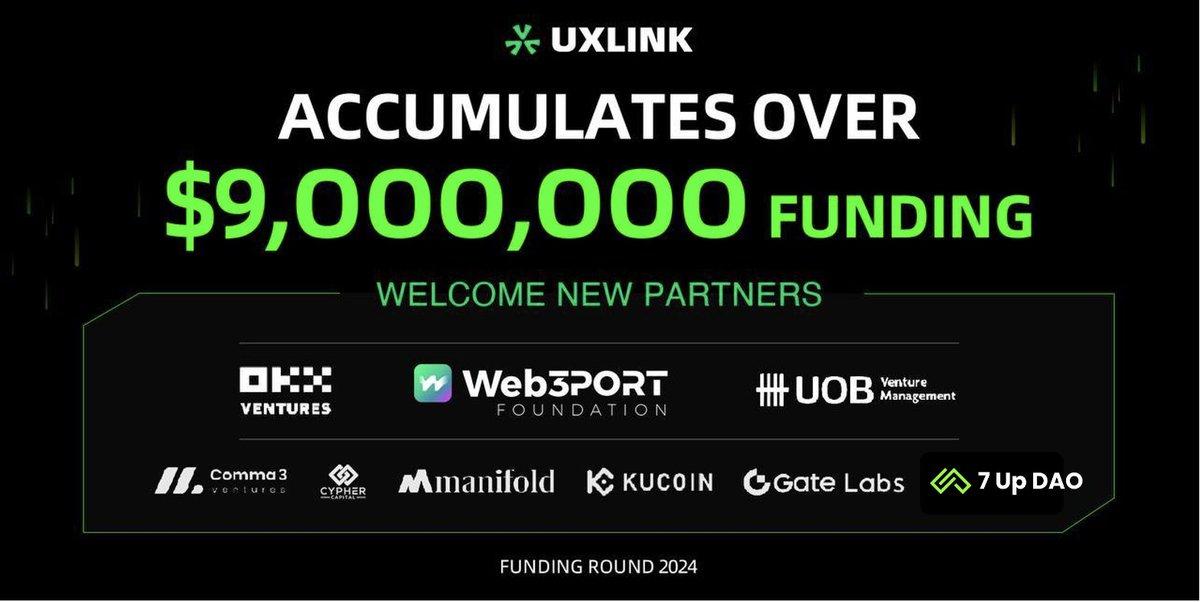
In March this year, UXLINK completed a new round of financing, raising a total of over $9 million. This round of financing was led by OKX Ventures, with participation from UOB Venture, a subsidiary of Dah Sing Bank, which invested millions of dollars in the TON ecosystem, the UAE's Cypher Capital, as well as Web3Port, Comma3 Ventures, Kucoin Ventures, Gate Labs, Forgame, ECV, Manifold, Signum Capital, and 7UPDAO, among other well-known institutions. In addition, according to Singapore company registration information, HongShan, Matrixport Ventures, and ZhenFund are also among the investing institutions. According to the community, before the official TGE, UXLINK may complete another round of financing.
The Attraction Rule of UXLINK: Relationship Expansion Based on Familiar Social Connections
In the 1960s, American psychologist Stanley Milgram proposed the "six degrees of separation" social theory, which suggests that any two people in the world can be connected through no more than six intermediaries. Within an individual's social circle, friends, family, and colleagues, among other familiar connections, are often the most direct links in their social network. Through these familiar connections, each individual can indirectly connect to a wider network of people. This means that integrating multiple relationship networks based on familiar social connections and paths will stimulate exponential growth potential. WeChat and Facebook, for example, have mastered this principle and have become national-level social applications with a large user base and high stickiness.
Most of the Web3 social applications currently on the market operate by imitating social media and forums such as X, Weibo, Reddit, and Quora. These communities, formed based on content creation, production, and consumption, are only weakly related to content or interest areas. When they transition from weak relationships to strong relationships and seek to deepen their understanding, they often face difficulties similar to "adding on WeChat." The content of Web3 social media platforms, whether in breadth or depth, is difficult to compete with traditional platforms. The gap between the slogan of "revolutionizing the social paradigm" and the actual user experience makes it challenging for these Web3 social platforms to acquire and retain users.
Unlike other Web3 social platforms that mainly focus on one-way follow relationships, UXLINK, which emphasizes two-way familiar social relationships, draws inspiration from applications like WeChat and Facebook and innovatively combines real-life social connections with blockchain technology. The social structure of UXLINK is based on a multi-point interpersonal communication model, integrating the "strong relationship network" represented by familiar relationships. Its ecosystem's UX Growth allows users to use social connections to establish and profit from Link to Earn mechanism. Through inviting new users, creating wallets, and ultimately joining or creating groups, users can not only expand their personal social network but also earn points rewards.
Strong relationships are the bonds within a group, while weak relationships are the bonds between groups, and people's relationship networks are an expansion process from strong relationships to weak relationships. The communities and groups established by UXLINK based on familiar relationship networks not only cultivate cohesion within the group but also fully leverage the bridging role of weak relationships in information dissemination. Dynamic, multi-dimensional interactions and connections also help expand and reshape individual social relationships.
Fraud Prevention, Strong Consensus, and Group Assets in the Strong Relationship Network
Familiar relationships are characterized by familiarity, intimacy, trustworthiness, and mutual obligations. Based on this, UXLINK's familiar social model naturally possesses stronger emotional closeness and a more stable foundation of trust. Users have a full understanding of others' qualities, values, and behavioral patterns, enabling them to more accurately judge the sincerity of others.
In an industry often criticized for fraud and rug pulls, this kind of trust is relatively scarce and valuable, and it is a good way to avoid the risk of being deceived. In addition, based on the mutual trust of the "strong relationship network," the community is more likely to reach consensus on decisions, goals, and actions, forming a virtuous cycle of "trust promoting consensus, and consensus strengthening trust."
It is well known that the value of crypto assets depends more on consensus accumulation than valuation. For example, the approval of a Bitcoin ETF has strengthened the consensus on its "asset allocation" and become an important driving factor for price increases.
Based on the consensus and trust advantages of group-based consensus, UXLINK empowers groups with the ability to create encrypted assets on the platform. Members of communities who are united by common beliefs will be able to create assets based on shared beliefs and spontaneously maintain, disseminate, and expand consensus, ultimately capturing value as a group through collective holdings.
This means that users not only can earn rewards from the platform through methods such as Link To Earn, inviting new users, and completing tasks, but also have the right to create assets. The decentralized exchange UXLINK Swap on the platform provides convenience for asset storage, trading, and management, making the process simpler and more immediate.
Building an Integrated Ecosystem of Applications and Infrastructure
As a decentralized and integrated social network that links real-world identities, UXLINK not only provides social application services for Web3 users in Telegram groups but also focuses on building data infrastructure based on real-world social identities for early users and developers. By integrating off-chain social identity information, on-chain asset data, and decentralized storage protocol data, UXLINK constructs a complex social relationship network for users. It also provides support for developers focused on AI, gaming, and other application services by offering protocols and data services, allowing developers to verify users' digital identities (UXLINK account identity verification) and access indexed social graph data and on-chain asset information through API/SDK services.
UXLINK has pioneered the "Real World Social (RWS)" system architecture to lay the foundation for exponential growth. The comprehensive architecture of this system consists of three key layers:
- Infrastructure Layer: To support large-scale adoption scenarios, technical issues such as low cost, high TPS, and high availability must be addressed. UXLINK adopts a hybrid scalable architecture (EVM+IPFS+cloud) to store identity and relationship data on-chain, while processing complex business scenario data off-chain for the convenience of application programs using this infrastructure layer. It operates on EVM-compatible chains such as Ethereum mainnet, Arbitrum, BNB Chain, Polygon, and Base, and provides decentralized storage and centralized data indexing services.
- Protocol Service Layer: Provides efficient tools for Web3 developers to manage user social identity and relationship data services through APIs tailored for on-chain and off-chain systems.
- Basic Application Layer: Provides basic product services for ecosystem applications, such as growth fission and group functions. This layer utilizes MPC-TSS (multi-party computation, threshold signature scheme) wallet account services and group-based EOA account services.
In addition, UXLINK's core AWC protocol can handle on-chain identity and asset relationships, helping developers better understand users and assisting AI models in behavior analysis and recommendations. Unlike other social infrastructure projects that emphasize one-way relationships, UXLINK emphasizes two-way social connections based on familiar relationships, distinguishing it from the social structure of platforms like Weibo and WeChat, and establishing a true familiar social network.
Dual Token Model: Utility Token UXUY and Governance Token UXLINK
To maximize transparency and fairness, UXLINK adopts a dual token model to establish a framework for governance and development within its community and ecosystem: the native utility token $UXUY and the governance token $UXLINK.
UXUY is a reward system for the development of the UXLINK community and ecosystem, and is a key part of Link To Earn. It is based entirely on a transparent Proof of Link (POL) mechanism and is not pre-minted. Users can earn UXUY by inviting others or contributing to the ecosystem, and store it in an Ethereum-compatible wallet. The token uses a decreasing logic similar to BTC, and its calculation formula is closely integrated with BTC's mining logic. Key variables affecting the reduction of the token include time, the number of connections of individual nodes, and the total number of users in the entire UXLINK network. As time passes and the UXLINK network expands, the UXUY obtained by users will decrease exponentially. Therefore, users who join the UXLINK network later will receive less UXUY, emphasizing the scarcity and value of early participation.
$UXLINK plays a crucial role in the UXLINK ecosystem as a governance token, empowering the community with decision-making power and capturing the value of projects and products. The token is about to be issued, with a total supply not exceeding 1,000,000,000 $UXLINK tokens. UXLINK has established a robust token supply and distribution strategy, with 65% of the tokens allocated to the community, 21.25% to investors, 8.75% to the team, and 5% to the treasury. It is worth noting that within the 65% community share, users account for approximately 40%, while all other types of builders and partners account for about 25%.
The token issuance schedule varies depending on the entity. After $UXLINK is listed, the community will airdrop to active users, builders, and partners every month. It is important to note that once airdropped, there is no lock-up period, and the tokens can be obtained immediately. UXLINK's community distribution strategy is closely related to the proof of work (POW) and proof of link (POL) contributions of users and builders. Partner and team tokens are locked for 3 months, followed by a linear quarterly release over 2 years, with 12.5% released gradually each quarter for 8 consecutive quarters to promote long-term participation.
What is the Value of UXLINK? Will it be the Answer to "Mass Adoption"?
At its inception last year, UXLINK's outlook for 2024 was a successful token listing and acquiring two to three million users. However, even before a third of 2024 has passed, UXLINK has already exceeded its initial target and is on the right path to becoming an important infrastructure for the WEB3 ecosystem.
Compared to leading competitors in the social track such as CyberConnect and Farcaster, UXLINK has shown strong momentum of being "late but first." CyberConnect, which is also a social infrastructure, currently has 2 million users and an official Telegram group of about 50,000 people; UXLINK has approximately 5.5 million users and an official Telegram group of about 240,000 people, with both having similar fan bases on X platform, around 560,000. Additionally, as of April 30th, according to Dappraddar data, CyberConnect's on-chain UAW is less than 3,000, while UXLINK's data is 52,000.
In terms of market value, CyberConnect's FDV fluctuates around $1 billion; Farcaster, which also experienced high growth this year and surpassed 330,000 users, is reported by Bloomberg to have completed a financing round led by Paradigm, with an estimated valuation of around $1 billion. Considering UXLINK's current achievements and high growth momentum, its total market value is likely to be around this figure.
Recently, UXLINK has collaborated with multiple AI and GameFi projects, including Bubble AI, 1Gen Labs, Pond, MetaCene, BacGames, Space Nation, and EarlyBird3, among others. UXLINK has also initiated the "UXLINK Social Ecosystem Alliance," empowering ecosystem projects with unique data value for growth and development.
The strategy of empowering the community to create assets based on the high trust and strong consensus brought by the strong relationship network of familiar social connections is undoubtedly the key point for the next high-speed growth. Throughout the development of the Internet, social applications have almost no middle ground, only becoming either a hit or going bankrupt. Perhaps UXLINK's flywheel has just begun to turn, and it will become the "vanguard" of mass adoption? It is worth waiting and seeing.
免责声明:本文章仅代表作者个人观点,不代表本平台的立场和观点。本文章仅供信息分享,不构成对任何人的任何投资建议。用户与作者之间的任何争议,与本平台无关。如网页中刊载的文章或图片涉及侵权,请提供相关的权利证明和身份证明发送邮件到support@aicoin.com,本平台相关工作人员将会进行核查。


