To solve the scalability issue of blockchain, the encryption industry has proposed three solutions: General Rollup L2+ Dapp, Modular Stack + Dapp Rollup (RollAPP), and Parallel EVM+ Programmable World State.
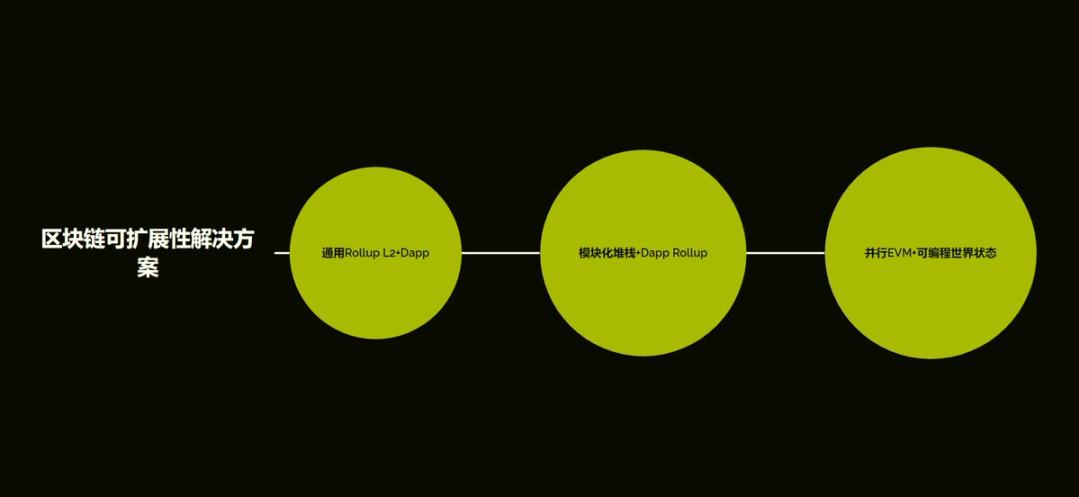
There is a certain inheritance-development relationship among these three solutions.
The design concept of General Rollup L2+ Dapp is to expand in a piecemeal parallel manner. Apart from Starknet and Metis, all other General Rollup L2s are obsessed with Ethereum's complete equivalence, just as Optimism Slogan says, "an extended version of Ethereum."
The original intention of General Rollup L2s to pursue Ethereum equivalence is to become one of the most competitive Ethereum execution layers, maximizing the suction of users, assets, and developers from Ethereum.
However, in the actual production environment, one after another, the highly similar General Rollup L2s have launched highly similar developer Grant plans and Odyssey tasks. Developers have to redeploy the same Dapp application on different General Rollup L2s, and users have to experience the same Dapp application on different General Rollup L2s.
Although this architecture effectively improves the scalability of L1 through the innovative mode of reselling block space, it is completely "infrastructure-centric," and the sovereignty of Dapp developers and user experience are almost completely ignored.
This is an important reason for the collective adjustment of the native token prices of General Rollup L2 protocols after the realization of the Cancun upgrade expectations.
In response to the bottleneck of the Rollup L2+ Dapp scalability solution, projects such as Celestia, Dymension, Avail, and Near have proposed a new solution: Modular Stack + Dapp Rollup.
The modular stack introduces Data Availability Sampling (DAS) technology into the block verification process, engineering the design concept of "centralized block production, decentralized block verification." While ensuring that the trustless nature of block space does not decrease, it achieves a significant reduction in block production costs, making Rollup development and deployment costs extremely low. On the Raas service provider platform, 1 Rollup can be deployed for as low as $5000.
In this new situation, the trend of developing and deploying a dedicated Rollup for 1 Dapp has become popular. Many projects of various types, such as PerpDEX, Web3 games, NFT markets, AI agents, chain abstractions, and Depin, have begun to use the Modular Stack + Dapp Rollup to build the underlying infrastructure of their stacks.
However, although this solution returns sovereignty to developers, it leads to further fragmentation of user experience and further isolation of funds. Faced with this situation, chain abstraction has become a new hot design space. However, this nested complex architecture has also attracted some market skepticism, as shown in the short video mocking Ethereum maxi by Solana, indicating that Ethereum is a bit addicted to layering.
Therefore, the solution of parallel EVM+ programmable world state intends to "use the enemy's own strength against him," abstracting the core features of Solana's high-performance public chain, parallel VM, and programmable world state as functional modules to solve the scalability issues of other blockchains (mainly Bitcoin and Ethereum).
Parallel EVM is easy to understand, that is, redesigning the Tx lifecycle of EVM to increase parallel processing. The core issues that parallel EVM needs to address include: state conflict resolution strategies, computational performance optimization, breaking through disk IO bottlenecks, and performance predictability.
The concept of programmable world state is relatively novel and abstract. In the field of blockchain design, the world state refers to the collection of state information of all accounts on the blockchain at a specific moment. The world state includes the balance of each account, the state of smart contracts, and other relevant information. In the design of EVM, the state is bound to individual accounts (including EOA addresses and smart contract addresses). This design simplifies state management, is easy to develop and understand, enhances security, but it has problems such as state explosion and parallel processing.
Therefore, high-performance public chains such as Sui, parallel EVM public chain @Artela_Network, modular execution layer public chain Fuel, and the full-chain game-specific Rollup Redstone, choose to modify the design architecture of EVM world state from different perspectives. The programmable world state is a new feature of Artela's programmable native extension framework Aspect.
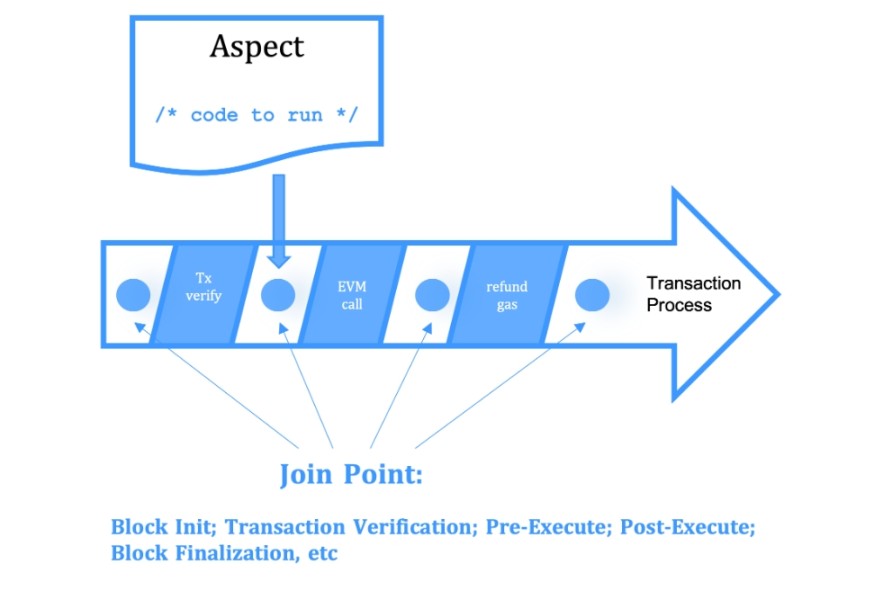
As a recent example of the parallel EVM+ programmable world state scalable solution, Artela consists of a POS L1 public chain based on Cosmos SDK CometBFT, a programmable native extension framework Aspect layer, and an application layer.
Artela's base layer inherits the features of CometBFT, supports elastic block space, and, combined with the programmable capability of the Aspect layer, allows Dapp to customize exclusive block space, achieving the effect of Dapp-specific Rollup on L1.
The design concept of the Aspect layer is inspired by the idea of "aspect-oriented" programming. Aspect uses the complete API set of the base layer to inject extension logic into specific connection points in the lifecycle of Tx, thereby achieving the programmability of the world state.
The Aspect layer allows Dapp developers to customize Tx verification processes, natively integrate middleware, customize block construction rules, access execution contexts, and create trusted asynchronous tasks.
For example, Artela has cooperated with GO+ to launch the Anti-Rug Aspect and with Cellula to launch the full-chain game AI Agent Aspect.
In conclusion, the process of solving the scalability issue of blockchain is a dynamic design space of "pressing the gourd and floating the dipper," and there is no so-called "end game."
Parallel EVM monad@monad_xyz recently secured a financing of 225 million, indicating that top-tier venture capital is heavily betting on the new generation of scalability solutions.
It is time to use the power of technology to solve the scalability issue of blockchain, rather than the block space commercial model innovation of General Rollup L2.
免责声明:本文章仅代表作者个人观点,不代表本平台的立场和观点。本文章仅供信息分享,不构成对任何人的任何投资建议。用户与作者之间的任何争议,与本平台无关。如网页中刊载的文章或图片涉及侵权,请提供相关的权利证明和身份证明发送邮件到support@aicoin.com,本平台相关工作人员将会进行核查。


