There will be new popular WEB3 games appearing, everyone please be patient.
Author: Guage, W Labs
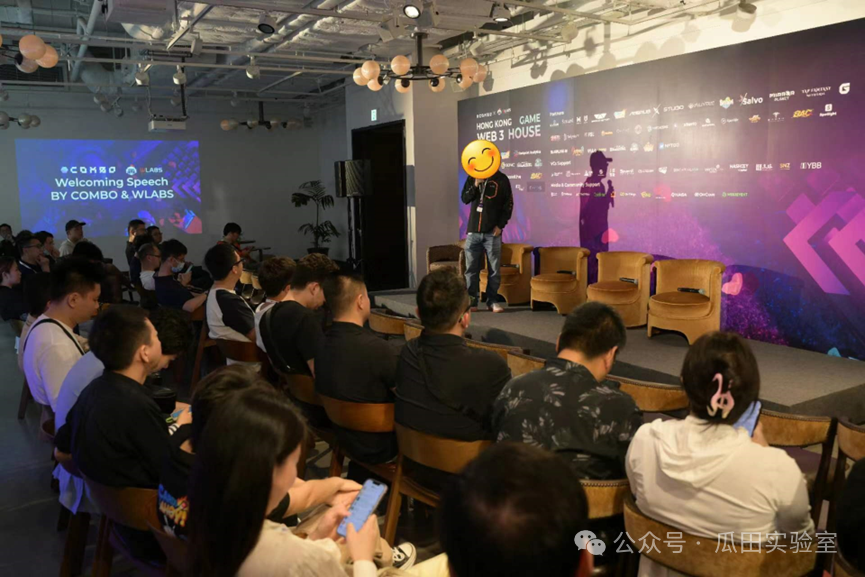
I spent almost a week at the 2024 Hong Kong WEB3 Carnival, filled with various meetups and gatherings. I envied those who could attend seven or eight events in a day, but I found myself feeling face-blind after just three or four events. Even now, I still feel a bit dizzy on the plane.
The best time to organize my thoughts is during the flight mode. This time, W Labs collaborated with COMBO to host a special Game House event for blockchain games. I originally thought I could speak at length during my session, but as soon as I started to shake my head on stage, the host kept pointing at his watch, indicating that 5 minutes had already passed. Huh? I hadn't even finished my warm-up activities, and I was being cut off like this? Haha, fortunately, I still have the skill of writing, so I recorded the unfinished thoughts for my friends to refer to.
First question: Has the WEB3 gaming track been proven false?
In addition to the event organized by myself, I also attended several panels with my friends. People are still debating whether there is a future for blockchain games, as no phenomenon similar to Axie and StepN in the previous bull market has emerged so far.
But my opinion remains unchanged: if you believe in WEB3, then firmly believe in WEB3 games. History has proven that games are the cornerstone for a nascent industry to enter the application layer (C-end).
For example, the development of the computer industry relies on chip upgrades. And over the past 50 years, one of the most important driving factors for the development of computer chips is the gaming industry. 50 years ago, the popularity of the Atari game console and the global craze for PACMAN directly led to the emergence of the chip industry, and even Steve Jobs was working at Atari at that time.
Similarly, in recent years, NVIDIA has become the world's top high-tech company in the AI wave, but NVIDIA originally made gaming graphics cards. The cash flow of NVIDIA's early days was contributed by hardcore gamers.
Games are the props that the general public seeks for happiness and excitement. Whoever captures the C-end must first capture the game.
Second question: So why haven't WEB3 games developed yet?
The answer is simple: it's too early + it's off track.
If we don't consider Crypto Kitty, which came out in 2017, the real clustering effect of blockchain games began with the popularity of Axie in early 2021, which is only a few years ago, too short. Let's take a look at the transformation and iteration process of electronic games in the first two stages.
First transformation: 25 years ago, the transition from selling hardware like Atari and the Japanese Famicom to selling software, because personal computers became popular. PC games became popular, from buying game software to later purchasing game time or points for online games, similar to Steam's distribution, all made huge profits.
Second transformation: 15 years ago, with the popularity of mobile phones and pads, heavy computers were no longer needed, and people started to play free games and pay to play. If the one-time purchase model of PC games was used, it would be outdated. Service-based games (Game-as-a-Service, abbreviated as GaaS) became the mainstream business model for mobile games.
The second transformation actually brought about significant changes to the entire industry's development model, such as personnel costs. After the launch of PC games, staff were gradually laid off after selling the software. However, mobile games require continuous development, increasing personnel costs, and the need for continuous customer service to stimulate players to continue paying. Furthermore, more casual games and 5-minute games emerged, as people were playing in fragmented time, making short games or a 5-minute match more suitable.
So what might the third transformation in the future be? Some companies are betting on the metaverse, and Facebook has even changed its name to Meta. The metaverse is great, everyone has seen "Ready Player One," and it's exciting, but it requires a lot of money, and infrastructure must continue to improve. For example, many players wearing ordinary VR headsets feel dizzy, but now Apple's VR is said to solve this problem.
In my opinion, the current early stage of WEB3 games may also be a direction. Have you ever thought about it? Looking at the ultimate goal, what will be the biggest difference between WEB3 games and WEB2 games? If the playability, entry barriers, project operations, and talent reserves are all raised to the same level, what will be the remaining difference? That's right, it's circulation and payment!

WEB3 games must be combined with the greatest feature of WEB3, which is the convenience of payment and transactions. Whether it's in-game payments or external payments, smooth operations are essential, without the various strict restrictions of different countries and regions on distribution platforms. Meta must have also thought of this, but its stablecoin Libra quickly died, perhaps touching too many external interests. Libra died, but the Libra team wanted to get rich, so Sui and Aptos were born.
Earlier, I mentioned that WEB3 games have gone off track because the first hit blockchain game, Axie, gave everyone a Play to Earn paradigm, so everyone seems to think that blockchain games can only be Play to Earn. As a result, almost all projects are copying Axie's model because, after all, Axie made a lot of money. Sometimes I have been thinking, if the first hit blockchain game was a casual chess and card battle game, a project more inclined towards circulation and payment, would the current situation of the WEB3 gaming track be healthier?
But it's better to go off track than not to go at all. The beginning of a major trend is nakedly earning is normal. For example, the start of the Age of Discovery attracted so many adventurers to become pirates, not because everyone still insisted on getting rich through trade (finding India and China to smuggle spices and silk), but because they happened to discover a large silver mine and profitable human trafficking in South America, which presented the first wave of profits that were attractive enough.
The future greater wealth effect will guide more teams to evolve towards circulation and payment, so I firmly believe that the real bull market for WEB3 games has not yet arrived. The current situation of a shortage of new projects is a good opportunity for startups preparing to enter the market. When the competitors have already expanded and conquered territories, it will be too late to enter.
Third question: How can circulation and payment be embedded in WEB3 games?
The answer to this question is extensive. We do not have the ability to discuss legal and regulatory matters, which requires the bosses with top-level resources to display their skills in different countries and regions.
From an economic model perspective, if we can build an economic model for WEB3 games, regardless of the effectiveness, it is basically at the level of a graduate student in economics. Circulation and payment itself involves the operation of the entire economic system, just like how to design the fiscal and financial systems of an economy in reality. It requires consideration of the basic level of this economy's development, the future direction of industrial development, the culture and cognitive level of citizens, international relations, and then determining the tax and monetary system, and then looking at how to regulate defense, infrastructure, bureaucracy, education, and healthcare expenditures.
The economic model design of WEB3 games is different from that of WEB2 games. Many parameters in WEB2 games can have a large margin of error because they are difficult to monetize and circulate. WEB3 games are different, involving tokens based on "coin" or "gold" that can be quickly monetized, and an imbalance in the design of various parameters can easily lead to collapse. Just imagine, even many economists and financial experts find it difficult to design a perfect economic model for a country, let alone us?
But being a keyboard warrior with a golden finger is still very tempting. Why were there so many knowledgeable "Big Vs" on Tianya and Zhihu in the early years? It's because being able to put one's thoughts and ideas into practice, even if only on paper, is a satisfying process. Currently, WEB3 games allow you to build such a system. Heroes, you don't need to fantasize about time travel, just come directly.
Of course, 100 economists have 101 economic theories, and even within W Labs, there are different understandings of game economic model design. I can only briefly state my own views for now.
First, compared to the decentralized purist faction, I lean towards the need for visible hands to regulate the project at the beginning. The origin of Western free-market economics can be traced back to Adam Smith's "The Wealth of Nations," which revealed the wonders of a free-market economy in terms of human nature and self-repair. Subsequent scholars, such as David Ricardo, pointed out that under free trade, social division of labor and exchange can create higher value.
However, even one of the founding fathers of the United States, Alexander Hamilton, did not adopt the ideas in "The Wealth of Nations" during his tenure as the first Secretary of the Treasury. Instead, he used the theories of Friedrich List from Germany, which advocated strong trade protectionism and tariff barriers to safeguard the fragile industrial development of the country, until it matured and could compete with foreign products. Despite the constant talk of free trade in countries like the United States, the United Kingdom, and others, they protected their industries more fiercely than anyone else when they were just starting out. Samuel Slater, the father of the textile machine in the United States, even ran away from England with textile technology to the United States and is still known as a traitor to England.
In the context of the WEB3 game model, it's the same. At the beginning, various tokens cannot be too freely circulated, as a pack of wolves like George Soros is watching from the outside. Whether through centralized regulation or internal mechanism guidance, maturity must be cultivated within the system before anything else.
Second, when the domestic industry gradually matures, it depends on the operating team's style whether to adopt the deep state intervention in the economic cycle seen during the rise of Germany, Japan, and South Korea in modern history, or the mechanism of small government and large market seen in the United States, the United Kingdom, and France. Both systems have successful cases. The first type rises quickly and has short-term effects, while the second type has long-term potential and a healthy fiscal model. Both models can be transformed at different stages of development. For example, the New Deal under Roosevelt in the United States after World War II actually adopted the first model, which was essentially a copy of the Soviet Union's five-year plan, but the effect was significant.
In terms of the economic model of WEB3, the first model mainly focuses on asset appreciation, which can quickly boost the GDP (FDV) of the economic system and attract more and more people to join. The second model relies on a tax mechanism set in the circulation process, with the main income of the economic system coming from taxes, similar to a casino operating model. The perfect strategy is "first one, then two," but it's easier said than done. Achieving "one" is already exceptional among people, and controlling greed, forcibly giving up the wealth that could be earned in the short term, and reforming for the elusive future, I guess most of the team members would not agree to that.
Third, if a project is fortunate enough to enter the "two" stage, it's a competition to see whose circulation and payment methods are more powerful. The transformation of user consumption patterns over the past few decades has already proven that whoever can improve the convenience of circulation and payment can lead the industry's transformation: swiping credit cards promotes consumption more than withdrawing cash from a wallet, and using PayPal or Alipay promotes consumption more than using credit cards. Once user habits are formed, it's difficult to change them. For example, users who are used to Alipay and WeChat Pay would find it very difficult to go back to the era of cash or credit cards. If WEB3 can lower the threshold for user consumption behavior more than WEB2, then WEB3 games will definitely be able to make a mark.
How can WEB3 games continue to steadily advance in the "two" stage? Generally, the developed economic systems in the world have achieved three points: a limited free-market economy, a consensus-based social operating system, and the continuous development of technological technology. Corresponding to WEB3 games, it's also three points: eliminating barriers to circulation and payment, allowing players to establish consensus through decentralized contract mechanisms, and synchronizing the development of new technologies in the gaming industry (such as AI and VR).
In conclusion: There will be new popular WEB3 games appearing, everyone please be patient.
End of the article.
免责声明:本文章仅代表作者个人观点,不代表本平台的立场和观点。本文章仅供信息分享,不构成对任何人的任何投资建议。用户与作者之间的任何争议,与本平台无关。如网页中刊载的文章或图片涉及侵权,请提供相关的权利证明和身份证明发送邮件到support@aicoin.com,本平台相关工作人员将会进行核查。


