StakeStone's expansion into the BTC ecosystem and its airdrop plan
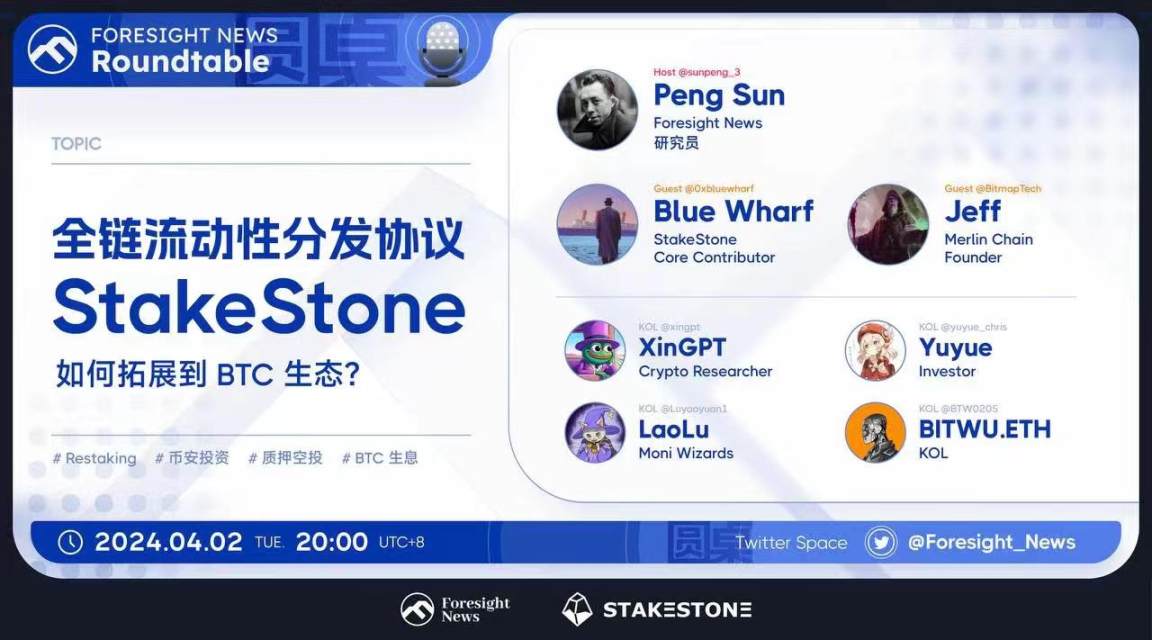
Host: Peng SUN, Foresight News Researcher
Guests: Blue Wharf, Core Contributor of StakeStone; Jeff, Founder of Merlin Chain
Around March 25th, StakeStone announced investments from both Binance and OKX, and recently launched a highly popular airdrop campaign. Additionally, StakeStone announced a strategic partnership with the BTC Layer2 network Merlin Chain, to release interest-bearing BTC "mSTONEBTC" and officially incorporate BTC liquidity into its comprehensive liquidity distribution network. Foresight News invited StakeStone's core contributor Blue Wharf and Merlin Chain's founder Jeff to discuss StakeStone's expansion into the BTC ecosystem and its airdrop plan.
Host: First, please have each guest introduce themselves and their respective projects.
Blue Wharf (Core Contributor of StakeStone): Hello everyone, I'm Blue Wharf from StakeStone. StakeStone is a comprehensive liquidity distribution protocol that serves as the main body of liquidity, including the major liquidity assets in the market. Before the rise of the Bitcoin ecosystem, the main liquidity assets in the market were based on Ethereum. However, during the development of the Bitcoin ecosystem, we recognized the potential of BTC as a new liquidity asset. Based on the vision of liquidity distribution, we chose to fully support and be compatible with Bitcoin assets.
For Ethereum assets, the architecture of our entire protocol is very clear. Users entrust their liquidity assets to us, and we continuously distribute them to the transition layer to obtain risk-free returns. We support various consensus mechanisms such as PoS, restake, AI, and RWA. We are not tied to a specific LP, and ETH is one of our underlying consensus assets. As more consensus mechanisms emerge in the market, we will also support more underlying consensus assets, as these assets are essentially risk-free.
In addition to consensus assets, if there are further risk-free underlying assets similar to RWA in the market, our protocol can also support them. Each underlying asset is a strategy, and this strategy is pluggable. Our entire protocol architecture is designed to distribute liquidity to various risk-free underlying assets. After the emergence of interest-bearing assets, we will distribute them to various chains and their application layers, forming a liquidity distribution protocol based on mainstream assets.
With the growth of the Bitcoin ecosystem, we realized the opportunity for Bitcoin to generate interest for the first time. By creating interest-bearing BTC assets and distributing liquidity downwards, and then distributing to various application layers within the ecosystem, this became possible for the first time. At the inception of this concept, it aligns with our long-term vision for a liquidity distribution protocol, and we officially announced the interest-bearing BTC asset "mSTONEBTC" targeting the Bitcoin ecosystem.
Jeff (Founder of Merlin Chain): Hello everyone, I am the founder of Merlin Chain. Since last year, we have been developing and building many protocols on the Bitcoin layer1, and this year we launched the Bitcoin scaling solution, Merlin Chain. Our main goal is to enable Bitcoin assets to have smart contracts on layer1 in a highly efficient and low-cost environment, and to have better liquidity, as well as easy access to more applications such as DeFi, gaming, and social networking.
Since the launch of Merlin Chain in February, we have nearly 2 million active addresses and nearly 40,000 BTC and a large amount of ORDI native Bitcoin assets on the chain. This time, we also announced our cooperation with StakeStone, hoping to ensure the decentralization of the entire network through this collaboration, and to allow the network's oracles to undertake more data verification and network security maintenance.
Host: What is the core narrative and positioning of StakeStone?
Blue Wharf (Core Contributor of StakeStone): In April of last year, we had in-depth discussions with major liquidity providers and found that these providers found it difficult to supply liquidity using native Ethereum assets. This was because native ETH had a staking yield of around 4%, and the settlement method was based on ETH, with interest settled in ETH. At that time, if a public chain was absorbing ETH liquidity, it would face a 4% PoS opportunity cost. This 4% opportunity cost should not be underestimated, as it is settled in Ethereum, meaning that if you are a public chain token, such as Manta, you would need 10 Manta tokens to cover this 4% opportunity cost.
For projects within the Manta ecosystem, they would need to achieve a potential 20% annualized yield to cover the PoS cost. We believed that this was a significant industry contradiction and an irreconcilable one. When LSDfi became a hot topic in April last year, the contradiction surfaced during the Shanghai upgrade process. We felt that from that moment, the history of ETH as a liquidity asset was about to change.
Because ETH was no longer the most suitable asset in terms of capital efficiency, it meant that someone had to step forward to create a new liquidity asset carrier, a new liquidity standard that would replace the liquidity properties of ETH and cover all opportunity costs, allowing various public chains and others to continue their ecosystem development at a lower cost. We saw this as a significant industry problem and opportunity, so StakeStone was born in April last year. In fact, when we first started discussing this with many chains and projects, not everyone fully understood it. It wasn't until Blast came forward to create a Layer2 with interest-bearing capabilities, exposing the biggest problem to the entire industry.
At that time, we were the only solution provider in the industry, and Manta was the first to adopt this solution. Our cooperation with Manta was very successful, as we not only identified the problem but also solved it, while Blast needed three months to come up with a solution. Seven months earlier, we had already addressed and resolved this issue, so our cooperation with Manta was very successful. Since then, projects have adopted new solutions to attract liquidity. We do not fully trust any underlying assets on the chain in this industry, as these underlying assets are constantly changing. Therefore, StakeStone was designed from the beginning as a protocol compatible with multiple underlying assets. Currently, Ethereum is the largest risk-free underlying asset, but if there are iterations in a few months, everyone will understand the significance and value of StakeStone as an upstream liquidity protocol.
The same logic will soon apply in the Bitcoin ecosystem, and we will continue to use our protocol. It does not mean that the code will remain unchanged; we will still make some customized developments for BTC to address similar issues. For example, it is necessary to have a Bitcoin carrier to help cover the opportunity cost of BTC. Our positioning and vision have always been to distribute the entire liquidity assets to improve the liquidity efficiency of the entire Web3 industry.
Host: What strategic considerations are reflected in this move to enter the Bitcoin ecosystem through interest-bearing BTC? What is the nature of your cooperation with Merlin Chain?
Blue Wharf (Core Contributor of StakeStone): It was difficult for us to predict the current explosive state of the Bitcoin ecosystem. Our initial and simple idea was that in the early stages of the Bitcoin ecosystem, the scale of Bitcoin as a liquidity asset was much smaller than that of Ethereum. Therefore, the Bitcoin ecosystem also needs a larger and better liquidity asset for corresponding settlement.
So when we first started in the Bitcoin ecosystem, we partnered with Merlin Chain to provide interest-bearing ETH. With the development of the Bitcoin ecosystem, we felt that simply offering interest-bearing ETH for Bitcoin ecosystem liquidity was no longer sufficient to meet the needs of the Bitcoin ecosystem. This is why we decided to further offer interest-bearing BTC. Currently, there are two approaches to interest-bearing BTC. One is a solution similar to Babylon, where a timestamp is created on another chain, and then someone issues a bill on the chain. The other approach is to directly issue bills on the Bitcoin chain.
The first approach seems very Crypto Native because the asset's collateral is on a public chain. However, there is a major issue with this approach: Layer1 itself does not have interest-bearing capabilities. Therefore, those using the first approach must seek a genuine source of interest, as they do not have interest-bearing capabilities themselves. They must find a chain that can provide interest, leading to a contradiction: why should I distribute the interest I generate to a third party? This is a sharp contradiction.
If Ethereum had Restake from the beginning instead of first implementing PoS and then Restake, no one would have paid attention to this issue. Today, Restake's main funding still relies on Ethereum PoS for support, and it is difficult to rely solely on AVS for support.
We believe that the primary issue to address in the Bitcoin ecosystem is PoS, rather than the need to address shared security first. We need to establish our own security mechanism first, and then have a third party offer to share security, rather than having a third party provide all of our security. Therefore, the core part of the complete security is PoS. We believe that the second approach is more important. We believe that we should first serve Merlin Chain and make the PoS mechanism sufficiently robust, rather than first establishing shared security and then providing shared security to Merlin Chain.
Host: How does Merlin Chain operate? How does it differ from other Bitcoin Layer2 solutions?
Jeff (Founder of Merlin Chain): Before February of this year, there was a lot of confusion about BTC L2. Many people thought it was a pseudo-concept, and I believe that many still think it is. The definition of BTC L2 is also unclear. The entire Bitcoin scaling solution is quite chaotic and is a state of contention among many. I think all projects are constantly exploring, and we are very pleased to see that whether it's new Bitcoin scaling solutions from overseas or in Asia, everyone's approach is getting closer to what we said a month ago.
So what is this approach? First, there needs to be a decentralized consensus mechanism to ensure the security and anti-fragility of the entire network, which is a core reason for our collaboration with StakeStone. Second, the most native trading data needs to be shared in a third-party form, allowing all nodes and users to participate in maintaining the data. Third, exploring anti-fraud mechanisms on the Bitcoin layer1. For example, Babylon's pure layer1 mechanism uses timestamp scripts for secure collateral. However, it is difficult to do this on layer2 because users' funds on layer2 are spent, so if layer1 funds are only locked through scripts, there will be double spending on layer2.
So today, all BTC L2 projects are exploring the possibility of implementing anti-fraud mechanisms on Bitcoin layer1. Therefore, all BTC L2 projects need to consider these three things. It's not enough to do any one of these well. If Bitcoin purely implements PoS, it may be questioned for not having a highly bound network security on layer1. However, if you want to slash on layer1 and implement anti-fraud mechanisms on layer1 through Rollup, Bitcoin's network itself is not a Turing complete environment, so it cannot achieve these things.
So in reality, everyone is constantly wavering between reality and ideals, trying to achieve security and network node mechanisms in various dimensions.
What we are doing with interest-bearing BTC is to maintain a decentralized Oracle network to uphold the simulated network security, whether in the form of agents or direct user participation. The nodes on Merlin Chain need to do a lot of work, such as data compilation, zkproof circuit compilation, uploading to the Bitcoin mainnet, verification on the Bitcoin mainnet, multi-party verification between Oracles, and ultimately generating signatures on the Bitcoin layer1, as well as zkproof settlement and final authentication. These tasks need to be carried out by the Oracles in our network.
These Oracles themselves need to stake a lot of BTC to maintain the network security, so if there is fraud or dishonest behavior, they will be slashed to compensate for the losses incurred by users. As network maintainers, they will also enjoy the network's fees and governance token incentives. Ordinary users can participate in this plan and join different nodes to earn profits.
Once interest-bearing BTC is minted, it can be used in various projects on Merlin Chain to generate multiple layers of financial returns.
Host: How does the comprehensive liquidity protocol StakeStone empower the Bitcoin ecosystem?
Blue Wharf (Core Contributor of StakeStone): I mentioned the structure of comprehensive liquidity distribution. First, we still believe that liquidity should be used for PoS-related functions, as PoS is currently the lowest-risk, only risk-free, and long-term sustainable source of income. First and foremost, liquidity must be distributed to the consensus layer. After minting interest-bearing BTC, if the consensus layer is sufficiently robust, it can continue to distribute to Layer3 or more application layer protocols to reduce everyone's capital costs.
The overall structure is the same for BTC, with the only difference being that the entry point for liquidity has shifted from layer1 to layer2, as BTC L2 corresponds to the role and function of Ethereum layer1. This is because it is difficult for BTC layer1 to execute more commands.
Jeff (Founder of Merlin Chain): Bitcoin assets have been overlooked in the blockchain wave over the past few years. They are more commonly seen as digital gold, with limited practical use. Ethereum has reaped the benefits over the past four years. Although Ethereum's market value has not surpassed that of Bitcoin, it is undoubtedly more popular among users, and ETH assets can participate more effectively in various ecosystems.
When I asked many American friends about their initial exposure to Web3, they only had ETH, and not stablecoins or BTC. This is because they needed to use ETH to buy small images, so the benefits were very clear. Now we are seeing the opportunity in the Bitcoin ecosystem, including the fact that the volume of Bitcoin itself is enough to create a larger ecosystem than Ethereum's.
Under these circumstances, the properties of Bitcoin assets need to be reconsidered. When StakeStone discussed this with us, we were very excited because our PoS network requires Bitcoin to ensure network security. In simple terms, it allows more people to participate in network maintenance. If there are failed transactions or fraudulent behavior, these nodes need to bear the losses incurred by users.
Once interest-bearing assets appear, they can be used in more ecosystem protocols and projects. Users holding Bitcoin will not just wait for it to appreciate; it will have more applications. Whether participating in ecosystem applications, maintaining the network security of Merlin Chain, or using interest-bearing assets to participate in more projects, its financial attributes will become more prominent. This will actually attract more users to hold Bitcoin and participate in the Bitcoin ecosystem, which is where I believe the core value of the comprehensive liquidity protocol lies.
Host: How do you think interest-bearing BTC will reshape the Bitcoin ecosystem?
Blue Wharf (Core Contributor of StakeStone): I think there will soon be many BTC L3 solutions. For L3, the emergence of interest-bearing BTC is crucial; otherwise, the efficiency structure of interest-bearing BTC funds will be very low. Therefore, interest-bearing BTC is needed to address the connection issue between L2 and L3, which will bring about significant structural changes. From the perspective of applications across the entire chain, the emergence of interest-bearing BTC will reduce the capital costs on the chain. In today's Ethereum L2, many chains have almost no ETH left, and interest-bearing ETH has replaced Ethereum as the main asset for ecosystem development.
In fact, interest-bearing BTC may also go to other chains, which is another important aspect of what StakeStone is doing. We are distributing comprehensive liquidity, not only vertically distributing to the underlying layer and the upper layer but also horizontally distributing liquidity. Therefore, liquidity is a comprehensive chain structure. In the future, interest-bearing BTC may also be like this, connecting to more BTC Layer3 or other networks to provide a comprehensive liquidity distribution structure.
Jeff (Founder of Merlin Chain): Everyone is talking about Bitcoin Layer2, but if you look closely, you will find that various projects are actually creating Ethereum for Bitcoin. Because Bitcoin itself is not Turing complete and cannot do what smart contracts can do, our approach to its scalability is essentially creating a large and comprehensive Ethereum. For Ethereum, network security is crucial, which can lead to performance bottlenecks, requiring various chains to supplement its performance issues.
These Layer3 solutions are actually based on the security of Merlin Chain to form a consensus. We are all essentially creating Ethereum for Bitcoin, and I think people will gradually understand this.
Some traditional Bitcoin financial services require an independent network environment to implement. For example, in traditional Bitcoin finance, there is high demand for lending and collateral, which is not easy to run on layer2 because its ledger is a CeFi ledger, but it needs to run a DeFi model on Merlin Chain. In reality, its fund security and fund rate issues cannot be met.
In simple terms, after decentralizing the ledger, it can conduct CeFi business at low cost and high security, while also sharing DeFi liquidity with the layer2 user base. DeFi demand is much greater than CeFi; for example, in CeFi, a 2-3% return is already high, but in DeFi, users may demand a 10% or even 20% return when borrowing coins. Therefore, it is essentially bringing CeFi onto the chain and sharing DeFi liquidity. The actual volume of this business is not just covering $10 billion; it is a very large traditional Bitcoin fund volume, but it is still very chaotic today. In fact, I think the terms Layer2 and Layer3 are not precise enough. I believe the role that Merlin Chain and our chain play is more like Ethereum layer1 and layer2.
The asset properties of BTC are relatively fixed, and people have very high expectations for it. Therefore, on a strong consensus basis, giving it some financial possibilities and interest-bearing possibilities is important. Bitcoin's market value is currently around $1.3 trillion, and with even a small portion of that having interest-bearing expectations and empowerment, it will have a significant impact on the development of the ecosystem and the prosperity of the entire network.
So I think today we are not discussing how it will reshape the Bitcoin ecosystem, but rather what will happen after opening up the possibilities.
Host: Let's have Wharf introduce StakeStone's airdrop activity.
Blue Wharf (Core Contributor of StakeStone): We will have three parts to complete the entire airdrop plan. The first part is actually a low-threshold activity that anyone can participate in. In the second part, we will collaborate with many chains, and each chain will have its own basic activities and ecological incentive plans. We will not conduct activities, but we will empower each public chain to carry out activities. Since we are doing liquidity distribution, the second part mainly reflects the distribution mission, and some tasks are quite hardcore and have certain thresholds.
However, we have encountered a small difficulty in that we did not add time weighting. Many large holders feel that there is no difference between depositing on the first day and the second day, so they are all waiting, creating a game dilemma. So we will add time weighting again and reorganize the rhythm. The third part is that we have a very large community, including mBTC, and we have previously cooperated with many media outlets. We will provide consolation prizes to the media and reward behaviors that have interacted with StakeStone in the past. We will first add time weighting, make adjustments, and then introduce assets like mBTC.
Many DeFi whales like to stack layers, but in reality, the more layers you stack, the higher the yield is not necessarily true. We will not stack too many layers, and ordinary users will not stack too many layers. We may lock in until the end of May, so just stacking one layer can account for everyone's capital efficiency.
The most important thing about airdrops is the withdrawal. Depositing money is very easy, and any protocol can do it. But withdrawing money is not as easy, and it really tests the protocol's capabilities. The act of withdrawing money significantly affects the yield. We are very clear about the timing of withdrawals, but many protocols do not inform users when they can withdraw. During our cooperation with Manta, there was a serious block congestion when withdrawing money, with two transactions occurring in the same block. Because Ethereum has a 12-second block time, block congestion is very serious. It only occurs in normal network conditions when there is a huge TVL trying to withdraw in a very short time.
To prevent block congestion, we need to create a queuing system. Engineers may have to work continuously for 22 hours without sleep to create a temporary queuing system. When there is block congestion, if one person fails to withdraw their money, they will have to pay a high gas fee. If 10 people submit transactions in the same block and 9 of them fail, all 9 will have to pay gas fees. So, we have specifically created a queuing system for this.
Host: Where is the future of interest-bearing Bitcoin, will it be realized on layer1 or layer2, and can a comprehensive liquidity infrastructure help strengthen Bitcoin's liquidity?
Jeff (Founder of Merlin Chain): Babylon does timestamping on layer1, but under their approach, there is actually no way to do Restake. If it first pledges funds to a decentralized network through a layer2 protocol and then adds a timestamp, it is actually a two-way interest-bearing mechanism from layer2 to layer1.
I personally think that interest-bearing BTC will definitely happen on layer2 because the Bitcoin network only requires miners to mine. It is a PoW consensus, not PoS, so it does not require your Bitcoin to do anything, and you cannot use your Bitcoin to do anything else.
The source is likely to be these applications, protocols, and new networks in the ecosystem, and you provide liquidity and security to these networks, and they provide corresponding incentives to you. So, the source of these financial returns actually comes from the ecosystem. When people talk about the Bitcoin ecosystem today, it actually refers more to applications on layer2.
Blue Wharf (Core Contributor of StakeStone): For example, one person works on layer1, but the work itself does not generate income, while another person works on layer2, and their work brings income to BTC. At this point, the person working on layer1 does not directly contribute to creating income but tries to take a large portion of the profit from the person creating contributions, which I think is unjust.
We firmly believe that interest-bearing BTC should first emerge on BTC L2. However, Jeff mentioned something very interesting. If you pledge mBTC on layer2, the actual native BTC can be staked on Babylon on layer1. In this way, you can not only receive the Babylon airdrop but also earn simulated PoS income from mBTC. After obtaining interest-bearing BTC, you can then participate in applications and distributions to earn additional income. We believe that the combined income structure is the most reasonable way for mBTC holders to earn income.
Host: Restaking is essentially a nesting game. Where do you think the risks lie?
Blue Wharf (Core Contributor of StakeStone): EigenLayer has actually created a middleware for consensus layer liquidity distribution, and each future AVS will run its own client. Essentially, for each chain, an AVS will have its own PoS client, similar to an operator running clients for iOS. The main innovation of EigenLayer comes from its belief that one Ethereum can provide shared security for multiple clients, resulting in Ethereum having AVS1, AVS2, AVS3, and so on, which theoretically is the collective income of AVS(N).
What are the risks? The more levels of N you undertake, the greater the risk of slashing. If any one of them gets slashed, they all get slashed. If there are 100 AVS, can you run all 100 AVS? Can your Ethereum be used 100 times? The service capacity of being able to use it 100 times is essentially the operator running 100 clients. These 100 iOS clients may upgrade A this week, B next week, and C and D combined the following week, so it becomes an operational work, and the income given by each AVS is actually very low.
Host: What if a run on the bank occurs?
Blue Wharf (Core Contributor of StakeStone): Because our underlying assets can be completely restored, there is no run on the bank; there is only a queuing issue for short-term withdrawals.
免责声明:本文章仅代表作者个人观点,不代表本平台的立场和观点。本文章仅供信息分享,不构成对任何人的任何投资建议。用户与作者之间的任何争议,与本平台无关。如网页中刊载的文章或图片涉及侵权,请提供相关的权利证明和身份证明发送邮件到support@aicoin.com,本平台相关工作人员将会进行核查。


