Airpuff will integrate a new insurance pool, launch more on-chain projects, and release the $APUFF token.
Authored by: THOR AND HYPHIN
Translated by: DeepTechFlow
Introduction
In the current DeFi activities, the strategy of airdropping points through leveraged exposure is likely the best strategy. Participants in the first season of the Ethena activity received returns ranging from 100-500% based on their leveraged exposure to Ethena's "shards". Many are looking forward to Eigenlayer and its LRT ecosystem to provide comparable returns. Currently, the value of EIGEN points ranges from 0.2 to 0.4 USD. One way to obtain these points is through Airpuff.
Airpuff is a multi-chain currency market that provides leveraged exposure for points projects such as Eigenlayer, Renzo, Etherfi, Kelp, and Ethena. Users can obtain leverage of up to 12.75 times the points, or trade by lending assets, which can yield over 50% annualized interest. Airpuff is preparing for their $APUFF TGE, and the Foundry LBP will continue until 12:00 PM UTC on April 11th. Today's report will analyze the Airpuff protocol, the $APUFF token, and provide specific strategies and expected returns.
Using Airpuff for leveraged point airdrop activities
The core of AirPuff consists of two key components that work together to facilitate leveraged point activities.
1. Lending
All necessary lending operations are executed through lending pools, which allow depositors to earn high yields across multiple networks by providing liquidity to the platform.
Deposits do not incur any fees, but withdrawing assets from the lending pool incurs a fixed 0.2% fee.
The interest received from providing assets is determined by the utilization rate of the collateral pool, which means it fluctuates continuously based on demand. Accrued interest is snapshot hourly and allocated to the value of the borrowed tokens, thus achieving effective compounding.
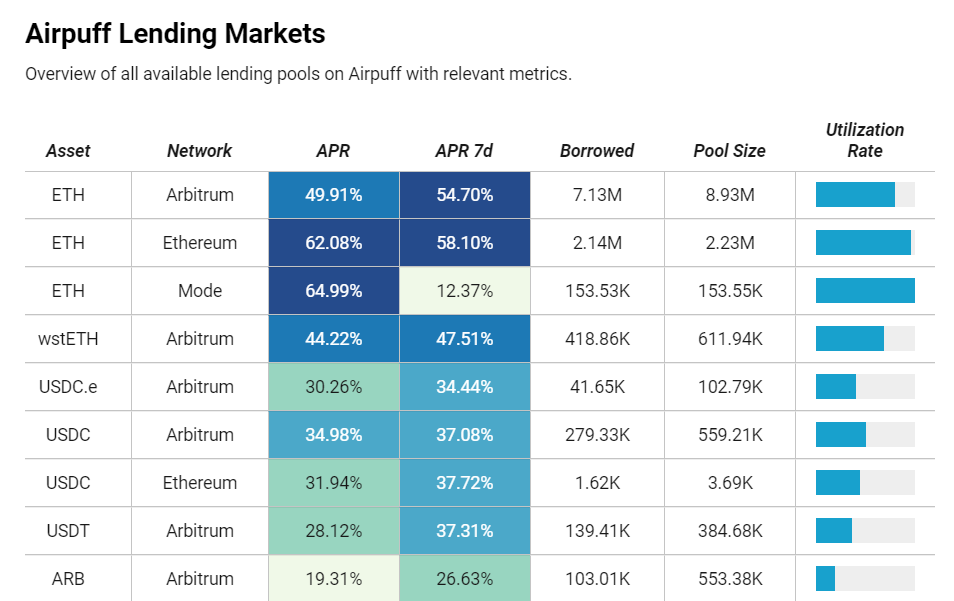
In most cases, there is a high demand for ETH and the yield is most attractive, mainly because borrowing non-ETH assets will automatically convert the collateral into ETH at the time of opening, effectively going long and introducing additional price risk to the borrower.
Another benefit of participating in the lending market is that users can receive a certain share of all points obtained from using collateral.
WhalesMarket data shows that liquidity providers have collectively earned approximately $77,000 in points from all lending pools.
Borrowers are also eligible to receive point rewards from AirPuff based on the specific assets provided (ETH and stETH for higher rewards), time, and quantity.
2. Airdrop
The protocol's native airdrop strategy Buffs can be used to obtain amplified airdrop rewards.
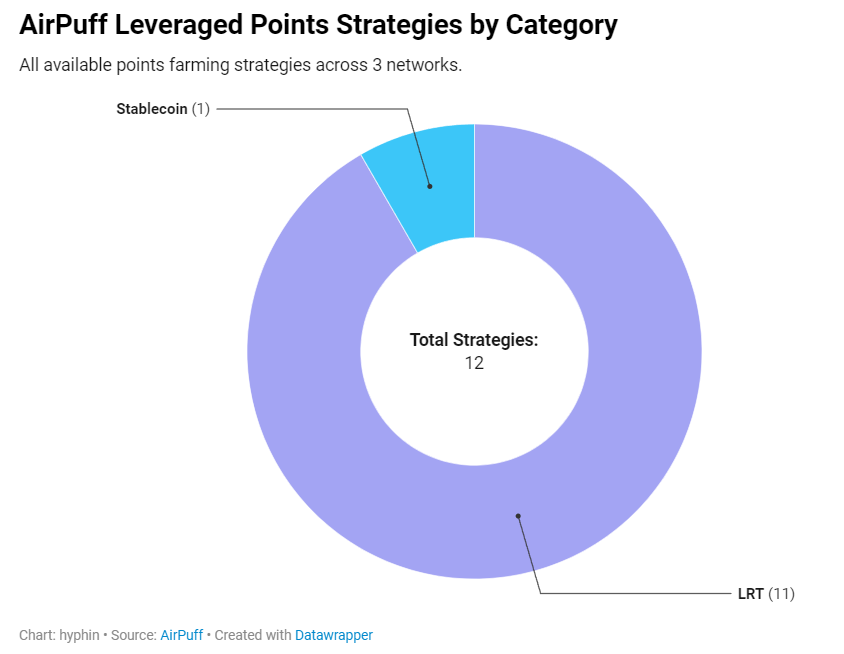
Currently, there are 12 different buffs available on 3 different networks, with most strategies related to providing EigenLayer points with LRT, while also offering native protocol incentives. However, there are also some choices that include additional unique ecosystem rewards (e.g., earning Mode points by using strategies on Mode).
Depending on the strategy, users can utilize various collateral options to maximize potential rewards from activities (including AirPuff), with leverage of up to 15 times. When borrowing any assets, it is important to note the higher than normal interest rates and consider the complexity of using non-ETH collateral.
10% of all points obtained from leveraged positions will be allocated to lenders, and an additional 5% will be allocated to veAPUFF participants. Closing positions also incurs a fixed 0.2% fee.
For speculators with lower risk preferences, there is also a non-leveraged airdrop option available, while taking advantage of the platform's rewards and incentives.
Expected Returns
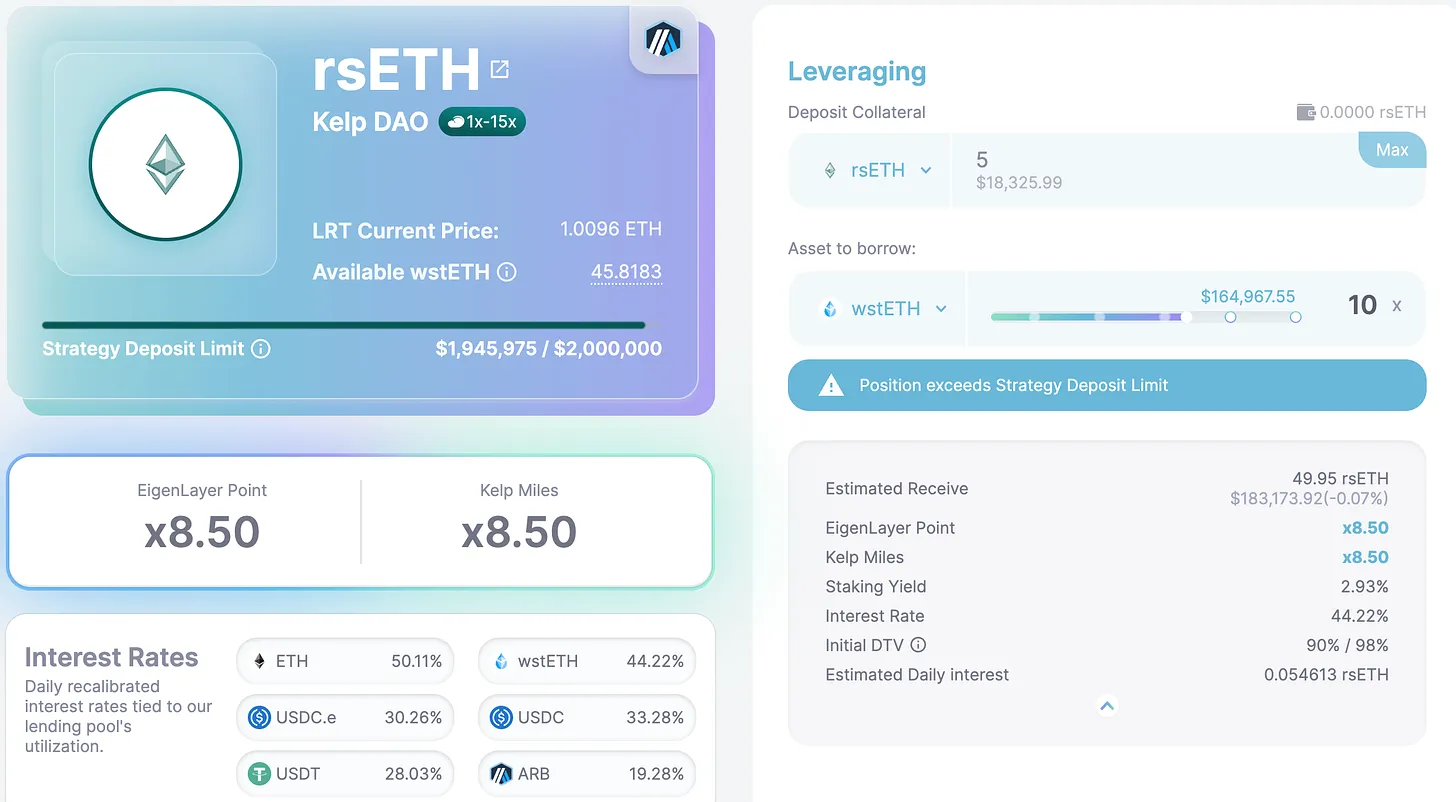
To illustrate the potential returns of the strategy, let's take a look at the rsETH liquidity restaking token from Kelp on Airpuff. The image below shows the insurance pool on Airpuff. Although it is almost full now, the future capacity is likely to increase.
In this example, using 5 ETH as collateral, wstETH is borrowed at 10 times leverage. Then, each cycle will convert wstETH into rsETH. Since Airpuff allocates points to veAPUFF holders and lenders, the effective points leverage is 8.5 times. The interest rates for various assets can be seen in the bottom left corner.
The following is the return calculation for this strategy. The value of Eigen points and Kelp Miles is based on predictions of TVL and airdrop percentages in another post and should be approached with caution (although these prices are more conservative). As seen, by depositing 5 ETH, leveraging at 10 times for 30 days, and borrowing wstETH, the strategy's return is a 16.94% ROI, equivalent to approximately 206% annualized return. It is important to remember that there are many assumptions here, so actual returns may differ from the estimates.
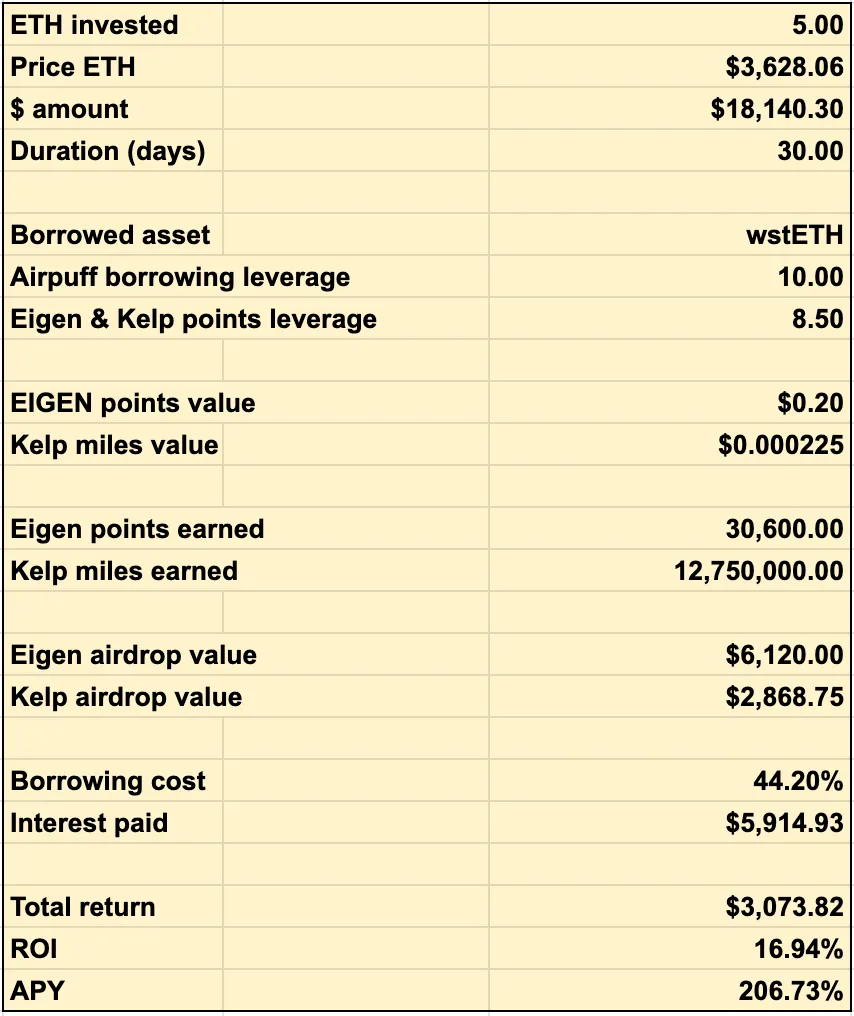
Since the utilization rates of various markets are all above 80%, the current lending rates are very high, which has a negative impact on returns (paying nearly $6,000 in interest). More information about these is as follows:
0-80% utilization: Rates will increase linearly from 5% to 15%.
80-100% utilization: Rates will increase linearly from 15% to 45%.
Since borrowing rates are much lower, why not borrow in USDC or ARB? Because you would take on more liquidation risk. If the value of rsETH against USDC or ARB decreases, you may be liquidated and lose the entire deposit. As leverage increases, the risk of liquidation also increases. The return of borrowing ARB compared to borrowing wstETH is as follows:
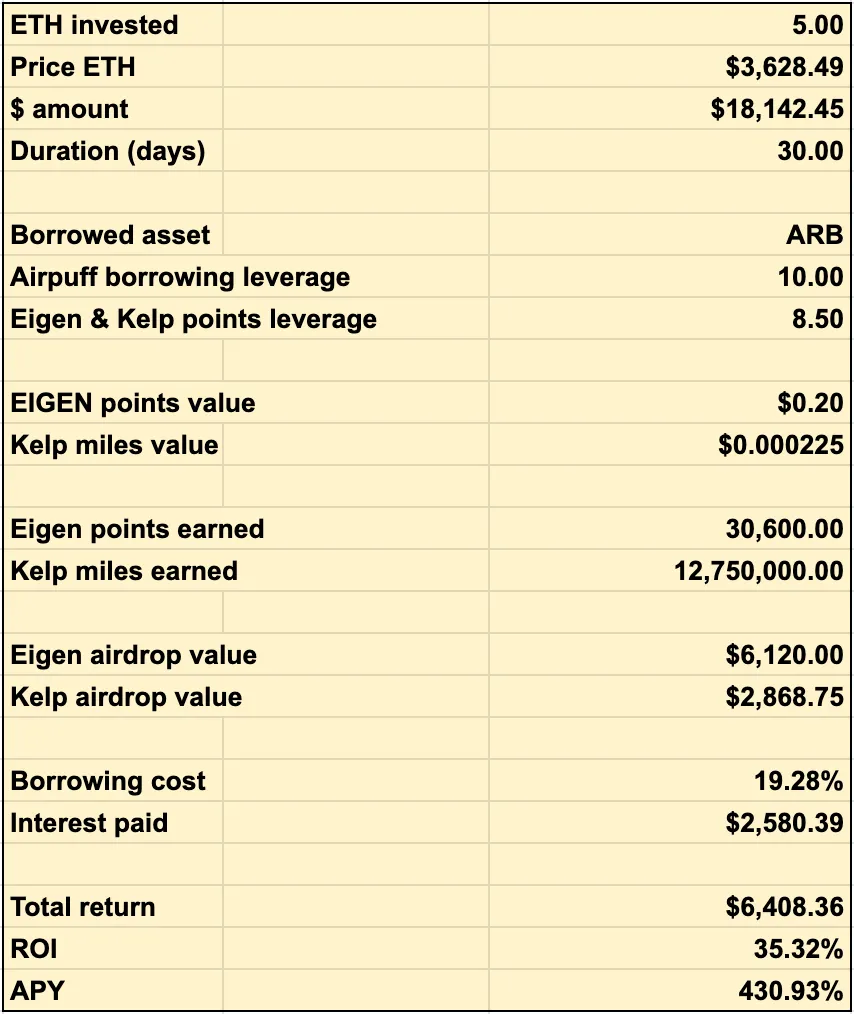
As seen, the return is higher. However, it is important to note that the liquidation risk is also higher.
TGE & $APUFF
Early depositors in Airpuff can not only obtain base points through Eigenlayer and LRT, but also receive "Airpuff points", which will be airdropped as $APUFF in May. A total of 7% of the $APUFF supply will be airdropped to protocol users over two seasons, with 4% airdropped in the first season and an additional 3% in the following season. For more information on how to qualify, please refer to this page.
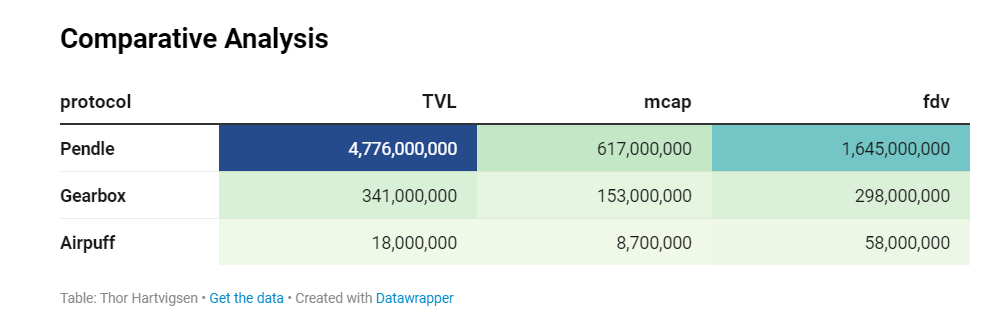
In addition, the $APUFF Liquidity Bootstrapping Pool (LBP) is currently live on Fjord Foundry from 12:00 AM UTC on April 8th to 12:00 AM UTC on April 11th. At the time of writing, Airpuff has raised $2.5 million in $APUFF through the LBP, which will bring the token's market value to $8.7 million and the FDV to $58 million. Click here to access the LBP website.
Once the LBP ends, the $APUFF token will go live. The initial circulating supply will be 16% (15% from LBP and 1% from private placement). Below are some comparison metrics between Airpuff, Pendle, and Gearbox.
APUFF Token Economics
Airpuff uses a dual-token model for $APUFF. Users can choose to lock $APUFF to obtain veAPUFF (similar to vePENDLE), which gives them the right to vote on token incentive allocations in various markets and earn rewards through bribes. These bribes come from the protocol paying Airpuff for formulating reserve strategies and directly issuing rewards as a means to promote protocol growth and increase adoption.
To further strengthen the token holder community and qualify for $APUFF issuance, users must lock at least 5% of the value of their holdings in veAPUFF. Finally, Airpuff extracts a 5% fee from all points obtained from lenders and borrowers (Eigen points, LRT points, etc.) and allocates it to veAPUFF holders to further enhance the utility of the token.
Conclusion
2024 is the year of points trading, and Airpuff has uniquely achieved this with its currency market and built-in leverage. In the coming months, Airpuff will integrate a new insurance pool, launch more on-chain projects, and release the $APUFF token, allowing users to have more exposure to various points projects.
免责声明:本文章仅代表作者个人观点,不代表本平台的立场和观点。本文章仅供信息分享,不构成对任何人的任何投资建议。用户与作者之间的任何争议,与本平台无关。如网页中刊载的文章或图片涉及侵权,请提供相关的权利证明和身份证明发送邮件到support@aicoin.com,本平台相关工作人员将会进行核查。


