Author: 1912212.eth, Foresight News
DA (Data Availability) simply means that block producers publish all transaction data of the block to the network so that validators can download it. If the block producer publishes complete data and makes it available for download by validators, we say the data is available. The DA layer is a layer abstracted out along with the expansion needs of various blockchains and the higher requirements for DA. We have seen a large number of projects emerge in the market, such as Celestia, EigenLayer, NearDA, Avail, and so on. These projects often stand alone, wave their own flags, and vow to make a name for themselves.
As the Bitcoin ecosystem is gradually favored by funds, various technical routes related to Bitcoin are also emerging. L2, staking, and DeFi projects that bring BTC into Ethereum or Solana have taken the stage, and BTC's native DA projects have also begun to receive market attention.
Just recently, NubitNubit completed a $3 million Pre-Seed round of financing, with dao5, OKX Ventures, Primitive Ventures, and others participating, and the team stated that they are preparing for the mainnet launch.
What is Nubit?
Nubit is a scalable Bitcoin-native DA layer, with security protected by Bitcoin. Nubit can effectively expand the data capacity of Bitcoin, providing support for applications such as Ordinals, L2, and oracles, thereby expanding the scope and efficiency of the Bitcoin ecosystem. It aims to fully inherit the security of Bitcoin, including economic security, resistance to tampering, and resistance to censorship.
When the cryptocurrency market is hot, the transaction fees for Bitcoin transfers or trades are often quite high, and even significant congestion occurs. The surge in demand in the market last year led to the storage of over 14GB of data on Bitcoin, resulting in extremely high costs. Data from its official website shows that Nubit can reduce transaction fees by over 95% and increase data throughput by over 100 times.
Nubit Architecture
Nubit mainly consists of four basic components: validators, trustless bridges, full storage nodes, and light clients.
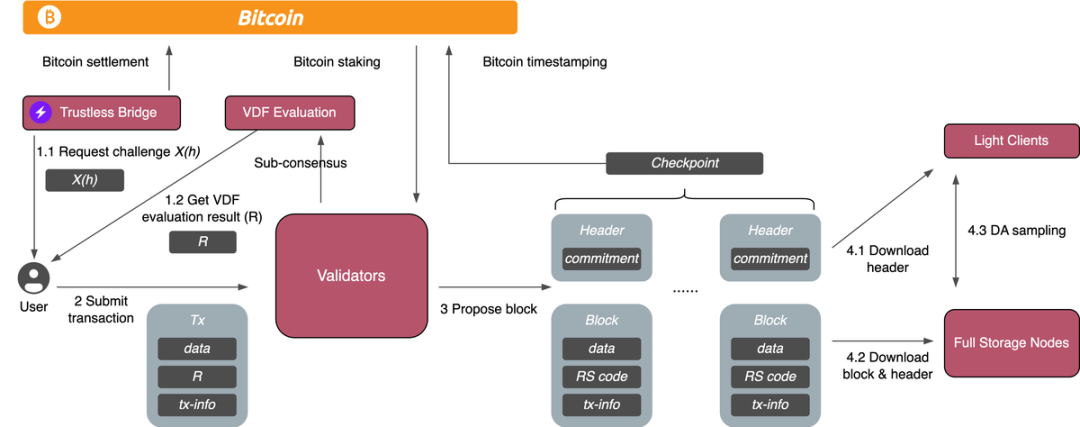
Among them, validator nodes mainly use the Practical Byzantine Fault Tolerance (PBFT) consensus algorithm, with the main task of proposing, verifying, and ensuring the integrity of transactions. The minimal trust bridge acts as an intermediary, charging users storage fees and distributing rewards to validators through payment channels. Full storage nodes mainly delegate the reliable storage of all data received from validators. The light client obtains blocks broadcasted by validators, including data commitments, and may randomly request data from full storage nodes to verify DA.
Nubit Highlights and Features
In terms of consensus mechanism, Nubit still adheres to the semi-synchronous network assumption. It introduces a consensus algorithm NuBFT that is deeply optimized for DA. NuBFT is a variant of the BFT consensus algorithm, combining the data partition process based on RS encoding and the generation of KZG. Even if some data nodes are damaged, the use of RS encoding can restore the original data.
In addition, the KZG submitted to Bitcoin ensures the validity of the original data. By integrating the block partitioning of RS encoding and the generation of KZG into the consensus algorithm, the integrity, availability, and scalability of stored data are directly linked to the consensus process, significantly enhancing the "robustness" of the entire DA system.
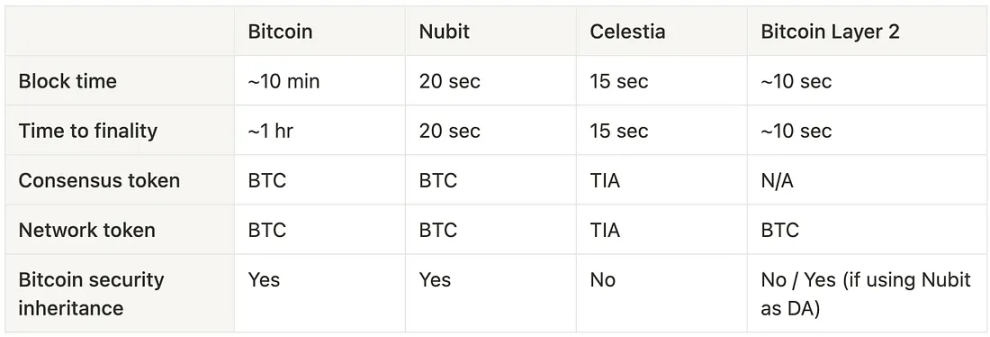
It is worth noting that Nubit uses BTC as the primary token for the consensus protocol, inheriting the economic security of Bitcoin through Bitcoin-native staking mechanisms such as Babylon. In contrast, general DA layers like Celestia use their network tokens, introducing additional trust assumptions outside of Bitcoin.
In terms of data availability, to address potential network interruptions caused by node data encoding errors, Nubit adopts a hybrid approach, integrating full nodes and light nodes to ensure data integrity. First, Nubit uses KZG as a proof of validity to ensure DA, while maintaining simplicity and reducing memory, bandwidth, and storage requirements. Even in the event of a complete collapse of the Nubit network, nodes can still recover data using full nodes and KZG commitments submitted to Bitcoin. To further enhance network scalability, Nubit adopts light nodes equipped with Data Availability Sampling (DAS). This addition can expand block size to meet the growing demand for data availability.
However, unlike other Bitcoin L2 solutions, Nubit does not have a smart contract execution layer.
In terms of trustless cross-chain bridges, previous Bitcoin L2 solutions usually relied on centralized cross-chain bridges, which potentially created security vulnerabilities due to Bitcoin's specific architecture limitations. Nubit directly chooses the Lightning Network, enabling Nubit to establish a secure and trustless bridge in the Bitcoin ecosystem.
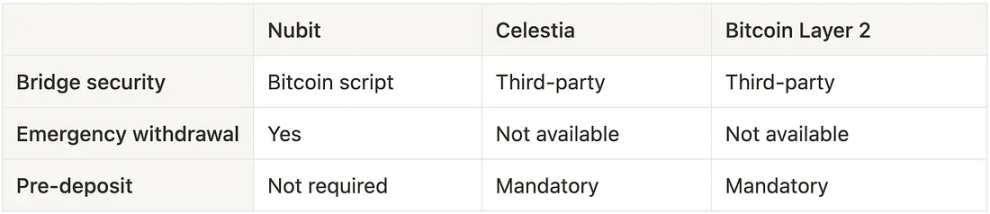
Nubit settles network fees using Bitcoin payment channels, which is a key difference from other BTC bridge solutions. Nubit users are not required to make deposits. Instead, they handle transaction fees directly within the state channel of each transaction, ensuring the security of user funds is directly related to the security of Bitcoin itself. In addition, Nubit's design allows for emergency withdrawals, so even if Nubit ceases operation, users can reclaim funds by closing Bitcoin payment channels.
Conclusion
In the past BTC technical practices, to some extent, solutions like SegWit, Taproot, and others have more or less enhanced Bitcoin DA. However, the emergence of Nubit seems timely, as at that time, modularization and the L2 wave had not yet risen, and a completely new solution has now appeared. After tirelessly collaborating with projects like Babylon, Merlin, BounceBit, etc., Nubit has stated that it will officially launch the mainnet later this year. The future development is worth paying attention to.
免责声明:本文章仅代表作者个人观点,不代表本平台的立场和观点。本文章仅供信息分享,不构成对任何人的任何投资建议。用户与作者之间的任何争议,与本平台无关。如网页中刊载的文章或图片涉及侵权,请提供相关的权利证明和身份证明发送邮件到support@aicoin.com,本平台相关工作人员将会进行核查。


