Article Source: AI Fan
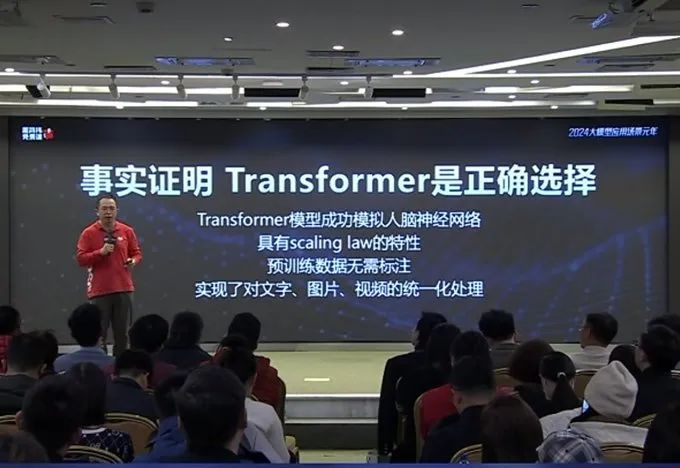
Yesterday, the well-known Chinese entrepreneur Zhou Hongyi discussed the Transformer architecture in a public lecture on artificial intelligence and put forward a series of viewpoints. These viewpoints subsequently sparked widespread controversy, with many netizens pointing out unprofessional aspects. In this commentary, we will analyze Mr. Zhou's viewpoints one by one and point out the misconceptions.
First, Mr. Zhou believes that the Transformer model successfully simulates the human brain's neural network. This viewpoint seems to oversimplify the complex relationship between the Transformer model and the human brain's neural network. Although the Transformer has achieved great success in processing sequence data, equating it directly with the workings of the human brain's neural network is inappropriate. The human brain's neural network is extremely complex, containing billions of neurons and interactions far exceeding those of the Transformer model. Therefore, although the Transformer performs well in certain tasks, it is far from replicating or simulating the complexity and functionality of the human brain.
Secondly, Mr. Zhou mentioned that the Transformer achieves unified processing of text, images, and videos. This is technically correct but requires further clarification. The Transformer architecture does indeed demonstrate strong flexibility in processing different types of data, especially through the application of models such as BERT, GPT, and Vision Transformer. However, this "unified processing" does not mean that all types of data can be processed in exactly the same way, but rather through adaptation and adjustment of the architecture to handle different types of data. Each data type has its specific processing methods; for example, the Vision Transformer for processing image data and the GPT for processing text data have significant internal structural differences.
Regarding the characteristic of having a scaling law, this viewpoint is well-founded. Research does show that as the model size increases, the performance of the Transformer model improves according to a certain scaling law. This finding is of great significance for model design and future research. However, this is not a unique feature of the Transformer, as other types of models also exhibit similar patterns.
Mr. Zhou also mentioned that pre-training data does not require labeling, which needs clarification. Although for certain tasks such as natural language understanding (NLU) and generation (NLG), the Transformer can utilize a large amount of unlabeled text for pre-training, this does not mean that all pre-training does not require labeled data. In fact, for specific tasks such as image recognition or video understanding, high-quality labeled data remains crucial.
Finally, Mr. Zhou asserts that the Transformer is the correct choice. While the Transformer architecture has undoubtedly achieved significant success in multiple fields, regarding it as a universal solution is inappropriate. The development of the technology field has always been a diverse and iterative process, and different tasks and applications may require different solutions. Blindly regarding the Transformer as a model solution may limit our exploration of other possible innovative paths.
In summary, although some of Mr. Zhou's viewpoints reflect recognition of the achievements of the Transformer architecture, they appear to be overly simplified or even misleading in certain aspects. Correctly understanding and evaluating any technology requires a deep understanding of its principles, careful consideration of its application scenarios and limitations, rather than making sweeping generalizations. In the rapidly developing field of AI, maintaining an open and critical thinking approach is particularly important.
Note: The viewpoints in this article are from GPT-4.
免责声明:本文章仅代表作者个人观点,不代表本平台的立场和观点。本文章仅供信息分享,不构成对任何人的任何投资建议。用户与作者之间的任何争议,与本平台无关。如网页中刊载的文章或图片涉及侵权,请提供相关的权利证明和身份证明发送邮件到support@aicoin.com,本平台相关工作人员将会进行核查。


