Author: Teng Yan, Researcher at Delphi Research
Translation: Luffy, Foresight New
I have been thinking about the debate between Ethereum and Solana, which is a hot topic in the cryptocurrency field.
Here I do not intend to delve into their technical differences, as there have been many in-depth analyses within the industry, such as the Solana paper by Syncracy Capital. I highly recommend everyone to read it.
Instead, I would like to provide my personal perspective on the direction of our industry's development.
I believe that Solana may become one of the most valuable human inventions in the future, alongside Ethereum and Bitcoin.
We are running out of time
Cryptocurrencies have been around for over 10 years. They have attracted billions of dollars from investors and have become a magnet for attracting the smartest talents. We may be one of the most talent-concentrated industries (perhaps excluding artificial intelligence).
However, we have not yet discovered that elusive killer use case: something that people cannot live without, and if deprived of it, ordinary people would feel exceptionally painful. In this way, it would be impossible for governments to shut down cryptocurrencies.
We urgently need the "ChatGPT moment" for cryptocurrencies. ChatGPT is an application that has gained 100 million users in the shortest time, in just 2 months.
As time passes, the pressure is increasing. Although cryptocurrencies currently have some political and social support, if they do not produce any influential results, these sentiments will weaken over time. We are at a crossroads, and the next few years will determine whether cryptocurrencies will become a key, world-changing technology.
We cannot wait any longer; the time is now.
In order for us to achieve killer applications, the infrastructure layer must be prepared for this.
The story of two philosophies
Ethereum and Solana adopt two different philosophies, but ultimately aim for the same end state.
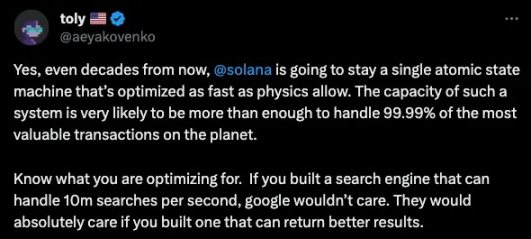
Solana's philosophy is to first build a useful blockchain, and then achieve decentralization and censorship resistance over time. It is designed for high performance and aims to become the best execution layer.
- Low cost, low latency, high throughput
- Solana is optimized for atomic composability, considering it the most useful feature of blockchain
- UX improves upon EVM (e.g., no need for token approval)
- Solana scales with hardware, as Moore's Law has been in effect for decades
- After 3 years of battle testing, tools and partnerships are in place.
Toly succinctly outlines his vision here:
On the other hand, Ethereum's philosophy is to first build a decentralized and censorship-resistant blockchain, and then improve its usability over time.
This has brought ETH a currency premium. Ethereum's future development plans (Surge, Verge, Purge, Splurge) focus on improving its scalability. This is a journey that will unfold gradually over the next few years, not immediately. Currently, transaction costs are high, and throughput is low.
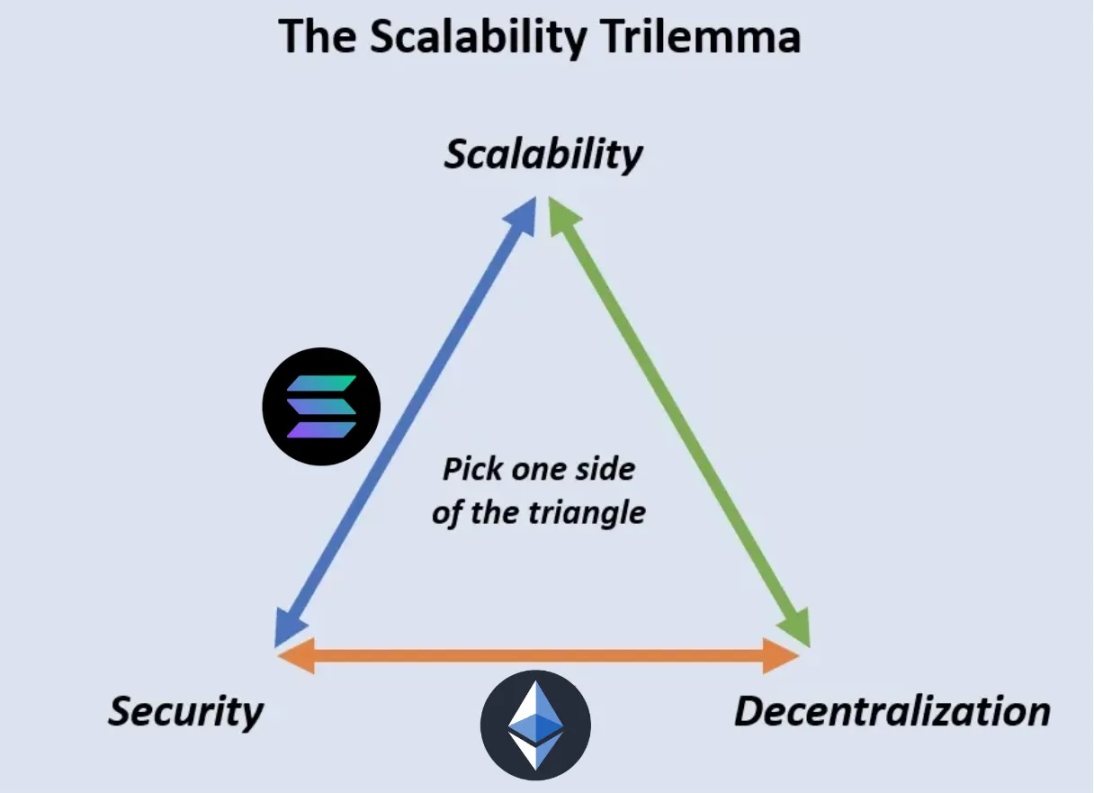
The well-known blockchain trilemma points out that achieving the best scalability, security, and decentralization in a single blockchain is extremely difficult. The model suggests that focusing on improving any two areas often compromises the third.
There is no perfect blockchain; trade-offs are necessary.
Most of the debate between Solana and Ethereum revolves around the nature and degree of these compromises. The key question is how to balance these trade-offs: how much decentralization should be sacrificed for scalability, or whether security should be the top priority, potentially at the cost of performance and fees.
Key issues
We need to figure out: what do builders, entrepreneurs, and society really want from blockchain technology?
Decentralization is not a binary concept, but a spectrum.
Some use cases require more decentralization, while others do not. Currency and finance: yes, it is necessary to ensure that I control my assets and no entity can take them away from me. Otherwise, I would choose a bank. But games? Social media? By achieving greater user ownership and adjusting incentives, these can be gradually improved without complete decentralization.
Considering this, this is my current mental model for the future of blockchain:
- Power law: a few (5) general chains will occupy most of the attention;
- There will be multiple chains, many of which will have specific use cases, and application-specific chains will be ubiquitous;
- There is no one-size-fits-all solution
Ethereum and Solana will coexist. They both have the potential to thrive and become huge technological platforms. But I find myself leaning towards Solana's philosophy, despite its flaws: weak censorship resistance, the need for a fee market, and an urgent need for light clients, among others.
Because now Solana is ready to support large consumer applications, such as compressed NFTs that can only be used on Solana.
We need to find the ChatGPT moment for cryptocurrencies. Now, not in another 5-10 years. Solana may be our best choice to achieve this goal.
免责声明:本文章仅代表作者个人观点,不代表本平台的立场和观点。本文章仅供信息分享,不构成对任何人的任何投资建议。用户与作者之间的任何争议,与本平台无关。如网页中刊载的文章或图片涉及侵权,请提供相关的权利证明和身份证明发送邮件到support@aicoin.com,本平台相关工作人员将会进行核查。


