Universal L2's ability to go up and down is key.
Author: Zuo Ye
Starting from May 2023, the explosion of Inscription and its various derivative protocols has made Bitcoin once again the new highland for entrepreneurship in the blockchain industry. In this wave, the "orthodoxy" established by UTXO transactions of Bitcoin and the "migratory" innovation of the Ethereum series have become two major characteristics.
In terms of orthodoxy, Ordinal (Inscription) and Runes (Rune) are protocols created by their author, Casey Rodarmor, for Bitcoin NFT and FT. However, Runes is still in development, but the wave has arrived, and BTC L2 is gradually gaining momentum.
In terms of migratory innovation, almost all circulating parts of Bitcoin asset issuance are integrated into the EVM ecosystem. Therefore, drawing on Ethereum's L2 development approach has become an industry consensus. Furthermore, ZK/OP has also been incorporated, but similar to Ethereum's scaling road, there are many followers but few innovators.
The core of BTC L2 lies in determining the paradigm and school. Only by determining the specific technical direction can high-quality projects be targeted. Currently, BTC L2 is still in the conceptual stage, where the concept outweighs the actual implementation.
The purpose of writing this article is to outline the possible development directions of BTC L2, rather than listing current projects, and it will not involve too many technical principles (this article does not contain formulas and code beyond the level of elementary school, so feel free to read).
Bitcoin needs to scale, "adding more water when there is too much water, and adding more noodles when there are too many noodles" is not feasible
Before BTC L2, the more mainstream expression was "scaling," due to Bitcoin's weak TPS being unable to accommodate slightly larger-scale transaction behaviors, such as high-frequency small payments, expensive gas fees, and snail-like confirmation speeds that are unbearable for at least some people.
Scaling is imperative, especially since the emergence of the BCH/BSV two major fork projects in 2017-2018, which in turn forced the Bitcoin mainnet to upgrade to SegWit. Bitcoin made its first decision to violate the ancestors—increasing the block size to 4MB instead of the 1MB designed by Satoshi Nakamoto.
According to Satoshi Nakamoto's design, a block header of Bitcoin without transaction information is approximately 80 bytes. With a 10-minute block time, each block will only generate about 4.2 MB of data per year. After the SegWit upgrade, the data volume will increase to 16.8 MB, but the improvement in TPS is minimal, still hovering in single digits.
This paradox arises because the improvement in TPS also requires a series of conditions such as hardware and network speed. If Bitcoin continues to scale at this speed for better transaction speed, it will eventually become centralized.
Some knowledgeable people believe that scaling should be stopped and L2 should be sought instead, giving rise to the first wave of L2 frenzy, and the idea of the Lightning Network also sprouted at this time.
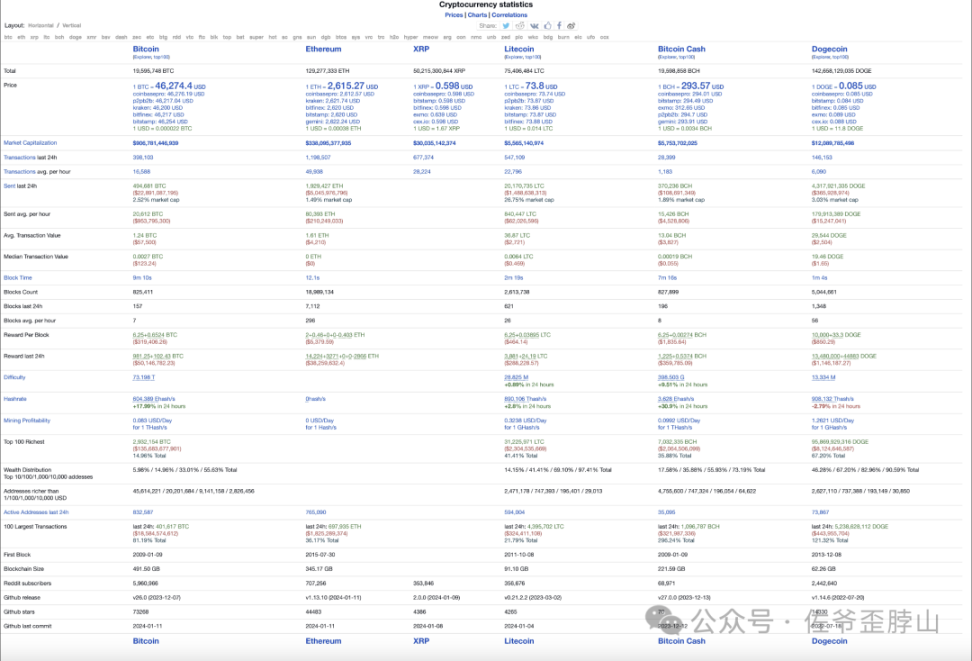
Bitcoin, Ethereum, Dogecoin, and Litecoin- Data Comparison
As shown in the above figure, Ethereum is the product of Vitalik's suggestion for Bitcoin to support smart contracts being rejected. LTC, BCH, and Dogecoin are all variants of Bitcoin, just with slight differences in lowering difficulty and increasing speed.
However, due to the lack of certain key elements, the process of establishing L2 for Bitcoin has been full of twists and turns. The main problems are:
- Bitcoin's development language lacks Turing completeness, making it difficult to support any complex functionality.
- The hardware level in 2008 limits Bitcoin's mainnet, which is indeed too slow and needs improvement.
Turing completeness actually refers to computability, which in simple terms means that within a limited set of rules, complex problems can be calculated. For example, to set up automatic transfers, Ethereum relies on smart contracts to set a rule that can be automatically executed. However, Bitcoin is just a public ledger that can only record transactions and cannot set up automatic transfers, which brings absolute security but also leads to extreme inefficiency.
Bitcoin's mainnet is very slow and its functionality is too limited. Therefore, the SegWit upgrade was implemented first, expanding the block space, followed by the Taproot upgrade, which Inscription relies on and is similar to code comments, benefiting from this.
Based on this, a minimal framework for Bitcoin scaling-L2 development can be established first, and details will be gradually filled in:
- In 2017-2018, early attempts at L2 were made: Lightning Network, ChainX, Stacks (founded in 2015);
- After the Taproot upgrade in 2021, some L2 attempts based on this were born, and EVM compatibility became standard, such as Liquid Network (predicted in 2020);
- After the explosion of Inscription in 2023, Ethereum has many L2 practice methods, such as ZK/OP Rollup, WASM, multi-signature bridge, and EVM has become widespread, such as BitVM, BEVM, Interlay V2. Overall, it is a stage of Rollup-EVM exploration benefiting Bitcoin.
In addition, it should be noted that the division of the three stages is not a replacement relationship, but more of a fusion. For example, most current BTC L2s basically cover EVM, but the implementation approaches differ. This article does not delve into history, but will only select representative solutions for interpretation.
Universal L2: The ability to go up and down is key
In a nutshell, current BTC L2 can be divided into four categories: Lightning Network type, bridging type, smart contract type (early based on the mainnet, now similar to Rollup), and sidechain type. This classification has little to do with the technology itself, mainly examining how they integrate into the EVM ecosystem. Unlike Ethereum L2, which primarily considers how to integrate with the mainnet, BTC L2 needs to connect Bitcoin's mainnet, L2 itself, and EVM on three levels.
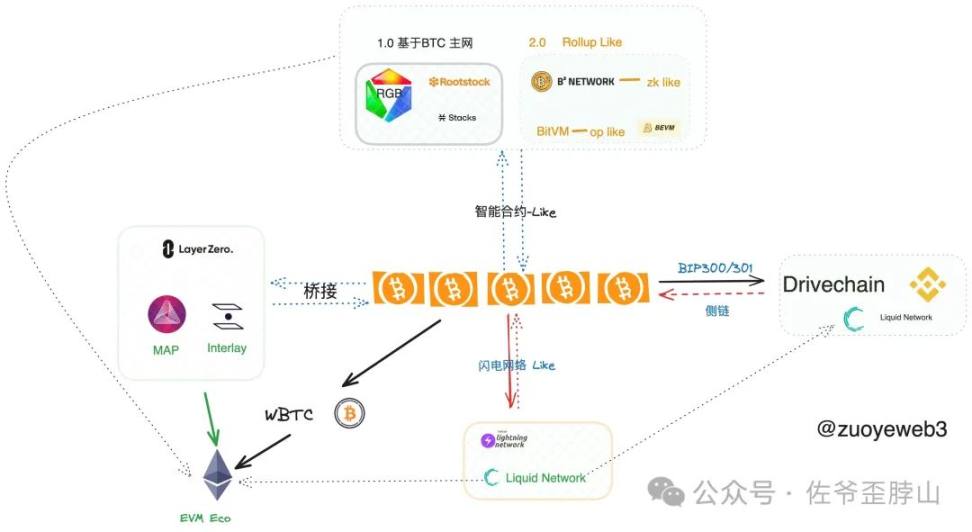
Deconstruction of BTC L2 paradigm
Among them, the Lightning Network cannot connect to EVM. The Lightning Network is also the BTC L2 most similar to Ethereum L2, but it is now an exception. In addition, the remaining BTC L2s' ideas can be included in the above figure. It is also not only the smart contract type that can support EVM. The above classification is for the sake of explanation, to highlight the characteristics of other types.
In terms of development, BTC L2s all need to consider the issue of bidirectional channels, that is, how to let BTC settle in their own L2, bear the actual use of BTC flowing into EVM, and how to return the final result to Bitcoin's mainnet transactions, in order to use Bitcoin's absolute security.
Here, we will focus on explaining the operation mechanism of WBTC and the Lightning Network, and subsequent solutions can be seen as a decentralized transformation of the former and a universal transformation of the latter to some extent. WBTC solves the problem of BTC entering EVM and DeFi, but in a centralized manner, while the Lightning Network ultimately settles with Bitcoin, and the security after settlement is completely consistent with the mainnet.
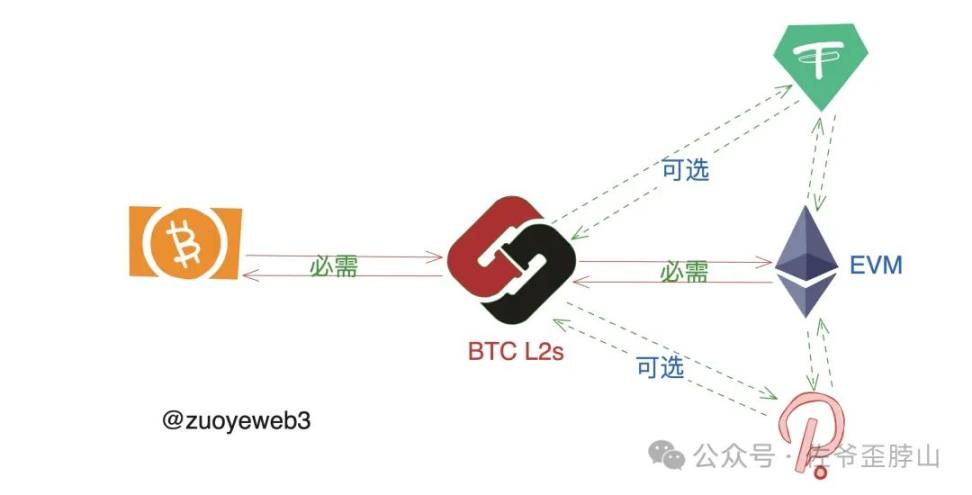
Explanation of the role of BTC L2
Operation principle of WBTC
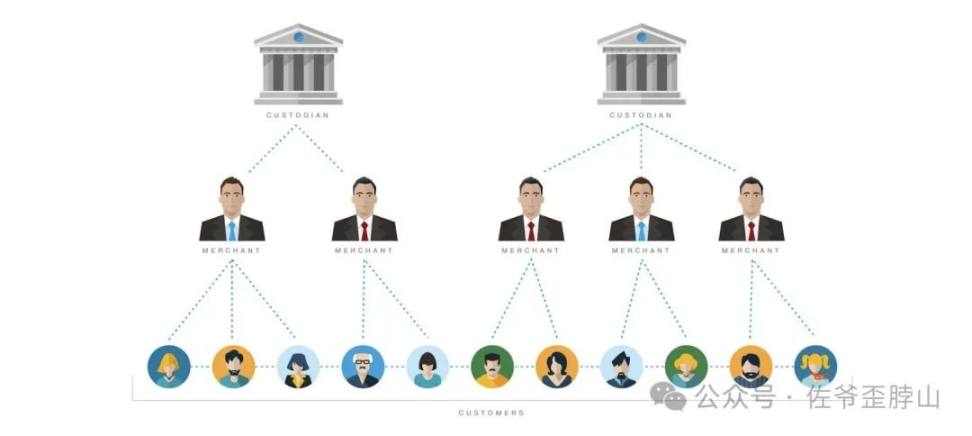
WBTC, short for Wrapped Bitcoin, is an ERC-20 token circulating on Ethereum, backed 1:1 by BTC. In operation, it consists of users, listers, and custodians, and its specific functions can be divided into acceptance, minting, and redemption.
- To accept WBTC, users need to apply to merchants, undergo KYC and AML verification, and have their identity confirmed by the merchant. Then, the user sends BTC to the merchant, and the merchant sends WBTC to the user.
- To mint WBTC, merchants apply to custodians, send BTC to the custodian, and the custodian sends WBTC to the merchant.
- To redeem BTC, merchants apply to custodians, and the custodian returns BTC to the merchant. The merchant destroys the WBTC, and the custodian confirms the destruction by the merchant, concluding the transaction.
It can be seen that WBTC operates based on custody and centralized verification. Although factors such as DAO, multi-signature, and transaction anonymity exist, overall, it is similar to USDT, where traditional financial logic permeates into blockchain, making it difficult to serve as the cornerstone of BTC L2.
Settlement Principle of the Lightning Network
As mentioned earlier, the Lightning Network ultimately settles using the Bitcoin mainnet. Specifically, the Lightning Network has multiple collateral nodes for BTC, creating a PoS-like operating network on top of Bitcoin. It can establish off-chain P2P transaction channels without the need for real-time confirmation, resulting in extremely high efficiency and very low gas fees. Only when both parties need to settle will the off-chain transaction channel be closed, entering the final on-chain settlement phase, where both parties need to transfer BTC.
Therefore, the Lightning Network balances Bitcoin's security and transaction convenience. However, because it is not settled in real-time, there are still security risks. Expanding the Lightning Network into a universal settlement system is another focus of current BTC L2.
With this, the basic approach of BTC L2 has been outlined. My intention is not to provide a technical interpretation, so I will skip many implementation details. I hope experts will understand, and consider this as my way of contributing to the discussion.
Next, I will use representative projects from each category to illustrate the current development status of BTC L2, for reference in investment or usage.
Paradigm and School: Thoughts on Various BTC L2s
I have organized various L2 solutions that have emerged, and it is clear that the surge was concentrated in 2023. The popularity of Inscription has attracted attention and resources, but it has also sparked significant controversy within the community. For example, Luke hopes to ban Inscription, but miners strongly oppose it due to economic interests. I have analyzed this in detail in a previous article, "Limiting the Inscription Debate: Behind the Developer Quarrel is a Battle for Interests".
The key to maintaining balance between miners and developers is the widespread use of L2, transferring such "creativity" to L2, while the Bitcoin mainnet is only responsible for final settlement. For example, the Runes protocol is also for this purpose. Referring to the development history of Ethereum, it is possible that Bitcoin will also become "modularized" after, forming a mainnet-Ordinal (BRC-20)-L2-dApp architecture.
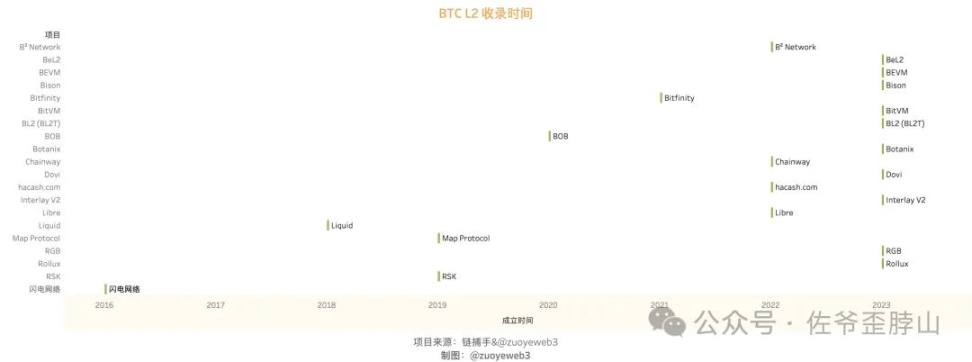
The projects listed here are based on their confirmed establishment time, such as the release of the whitepaper or the launch of the mainnet, but this does not affect their classification and explanation. The focus is on understanding.
Based on the different ways of BTC upward and transaction result downward, I have further divided L2 into specific parameters, such as BTC mapping method, L2 fund management method, data feedback method, complemented by EVM compatibility, token issuance, etc., to build a comparison table of representative projects for the existing L2 types.
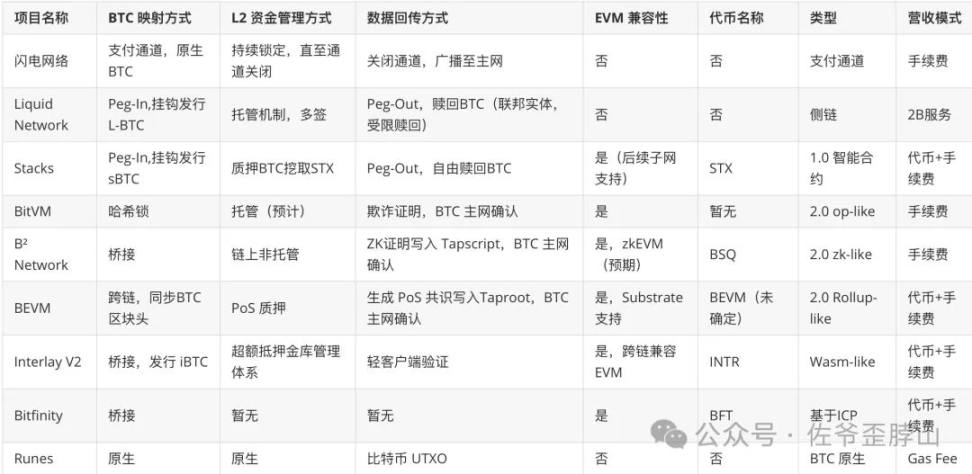
From the above table, it can be seen that there are almost no perfect decentralized L2 solutions. They all more or less require off-chain transfer or the use of multi-signature to operate, and they seek a balance between efficiency, decentralization, and scalability (EVM compatibility).
Taking the Lightning Network as an example, it is almost the only surviving L2/scaling solution from the previous era. It fully utilizes various features of the Bitcoin mainnet and does not issue its own tokens. However, payment channels limit its universality, and non-real-time settlement also prevents large transfers.
The Liquid Network that follows can be seen as a special variant of the Lightning Network with a strong admission system, specifically, Liquid is a specialized, centralized variant of the Lightning Network aimed at B-side institutions, more appropriately called a sidechain. Although it can reissue and circulate BTC, it cannot be opened to all users, and its level of decentralization is too low.
Stacks goes further in terms of openness and attempts to introduce smart contracts. Its plan is to issue sBTC, with certain non-admission features, especially since it will support EVM in the future. However, miners need to stake BTC to mine its token STX, and its token exists more as a governance token, lacking sufficient use cases. It can be understood as an EVM-compatible attempt before Inscription.
Similar to Stacks, there are projects like RGB and Rootstock, with overall differences being minor, mainly in terms of decentralization and the issuance of their own tokens. I believe these will not become mainstream in the future.
The mainstream has already emerged, and solutions similar to Ethereum's Rollup L2 are likely to prevail. Sidechains, the Lightning Network, and others, according to Ethereum's scaling categories, do not belong to L2, especially Rollup L2. This article simply groups them together for the sake of discussion. Regarding Bitcoin scaling, I estimate that it will also follow Ethereum's path.
Specifically for Ethereum-like Rollup L2 solutions, BitVM uses hash locks to introduce BTC, then uses Bitcoin scripts to store optimistic verification results to ensure security. Essentially, it moves computation off-chain and results on-chain, but optimistic verification involves a time difference, especially when it involves BTC. The efficiency of fund utilization and how to handle fraud may not be completely consistent with Ethereum's OP system. Given that this project is still in its early stages, I will continue to monitor it.
Then there is the ZK-based L2 B² Network, which seems to (not entirely certain) bridge the BTC official to L2, and then write the ZK result proof into Bitcoin scripts to ensure security. The hidden premise here is that the generated ZK results are completely correct, and Bitcoin only serves as the final confirmation layer. The whitepaper indicates that it will issue the BSQ token, and it is worth following its future development plans.
Another Ethereum-like solution is BEVM, which emphasizes the "synchronicity" between Bitcoin and L2. When BTC is bridged to BEVM, it synchronizes Bitcoin block header data to maintain data consistency. For the generation of final results, it uses PoS consensus, and the final results are written into Bitcoin scripts. However, it needs to ensure that the consensus itself does not encounter problems in operation, which will require time to verify.
In addition, there is also the bridging + WASM solution, which is one of the few BTC L2 solutions that uses Polkadot. It still involves the familiar bridging and issuance of iBTC. The innovation lies in the emphasis on liquidity provision in the treasury management scheme, encouraging treasuries to invest iBTC in DeFi. Furthermore, it connects to the Near/EVM/Cosmos ecosystems through various cross-chain bridges, which greatly tests security. It has already won the Polkadot parachain auction twice and serves as the main bridging solution between Polkadot and Bitcoin. It will also issue the INTR token, which is worth paying attention to.
Since there is Polkadot, there must also be ICP. Both are heterogeneous chains and were once considered Ethereum killers and top-tier projects. Bitfinity has built a BTC L2 compatible with EVM based on ICP. It has good support for BTC assets, allowing not only BTC to be bridged to L2 through threshold signatures, but also BRC20 assets to be bridged to L2. However, it is currently uncertain how on-chain funds will be handled and the data feedback method. I welcome any additional information from the community.
Starting from the Lightning Network, we ultimately return to Bitcoin. The Runes protocol created by the founder of Ordinal, can also issue tokens, and I classify it as part of L2. Similar to BRC20, it operates entirely based on the Bitcoin mainnet, using UTXO to issue tokens. Although it is not currently in use, it is likely to be the next frenzy on the Bitcoin mainnet. After all, miners earn fees, and they have enough incentive to create FOMO and attract funds.
Returning to the beginning of this section, the underlying intention of each project is actually to issue tokens, even if they are governance tokens. The gravitational effect of BTC is too strong. If the entire ecosystem is built on BTC, the only ones who will benefit in the end are the miners. L2 may only receive a small share of the fees. In the business model of Ethereum L2, almost all L2 solutions eventually issue tokens. I believe this pattern will also occur in BTC L2. The only problem is that BTC is too dominant, and it is not easy to convince users to stake BTC or exchange it for their own governance tokens.
So far, I have basically outlined the existing BTC L2 paradigms and representative projects. You can feel that my focus is on classifying BTC L2 and the potential for future development. I have omitted some details about the projects and ecosystems, but that's not important. What's important is to see the future direction, and the most important thing is to choose the right path.
BTC L2 Vision: Multi-layer Folding, LSD/LRT Boosting Liquidity
For a long time, BTC has only served as a digital gold, and along with USDT, it has been a measure of value and a medium of exchange in the crypto market. Although WBTC is already suitable for daily use, after Inscription, BTC has become an asset issuance platform. Whether it's the first layer BRC20 & Ordinal protocol or the flourishing various BTC L2 solutions, it means that BTC itself has surpassed its previous single function. Even as a transaction fee, it generates new growth points due to asset minting, issuance, and transfer.
We can continue to envision that most BTC is not active, simply serving as a means of storing value. However, after the halving of mining rewards and the approval of BTC spot ETFs, BTC needs to learn how to survive, similar to ETH's transition to PoS. For example, the leverage effect of LSD/LRT. Currently, BTC's market value is around a trillion dollars. If a large amount of BTC is pledged to L2, its capital efficiency will decrease. Following Blast's approach, interest-bearing L2 can attract retail investors and funds, and BTC's value is sufficient to support leverage of tenfold or even dozens of times. It's a shame not to use it as a pegged product for LSD/LRT.
免责声明:本文章仅代表作者个人观点,不代表本平台的立场和观点。本文章仅供信息分享,不构成对任何人的任何投资建议。用户与作者之间的任何争议,与本平台无关。如网页中刊载的文章或图片涉及侵权,请提供相关的权利证明和身份证明发送邮件到support@aicoin.com,本平台相关工作人员将会进行核查。


