Since December last year, the decentralized physical infrastructure network has been condensed into the term "DePIN," once again becoming a hot topic in the Web3 world.
Based on blockchain network construction of data layers and incentive systems, and providing specialized hardware and software for users to contribute surplus computing, networking, and even energy resources for sale to individuals or businesses in need, DePIN application builders form a commercial closed loop.
Among the 650+ DePIN projects, Helium, a decentralized wireless network born in 2013 and transformed into Web3 in 2017, has attracted attention. The project focuses on two popular scenarios: "Internet of Things" and "5G," attracting 405,525 Helium IoT devices and 4,958 Helium 5G mobile devices to join the network.
The success of Helium is attributed to its dominance in the widely used and increasingly essential "wireless network" scenario. Both Internet applications and the Internet of Things require wireless networks, and more new DePIN applications are targeting this "most accessible" resource characteristic, pushing the deployment of devices/nodes towards the general public.
Recently, another wireless network DePIN application, "MetaBlox," has deployed 29,009 self-owned WiFi nodes, which is 5.4 times the number of Helium 5G subnetwork devices. Relying on the wireless network resources contributed by these node devices, MetaBlox is providing enterprise-level WiFi roaming for global users.
In the decentralized wireless network, those who own nodes have the upper hand. MetaBlox has grasped this trick and is attracting contributors of wireless network resources through low-threshold access, device discounts, and upcoming incentive plans.
Breaking Helium's Dominance: New DePIN Dominates the WiFi Scene

Use cases and scenarios connect to the real world, making DePIN appear more understandable and accessible to ordinary users compared to Web3 applications such as DeFi, GameFi, and SocialFi, without relying on the common financial gameplay of Web3 to build a business model. Capital has already seen the growth potential of the DePIN track, with approximately $10 billion in venture capital flowing into the top 10 DePIN projects by market value.
The established Web3 storage facility Filecoin has attracted $250 million in financing, and now, the Web3 wireless network infrastructure Helium has reached the same level.
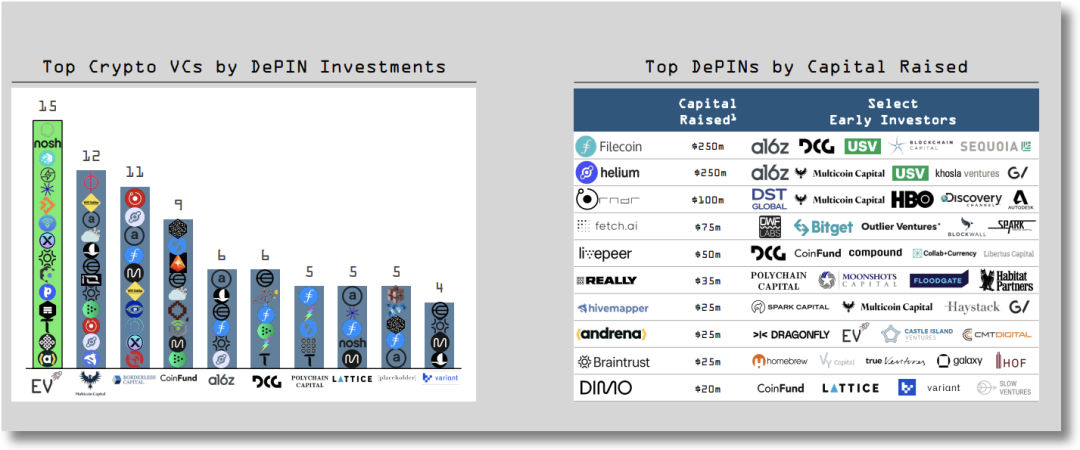 Helium Financing $250 million (Image from Messari)
Among the new DePIN unicorns, Helium stands out.
Helium, which entered the Web3 world in 2017, deployed its own decentralized wireless network infrastructure, becoming the world's largest LoRaWAN (Long Range Wide Area Network) standard network. It mainly supports IoT and 5G use cases, allowing users to purchase and connect their own hotspots to build the network. Participants receive encrypted asset incentives, and the MOBILE token, which was later hyped by the cryptocurrency market, is the incentive token for the Helium 5G subnetwork.
After Helium was launched, some IoT and 5G hardware and service providers quickly joined the network. Currently, the number of Helium IoT devices is 405,525, and the number of Helium mobile 5G devices is 4,958.
According to data from April 2023, since its launch, Helium has deployed nearly 1 million hotspots, covering over 77,000 towns and cities in 192 countries, forming a widespread decentralized WiFi network. The $20/month 5G telecom service launched in the United States at the end of last year became popular due to its low price.
Helium's success also validates the effectiveness of the Web3 model in utilizing wireless network resources, leading to the emergence of more DePIN infrastructure focused on wireless networks.
On third-party DePIN data websites, wireless networks (WiFi) are becoming the most constructed DePIN scenario after servers. Among them, Helium undoubtedly has the highest attention and market value, followed closely by WiFi Map and WiCrypt. More wireless network DePIN projects are already in progress, and the most significant feature of the latecomers is their novelty, with the important indicator being the incentive token not yet listed.
Among the numerous DePIN projects in the wireless network scenario, a network called MetaBlox is showing great potential, with the standout metric being the number of nodes. Currently, MetaBlox has 29,009 self-owned WiFi nodes, which is 5.5 times that of Helium and still increasing.
According to the MetaBlox official website, MetaBlox provides global users with free enterprise-level secure WiFi roaming services, with its performance indices comparable to or even surpassing those of 5G mobile cellular networks.
In today's abundant Web3 applications, MetaBlox provides a seamless and secure WiFi bridge for traditional world users migrating to Web3 without the need for repeated logins. Furthermore, MetaBlox's WiFi routers and their inherent geographical location attributes provide the most direct cooperation platform and traffic channels for other DePIN infrastructure projects and layer2 applications.
In short, users on MetaBlox's WiFi routers can not only receive hardware miner rewards but also participate in network construction or complete other tasks through the MetaBlox App to earn rewards. Since this network also serves Web3 scenarios, users also have the opportunity to receive airdrop rewards for the SocialFi and DeFi applications it supports.
Furthermore, we want to understand why MetaBlox, which has been deeply involved in the DeWi track for over two years, has been able to deploy over 30,000 nodes in 98 countries in a short period of time. Can it surpass Helium to become another major Web3 WiFi supplier?
Sharing WiFi for Incentives: MetaBlox Implements "Soft and Hard" Approaches
Since DePIN was distilled by the cryptocurrency research institution Messari at the end of 2022, it has become a major track in the Web3 infrastructure and application field. Wireless networks (WiFi) occupy a major decentralized physical infrastructure scenario within this track.
The reason why this scenario has attracted a large number of builders to adopt the Web3 model is that wireless networks themselves require a variety of modems, routers, and other hardware to access the network in a distributed manner.
Wireless network resources are mainly built and owned by centralized telecom service providers, who then sell them to users, including enterprises, government agencies, and ordinary users. Users are often on the paying end. DePIN wireless network infrastructure projects such as MetaBlox attempt to allow downstream resource users to also profit from sharing, thereby diluting the cost of using WiFi.
Traditional WiFi has a series of limitations. Due to its dispersed nature, WiFi not only has uneven coverage and instability, but users are also unwilling to pay for WiFi connections at a single location. This is why when you connect to a wireless network in a coffee shop or restaurant, it is "free," but in reality, the cost of the wireless network is already included in the operating costs of the physical businesses. Furthermore, the speed and security of public WiFi cannot be guaranteed.
To provide users with more convenient wireless networks, the Wireless Broadband Alliance (WBA) launched the OpenRoaming framework in 2021, aiming to simplify roaming access between cellular, commercial WiFi networks, and public WiFi hotspots. This not only solves the problem of frequent wireless network interruptions but also eliminates the need for users to register or log in frequently.
Within this framework, MetaBlox is one of the WBA's officially designated 9 OpenRoaming service providers, alongside more familiar names such as Cisco and Boingo, making MetaBlox the only member in the Web3 field.
After two years of development, MetaBlox has integrated small residential and commercial locations into the OpenRoaming framework (referred to as "OR") using a blockchain-based architecture, unified decentralized identity (DID), and verifiable credentials (VC) system.
The DID technology adopted by MetaBlox is a new type of decentralized identifier that achieves verifiable, decentralized digital identity. DIDs can represent any type of entity, such as data models, physical objects, institutional organizations, etc., chosen by their controllers.
The VC system allows users to independently decide whether to share personal resources and under what circumstances and in what manner to share them.
With over 3 million OpenRoaming nodes and 29,009 self-owned nodes, MetaBlox has accumulated a significant infrastructure scale, covering approximately 98 countries, with the goal of providing secure and stable WiFi roaming services to global users.
It's worth noting that a similar scenario, Helium 5G, is limited to the domestic market in the United States due to frequency band restrictions and is essentially a mechanism of a virtual card operator (a centralized issuer) grafted onto T-Mobile. Furthermore, it is a subnetwork of Helium, and further expansion requires continuous support from the Helium mainnet ecosystem. In comparison, MetaBlox's decentralized nature and coverage clearly provide a competitive advantage.
To drive community participation in building a Web3-style WiFi network, MetaBlox uses both hardware and software for user acquisition.
The hardware is the MetaBlox WiFi router Miner, which has now been upgraded to the second generation. It also serves as the node hardware connecting to the OR and its compatible networks. When more people connect to the OR network, the router generates mPoints rewards. As a Utility Token in MetaBlox Tokenomics, mPoints can be directly exchanged for rewards in the MetaBlox APP and also provide access to other collaborative Web3 applications/services. Additionally, it can be used for future governance tokens through staking.
The online platform is the official MetaBlox App, which supports both Web2 and Web3 registration methods. After registration, users can use the currently supported global WiFi roaming services for free. Furthermore, users can participate in the construction of the MetaBlox network through the app—adding self-owned/public WiFi networks can earn different amounts of mPoints rewards.
By using a dual incentive approach of hardware and software, MetaBlox continues to accumulate infrastructure for global Web3 WiFi roaming and wireless network resources.
The first batch of MetaBlox routers has sold out, and the next generation is offered at a 50% early bird price of $249. MetaBlox's governance token is expected to be launched in the second quarter of 2024, and currently, the only way for users to obtain governance tokens through staking is by collecting mPoints through router mining and network participation.
With the expected value of incentives, it's easy to understand how MetaBlox has built a significant infrastructure scale with over 3 million OpenRoaming nodes and 29,009 self-owned nodes.
With such infrastructure expansion, MetaBlox is poised to become another major supplier of DePIN wireless network services after Helium, providing a new choice for WiFi providers and users. More importantly, WiFi supply under the DePIN paradigm will promote more balanced coverage of wireless network resources, especially in areas with limited wireless resources, serving global internet users.
(Disclaimer: Readers are strictly advised to comply with local laws and regulations. This article does not represent any investment advice.)
免责声明:本文章仅代表作者个人观点,不代表本平台的立场和观点。本文章仅供信息分享,不构成对任何人的任何投资建议。用户与作者之间的任何争议,与本平台无关。如网页中刊载的文章或图片涉及侵权,请提供相关的权利证明和身份证明发送邮件到support@aicoin.com,本平台相关工作人员将会进行核查。


